|
|
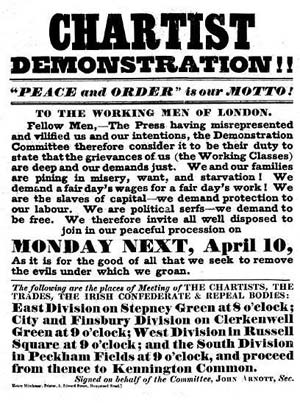 Chartist Demonstration Poster of 1848 We here in Ireland need to behave like the Charterist Movement of the early 1840’s, and we, unlike them, have one advantage, we have the right to vote.
With the present General Election looming, most of those who have been part of our outgoing government are fully aware that their only place in a new Dail Eireann, will be by taking over the seating arrangements, previously kept warm by the arses of our present opposition.
Fianna Fail under Micheál Martin, displaying an inherited FF arrogance, called today for a public debate, still dreaming that the party he represents are still going to have a major say in our immediate future.
Knowing they are going to remain in opposition, small political groupings like Sinn Fein, Independents and possibly the Green Party, can now spout whatever they feel their understandably angry voters want to hear. They can and will protest about everything, the Four Year Plan, Environmental policy,The IMF, Lower Paid Workers, the Universal Social Charge or reclaiming control of the Public Sector. But these protests must be seen by voters for what they are, attempts to gather votes by gombeen individuals who selfishly are seeking another term of unvouched expenses, inflated salaries, inflated pensions and most of all the sense of being powerful.
We now need a different breed of politician in Ireland and change must come quickly, because to survive as a state, with the present political system, we can no longer carry on. We have, as a nation, once again allowed ourselves to be invaded. There are two ways to conquer a country, send in an invading force of well armed troops, or the EU modern way, which is loan us vast sums of money at high interest rates which they know we cannot repay. Ireland, thanks to our gombeen politicians, has been invaded, we have been enslaved and sadly we only have ourselves, as voters, to blame.
In a democracy such as ours, change can only ever originate from the electorate. If we continue to elect our representatives, without looking beyond our own narrow views of personal self interests, we will continue to attract the gombeen politicians we truly deserve and as Irish men and women, remain the hewers of wood and the drawers of water, within Europe.
We as a nation are unable to even protest democratically in any unified way. When our elderly citizens demonstrated against losing their medical card, they did so very much alone. When our student sons and daughters marched, they did so detached, while agents of our State were allowed to discourage them, using rough justice. When our present Fianna Fail Government clung to power, long after the electorate had made it clear that they no longer had a mandate to govern, we as a nation remained deathly silent. Despite the fact that this outgoing government continued to embarrass us on the world stage, making us a laughing stock in front of our European partners, we as a nation take no action.
Ireland is a nation and our democratically elected representatives are, by accepting their elected role, charged with standing up for our citizens and our down trodden, behaving democratically, safeguarding our wealth and fairly distributing our scarce public funds responsibly.
This present Government in December last, told us that we must now pay increased taxes and endure reduced public services, because they were not minding the shop, while they themselves continued to misappropriate our funds and our loyalty in a cynical and contemptuous way for the purchase of future votes. They allowed minority Independent TD’s of minor importance, to pull their strings, to the detriment of our democracy and the well being of the people of this country as a whole. They have placed their brain washed followers in positions of importance on boards and in positions of influence to make decisions which will effect and assist ‘The Party‘.
Continue reading How To Cast Your Vote In A Dysfunctional Ireland
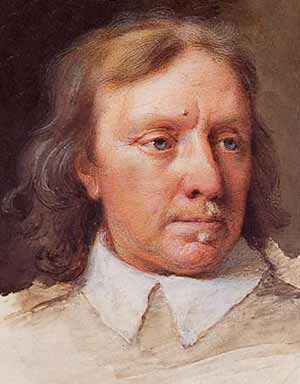 Oliver Cromwell (1599–1658) Oliver Cromwell is still a figure of hatred in Ireland, considered a regicide dictator with his name being associated with massacre, religious persecution, and mass dispossession of the Catholic community. A traditional Irish curse still used is ‘mallacht Chromail ort ‘ or translated into English ‘the curse of Cromwell upon you ‘.
On 15th August 1649 Oliver Cromwell landed at Ringsend,Dublin, with an army of over 3,000 battle hardened ‘Ironsides‘. The civil war in England had come to an end, and King Charles I had been executed seven months previously.
In Ireland the Roman Catholics had been in revolt since 1641 and now held much of the island. They had in general taken the King’s side, encouraged by the Church of Rome, though some inhabitants had observed that in England’s civil war internal turmoil a chance existed to restore independence to Ireland.
From Dublin Cromwell marched north to Drogheda, which was defended by an English Catholic Royalist, Sir Arthur Aston. When Cromwell’s surrender demand was ignored, he stormed the city ordering the death of every man in the garrison who held arms, describing his actions as “a righteous judgment of God upon these barbarous wretches“. The nearby garrisons at Dundalk and Trim, on learning the news, ‘took to their heels’.
Realising he had secured the route into Ulster, Cromwell turned on the south eastern port of Wexford town, slaughtering townspeople and the garrison alike. Neighbouring towns quickly submitted.
Oliver Cromwell’s campaign ended with an assault on Clonmel here in Co.Tipperary, where, after some stout resistance, the defenders withdrew, under the cover of darkness.
But the reign of Oliver Cromwell was not all bad, under his rule in England the contract between a monarch and his subjects was analysed and clearly defined. An elected representative must represent the best interests of his electorate and each subjects must obey the law of the land, as represented in the person of that elected individual.
Cromwell established that a parliament exists only to serve its electorate, and not the other way round. He demonstrated that governments were fully answerable to their subjects for any wrong doing. Under his leadership the reigning king, Charles 1, indeed was executed for the treason of ‘making war on his own people‘.
He demonstrated that good organisation and administration was more important in government than any social position, to get things done properly and that leadership can exist at all levels of a country’s society. He invited the expelled Jewish community to return to England, following their 400 years in exile, and thus began massive expansion of financial and trading services across Europe with England as the centre. Further proof of his appreciated governance is that in a 2002 BBC poll, in Britain, Cromwell was selected as one of the ‘Top 10 Britons’ of all time.
Cromwell’s principles of government have in the past been quoted by American colonists to justify their rebellion against British rule, by moderate French Revolutionaries, by the 1830 revolutionary leaders of Paris, by the 1848 revolutionary leaders of Vienna and Paris, by Frederick Engels in the Communist Manifesto, and by early Trade Union pioneers. His ideas have become relevant to many societies and world governments where it became necessary to overthrow tyranny and reckless greedy corruption.
His speech to the House of Commons on 20th April 1653, just minutes prior to him dissolving the Long Parliament, perhaps expresses the true feelings of many politically disillusioned men and women in the Ireland of 2011.
“It is high time for me to put an end to your sitting in this place, which you have dishonored by your contempt of all virtue, and defiled by your practice of every vice. Ye are a factious crew, (Exp: Given to promoting internal dissension) and enemies to all good government; ye are a pack of mercenary wretches, and would, like Esau, sell your country for a mess of pottage or like Judas, betray your God for a few pieces of money.
Is there a single virtue now remaining amongst you? Is there one vice you do not possess? Ye have no more religion than my horse; gold is your God.
Which of you have not bartered your conscience for bribes? Is there a man amongst you that has the least care for the good of the Commonwealth?
Ye sordid prostitutes, have you not defiled this sacred place, and turned the Lord’s temple into a den of thieves, by your immoral principles and wicked practices?
Ye are grown intolerably odious to the whole nation; you were deputed here, by the people, to get grievances redressed, are yourselves gone!
So! Take away that shining bauble there, and lock up the doors.
You have sat too long, for any good you have been doing lately. Depart, I say; and let us have done with you. In the name of God, go!”
Where can we find an Oliver Cromwell in 2011?
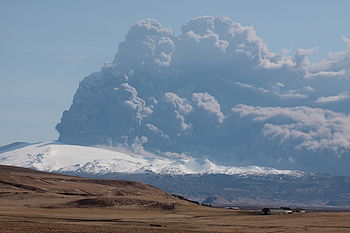 Eyjafjallajokull Volcano Natural calamity always tests the administrative structures and social bonds of our society and the recent weather experienced here in Co.Tipperary over the past few weeks certainly tested all of these.
Yet this type of weather, contrary to popular media reports, is indeed not new to Ireland. “The Great Frost”, “Bliain An Áir” (Translated into English “year of the slaughter“) or the “Forgotten Irish Famine” happened between December 1739 and September 1741 and was one of many such calamities which struck Europe in the past and occurred after a decade of relatively mild winters, such as we have recently experienced here in Ireland.
This crisis of 1739-1741 should in no way be confused with the even more devastating ‘Great Famine’ in Ireland, a century later between 1845 and 1849.
Temperature readings for Ireland then ranged between −12 °C and 0 °C. Ireland was locked into a stable and vast high-pressure system which stretched across most of Europe, from Russia to northern Italy, in a similar way as experienced recently. Our lakes, rivers,and waterfalls froze and fish died. Rural dwellers fared better than city dwellers, due to easier access to fuel, while poor urban dwellers lived in freezing basements and below standard housing.
Retail prices for coal soared, urban and rural mill-wheels became frozen stiff and since water powered our machinery, bakers could not grind wheat, printers could not pulp rags for paper and the work of weavers was greatly prohibited, disrupting craft employment and food processing.
The export of grain out of Ireland was prohibited to all destinations except Britain. The Church of Ireland parish clergy and the Established Church solicited donations from the property classes, which they converted into required rations for free dispersal to mainly city dwellers, distributing nearly 80 tons of coal and ten tons of meal in the first month of this unprecedented cold spell.
One of the main food sources, the humble potato became frozen and inedible. Spring rains never arrived and drought killed off sheep and other animals in the fields. The potato crisis caused an increase in grain prices which in turn led to higher bread prices. Starving rural dwellers began to move into the larger towns with bands of citizens causing food riots.
Documentation of deaths were far from accurate between December 1739 and September 1741, but cemeteries provide some small information. We can estimate that the normal death rate for the country tripled in January and February 1740 and burials averaged about 50% higher during the period of this crisis, than for the total previous years of 1737 to 1739.
It is interesting to note that Mount Tarumae in Japan experienced a major volcanic eruption, as did Mount Asahi, Japan’s tallest mountain, in 1739.
In 1783 and 86 we experienced two successive severe winters both attributed to an Icelandic volcanic eruption.
In 1816, known as the year without summer, snow fell late and the summer never really materialised. The winter proceeding it was also severe. A volcanic eruption at Mount Tambora on the island of Sumbawa, Indonesia, greatly disrupted wind patterns and temperatures.
In 2010 the eruptions of Eyjafjallajökull, Iceland caused enormous disruption to air travel across western and northern Europe over a period of six days in April 2010. Additional localised disruption continued into May 2010.
Is there a connection between volcanic activity and our unusual Irish weather?

The Tipperary Peace Convention Committee have named their nominees for the 2011 Tipperary Peace Award.
The Tipperary Peace Award was first founded in 1984, set up to recognise people in Ireland and across the world, who promote the ideals of peace and peaceful co-operation.
Previous recipients include the late former Pakistan prime minister Benazir Bhutto, former South African President Nelson Rolihlahla Mandela, Irish singer, songwriter, author, occasional actor and political activist Robert Frederick Zenon “Bob” Geldof, KBE, and former 42nd US President William Jefferson “Bill” ClintonClinton.
Amongst this years nominees are former president and ex-United Nations High Commissioner Mrs Mary Robinson, the Burmese pro-democracy leader, Aung San Suu Kyi, who has been recently released from detention, chairman of the Afghanistan Independent Human Rights Commission and United Nations Special Rapporteur, Dr Sima Samar and the Taiwanese Buddhist nun Cheng Yen. Also shortlisted are the the head of the United Nations Relief and Works Agency in Gaza John Ging and the prime minister of Zimbabwe Morgan Tsvangirai.
The Tipperary Peace Convention Committee are expected to consider the nominees over the coming weeks and the winner will be announced on New Year’s Day.
Last year’s winners were the late Senator Ted Kennedy and his sister Jean Kennedy Smith, latter former US ambassador to Ireland.
The 2010 award will be presented, as usual, at a special ceremony in Tipperary town, on a date to be agreed early in the new year.
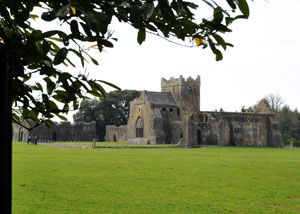 Kilcooley Abbey, Gortnahoe, Thurles, Tipperary It is another part of our hidden Tipperary, but Sliabh-Ardagh Rural Development, based in the Heritage Centre in Killenaule, Thurles, Co Tipperary, are now poised to reveal Kilcooley Abbey’s architectural beauty, through the launch of a spectacular publication ‘Kilcooley Abbey’ by authoress Maura Barrett.
Kilcooley Abbey is a Cistercian Abbey close to the Village of Gortnahoe, here in Co Tipperary, located within the grounds of the Kilcooley Estate. This abbey dates from 1182 when Donal Mor O’ Brien granted lands to the Cistercians, to build an abbey here. The abbey which is a sister house to both Jerpoint Abbey and Holy Cross Abbey, is considered to be a hidden gem,tucked away in this remote corner of Co. Tipperary.
This book which has been written by Maura Barrett, latter Heritage Development Manager with Sliabh-Ardagh Rural Development and part time Librarian in Killenaule, is their second outing into the world of publishing on this topic, explains Chairperson Sr. Patricia Wall. In 2005 they republished ‘Kilcooley: Land and people in Tipperary,’ also.
The author Maura Barrett provides a unique understanding of the history of this abbey and an analysis of the medieval tombs and sculpture contained within and is a must for history lovers.
Kilcooley Abbey is popular with visitors, but it is one of the lesser known sites in Tipperary and it doesn’t have a guide on site. There are no leaflets to explain the history of the abbey and Sliabh-Ardagh Rural Development, in producing this book, attempts to break this barrier.
 The book contains a history of the abbey, which spans one thousand years. Maura Barrett’s admiration for this site shines out through every page. She outlines a potted history of the abbey and goes to great pains to explain the medieval sculpture contained within the abbey. There are twenty pages of colour photographs depicting aspects of Kilcooley Abbey. Maura explains: “I have always been fascinated by Kilcooley Abbey, Maura, it gets in on you, every time I visit, I see something different, I was delighted to be able to write this book.” The book contains a history of the abbey, which spans one thousand years. Maura Barrett’s admiration for this site shines out through every page. She outlines a potted history of the abbey and goes to great pains to explain the medieval sculpture contained within the abbey. There are twenty pages of colour photographs depicting aspects of Kilcooley Abbey. Maura explains: “I have always been fascinated by Kilcooley Abbey, Maura, it gets in on you, every time I visit, I see something different, I was delighted to be able to write this book.”
Sliabh-Ardagh Rural Development is a community based charity, set up in the early 1990’s to develop the tourism and heritage potential of the Slieveardagh region of Tipperary. The Barony of Slieveardagh includes the the parishes of Glengoole, Gortnahoe, Killenaule,Moyglass, Ballingarry and Kilcooley. The region has many attributes and attractions, whose potential is underdeveloped. Little is known about the region outside the general locality, hence, it is often referred to as ‘another hidden corner of Tipperary’. The area is home to the Derrynaflan Chalice, the beautiful Kilcooley Abbey, the 1848 Famine War House and a rich flora and fauna habitat. Other notable features of the area include its bog-lands and the areas long tradition of coal-mining. The heritage and culture of the area is acknowledged as its key strength and the main challenge of Sliabh-Ardagh Rural Development is to exploit the commercial potential of these attributes, to create employment, stimulate investment in local businesses and above all to instill an awareness of the uniqueness of the area’s landscape.
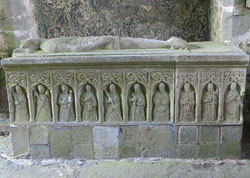
Kilcooley Abbey is best noted for its fine East Window which according to the author Maura Barrett, contains the ‘finest example flame tracery in Christendom’. There are a number of medieval tombs within the confines of the abbey, the most noted being the knight effigy tomb of the Butlers, latter progenitors to the present heirs to the British Crown, which is signed by the sculptor Rory O’ Tunney. “We are very lucky to have such an outstanding example of O’ Tunney’s work housed in Kilcooley, it is by far his most well known work.” explains Maura Barrett.
Sliabh-Ardagh Rural Development have developed three Loop Walks in the area, one at Derryvilla, and two at Grange called the Grange/Crag Loop walks. An angling facility at Lough Doire Bhile has been developed also and this is an area of special interest for biodiversity, as it is home to the Marsh Fritillary Butterfly.
The Heritage Centre in Killenaule houses an Internet cafe, a community based office secretarial service, an ICT Training facility and Killenaule Library. Sliabh-Ardagh Rural Development are currently renovating the Old School House in The Commons for multi purpose community use.
This book, entitled ‘Kilcooley Abbey’ by Maura Barrett, will be launched in Tipperary Institute here in Thurles on Saturday 11th of December next at 8.00pm by Br Anthony Keane of Glenstal Abbey.
Refreshments will be served and all are welcome. The book is available for sale at Saturday’s launch for a special launch price of €10.
Further queries please, to 052 – 9156165 and 085 – 1169650.
|
Support Us Help keep Thurles.info online by donating below. Thank you.
Total Donated 2026: €300.00
Thank You!
Daily Thurles Mass Livestream
|



Recent Comments