|
|
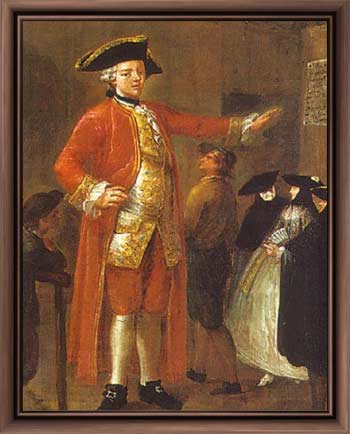 Cornelius Magrath the Silvermines Giant, The skeleton of Cornelius Magrath, the ‘Tipperary Giant,’ will be one of the exhibits on display in an exhibition, marking 300 years of medicine, at Dublin’s Trinity College, over the coming weeks.
The parents and siblings of Cornelius, who was born near the Silvermines, Nenagh, Co Tipperary, were people of ordinary stature, but Cornelius, as he turned 15 years old, became seized with pains in his limbs and in the space of one year grew some 21 inches in stature.
In July, 1752, when just 16 years old, Cornelius Magrath, (Born March 1736) went to Youghal, Co.Cork, to receive saltwater treatment. Latter was a cure to alleviate his growing pains. Here large crowds of individuals, began to take a curious interest in this giant.
While in Youghal, the then Bishop of Cloyne, Dr George Berkery, who died in 1753, took a keen interest in the young boys health, keeping him in his home and assisting him in his recovery.
By this time Cornelius’s hands, we are told, had grown to the size of “a shoulder of mutton, while his shoes measured some 15 inches.‘ His appetite was considered quite moderate and he drank cider with his meals, to assist in alleviating his growing pains.
The London Magazine in August 1752 states (Headlined Cork July 24th) “There is now in this city one Cornelius McGrath, boy of 15 years, 11 months old, of a most gigantic stature, being 7 feet 9 inches three quarter high. He is clumsily made, talks boyish and simple, he comes hither from Youghal, where he has been a year going into the salt water for rheumatic pains which almost cripple him…”
It was while in Youghal, Co.Cork, that he was persuaded to show himself off in return for money, so he headed to London in 1753 to launch his career and was first exhibited in Bristol.
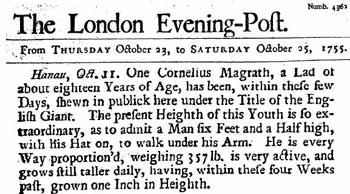 Cornelius Magrath advert. In an English issue of the then “Daily Advertiser” newspaper dated January 31st 1753, his sponsors ran the following notice: “Just arrived in this city, from Ireland, the youth, mentioned lately in the newspapers, as the most extraordinary production in nature. He is allowed by the nobility and gentry, who daily resort to see him, to have the most stupendous and gigantic form (although a boy), and is the only representation in the world of the ancient and magnificent giants of that kingdom. He is seven feet three inches in height, without shoes. His wrist measures a quarter of a yard and an inch. He greatly surpasses Cajanus the Swede, in the just proportions of his limbs; and is the truest and best proportioned figure ever seen. He was sixteen years of age the 10th of last March and is to be seen at the ‘Peacock,’ at Charing Cross, from eight in the morning, till ten at night.”
Magrath went on from England to visit Paris and most of the larger cities in Europe, including Regensburg, on the northernmost part of the Danube river in Germany, in 1756, where his portrait was engraved by Johann Nepomuk Maag, beside a grenadier. At this time grenadiers were chosen because of their strength and height and would lead assaults in the field of battle, because of their large physique.
A Venetian artist, famous for painting contemporary scenes of life, Pietro Longhi, painted Cornelius, at the age of 20 years in 1757, part of a commission for the “Noble Gentleman Giovanni Grimandi dei Servi, Patrician of Venice.” The painting is entitled ” True Portrait of the Giant Cornelio Magrat, the Irishman.”
While in Flanders Magrath was forced to return to Ireland due to ill health.
Next we are informed by The London Intelligencer, of May 24th 1760, which reports: “Dublin May 20th. The 17th instant died in College – Green, Cornelius Mag, the man of gigantic stature, who has been for some time exhibited as a show in this city. He was but 23 years of age and measured while living 7 feet five inches high while stretched, he wanted but two inches of eight feet.” (Some reporter not too hot on the maths.)
Students, from nearby Trinity College, whom he had befriended, are believed to have stolen his body on the day he died. The students having dissected his body, preserved his bones and they still remain in Trinity College to this day.
Admission to this fine exhibition at Dublin’s Trinity College, will cost €9 for adults, and children under 12 years are admitted free of charge.
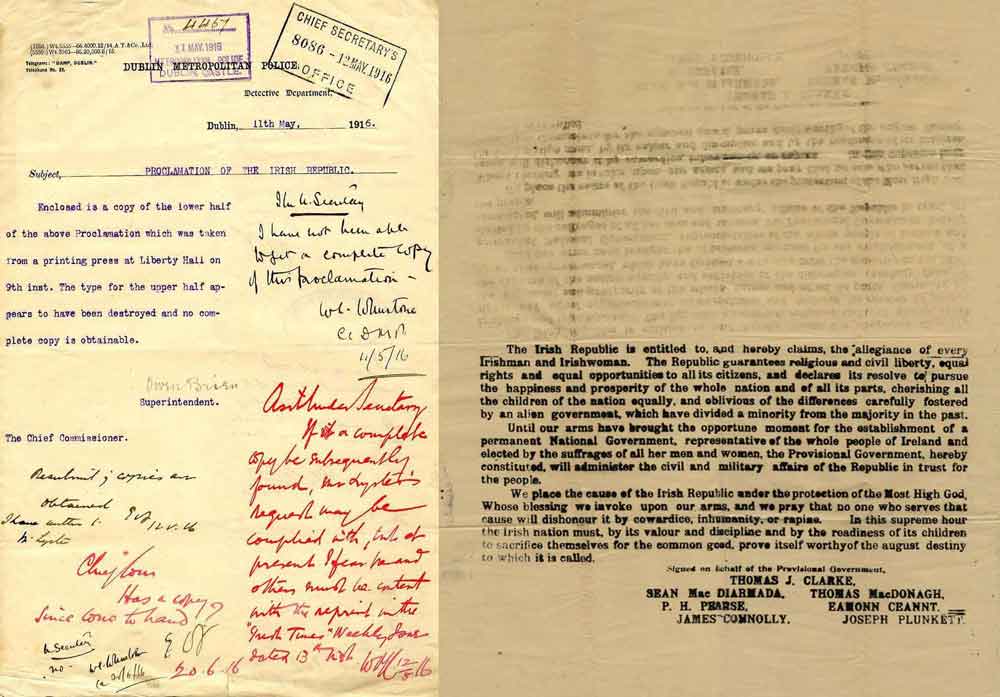 Half-copy of the Irish 1916 Proclamation Ninty Five years ago today, the Proclamation of the Irish Republic (In Irish: Forógra na Poblachta), issued by the Irish Volunteers and Irish Citizen Army, was read by Patrick Pearse, at four minutes past noon on Easter Monday, April 24th, 1916, from the steps of the General Post Office in Sackville Street, now known as O’Connell Street, in Dublin.
Pictures courtesy of National Archives of Ireland. (Please Click on image to read in full.)
1916 Proclamation of the Irish Republic
IRISHMAN AND IRISHWOMEN: In the name of God and of the dead generations from which she receives her old tradition of nationhood, Ireland, through us, summons her children to her flag and strikes for her freedom.
Having organized and trained her manhood through her secret revolutionary organization, the Irish Republican Brotherhood, and through her open military organizations, the Irish Volunteers and the Irish Citizen Army, having patiently perfected her discipline, having resolutely waited for the right moment to reveal itself, she now seizes that moment, and, supported by her exiled children in America and by gallant allies in Europe, but relying in the first on her own strength, she strikes in full confidence of victory.
We declare the right of the people of Ireland to the ownership of Ireland, and to the unfettered control of Irish destinies, to be sovereign and indefeasible. The long usurpation of that right by a foreign people and government has not extinguished the right, nor can it ever be extinguished except by the destruction of the Irish people. In every generation the Irish people have asserted their right to national freedom and sovereignty; six times during the past three hundred years they have asserted it in arms. Standing on that fundamental right and again asserting it in arms in the face of the world, we hereby proclaim the Irish Republic as a Sovereign Independent State. And we pledge our lives and the lives of our comrades-in-arms to the cause of its freedom, of its welfare, and of its exaltation among the nations.
The Irish Republic is entitled to, and hereby claims, the allegiance of every Irishman and Irish woman. The Republic guarantees religious and civil liberty, equal rights and equal opportunities of all its citizens, and declares its resolve to pursue the happiness and prosperity of the whole nation and of all its parts, cherishing all the children of the nation equally, and oblivious of the differences carefully fostered by an alien government, which have divided a minority in the past.
Until our arms have brought the opportune moment for the establishment of a permanent National Government, representative of the whole people of Ireland and elected by the suffrages of all her men and women, the Provision Government, hereby constituted, will administer the civil and military affairs of the Republic in trust for the people.
We place the cause of the Irish Republic under the protection of the Most High God, Whose blessing we invoke upon our arms, and we pray that no one who serves that cause will dishonour it by cowardice, inhumanity, or rapine. In this supreme hour the Irish nation must, by its valour and discipline and by the readiness of its children to sacrifice themselves for the common good, prove itself worthy of the august destiny to which it is called.
Signed on behalf of the Provisional Government,
THOMAS J. CLARKE.
SEAN MAC DIERMADA. THOMAS MACDONAGH.
P.H.PEARSE. EAMONN CEANNT.
JAMES CONNOLLY. JOSEPH PLUNKETT.
Continue reading Easter Proclamation Of Irish Republic
I never really believed that the late Princess Diana would ever accept an invitation to visit Thurles, but ‘nothing ventured ‘ for Thurles, can often result in ‘nothing gained.‘
Over 4 million British tourists had visited the Republic of Ireland in 2006. Tourism in Thurles was then practically non existent, with those responsible for marketing North Tipperary, only pushing their products west of the Shannon, in an attempt to justify earlier politically influenced public finances spent in funding in counties Limerick, Clare and Galway, while ignoring projects in the environs of Thurles, a practise they appear to still continue, as part of their marketing strategy today.
To cut a long story short, the following ‘Letter of Invitation‘ was penned and sent to Kensington Palace. I was encourage in this venture by the recently deceased Mr Ned Ryan, Upperchurch, and also by friend and lifetime museum patron, the late Mr Matty Ryan, both of whom had close associations with the late Princess Margaret, Countess of Snowdon, and younger sister of Queen Elizabeth II.
Our communicated invitation read as follows:-
Kensington Palace,
London W8 4PU
Date :- 22/ 7/ 1997.
Your Highness, Diana, Princess Of Wales,
On behalf of the people of Thurles, the members of our committee and myself, I would like to extend an invitation to Your Highness, to visit the home of your ancestors here in County Tipperary, Ireland.
As you maybe aware, your ascendancy were protectors and rulers of Thurles until 1841 and it is the intention of this committee to erect a stone testimonial,to commemorate your progenitor, Lady Elizabeth Butler, Viscountess Thurles, (1587-1673).
It is now the fervent desire of this committee, that You Highness would greatly honour us by unveiling this stone inscription.
We are very much aware of your many personal and public commitments, both at home and abroad, and fully comprehend that significant preparations would need to be put in position between, both Her Majestie’s Government and the Government of the Irish Republic, before such a visit could take place.
If, however, Your Highness were to signal her willingness and availability to accept this invitation, immediate preparations could be entered into, which would conform with your busy agenda.
It is our heartfelt wish that Your Highness will find time, in her busy calendar of events, to accept this invitation sometime in the near future.
I remain,
Yours most sincerely,
St. Mary’s Famine Memorial Church, Thurles, Co. Tipperary.
 The reply from Kensington Palace We were aware that, politically, it was not possibly the best time in our nations history to send such an invitation. Then Fianna Fail Minister for Foreign Affairs, and later disgraced T.D., Mr Ray Burke, had days before, just welcomed the decision taken by the Orange Order, with regard to certain of their Annual Marches, which gave space for all feuding factions in the North, to consider how the whole marching issue could be handled on the basis of respect for the rights of all, both the Orange Order and the wider community alike.
The now deceased, but then Northern Ireland Secretary Mow Mowlam had hinted that substantive negotiations, seeking a genuinely new political dispensation, based on equality, parity of esteem, respect for human rights and the principle of consent, were about to begin that September in Northern Ireland. Sinn Féin were being encouraged to take their place at the Conference Table, to represent the views of those who supported them. Fair and reasonable assurances had been spelled out with regards to what was expected by both British and Irish negotiators, before Sinn Féin would be allowed take part in these upcoming negotiations.
That same July 1997, the Democratic Unionist party leader Ian Paisley would vote against the Anglo-Irish plan for guerrilla disarmament, storming out of the voting session in Stormont Castle, near Belfast, while stating his party was out of the peace talks for good, while Mowlam confirmed that Sinn Fein would now sit at the negotiating table, when peace talks would resume in September of the same year.
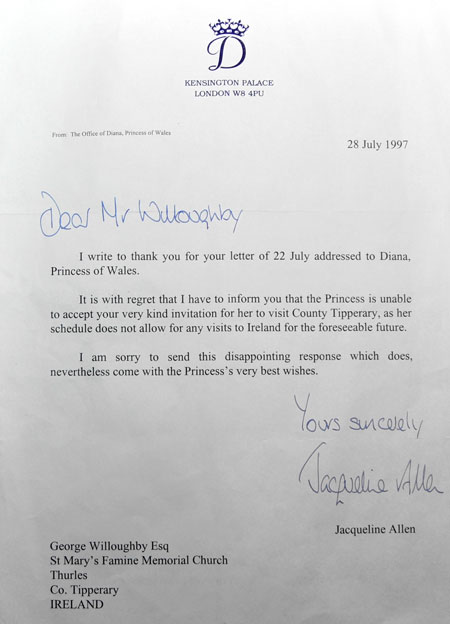
Princess Diana’s reply to our invitation arrived six days later in a letter from Kensington Palace and as expected her reply, pictured here, disappointingly spelt out her sincere regret. We now share this letter with you, our readers, for the very first time. (Click on Letter Image to enlarge.)
A little over just 4 weeks later, on the 31st of August 1997, Diana, Princess of Wales, was fatally injured as a result of a car collision in the Pont de l’Alma road tunnel in Paris, France. Her companion, Dodi Fayed, and the driver of the Mercedes-Benz W140, Henri Paul, were pronounced dead at the scene of the accident. Fayed’s bodyguard, Trevor Rees-Jones, was the only survivor. Although earlier the media pinned the blame on the paparazzi, the crash was ultimately found to be caused by the reckless actions of the chauffeur, who was the head of security at the Ritz and had earlier goaded the paparazzi waiting outside the hotel.
An eighteen-month French judicial investigation concluded in 1999, that the crash was caused by Henri Paul, who lost control of the car at high speed, while under the influence of alcohol, which may have been made worse by the simultaneous presence of an antidepressant and traces of a tranquilizer in his body.
On hearing the news, Thurles ladies began to arrive with bouquets of flowers to the door of St Mary’s Church here in Thurles, in an unprecedented show of sympathy and solidarity.
July 31st each year I often think, what an ambassador this world has truly lost and what if the Princess had decided to visit her ancestral home of Thurles, instead of visiting France, on that fateful day in 2007.
But then each person’s road, while on this earth, is so often paved with numerous ‘what if ‘s.’
The picturesque village of Clonoulty,Thurles, in Tipperary, is situated in the Golden Vale, latter the richest farm land in Europe. To the casual passing tourist it is just another Irish rural village, displaying very great civic pride, through its well kept appearance.
The village gains “National Prominence” each year when it, together with it’s sister village Rossmore, becomes host to the International Miss Macra Festival, latter which this year celebrates it’s 40th birthday. However tourists take note; there is more to the village of Clonoulty than meets the eye, as my tale will tell.
From a sporting perspective, this area has always been a hive of GAA activity and possibly therefore few are aware of its associations with past Rugby glory, its contribution to World leadership or even it’s British Royal Family connection.
Now with Her Majesty Queen Elizabeth II due to make her first State visit to Ireland, Thurles, her ancestral home and Clonoulty are both being focused on by Urban District Councillors and County Councillors, anxious to make a good impression and hoping to take full advantage of the much needed tourism that will be generated by Her Majesties visit. While we are aware of her Thurles connections, many may not be aware of the ‘Clonoulty Connection’.
The Clonoulty Connection
Detailed in the Census of 1911 the residents of Srahavarrella, now the home of Thomas Heffernan, in Clonoulty West, Tipperary are as follows:-
Pike William, (Church of Ireland Clergyman.) age 48, Husband and head of the family and a native of Co Mayo.
Harriett Florence Pike (Maiden Name, Surridge.) aged 34, Wife and a native of Dublin City.
Margaret Walker Pike, aged 8, a daughter, born in Co Kilkenny.
Andrew Hamilton Pike, aged 7, a son born in Co Kilkenny.
Theodore Ouseley Pike, aged 6, a son born in Co Tipperary.
Robert Bonsall Pike, aged 5, a Son, born in Co Tipperary.
Victor Joseph Pike, aged 3, a Son, born in Co Tipperary.
Charlotte Florence Pike, aged 2, a Daughter, born in Co Tipperary.
John Surridge Pike, aged 1, a Son, born in Co Tipperary.
From this information we can glean the villages Irish Rugby Football connection, a world leader and even a British Royal Family connection.
Victor Joseph Pike
Victor Joseph Pike, born July 1, 1907, Clonoulty, Thurles and died February 25, 1986, in Salisbury aged 78 years and 239 days.
Played Rugby for Ireland between 1931-1934, including in the Five Nations at Twickenham, where he made his Ireland Test debuts on the 14th February 1931, in the position of Hooker.
The Irish Team that day were as follows: – SH-Mark Sugden (Capt), FB – Major Egan, W- Edward Lightfoot, C– Eugene Davy, C – Laurence McMahon,W- Joxer Arigho, FH-Paul Murray, H-Victor Pike, N8-Hal Withers, L– Jimmy Farrell, N8– Jack Siggins, L– Jack Russell, F- Noel Murphy, N8– George Beamish, F- James Clinch. Match attendance on the day was 60,000
Victor Joseph Pike CBE CB, went on to become the Anglican Bishop of Sherborne,in the third quarter of the 20th century. He was educated at Trinity College, Dublin and ordained in 1930. His ministry began with a curacy at Dundrum, Dublin, after which he began a long spell as a Chaplain to the Forces, rising eventually to become Chaplain-General.
His Military précis reads:- The Reverend Canon Victor Joseph PIKE,C.B.E., Q.H.C., Chaplain-General to the Forces (53409), Royal Army Chaplains’ Department. REGULAR ARMY RESERVE OF OFFICERS: Ven. Archdeacon V. J. PIKE, C.B., C.B.E., D.D. (53409) Chapln. to the Forces 1st Cl. Having attained the age limit ceases to belong to the Res.of Offrs., 1st Jul. 1967, retaining the rank of Chapln. to the Forces 1st Cl.
After his death a trust was set up to assist in the education of sons and daughters of Protestant clergy.
Continue reading Clonoulty Tipperary: Rugby, Queen Elisabeth II & Miss Macra Festival
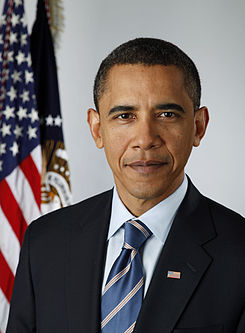 Barack Obama, 44th President of the United States USA’s 31st Irish President Barack Obama and Queen Elizabeth II are likely to visit Ireland in late May or early June of 2011.
In the case of President Obama his visit is likely to coincide with other European engagements. “The end of May is likely,” said an official, familiar with discussions regarding Mr Obama’s forthcoming trip to Europe. Records unearthed by the Church of Ireland’s Rev. Canon Stephen Neill show beyond doubt that Mr Obama’s ancestors, on his mother’s side lived, worked, married and had children in the Moneygall area, situated on the border separating counties Tipperary and Offaly. It is expected that the president will wish to visit his ancestral home during this visit.
Mr Obama and his wife, US first lady Michelle Obama, will visit Britain on a state visit at the invitation of Queen Elizabeth II, from May 24th to 26th. He will travel on to Deauville, France, for the G8 Summit on May 26th to 27th. Discussions within the US administration are now focused on whether Mr Obama should visit Ireland before London or after Deauville and the White House hope it is before the UK, visit according to US officials.
Neither the White House, the Irish Embassy in Washington nor indeed the US embassy in Dublin would confirm officially that a visit is likely in late May. Discussions about the trip appear not to have, so far, involved the Irish government, with the speculation that the US are waiting for Irish politics to be fully clarified over the coming week.
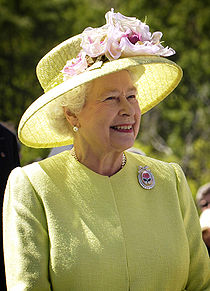 Her Majesty Queen Elizabeth II The annual St Patrick’s Day pilgrimage to Washington will be one of the first acts of our new Taoiseach Enda Kenny and if the May expected visit materialises, a visit is likely to be announced at the White House during the St Patrick’s Day reception.
Democratic congressman Richard Neal, the former head of the Friends of Ireland in the House of Representatives, stated that a visit to Ireland would have obvious implications for Mr Obama’s re-election campaign.
Planning in relation to both visits is somewhat complicated by the fact that Irish President Mary McAleese has already issued an invitation to Her Majesty Queen Elizabeth, to visit Ireland, probably also in late May or June.
Regarding Her Majesty Queen Elizabeth’s II visit, there may be a reluctance on the part of the Irish government to take on two such important visits so close together, however these logistics are something that both governments will be anxious to negotiate.
Queen Elizabeth II, although she has never visited Thurles, has strong ancestral connections with the town and is a direct descendant of Viscount and Lady Thurles through their eldest son, the Duke of Ormond. The Duke’s daughter, Elizabeth, married Philip Stanhope, 2nd Earl Chesterfield, and their daughter Elizabeth Stanhope married John Lyon, 4th Earl Strathmore. Six generations later in direct line was the 14th Earl Strathmore whose daughter, Elizabeth Bowes-Lyon married the future King George VI; and these are the grandparents of Prince Charles. Thurles is therefore expected to be included as a stop off point in any proposed future visit.
Many of Queen Elizabeth’s ancestors are buried at St. Mary’s Church here in Thurles, including Lady Elizabeth Butler,(Elizabeth Poyntz, Acton, 1673.) from whom she inherited her christian name. Sophie Helen Rhys-Jones, wife of Prince Edward attended a funeral on behalf of the British Royal Family in November last, here in Upperchurch, Thurles, Co Tipperary.
|
Support Us Help keep Thurles.info online by donating below. Thank you.
Total Donated 2026: €300.00
Thank You!
Daily Thurles Mass Livestream
|



Recent Comments