|
|
It is just an idea for Thurles Town Council, North Tipperary Co.Council and the Principal Landscape Architect operating with URS Ireland Ltd., latter tasked with planning and managing the upcoming refurbishment of Liberty Square.
Proposed Idea: Check the names of all great Irish men, natives of Thurles, Co Tipperary who have made a considerable contribution not just to Ireland, but to the world. Have their names cast in brass and placed into our pavements on Liberty Square, in similar style to the now world famous “Hollywood Walk of Fame.”
Believe me when I state that you will be greatly surprised at the contribution Thurles has made down through the years, as indeed my profile sketched hereunder is a true testament.
“Death the Leveller,” by Poet/Dramatist James Shirley B.A. (1596 – 1666)
“The glories of our blood and state are shadows, not substantial things;
there is no armour against fate; death lays his icy hand on kings.
Sceptre and crown must tumble down and in the dust be equal made,
with the poor crooked scythe and spade.”
Architect Patrick Charles Keely (1816 – 1896) today sleeps peacefully in Holy Cross Cemetery, Kings County, New York, USA, (Plot: St Peters, range E). Patrick incapacitated by age, died following a heat stroke and rests today in this cemetery with organized crime figures like Louis Capone (1896 – 1944) and Frankie Yale (1893 – 1928), with U.S. Representatives John Michael Clancy (1837 – 1903) and Ardolph Loges Kline (1858 – 1930), with racehorse trainer “Sunny Jim” Fitzsimmons (1874 – 1966) and jockey Edward R. Garrison (1868 – 1930), with Major League Baseball player and manager Gil Hodges (1924 -1972) and the Irish-American businessman William Russell Grace (1832-1904).
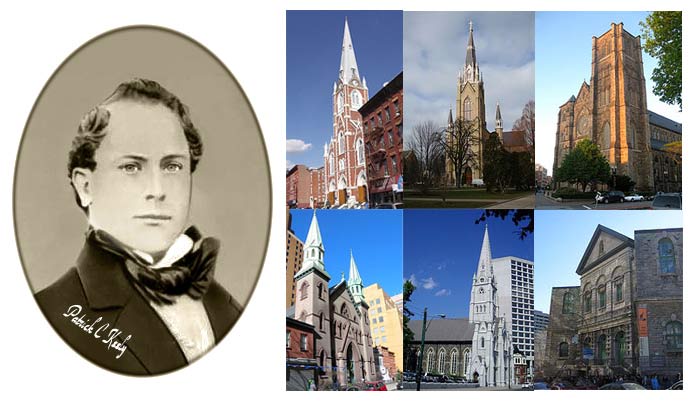 Patrick Charles Keely, Aug 9th, 1816 – Aug 11th, 1896. In a telephone conversation with one of our regular history readers here on Thurles.Info recently it was correctly suggested to me that Ireland and Tipperary should perhaps begin to celebrate the period of the Great Irish Famine, not only through just viewing its darker moments, mainly depicted through forced emigration, death, disease and starvation, but also from the viewpoint of our countries major contributions to every continent worldwide, during this same catastrophic period in our countries history.
Focusing on the latter, let us take a close look at the architect Patrick Charles Keely (possibly originally spelt Kiely) who was born here in Thurles, Co. Tipperary, “in comfortable circumstances,” on August 9th 1816.
Little is truly known of his early education, however he most certainly was apprenticed to his father John, latter a Kilkenny native who came to Thurles as skilled carpenter and builder (Possibly John Kiely of Stradavoher Street, Thurles, whom history records as a listed carpenter and builder.) and who is credited with building St. Patrick’s College in 1829-37 and the Thurles then St. Mary’s Fever Hospital begun in 1838-40.
At the age of twenty six, Patrick emigrated to the United States and settled in Brooklyn. He immigrated through Castle Gardens to Brooklyn, New York, in 1842, which may have been the reason for the spelling of his name changing from ‘Kiely,’ to ‘Keely.’ Castle Clinton or Fort Clinton, once known as Castle Garden, is a circular sandstone fort now located in Battery Park at the southern tip of Manhattan Island, New York City. It should be noted that since many Irish people then coming into America were illiterate, (Not so Mr Keely). Names often were spelt by those recording immigrants incorrectly, based on individual verbal accents and pronunciations. Castle Gardens is perhaps best remembered as America’s first immigration station (pre-dating Ellis Island), then giving access to more than 8 million people worldwide then arriving in the U.S. particularly between 1855 and 1890.
Arrived at a time when Catholicism in the United States was much on the increase, Keely initially worked as a carpenter for a number of years without attracting much attention. However it was during this time, his path crossed with the Rev. Sylvester Malone, a Roman Catholic priest. Fr. Malone had been sent to form a parish near the waterfront at Williamsburgh, Brooklyn, Kings County, New York, in 1846. Now together with Keely, they would work on plans to build a Gothic style church. A Gothic revivals had begun in the mid-18th-century continuing throughout 19th century in Europe and America and was largely chosen as the construction style for most ecclesiastical and university buildings.
Thus the new Church of Sts. Peter and St. Paul was to be Patrick C. Keely’s first designed ecclesiastical edifice, duly dedicated in 1848. Regrettably, facing a decline in parish enrolment during the 1950’s this structure was eventually demolished in February of 1957. However not before an article in the “Irish World” on September 19th, 1896 entitled, “The Late Architect Keely,” described a requiem Mass to be celebrated at Sts. Peter and Paul Church one month following Keely’s own death. The article gives us a ‘mind’s eye’ glimpse of the decorations for his Requiem Mass; “The altar was draped in purple, and in front of the altar, in the centre aisle, stood a handsome catafalque (platform or box used to stand in place of the body of the deceased) and candelabra. Two palms surmounted the catafalque, while the candelabra contained twenty-six lights. A special musical programme was rendered under the direction of the organist, Frederick Bradles, and the choir of the church.”
Patrick Keely’s reputation for honesty and integrity quickly now made him a popular choice amongst the hierarchy and clergy of all main religious denominations throughout the eastern United States and his would eventually lead to his designing over 600 buildings that would include The University Of Notre Dame Basilica of the Sacred Heart, Saint Francis Xavier in New York New York, Cathedral of St. John the Evangelist in Cleveland Ohio, and The Immaculate Conception Church in Boston, to name but a few. The locations of his churches range from Nova Scotia all the way south to Louisiana and as far west as Iowa.
He was called on to prepare plans for many new churches, by those who had observed, first hand, evidence of his skill, not just as a carpenter and builder but also as a wood carver. Evidence of his carving ability can be seen at the St Mary’s Roman Catholic Church, in Boston’s oldest neighbourhood of Charlestown, which today proudly displays a Hammerbeam ceiling, personally hand carved by Keely.
Keely was the second man to receive a gold medal annually awarded by the University of Notre Dame, Indiana, in recognition of his architectural genius. His design for the Jesuit church in Sixteenth Street, New York, is still considered as the best example of Roman ecclesiastical architecture, anywhere in today’s America.
Keely’s funeral took place after 9.30am Mass, from St. John’s chapel, Clermont and Greene Avenues, with the Rev. J.H. Mitchell, chancellor of the diocese, being celebrant followed by interment in the family plot in the cemetery of The Holy Cross. At the time of his death Patrick Charles Keely was survived by eight children, (Two sons, one unmarried daughter and five married daughters).
Go ndéana Dia trócaire ar a anam dílis.
Autumn months according to our National Meteorological Service, Met Éireann, are September, October and November, however according to our Irish Gaelic traditional Calendar, autumn constitutes the months August, September, and October. Harvest or ‘Fall,’ was the term usually used rurally to refer to autumn and came to refer only to the actual activity of reaping crops sown.
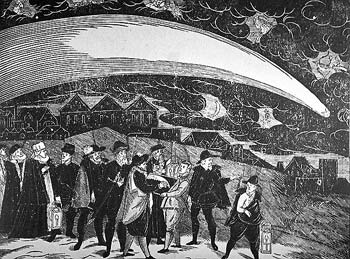 Great Comet of 1577. Whatever month autumn begins, August brings into focus thoughts of future winter weather, flu epidemics and hopes of general well being. Generally these thoughts are based on our own previous experiences of health issues or unprecedented winter conditions experienced during our own lifetimes.
So what awaited past Irish generations before modern day scientists came up with the theory of ‘Global Warming.’ ?
Let’s take a look at what history has recorded in Ireland between the years 1178 and 1603 with regard to health and unusual occurring weather.
1178. (Four years after the Battle of Thurles and the same year Donal O’Fogarty, Bishop of Ossory, died.) A great wind this year by which many trees were uprooted and many churches laid prostrate. Some 120 trees fell at Derry Columkille. The river of Galway dried up for several days so that things lost in it from time immemorial were recovered, great quantities of fish were taken by the inhabitants.
1224. An awful and strange shower fell in Connaught and there followed diseases in cattle, and those who drank their milk got extraordinary internal diseases.
1236. Great storms and rain and violent wars prevailed this year.
1252. A great heat and drought this summer, so that people passed over the principal rivers with dry feet and trees became ignited with the heat of the sun.
1326. Small-pox raged though Ireland and great numbers died.
1328. According to Annals of Ireland by the Four Masters, an awful thunder and lightning occurred by which vegetation and fruit were extensively damaged and corn blighted. An epidemic disease called Slaodan (Translated. influenza) prevailed, and continued for four days on those afflicted with it, and proved almost fatal to them.
1329. Crops remained un-reaped until after Michaelmas, (Michaelmas derives its name from the Feast of St Michael and All Angels, which falls annually on 29 September 29th), in consequence of wet weather.
1349. A great plague in Ireland particularly in Moylurg (Magh Luirg Roscommon North east of the province of Connacht ); an immense number died of it.
1383. An awful and very fatal plague raged throughout Ireland. Judith, daughter of the Earl of Ormond, the wife of Teige O’Carroll, lord of Tigh Muna (Timoney, near Roscrea, Co Tipperary) and the daughter of O’Brien, wife of O’Kennedy died of the plague.
Continue reading Past Health & Weather Records Reviewed
Minister for Arts, Heritage and the Gaeltacht, Mr Jimmy Deenihan is to travel to Hyde Park Barracks, Sydney, Australia on Sunday to lead the ceremonies for the 2013 International Commemoration of the Great Irish Famine. Here he hopes to meet descendants of Irish orphan girls who travelled to Australia between 1848 and 1850, during the great famine period of 1845-1851.
More than 4,000 women and girls left from Irish workhouses aged between 14 and 20 years old, during the years between 1848 and 1850 under the Earl Grey Scheme. Like the young unemployed of today’s Ireland many went to Australia in search of hope and a new beginning. The difference between today and back then is that today, to our shame, those leaving our shores for Australia are highly educated, while back then those leaving were made up of abandoned, or orphaned children, many untrained, without in many case the ability to read or write.
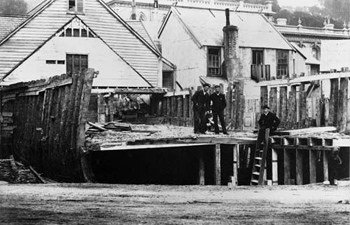 The rotting Hulk of “Inconstant,” wrecked at Wellington, New Zealand in 1851 & which had previously transported young girls from workhouses in Tipperary to Australia. To call them orphan girls in this period of Irish history (1845-1851) perhaps is an inaccurate statement, for it was quite common for Irish destitute families to leave their children abandoned at the gates of local workhouses, the parents fearing they could no longer care for them. At the beginning of the Nineteenth Century here in Ireland, poverty was widespread. It was estimated that over two million were nearly destitute and at levels of starvation.
Workhouses to assist those starving arose from the July 1838 British Governments “Act for the Effectual Relief of the Destitute Poor in Ireland,” and some 130 such buildings throughout Ireland were eventually established between 1840 and 1845, with each building depending on local population, to accommodate somewhere between 2000 and 700 persons. One such building, now demolished, was the former Hospital of The Assumption, here in Thurles, Co Tipperary.
The Earl Grey Scheme
The ‘Earl Grey Scheme,’ was an operation carried out between March 1848 and 1850. Earl Henry George Grey, Secretary of State for the Colonies, specifically set-up this scheme to send orphaned or abandoned girls from workhouses in Tipperary, Roscrea, Ballina, Tullamore, Dublin, Cork, Skibbereen, Mountmellick, Newcastle, Mullingar and Loughrea, amongst others north of the country like Belfast, Cookstown, Dungannon and Magherafelt. Thus, encouraged and partially forced emigration became Grey’s brain-child, primarily designed to meet an Australian demand for domestic servants and marriageable young women. In the eyes of the then so called Imperial social engineers of this time who supported his plan, these Famine orphans were being observed as young marriageable women who would bring a somewhat stabilising influence to an existing rough male colonial society. Grey believed he could alleviate the worsening problem of overcrowding in Ireland’s famine filled workhouses, while at the same time solving Australia’s problems of a shortage of labour and an imbalance of the sexes.
Arrivals
From the very first arrival via the ships “Roman Emperor,” “Maria,” “Inconstant,” “Ramilies,” “Earl Grey,” and “Elgin” between 1848/49 and for years afterwards these young girls would confront often angry, heated, local Australian hostility. Hatred centred on their being young, their complete and utter incompetence, their lowly workhouse origins, their total inexperience in any form of household service and possibly also their being Irish.
The 1850’s onwards was also the period when native Aboriginal people were being forced into reservations. Those who believed they had an inside tract on social mores, began eroding Aboriginal traditional ways of life through the banning of Aboriginal names and their traditional customs, while perceiving the need to keep Aboriginal people, a primitive race doomed to extinction, separate from their superior white population, while their race died out. Aboriginal people lost all basic human rights such as their freedom of movement, labour, custody of children and control over personal property.
Continue reading Irish Girls – Stunted Figures, Thick Waists, Clumsy Ankles
The people of Ballingarry (South), Thurles, Co Tipperary, latter situated at the foot of Slievenamon Mountain, are hosting the Ballingarry Gathering Cultural & Historical Festival, which begins this coming weekend, the 27th and 28th of July 2013 inclusive.
Saturday the 27th July will have a line up of varied events beginning at 12.30pm in The Commons, where a Mining exhibition will be held in ‘The Old School, showing Photographs and Artefacts. There will also be a re-enactment of the pre-rising meeting of the Young Ireland leaders.
The annual commemorative ‘Famine Warhouse Walk,’ led this year by Dr. Martin Mansergh, will commence as is customary at the National Flag monument in the village and proceed to the Widow McCormack’s 1848 Warhouse, a distance of 1.5 miles, which in 1848 was the scene of the only rebellion which took place during the ‘Great Famine,’ period 1845-1849.
On Sunday 28th July, Noreen Maher from ‘Hibernia Roots,’ will host a genealogy lecture in The Old School, The Commons, and entitled ‘How to Start Researching Your Family,’ which will commence at 1.00pm. Following this a free display of traditional music played by individual musicians and groups will take place, again at The Commons, commencing at 2.00pm.
 The signatures of Thomas Francis Meagher & Patrick O’Donoghue, both present at the Ballingarry uprising of 1848. The signatures are written on the inside cover of a book found in Richmond prison, Tasmania. The book is entitled “Wreath of Friendship,” & dated 26th February 1849. Same can be viewed currently at St Mary’s Famine Museum, Thurles, Co Tipperary. 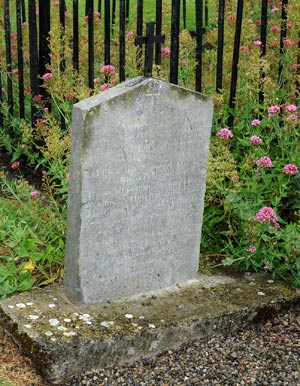 Burial place of Maurice Richard Leyne. To give you all a taste for the history of this period, the following is an extract from the little known journal written by Patrick O’Donoghue, while on his way into exile in Tasmania, on board her Majesty’s sloop of war “Swift,” sections of which were published in The Nation newspaper. The Nation newspaper of course was co-edited by Maurice Richard Leyne, along with Charles Gavan Duffy, both following on from its re-launch in 1849.
Leyne was born in 1820 the grand-nephew of Daniel O’Connell and the only member of the family to align himself with the Young Ireland movement. He was an Irish nationalist, repeal agitator and like T.F. Meagher, William Smith O’Brien, P O’Donoghue & Terence MacManus was a member of Young Ireland and present with the latter in Ballingarry for the uprising. Leyne left ‘The Nation’ newspaper and moved to Thurles to become editor of the Tipperary Leader newspaper, where he died in 1854 days before its first publication in that same year and is buried in St Mary’s Churchyard, (Famine Museum) Thurles, Co. Tipperary.
Leyne’s small limestone tombstone reads:- (Click on image left for greater for resolution.)
“He whose virtues deserve a temple can now scarcely find a stone.” “In this grave are deposited the remains of Maurice Richard Leyne Esq who died 29th June 1854. This stone has been placed over him by a few humble admirers of his great virtues and talents to preserve his memory until a competent hand shall write his epitaph and a more grateful and generous people regard his merits. May his soul rest in peace. Amen.”
Continue reading Ballingarry (South) Tipperary Host Cultural & Historical Festival
“War does not determine who is right – only who is left.” Quote attributed to Bertrand Russell.
It was on 21st January 1919 that two Irish born Roman Catholic RIC constables, James Alec McDonnell and Patrick O’Connell, were escorting a horse drawn cart containing gelignite from the Tipperary town Military Barracks to the local Soloheadbeg Quarry, a distance of 7.7km or just 10 minutes modern day driving time apart. The driver of the cart was James Godfrey, accompanied by Patrick Flynn, the latter a County Council employee.
Constable McDonnell, a native of Belmullet, Co. Mayo and father of seven children, together with comrade Constable O’Connell, latter a native of Coachford, County Cork and unmarried, were both guarding this cargo of explosives.
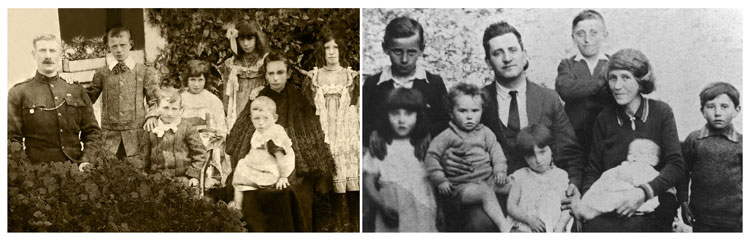 James McDonnell & Anastasia (Doyle) (Sepia Pic) – His son Christopher McDonnell & Bridget (McGrath) (Black & White Pic)
Pictures come courtesy of the Sweeney family. History records that possibly up to eight armed and masked men, members of the then Irish Volunteers from the South Tipperary Brigade, which included their leader Séamus Robinson, Sean Tracy, Dan Breen, Sean Hogan, Tadgh Crowe, Patrick Dwyer, Michael Ryan, and Patrick McCormack opened fire on the Constables, killing both men. Volunteer GHQ had not sanctioned this ambush.
The driver and County Council worker were left unharmed. In the pocket of Constable McDonnell’s uniform were 30 electric detonators which remained undiscovered by their assailants. Hogan with Treacy and Breen drove the cart together with the explosives away from the scene. Eye witnesses later saw the cart being driven at high speed in the direction of Dundrum village, County Tipperary, and indeed the horse and cart minus its contents were later found abandoned at Allen Creamery near Dundrum, by the District Inspector of Clonmel Poer O’Shee.
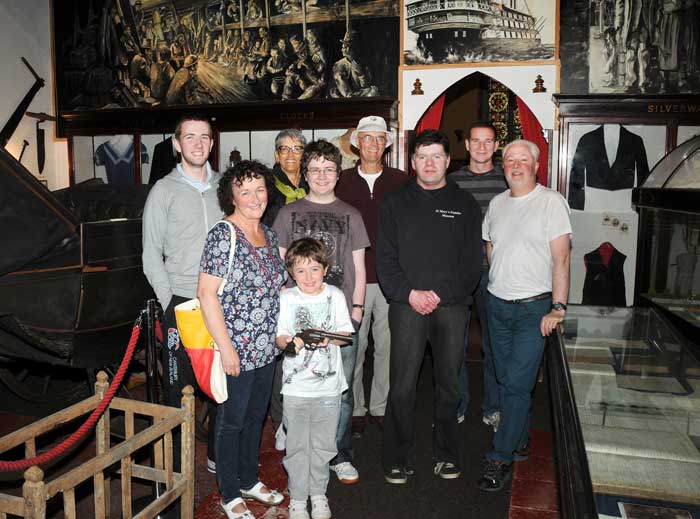 The picture directly above shows; Back Row: – Bonnie, Alden & Doug Rohrer from Texas. Front Row:- Aileen Sweeney (Left), her husband Roy (Right), with their children Neil, Eoin & Blaine, & St Mary’s Famine Museum, Thurles, guide Stewart Willoughby. A major historic event took place in St Mary’s Famine Museum in June of this year 2013, which truly should have demanded a far wider audience. It was the visit by Mrs Aileen Sweeney, latter the great granddaughter of James Alec McDonnell, the first victim of the War of Independence against England, together with her immediate family. Picture above shows McDonnell’s great, great grandson holding the gun, a Colt 45, which killed his great, great grandfather and possible the gun which fired the first shot which began the War of Independence, eventually leading to brother fighting brother, in an ensuing civil war.
Continue reading Rare Unseen Pictures Which Relate To Tipperary
|
Support Us Help keep Thurles.info online by donating below. Thank you.
Total Donated 2026: €300.00
Thank You!
Daily Thurles Mass Livestream
|



Recent Comments