French-bred and Irish-trained two-time Cheltenham Gold Cup winner ‘Galopin Des Champs’ died on Tuesday, September 1st 2026, aged 10, after suffering a severe leg injury in a field, just five days following his retirement.
Mr Ruby Walsh confirmed that vets attended immediately, but X-rays showed damage that could not be repaired. The much-loved gelding had joined the Walsh family to begin a new equestrian career.
Trained by Mr Willie Mullins and owned by Ms Audrey Turley; ‘Galopin Des Champs’ enjoyed an outstanding racing career, winning 15 of his 26 starts and earning approximately €2.3 million in prize money. His 12 Grade One victories included consecutive Cheltenham Gold Cups in 2023 and 2024, alongside three Irish Gold Cups between 2023 and 2025.
His death has left his owners, carers and racing fans mourning a remarkable champion. Mr Mullins described the loss as heartbreaking for everyone connected with him.
Galopin Des Champs leaves a lasting legacy and memories of unforgettable triumphs on the racecourse.
“A society grows great when old men plant trees in whose shade they shall never sit” Above quote by the late American theologian and Quaker Elton Trueblood, (1900 – 1994). [From his 1951 book “The Life We Prize”].
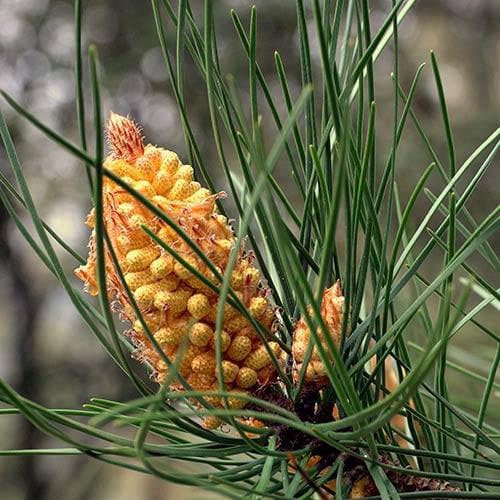
Scots Pine(Pinus sylvestris).
“Planting for the Planet,”
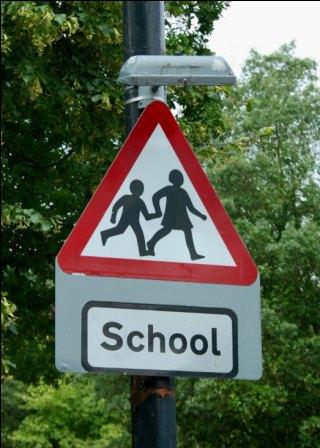
Primary schools across County Tipperary are being encouraged to get outdoors and get planting as National Tree Day returns on Thursday, October 1st 2026.
Organised by the Tree Council of Ireland and supported by Glennon Brothers, the initiative is making 2,000 free Scots Pine saplings available to primary schools nationwide, giving pupils throughout the Premier County an opportunity to take part.
This year’s theme, “Planting for the Planet,” highlights the contribution trees make to our environment. From storing carbon and protecting soil to providing food and shelter for wildlife, trees play an essential role in the world around us.
Schools can mark the occasion with tree planting, nature walks, tree identification and classroom activities. It is a chance for children to explore their surroundings, discover local wildlife and learn why caring for trees matters.
The Scots Pine (Pinus sylvestris) offers plenty for young nature enthusiasts to discover. An evergreen with distinctive needles and cones, it provides seeds for red squirrels and shelter for birds and insects. Planting a sapling can also create an ongoing learning opportunity as pupils watch their tree develop through the seasons.
Teachers and school leaders can request a free sapling through the online form HERE. Trees are available on a first-come, first-served basis, and the organisers advise that a similar variety may be substituted if demand requires it.
Get your school involved and help a new generation in Tipperary discover the value of planting, protecting and caring for trees.
Ireland’s free hot school meals programme is set for changes aimed at improving nutrition, offering more suitable portions and reducing the amount of food left uneaten.
Minister for Social Protection Mr Dara Calleary outlined the proposed reforms after Cabinet discussed two Government-commissioned reviews of the scheme. A cold lunch option, a standardised three-week menu and better provision for children with additional dietary needs are among the measures being considered. Discussions with schools and suppliers will now take place, with changes intended for the 2027/28 cycle.
Attention Turns From Expansion to Food Quality Following its nationwide extension in September 2025, the programme covers approximately 3,200 primary schools and more than 550,000 school children. Mr Calleary defended the scheme’s rapid growth and said it continues to provide valuable support to families. However, he acknowledged that improving the food itself must now become a central priority. The programme is estimated to save a household with two primary school children about €1,152 annually. An Taoiseach Mr Micheál Martin also recognised the scheme’s benefits while accepting that its quality and waste levels need attention.
Uneaten Meals Raise Difficult Questions The reviews indicate that roughly one in five meals supplied; approximately 100,000 a day, goes uneaten when pupil absences are taken into account, the proportion falls to 11.1%. Mr Calleary said his department takes food waste seriously, while noting that children being absent explains part of the problem. There are also questions about how waste is measured. Food Policy Ireland chief executive Ms Ruth Hegarty cited an estimated 6.3 million kilogrammes of food wasted over a school year, but questioned the basis for the reported uneaten-meal percentage because direct food waste audits had not been conducted in schools. The parent survey suggests that unfinished lunches predate the programme; almost half of respondents said their children previously brought food home uneaten.
Smaller Portions for Younger Pupils, More for Older Children A nutritional assessment examined 360 meals from 15 suppliers and included visits to 54 schools. It identified a problem with serving the same portion size across different age groups. Meals that may be sufficient for younger pupils can provide too few calories for older children. The review also found that children tended to select foods higher in fat, salt and sugar when those choices appeared alongside healthier alternatives. Proposed changes would introduce portions suited to different ages and a standardised menu rotating over three weeks. Menus would also be adapted for special schools, special classes and children with specific dietary requirements.
Parents Want Greater Lunch Flexibility A possible cold lunch option emerged as a strong theme in the feedback, with 84% of parents supporting its availability. The review recommends allowing children to choose a hot or cold meal on a given day, suggesting that greater flexibility could help reduce waste. The Ipsos/Behaviour & Attitudes research gathered responses from 86,637 parents and guardians, 6,884 children, 2,420 teachers and principals, and 47 suppliers, with 747 schools participating. Three-quarters of children said they ate at least some of their meal, while 63% of teachers and principals considered the programme’s overall impact positive. Meal ordering was strongest among younger children. Participation averaged 97% from Junior Infants to First Class, compared with 81% in Fifth and Sixth Class. The overall average was 85%.
The Government remains committed to extending the programme to secondary schools during its term. Mr Calleary has yet to announce a timetable for that expansion.
Recall of a batch of Dunnes Stores Potato Waffles 680g due to elevated levels of mineral oil aromatic hydrocarbons (MOAH)
Alert Summary dated Friday, 18th September 2026
Category 1: For Action. Alert Notification: 2026.59. Product Identification: Dunnes Stores Potato Waffles, pack size: 680g. Batch Code: Best before: July 2028.
Message: Dunnes Stores are recalling the above batch of Potato Waffles 680g due to elevated levels of mineral oil aromatic hydrocarbons (MOAH)
Recall notices will be displayed at point-of-sale in Dunnes stores.
Nature Of Danger: Mineral oil hydrocarbons comprise a wide range of chemical compounds obtained mainly from petroleum distillation and refining. They are categorised into two main groups referred to as mineral oil saturated hydrocarbons and mineral oil aromatic hydrocarbons. Mineral oil hydrocarbons can be present in food in many ways, such as through environmental contamination; use of lubricants for machinery during harvesting and food production; processing aids; food or feed additives; and migration from food contact materials. Some substances in the mineral oil aromatic hydrocarbons group are of possible health concern. Although the consumption of the contaminated product does not pose an immediate risk to health, continuous consumption over a long period of time may pose a potential risk to health. Therefore, exposure to mineral oil aromatic hydrocarbons needs to be minimised.
Action Required: Consumers: Consumers are advised not to eat the implicated batch.
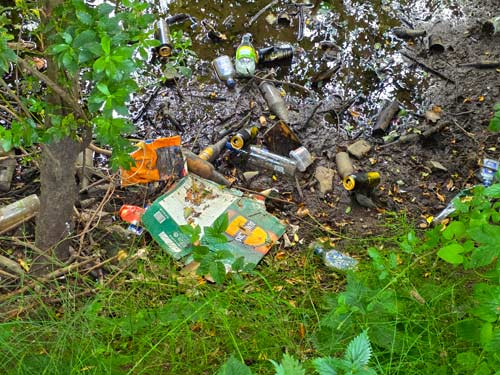
The summer foliage is dying back, unveiling more of the uncollected rubbish along the banks and in the River Suir in central Thurles. Bottles, cans, flower pots and other litter remain, while fallen trees and uncontrolled shrubbery continue to obstruct the river, as the stench persists.
After more than 13 year, the problems remain unresolved. Certainly over the past six weeks, despite my contact with the Environmental Protection Agency and Tipperary County Council, there have been no meaningful progress on the continuing litter, obstructions and overall pollution. The installation of litter bins also still remains unaddressed.
Two Years On – Bed Of River Suir At Low Tide.
Dear Mr Willoughby, Further to previous correspondence and responding to your concerns, the EPA wrote to Tipperary County Council seeking a written response from them on actions taken or planned on this matter. The Council responded to the EPA on 15/09/2026. However, the response did not provide sufficient information. The EPA has therefore requested further information from the Council. We will provide you with an update in three weeks. In the interim, we recommend you continue to report any further issues relating to this matter to the Council. Please use the reference number above in any further communication with the EPA regarding this matter. Trusting this is of assistance to you. Kind regards, Signed:Ms Shelly Laffan (Complaints Unit | Office of Environmental Enforcement) (Aonad Gearán na hOifige Forfheidhmithe i leith cúrsaí Comhshaoil)
Now, a response to my initial complaint from Ms Shelly Laffan, of the EPA’s Complaints Unit, Office of Environmental Enforcement, raises further questions about the Council’s handling of this matter.
The EPA confirms that it sought a written response (See above) from Tipperary County Council on actions taken or planned. The Council replied on September 15th 2026, but the EPA states: “However, the response did not provide sufficient information.”
The EPA has now requested further information and says it will update me in three weeks. In the meantime, it advises me to continue reporting further issues to the Council and to use my complaint reference [Ref: COM021813], in future correspondence with the EPA.
Thurles residents deserve to know what action if any is being actually taken, and when visible work will begin.
The Stench Continues. Where Is the Public Accountability?
The accompanying video hereunder records what appears to be effluent entering the river. It also shows a flat flagstone positioned over one pipe outlet, raising questions about whether the discharge is being obscured. Who placed it there, and why, requires investigation. The discharge itself needs to be identified and its source established.
I have also received reports of fish found floating near ‘The Willows’ housing estate in the recent past. The account relayed to me attributes this to an accidental chemical spill washed into the Suir through a connected surface-water drainage pipe. That explanation remains unconfirmed. The relevant authorities should establish what happened and publish their findings, including any available sampling results.
These concerns have a history. Local reporting in May described dumped shopping trolleys, plastic debris and suspected effluent along this same town-centre river.
Despite a political promotional video, 13 years too late, same highlighting the river’s condition, no subsequent update has come from same hand holding politicians, with the sole exception of local councillor Mr Jim Ryan who has taken up the cause. His communication on local radio over past months is acknowledged. Others,, if any, who have publicly expressed concern should explain what further follow-up they have undertaken.
Tipperary County Council should also now publish a dated programme for litter removal, for required bin provisions and assessment of the fallen-tree obstructions. The relevant authorities must investigate the discharges, explain their findings and identify who is responsible for each next step. Every further week of delay leaves the rubbish, the smell and the unanswered questions with the people of Thurles.
A copy of today’s updated report has been forwarded to all those responsible for this crime of neglect.
The River Suir deserves urgent care, sustained maintenance and public accountability. When will that work become visible?
This website uses cookies to improve your experience. We'll assume you're ok with this, but you can opt-out if you wish.AcceptRead More
Privacy & Cookies Policy
Privacy Overview
This website uses cookies to improve your experience while you navigate through the website. Out of these, the cookies that are categorized as necessary are stored on your browser as they are essential for the working of basic functionalities of the website. We also use third-party cookies that help us analyze and understand how you use this website. These cookies will be stored in your browser only with your consent. You also have the option to opt-out of these cookies. But opting out of some of these cookies may affect your browsing experience.
Necessary cookies are absolutely essential for the website to function properly. This category only includes cookies that ensures basic functionalities and security features of the website. These cookies do not store any personal information.
Any cookies that may not be particularly necessary for the website to function and is used specifically to collect user personal data via analytics, ads, other embedded contents are termed as non-necessary cookies. It is mandatory to procure user consent prior to running these cookies on your website.





Recent Comments