Yesterday, Friday, November 10th 2023, the HSE updated the status of its warning in relation to heroin overdose clusters in the Dublin Region.
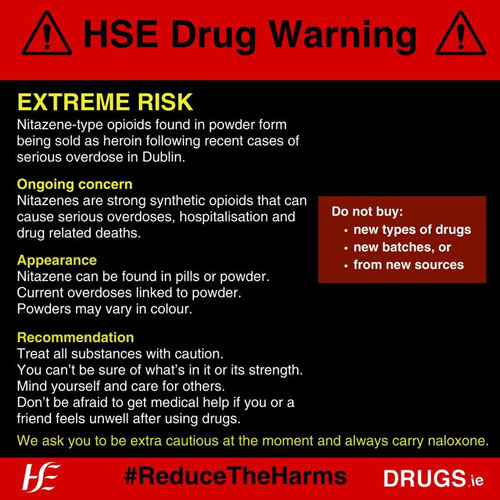
It has been confirmed through analysis conducted by Forensic Science Ireland (FSI) that a trace amount of a Nitazene type substance has been identified in a brown powder, associated with a Dublin overdose. Ongoing analysis is being conducted on the sample to identify the exact composition of the substance.
The HSE advises that there is “Extra Risk” at this time and strongly recommend that people do not try new types of drugs or new batches being sold on the market.
It is accepted that the Dublin to Cork train service, which passes through Thurles, is used regularly by drug dealers to transport their illegal product into the Tipperary area and beyond.
Professor Eamon Keenan, HSE National Clinical Lead, Addiction Services, said: “We are urging extreme caution following a sharp rise in the number of overdoses related to a powder being sold as heroin in the Dublin region. Preliminary laboratory analysis has confirmed that recent overdoses may be caused by heroin mixed with nitazene, a potent and dangerous synthetic opioid.These pose a substantial risk of overdose, hospitalisation and death.”
A total of 40 drug related overdoses have been reported to the HSE in the last 36 hours. We are reminding people to be extra careful, and avoid using new drugs, new batches of drugs or buying from new sources. It is safer not to use drugs at all. Your well-being is important, remember to look after yourself and care for others.
Naloxone is available free from every Dublin Addiction Service. Naloxone temporarily reverses the effects of opiate-type drugs like heroin, keeping the person alive until emergency services arrive.
The HSE asks people who use drugs to follow harm reduction steps, which can help reduce the harm if they are using substances.
Be aware, be extra vigilant at this time, there is increased risk at present and a number of overdoses have occurred in Dublin City yesterday morning. Avoid new batches of heroin, avoid buying from new suppliers and avoid trying new batches or new types of drugs. This brings unknown risks. Access Naloxone, talk to your local service or doctor about accessing naloxone as soon as you can. Avoid using alone and make a rescue plan, and let someone know you are using and where. Test the dose, start low and go very slow, there is an increased risk of overdose at this time. Avoid using other drugs, including methadone, benzodiazepines or alcohol. Get medical help immediately, look out for the signs of overdose and don’t be afraid to get medical help if someone is unwell. Stay with the person until help comes.
Due to this concerning rise in opioid overdoses in the Dublin area and the risks posed by nitazene type substances, the HSE is continuing to collaborate with various partners, including Hospital Emergency Departments, Dublin Fire Brigade, non-governmental organisation (NGO) service providers, An Garda Síochána, and laboratories at the National Drug Treatment Centre and Forensic Science Ireland to monitor the situation closely. Laboratory tests are underway to identify the substances involved.
Possible presence of milk in a specific batch of Tesco Plant Chef Sweet Potato & Chickpea Tikka Masala.
Allergy Alert Notification: 2023.A28 Allergen: Milk Product Identification: Tesco Plant Chef Sweet Potato & Chickpea Tikka Masala; pack size: 400g. Batch Code: L23215S; Best before date: End of August 2024
Message:
Milk may be present in the above batch of Tesco Plant Chef Sweet Potato & Chickpea Tikka Masala, however, it is not declared on the list of ingredients. Tesco, prompted by the Food Safety Authority of Ireland (FSAI) is recalling this affected batch as it may be unsafe for consumers, latter who are allergic to or intolerant of milk.
The Food Safety Authority of Ireland (FSAI) today reported that five Enforcement Orders were served on food businesses during the month of October, 2023, for breaches of food safety legislation, pursuant to the FSAI Act, 1998 and European Union (Official Controls in Relation to Food Legislation) Regulations, 2020. The Enforcement Orders were issued by Environmental Health Officers in the Health Service Executive (HSE) to premises in Co. Kildare, Co. Meath, Co. Roscommon with two issued in Co. Dublin. Co. Tipperary saw no Enforcement Orders served during the past month.
Some of the reasons for the Enforcement Orders in October include: cooking trays not washed after use and congealed with grease and charred food particles; mould growth visible on the internal surfaces of a milkshake blender with a foul odour detected when the lid was removed; the presence of undeclared allergens in food with a potential to cause a life threatening allergic reaction; no evidence of a food safety culture; a drinking water sample taken from the food business indicating contamination of the supply; large open containers of raw chicken left on various surfaces throughout the food premises at room temperature, permitting the growth of bacteria; no hand washing observed during the inspection; filthy premises with dirty cardboard used both as a food contact surface for cooked rice and on the flooring throughout the premises.
Commenting, Dr Pamela Byrne, (Chief Executive, FSAI), said that the issues resulting in the five Enforcement Orders in October related to failures in basic food safety and hygiene requirements, and expressed her disappointment at the absence of food safety culture in some establishments.
Dr Byrne stated, “Food businesses must ensure there is a strong food safety culture in place, including adequate training for all staff. This simply must be a top priority for food businesses. Consumers have a right to safe food, and there is a personal responsibility for managers and all employees to comply with food safety legal requirements at all times. Neglecting food safety demonstrates disregard for the well-being of customers and also potentially places their health at an unnecessary risk. There can be zero tolerance for negligent practices that put consumers’ health at risk, and the full powers of food law will be used if a food business is found to be in breach.”
Closure Orders and Improvement Orders will remain listed in the enforcement reports on the website for a period of three months from the date of when a premises is adjudged to have corrected its food safety issue, with Prohibition Orders being listed for a period of one month.
Firstly, one patient (Who wishes to remain anonymous) interviewed by Thurles.Info, wishes to thank and show their appreciation to the many nurses, doctors, surgeons and all the other hospital staff at University Hospital Limerick, that work tirelessly, each and every day, to save lives under, at times, some of the toughest and most frustrating working conditions one could possibly imagine.
The patient also wishes readers to note that email correspondence sent on June 23rd, June 28th, and July 1st, 2023, forwarded to Mr Stephen Donnelly, (Fianna FáilMinister for Health), seeking answers to basic questions; while same were acknowledged by his staff, all have remained unanswered to current date, (November 8th, 2023).
Silence in the face of pertinent and direct questions usually tends to denote guilt.
The current year, 2023, has seen some of the worst figures for hospital bed shortages, with highs of up to 838 patients waiting on trolleys nationally, on just one day alone. Patients waiting on trolleys is a long-standing dangerous and persistent problem that puts lives at risk and additional strain on hardworking hospital staff. University Hospital Limerick (UHL) is one of the biggest offenders when it comes to bed shortages, hitting a record high of 130 patients on trolleys, on just one day alone in October 2023.
When we ask our Health Minister and politicians what is the solution to this critical problem, we typically get a simple response “We need MORE beds and MORE community resources”. We are typically led to believe that a sudden surge in the number of sick people has led to the need for more hospital beds and accommodation. This may be true to a certain extent, particularly during the winter months. It is certainly true also, that we need more community resources and that UHL is buckling under the pressure of meeting the hospital needs of such an extensive geographical area.
Thurles.info has recently come to learn, however, that too many patients, coupled with not enough beds and community resources fails to explain the problem in its entirety. The trolley crisis problem, like so many other HSE issues, is much more complicated. One facet of this complicated problem relates to avoidable extended patient stays. Put simply, sometimes there aren’t enough beds, because patients who could be discharged to free up beds, can’t get out of hospital despite the very best efforts of nurses, surgeons and hospital administrators.
The letter copied here below and shared with Thurles.info (with full patient permission to print it minus personal details), describes an extreme case of unnecessary patient overstay at UHL. The patient in the case below, could have been discharged into the community after a two-week hospital stay via the OPAT (Outpatient Parenteral Antimicrobial Therapy) service. Among other reasons, the patient’s outstanding medical team wanted to get them home to their family to speed up their recovery and prevent them from picking up another hospital acquired infection, the superbug CPE, rampant in UHL. Medical staff put everythingin place for this to be achieved. They sourced an OPAT nurse from the patient’s local community to tend to the patient’s medical needs, which primarily centred around the receipt of an antibiotic. Despite everyone’s best efforts and the common sense researched benefits of the OPAT option, the patient ended up staying in UHL for an additional four weeks, a total stay of six weeks. Why? Despite a willing patient and available OPAT nurse, the hospital could not get the antibiotic from the supplier Baxter. “Try another supplier!” I hear you shout. That would seem like an obvious and logical solution, but UHL were not permitted to explore other options because of their contractual conditions with Baxter.
First of two communications received by patient (By post) from Outpatient Parenteral Antimicrobial Therapy (OPAT):
Dear [Patient], I am following up on your complaint you sent through ‘Your Service Your Say’ on the 1st July 2023. I have completed the investigation process pertaining to your complaint and attached the complete review for your attention. We do sincerely apologise for your experience during your recent admission to University Hospital Limerick (UHL) that led to a prolonged stay in a bed in University Hospital Limerick.
Summary of your complaint/background. The failure by OPAT to obtain antibiotics thus freeing up hospital beds in UHL. Investigations. I sought comments from the following in relation to the issues raised in your correspondence: Outpatient Parenteral Antimicrobial Therapy (OPAT) Team UHL, who also met with you once this complaint was shared with them. Findings [An employee for the OPAT service not named] reviewed your complaint and met with you prior to your discharge to address the concerns you raised.
An employee for the OPAT service then provided the second and following response, in relation to the patients complaint, which read as follows:-
Dear [Patient], Many thanks for contacting us via “Your Service Your Say”. Unfortunately, OPAT is disappointed to hear that our service has let you down in what appears from your correspondence “an excellent experience” in UHL. On review of your medical notes and following our discussions I would like to offer a sincere apology on behalf of the OPAT service here at UHL for our lack of communication. It is most unfortunate that Baxter was unable to provide the appropriate [antibiotic] therapy in a timely manner to facilitate your discharge. However, while this is beyond our control at a local level, I can assure you it is escalated nationally. Baxter is an external company that supplies the antibiotic to be administered to you in your home. However, they had issues that led to you not being able to avail of this service. You did need this therapy as part of your treatment and could not be discharged without completing a full course of antibiotics as prescribed by your treating consultant.
This supply chain issue did lead to a prolonged stay in hospital and if the service was available by Baxter you could have discharged home allowing the inpatient bed to be utilized by another patient. We have escalated to our executive team here in UHL, who have raised it at a national HSE level. Baxter currently has the contract for this and they too are working on their supply issue.
We welcome your complaint as this affords the opportunity to continue to strive for a patient cantered quality service.
We wish you well in your recovery and please feel free to contact us again if this response does not suffice.
Recommendations. The lack of the [antibiotic] therapy led to a prolonged stay in UHL and this drug is supplied by Baxter. We will continue to work locally and nationally to find a resolution to this, to avoid other patients experiencing this. This is as an issue for other hospitals who use the OPAT service and to avoid delays in discharges that impact on patient care, we will continue to work on a solution for this.
Conclusion. Again we do sincerely apologise for what you experienced and hope the supply of the [antibiotic] therapy gets resolved by Baxter or another company if viable. As part of the process if you are dissatisfied with how I have handled your complaint you are entitled to seek a review by writing to, [name and address of relevant complaints employee and section provided but not published].
The request for a review will be examined, and a Review Officer will be assigned to review your complaint. A request for review must be made within 30 working days of the date of this letter.
Please note that it is also open to you to refer your complaint to the office of the Ombudsman.
Signed.
As the letter and case above highlights, the ‘trolley’ crisis’ is not simply a question of more beds and more community services. UHL, while at the mercy of Baxter, could not discharge the patient for an additional four weeks. In addition to that patient unnecessarily occupying a bed for someone left on a trolley, the four weeks overstay undoubtedly resulted in avoidable costs to UHL, the HSE and ultimately the tax payer in terms of food, bed linen, medical supervision, blood testing and care. Indeed, in 2019, the HSE estimated that the average daily running cost of an in-patient hospital bed across acute hospitals was €878 per night. By these already outdated figures, a two-week hospital stay would have cost €12,292. A six-week hospital stay would have cost €36,876, representing a €24, 584 hospital overspend for the unnecessary four weeks that this patient could have spent at home, under the care of OPAT community services.
As we brace ourselves for another flu season, our politicians urgently need to engage with these incredible nurses, doctors and surgeons at UHL and other medical facilities nationwide. They need to listen to the many issues contributing to the trolley crisis – just one of them being hospitals tied into contracts with companies who don’t seem to be held accountable or replaced when they have supply issues and aren’t delivering the service they are paid for.
Taxpayers wonder when they see news headlines “Minister for Health Stephen Donnelly said the HSE overspend of €1 billion is being driven by the HSE spending money in areas where it should not be spending”.
Finally, research undertaken by the unnamed patient, confirmed that 5 other patients at UHL were in a similar boat, holding up another 5 beds, each unable to access antibiotics, due to lack of supplies provided by Baxter.
This morning, November 9th, 2023 the Tánaiste and Minister for Foreign Affairs and Minister for Defence, Mr Michéal Martin, T.D., (Time 9:16 am) in an automated message, acknowledged receipt of my correspondence.
This morning, November 9th, 2023 the Department of Health, (Time 10:38 am), in an automated message, acknowledged receipt of my correspondence, stating that same would be forwarded to their officials for attention and advice. [Seo deimhniú le cur in iúl duit go bhfuair an Roinn Sláinte do chomhfhreagras agus cuirfear ar aghaidh é chuig na hoifigigh chuí le freagairt.]
Two Tipperary Farming Families Featured Among Winners At 2023 NDC & Kerrygold Quality Milk Awards.
Denis and Teresa Bergin, with their son David, who run their family farm in Kilbragh, Cashel, Co. Tipperary.
The Bergin family, (Who supply Centenerary Thurles Co-op), are from Kilbragh, Cashel were crowned the overall runner up at this year’s ceremony. Denis and Teresa Bergin, with their son David, run their family farm, supported by their son Keith and daughter Avril. David, a fifth-generation farmer, briefly pursued a career as a jockey before returning to his true passion, dairy farming. The farm is steeped in history, with the ruins of a 12th-century village standing proudly, preserving a piece of the past. An old church and village on the Bergins’ lane are also part of the farm’s heritage. The Bergin family preserve the historical buildings that surround them as well as maintaining the land itself. They also won the Environment category. The family’s love for the herd is obvious through their passionate care of their cows above all else. The Bergins exhibit fantastic family unity, often gathering around the kitchen table where everyone is involved in the decision making on the farm.
The Lonergan family from Drangan More, Cahir, Co. Tipperary.
The Lonergan family, (Who supply Tipperary Co-op), are from Drangan More, Cahir, Co. Tipperary, won the Lowest Carbon Footprint Award. John Lonergan lives on the farm with his wife Martina and their daughter Cora. John has harboured a deep passion for farming since the age of 12 years, before officially taking the reins of their family farm as a 27 year old. John now hopes to pass the farm down to Cora, who shares an equal love for the land. Martina plays an integral role on the farm and the Lonergan’s close-knit relationship fosters a strong partnership between the three. Together, Martina and Cora stand as shining examples of the invaluable contributions of women in agriculture. The Lonergans have witnessed the transformative journey of farming, from the horse and trap era to embracing modern technologies.
This website uses cookies to improve your experience. We'll assume you're ok with this, but you can opt-out if you wish.AcceptRead More
Privacy & Cookies Policy
Privacy Overview
This website uses cookies to improve your experience while you navigate through the website. Out of these, the cookies that are categorized as necessary are stored on your browser as they are essential for the working of basic functionalities of the website. We also use third-party cookies that help us analyze and understand how you use this website. These cookies will be stored in your browser only with your consent. You also have the option to opt-out of these cookies. But opting out of some of these cookies may affect your browsing experience.
Necessary cookies are absolutely essential for the website to function properly. This category only includes cookies that ensures basic functionalities and security features of the website. These cookies do not store any personal information.
Any cookies that may not be particularly necessary for the website to function and is used specifically to collect user personal data via analytics, ads, other embedded contents are termed as non-necessary cookies. It is mandatory to procure user consent prior to running these cookies on your website.







Recent Comments