Allergy Alert Notification: 2024.A30 Allergen: Gluten Product Identification: Deluxe Chicken & Vegetable / Sweet Potato & Chicken Soup Lidl Batch Code: 5258, Use by date 29.Sept.24 Country Of Origin: Ireland
Message: Lidl are recalling the Deluxe Chicken & Vegetable/ Sweet Potato & Chicken soup, due to incorrect labelling. Chicken & vegetable soup was packed incorrectly to Sweet Potato & Chicken soup. Due to this, the allergen Gluten has not been declared on the packaging.
This may make the batches unsafe for consumers who are allergic to or intolerant to Gluten.
The Food Safety Authority of Ireland(FSAI) today reported that eight Closure Orders, (including one in North Tipperary), were served on food businesses during the month of August for breaches of food safety legislation, pursuant to the FSAI Act, 1998 and the European Union (Official Controls in Relation to Food Legislation) Regulations, 2020. The Closure Orders were issued by Environmental Health Officers in the Health Service Executive (HSE).
Two further Closure Orders were served under the FSAI Act, 1998 on:
Jazz Chinese Restaurant, Coolock Village Shopping Centre, Beechpark Avenue, Coolock, Dublin 5. Freshly Chopped & Neat Pizza(Restaurant/Cafe), First Floor, 13-15 Main Street, Fairview, Dublin 3.
Some of the reasons for the Closure Orders in August include: evidence of ongoing rodent infestation with droppings found in kitchen area; failure to implement adequate pest control measures; dead cockroaches found in traps and flies in the deli area; inadequate regular and thorough cleaning; uncovered bins filled with food waste; a build-up of dirt on used catering equipment and on the floor; a lack of basic hygiene provisions, such as hot water, soap, and drying facilities for staff; food not stored at correct temperature; a lack of food allergen information available for customers; failure to implement an appropriate food safety culture.
Dr Pamela Byrne, (Chief Executive, FSAI), warned that there is a legal responsibility for food businesses to act responsibly and ensure the food they provide to their customers is safe to eat. “Whilst most food businesses follow high food safety standards and are compliant with food law, inspectors continue to encounter cases where consumers’ health is put at risk through a failure to comply with food safety and basic hygiene requirements. These non-compliances are avoidable, and we have zero tolerance for any food business that does not comply with its legal requirements. Food businesses have a legal requirement to ensure the safe supply of food and it is unacceptable that basic procedures like handwashing, cleaning, robust pest control measures and storing food correctly at the appropriate temperature are not being properly followed. Food businesses must do better.”
Details of the food businesses served with Enforcement Orders are published on the FSAI’s website. Closure Orders and Improvement Orders will remain listed in the enforcement reports on the website for a period of three months from the date of when a premises is adjudged to have corrected its food safety issue, with Prohibition Orders being listed for a period of one month from the date the Order was lifted.
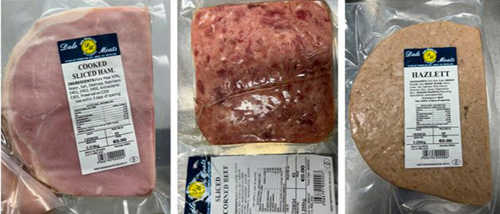
Recall of Dale Meats Cooked Sliced Ham, Hazlett and Sliced Corned Beef, due to the possible presence of Listeria monocytogenes.
Alert Summary dated Tuesday, September 3rd, 2024.
Category 1: For Action. Alert Notification: 2024.40. Product Identification: Please see table below. Batch Code: All batch codes and all use-by dates up to and including 27/09/2024. Country Of Origin: Ireland.
Product Name (Retail Products).
Pack Size.
Use-by dates.
Dale Meats Cooked Sliced Ham
125g and 250g
Up to and including 27/09/2024
Dale Meats Hazlett
125g, 250g and 400g
Dale Meats Hazlett
125g, 250g and 400g
Product Name (Catering Products).
Pack Size.
Use-by dates.
Dale Meats Whole Gammons
Variable Weights.
Up to and including 27/09/2024
Dale Meats Half Gammons
Variable Weights
Dale Meats Cooked Sliced Ham
500g and 1 kg
Dale Meats Cooked Ham Whole
Variable Weights
Dale Meats Hazlett Whole
Variable Weights
Dale Meats Hazlett Half
Variable Weights
Dale Meats Sliced Hazlett
Variable Weights
Dale Meats Sliced Corned Beef
Variable Weights
Message: Dale Meats is recalling all batches of Cooked Sliced Ham, Hazlett and Sliced Corned Beef with a use-by date up to and including 27/09/2024, due to the possible presence of Listeria monocytogenes.
Nature Of Danger: Symptoms of Listeria monocytogenes infection can include mild flu-like symptoms, or gastrointestinal symptoms such as nausea, vomiting and diarrhoea. In rare cases, the infection can be more severe, causing serious complications. Some people are more vulnerable to Listeria monocytogenes infections, including pregnant women, babies, and people with weakened immune systems, including the elderly. The incubation period (time between initial infection and first symptoms appearing) is on average 3 weeks but can range between 3 and 70 days.
Action Required:
Wholesalers/distributors: Are requested to contact their affected customers and instruct them to recall the implicated batches and provide a point-of-sale recall notice to their retail customers. Caterers: Should not use the implicated batches. Retailers: Are requested to remove the implicated batches from sale and display recall notices at point-of-sale. Consumers: Consumers are advised not to eat the implicated batches.
Food Safety Authority of Ireland warn of incorrectly declared allergens in some Mayil products.
Alert Summary dated Friday, August 16th 2024
Allergy Alert Notification: 2024.A27 (Update 1) Allergens: Mustard, sesame seeds, fish and crustaceans Product Identification: Please see table below. Batch Code: All batch codes and all best before dates. Please see table hereunder. Country Of Origin: India
Product name.
Pack size.
Allergen(s) ingredient.
Mayil Vaduka Puli Pickle.
400g.
Mustard and sesame seeds.
Mayil Cut Mango Pickle.
1kg.
Mustard and sesame seeds.
Mayil Uluva Nellicka.
300g.
Mustard and sesame seeds.
Mayil Hot and Sweet Lime Pickle.
400g.
Mustard and sesame seeds.
Mayil Dry Chilly Chutney.
400g.
Sesame seeds.
Mayil Prawn Chutney Powder.
200g.
Crustaceans.
Mayil Uluva Mango.
300g.
Mustard.
Mayil Tender Mango Pickle.
400g.
Mustard and sesame seeds.
Mayil Fish Chutney.
200g.
Fish and sesame seeds.
Mayil Kaduku Mango Pickle.
400g.
Mustard and sesame seeds.
Mayil Crushed Chilly Chutney with Prawn.
200g.
Crustaceans and sesame seeds.
Mayil Prawn Pickle 400g.
400g.
Crustaceans, mustard and sesame seeds.
Mayil Lemon Pickle
400g.
Mustard and sesame seeds.
Mayil Bitter Gourd Pickle
400g.
Sesame seeds.
Mayil Bitter Gourd Pickle (Home Made)
200g.
Sesame seeds.
Message: Further to FSAI food allergen alerts 2024.A27 and 2024.A28, the affected Mayil products listed in the table below contain certain allergens which are incorrectly declared on the label. This may make the batches unsafe for consumers who are allergic to or intolerant of mustard, sesame seeds, fish and/or crustaceans.
Food Safety Authority warn of recall of batch of Kombucha Na Dálaigh due to an elevated alcohol level.
Alert Summary dated Thursday, 15 August 2024
Category 1: For Action Alert Notification: 2024.38 Product Identification: Kombucha Na Dálaigh Sláinte Turmeric, Ginger & Honey; pack size: 330ml, and Kombucha Na Dálaigh Sú Mara Carrageen Moss & Berry; pack size: 330ml Batch Code: 01L; best before: 02/2025 Country Of Origin: Ireland
Message: The above batch of Kombucha Na Dálaigh is being recalled due to an elevated alcohol level. Alcohol is not declared on the label of this product.
This website uses cookies to improve your experience. We'll assume you're ok with this, but you can opt-out if you wish.AcceptRead More
Privacy & Cookies Policy
Privacy Overview
This website uses cookies to improve your experience while you navigate through the website. Out of these, the cookies that are categorized as necessary are stored on your browser as they are essential for the working of basic functionalities of the website. We also use third-party cookies that help us analyze and understand how you use this website. These cookies will be stored in your browser only with your consent. You also have the option to opt-out of these cookies. But opting out of some of these cookies may affect your browsing experience.
Necessary cookies are absolutely essential for the website to function properly. This category only includes cookies that ensures basic functionalities and security features of the website. These cookies do not store any personal information.
Any cookies that may not be particularly necessary for the website to function and is used specifically to collect user personal data via analytics, ads, other embedded contents are termed as non-necessary cookies. It is mandatory to procure user consent prior to running these cookies on your website.







Recent Comments