The Irish Competition and Consumer Protection Commission (CCPC) confirmed today that since last year the prices of some agricultural products such as meat and dairy have risen considerably here in Ireland, compared to prices in the rest of the European Union. The CCPC had come to that conclusion having undertaken an investigation into the grocery retailer sector and finding that there is no evidence indicating any issues regarding competition among retailers, in terms of food prices.
The CCPC Commission further confirmed that consumers had seen a 27% rise in grocery prices, in the past 4 years, but prices remained well below the average EU increase of 35%.
I wonder did the CCPC observe the difference in butter prices?Let us take a peep.
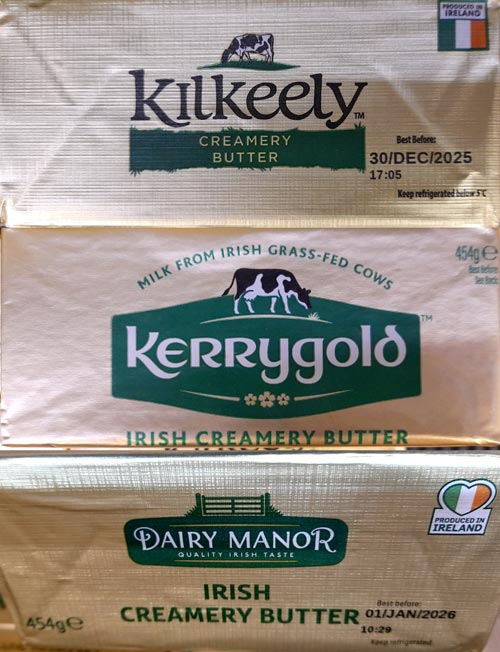
Let us take a look at what Irish Butter, bearing the IE 1024 EC tag “Made From Irish Grass-Fed Cows”, wrapped in similar gold foil, contains in the table shown hereunder. Note: “IE 1024 EC” refers to the identification mark used on food products in Ireland (IE) that meet specific European Union (EU) regulations. The no. “1024” is the unique approval number assigned to a particular food establishment in Ireland. “EC” signifies that the product was processed within the European Community.
Butter Brand & Quantity.
Price & Quantity.
Energy.
Fat/ Saturates.
Carbohydrates.
Sugars.
Protein.
Salt.
Kilteely. 454g.
€3.99/€4.00.
3034kj/738kcal
81g/51.7g
1.9
0.6g
0.2g
1.5g
Kerrygold. 454g.
€5.49/€5.50.
3059kj/744kcal,
80g/53g
0.6g
0.6g
0.6g
1.8g
Dairy Manor.454g.
€3.99/€4.00
3034kj/737kcal
81g/51.7g
1.9
0.6g
0.2g
1.62
Question:So what is the difference between one brand and another? Answer:€1.50 in price and little else. Also notice the healthier product, with less salt, is €1.50 cheaper.
Maybe someone can contact me to explain, what I regard as a massive price anomalyfor nothing extrafor consumers.
While I am on the subject of prices; coins valued at 1 cent and 2 cent while still remaining legal tender in Ireland, are being phased out of general circulation due to the high cost of minting them. Since 2015, a “rounding” system for cash transactions has been in place, with total amounts rounded to the nearest 5 cents. When will we stop our supermarkets pricing goods, like butter as being €3.99, while only accepting €4.00 for such products? This “rounding” as it is called, only applies to cash transactions and does not apply to payments made by card or other electronic methods.
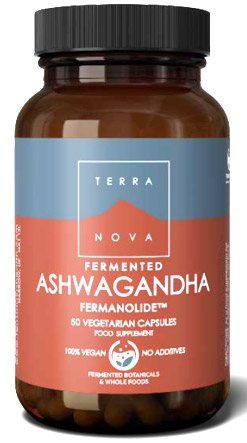
Food Safety Authority of Ireland warn of undeclared peanut in a batch of Terranova Fermented Ashwagandha food supplement.
Alert Summary dated Wednesday, August 6th 2025.
Allergy Alert Notification: 2025.A29 Allergen: Peanut Product Identification: Terranova Fermented Ashwagandha food supplement; pack size: 50 capsules Batch Code: 2400881; best before date: 05/2028 Country Of Origin: United Kingdom
Message: The above batch of Terranova Fermented Ashwagandha food supplement contains peanut which is not declared on the label. This may make the batch unsafe for consumers who are allergic to or intolerant of peanuts, and therefore, these consumers should not eat the implicated batch.
Food Safety Authority of Ireland recall a batch of Tom & Ollie Traditional Hummus, due to the possible presence of Listeria monocytogenes.
Alert SummaryTuesday, 05 August 2025.
Category 1: For Action. Alert Notification: 2025.38 Product Identification: Tom & Ollie Traditional Hummus; pack size: 150g Batch Code: VG189; use by date: 08/08/2025 Country Of Origin: United Kingdom
Message: The above batch of Tom & Ollie Traditional Hummus is being recalled due to the possible presence of Listeria monocytogenes. Recall notices will be displayed at point-of-sale. There is currently no evidence that this food recall is linked with the listeriosis outbreak related to ready-to-heat meals or the recall of spinach and mixed leaves products. Please see this News Article.
Nature Of Danger: Symptoms of Listeria monocytogenes infection can include mild flu-like symptoms, or gastrointestinal symptoms such as nausea, vomiting and diarrhoea. In rare cases, the infection can be more severe, causing serious complications. Some people are more vulnerable to Listeria monocytogenes infections, including pregnant women, babies, and people with weakened immune systems, including the elderly. The incubation period (time between initial infection and first symptoms appearing) is on average 3 weeks but can range between 3 and 70 days.
Action Required: Manufacturers, Wholesalers, Distributors, Caterers & Retailers: Retailers: Same are requested to remove the implicated batch from sale and display recall notices at point-of-sale. Wholesalers/Distributors: Same are requested to contact their affected customers and recall the implicated batch and provide a point-of-sale recall notice for their customers. Caterers: Same should not use the implicated batch. Consumers: Consumers are advised not to eat the implicated batch.
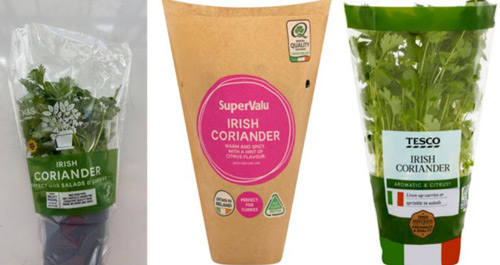
Food Safety Authority Of Ireland Recall O’Hanlon Herbs Potted Coriander.
Recall of various brands of O’Hanlon Herbs Potted Coriander due to possible presence of Listeria monocytogenes
Alert Summary dated August 5th, 2025.
Category 1: For Action Alert Notification: 2025.39 Product Identification: Please see table below. Batch Codes: Please see table below. Country Of Origin: Ireland
Message: The below branded potted coriander products are being recalled by O’Hanlon Herbs due to the possible presence of Listeria monocytogenes. Recall notices will be displayed at point-of-sale in affected stores.
Nature Of Danger: Symptoms of Listeria monocytogenes infection can include mild flu-like symptoms, or gastrointestinal symptoms such as nausea, vomiting and diarrhoea. In rare cases, the infection can be more severe, causing serious complications. Some people are more vulnerable to Listeria monocytogenes infections, including pregnant women, babies, and people with weakened immune systems, including the elderly. The incubation period (time between initial infection and first symptoms appearing) is on average 3 weeks, but can range between 3 and 70 days.
Action Required:Manufacturers, Wholesalers, Distributors, Caterers & Retailers: Retailers: Same are requested to remove the implicated batches from sale and display recall notices at point-of-sale. Consumers: Consumers are advised not to eat the implicated batches.
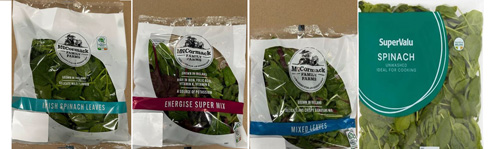
UPDATE (3) to recall of various branded Spinach and Mixed Leaves products produced by McCormack Family Farms, due to the detection of Listeria monocytogenes.
Alert Summary dated Saturday, 02 August 2025.
Category 1: For Action Alert Notification: 2025.35 (Update 3) Product Identification: Please see table below. Batch Code: Please see table below. Country Of Origin: Ireland
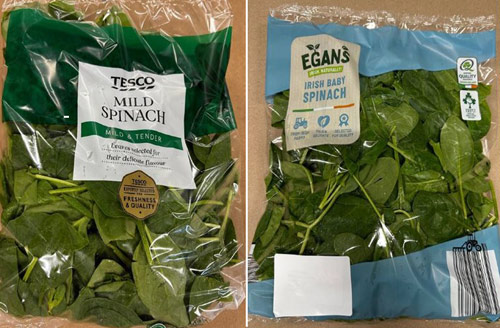
Message: Further to Food Alert 2025.35 and 2025.35 (Update 1) and 2025.35 (Update 2), the below additional batches of Spinach are being recalled due to the detection of Listeria monocytogenes. Recall notices will be displayed at point-of-sale in stores.
NOTE: There is currently no evidence that this food recall is linked with the listeriosis outbreak related to ready-to-heat meals that is currently under investigation. Please see this News Article.
Product Name.
Pack Sizes.
Best Before Dates / Batch Codes.
Egan’s Irish Baby Spinach.
250g.
Best before dates: 30/07/2025, 31/07/2025, 01/08/2025; Batch code: 206.
McCormack Family Farms Lettuce.
200g
Best before dates: 02/08/2025, 03/08//2025, 09/08/2025, 10/08/2025; Batch codes: 205, 212.
McCormack Family Farms Mixed Leaves.
75g.
Best before dates: 26/07/2025, 27/07/2025, 29/07/2025, 31/07/2025, 01/08/2025, 02/08/2025, 03/08/2025; Batch codes: 199, 202, 204, 205, 206, 207
McCormack Family Farms Rocket.
75g.
Best before dates: 31/07/2025, 03/08/2025; Batch codes: 204, 206,
McCormack Family Farms Spinach,
100g, 200g & 250g.
Best before dates: 01/08/2025, 02/08/2025, 03/08/2025, 04/08/2025; Batch codes: 205, 206, 207,
McCormack Family Farms Energise Mix.
100g.
Best before dates: 28/07/2025, 29/07/2025, 30/07/2025, 03/08/2025; Batch codes: 199, 203, 205.
SuperValu Spinach.
250g.
Best before dates: 01/08/2025, 03/08/2025; Batch code: 206.
Tesco Mild Spinach.
350g
Best before date: 02/08/2025; Batch code: 206
Nature Of Danger: Symptoms of Listeria monocytogenes infection can include mild flu-like symptoms, or gastrointestinal symptoms such as nausea, vomiting and diarrhoea. In rare cases, the infection can be more severe, causing serious complications. Some people are more vulnerable to Listeria monocytogenes infections, including pregnant women, babies, and people with weakened immune systems, including the elderly. The incubation period (time between initial infection and first symptoms appearing) is on average 3 weeks but can range between 3 and 70 days.
Action Required:Manufacturers, Wholesalers, Distributors, Caterers & Retailers: Retailers: Same are requested to remove the implicated products from sale and display recall notices at point-of-sale. Wholesalers/Distributors: Same are requested to contact their affected customers and recall the implicated products and provide a point-of-sale recall notice to their retailer customers. Caterers: Same should not use the implicated products. Consumers: Consumers are advised not to eat the implicated products.
This website uses cookies to improve your experience. We'll assume you're ok with this, but you can opt-out if you wish.AcceptRead More
Privacy & Cookies Policy
Privacy Overview
This website uses cookies to improve your experience while you navigate through the website. Out of these, the cookies that are categorized as necessary are stored on your browser as they are essential for the working of basic functionalities of the website. We also use third-party cookies that help us analyze and understand how you use this website. These cookies will be stored in your browser only with your consent. You also have the option to opt-out of these cookies. But opting out of some of these cookies may affect your browsing experience.
Necessary cookies are absolutely essential for the website to function properly. This category only includes cookies that ensures basic functionalities and security features of the website. These cookies do not store any personal information.
Any cookies that may not be particularly necessary for the website to function and is used specifically to collect user personal data via analytics, ads, other embedded contents are termed as non-necessary cookies. It is mandatory to procure user consent prior to running these cookies on your website.



Recent Comments