The Blink Outdoor 4, a wireless HD smart security camera with a two-year battery life and IP65 weatherproof rating, has to stands out this Black Friday as one of the most compelling home-security bargains online. With this 2-camera system bundled with the Sync Module Core, now reportedly reduced by around 59%, the value proposition is hard to ignore.
In a season when home burglaries tend to rise, particularly over darker winter evenings and especially around Christmas, when homes may be unoccupied or gifts visible through windows, investing in reliable external surveillance is increasingly prudent.
Long battery life & low maintenance: Blink claims up to two years on two AA lithium batteries, a rare advantage among battery-powered outdoor cameras. Hassle-free, wireless installation: The wireless design avoids messy complicated wiring, making it easy for homeowners to place cameras where they are most needed. Weather resistance & durability: With IP65 rating, Blink Outdoor 4 is built to withstand rain, wind, and cold, essential for Irish winter conditions. Good video quality & effective motion detection: Users in the Thurles area report satisfactory 1080p HD video and reliable motion-activated alerts.
Local storage option (no mandatory subscription): The included Sync Module Core allows for local USB storage, (latter not included but can be purchased cheaply HERE) giving homeowners control over their surveillance footage without needing to pay for a cloud plan.
Why this deal matters, especially now: With many discounts across the board this Black Friday, the steep reduction in price makes Blink Outdoor 4 a very attractive entry point for homeowners seeking upgraded security, especially for those living alone, in a period where opportunistic burglaries tend to increase. The balance of ease of installation, decent video quality, weather-proofing and low maintenance makes it a very sound choice for people who want visible deterrence and peace of mind, without investing in a fully wired CCTV system.
Given the current price drop, this looks very much like one of the “best deals online” for outdoor, battery-powered home-security cameras.
Tipperary County Council has rolled out a range of free-parking initiatives across multiple large towns in the county in the run-up to Christmas 2025. The aim is to support local retailers and encourage festive shopping.
Thurles Town – Free Parking Offer.
In Thurles Town: courtesy of Thurles Municipal District Councils administration (signed off on by Ms Sharon Scully), free parking will be available only for the first 30 minutes every day, (Fifteen minutes more than every ordinary) every day, throughout December 2025. Additionally, all council-owned car parks will provide free parking on the following Saturdays: 6th, 13th and 20thDecember2025. As it stands currently, it is important to note that three out of the town’s six main car parks will likely remain closed for this busy season, namely the car park beside the former Munster Hotel, (a long-standing resource for shoppers, parishioners and students); the car park underneath The Source building, (latter now closed for 3 years) and the new Market Area car park, beside The Source, (the upgrading of which has suffered serious delays). So, no concessions on the busy three days prior to December 25th. This limitation significantly undermines the stated objective of boosting local trade and enabling easy access to town centre shops.
Comparison With Other Tipperary Towns: Tipperary Town: Same offers one hour of free on-street parking each day, and unlimited free parking in all council car parks for December 2025. Roscrea: Same will have free parking throughout their towns every Saturday in December. Templemore: Same will have free parking throughout their town every Saturday in December. Clonmel Borough District: All council-owned car parks will have free parking on each Saturday in December, after 10am. The town also has a car park in Suirside which is free all year round and which will also be available for Christmas shoppers. Cashel Town: Same will also offer free parking in all council-owned car parks on Saturdays throughout December. Cahir Town: Same will also offer free parking in all council-owned car parks on Saturdays throughout December. Carrick-on-Suir Town: There will be free parking in all of the council-owned car parks on each Saturday throughout the month of December. Finally, in Nenagh Town: Here there will be three hours free parking in all council-owned car parks from Saturday December 6th, until Friday December 26th 2025. On-street parking will remain subject to ‘pay-and-display’.
Disparity Between Thurles and Tipperary Town: The differential treatment between Thurles and Tipperary Town, in particular, is stark and concerning: In Tipperary Town, shoppers benefit from unlimited free car-park access, plus one hour of free on-street parking, offering real convenience to those visiting the town centre.
In contrast, Thurles’ offer is limited to just 30 minutes free daily, and only on three Saturdays in December, while simultaneously reducing the supply of parking spaces by possibly having three of its main car parks closed. This severely undermines the town’s capacity to attract and accommodate shoppers.
Question: So where in this scenario are our Local elected Municipal District Councillors and our Thurles Chamber of Commerce.Thurles businesses no longer has a voice.
Given that the declared purpose of the initiative is to “promote local trade and encourage support for Town Traders during the festive season,” this disparity highlights an inequality in how different towns within the county are supported. Oh and by the way there is little on-street parking in Thurles town centre since over 60% was removed following it beings half upgraded.
Call for Review & Equal Treatment. We call on Tipperary County Council to reconsider the parking allocations for Thurles, especially in light of the closure of significant car parks, thus ensuring that the town receives a level of support comparable to other towns such as the afore mentioned Tipperary Town.
Failing to address this inequity risks undermining the very objective of stimulating local commerce in Thurles during what should be one of the busiest trading periods of the year.
Thurles Bypass confirmed in the updated NDP today, a major step forward.
Major Step Forward as Project Enters Pre-Approval Stage Under Government’s Updated Framework.
Now classed as a priority project, it will advance through design & planning, with a push to be construction-ready by 2030.
The long-awaited Thurles Outer Bypass has been formally included in the revised National Development Plan (NDP), announced today, November 26th, 2025. The confirmation marks a significant milestone for the town of Thurles and the wider mid-Tipperary region, placing the long-discussed project back onto the national agenda and ensuring it will now advance through the required planning and design phases.
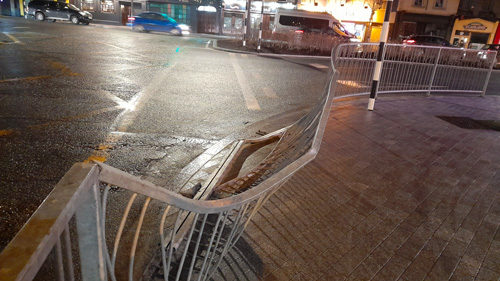
Damage caused on a regular basis by heavy goods vehicles. Pic: G. Willoughby.
Project Confirmed Under Appendix A of the National Development Plan. According to today’s announcement, the Thurles Bypass is listed within Appendix A of the NDP and designated to progress through the Pre-Approval / Gateway 1 stage. However, this represents only the first formal step in the Government’s project-delivery process, enabling detailed assessment, updated design work, and the preparation of a preliminary business case. The scheme is viewed as essential to addressing long-standing congestion and safety concerns, as well as supporting the town’s commercial and residential development.
Damage caused on a regular basis by heavy goods vehicles. Pic: G. Willoughby.
Associated Road Projects Also Advancing. Today’s publication confirms that the Thurles Bypass will sit alongside other significant transport projects for the area, including:
Thurles Inner Relief Road.
Local realignment schemes intended to improve connectivity and traffic flow.
Additional regional investments aimed at strengthening transport infrastructure across County Tipperary.
These projects combined form an integrated approach to improving mobility, safety, and economic prospects for Thurles town and surrounding areas.
Next Steps: Planning, Design and Approvals: While the Thurles bypass’s inclusion in the NDP does not indicate an immediate start to construction, it does secure its place within the Government’s investment programme through to 2030. The project will now move into:
Updated design and engineering work.
Preparation of statutory documents.
Preliminary business case development.
Environmental and route-corridor assessments.
Progression through further Government approval gates.
List of Strategic Regional Road Projects Scheduled to Commence Construction by 2030.
Project.
Sponsoring Agency.
Current Stage of Project Lifecycle.
Next Approval Gate.
Procurement Timeline.
Construction Timeline.
Successful Tenderer.
Cost Range.
Thurles Inner Relief Road.
Tipperary County Council
Final Business Case
AG1
Procurement by 2026
Commence by 2027
Not yet awarded
€10m- €20m
Appendix A. Thurles Bypass.
Various
Pre-AG1
AG1
?
?
?
?
See table above: “There’s many a slip ‘twixt the cup and the lip.”King Ancaeus of Samos.
It is now important, unlike in the past, that local representatives, at all levels, emphasise their intention to push for tangible, measurable progress on this project, so that the scheme can be construction-ready by 2030.
A Long-Awaited Boost for Thurles. The bypass is widely regarded as a crucial infrastructure project for Thurles. Heavy traffic, including a high volume of HGVs, currently passes through the town centre, particularly in Liberty Square where national routes intersect. Business groups, residents, and community organisations have repeatedly highlighted the impact on safety, air quality, congestion, and commercial activity.
Today’s confirmation is seen as the first real movement on the project in many years, following earlier plans which stalled during the economic downturn.
The introduction of new legislation allowing consumers to exit mobile and broadband contracts in the event of price hikes is a welcome and long-overdue step. For years, customers have faced routine annual increases, often quietly applied and seldom explained, leaving households paying more for the same level of service.
However, while this new move addresses unfair price rises, it fails to tackle an equally serious issue: with providers continuing to charge full price even when their services are down for extended periods. Across the country, customers routinely experience outages lasting hours or even several days, yet no automatic refunds or meaningful compensation are offered.
This situation is unacceptable. It is fundamentally unfair that consumers are expected to honour their contracts in full when providers do not honour theirs. Reliable service is not a luxury; it is an essential utility, particularly for families working from home, students relying on online learning, and older people depending on digital communication.
Mobile and broadband companies have for too long enjoyed strong profits while delivering inconsistent service, placing the burden on customers who often have little choice of an alternative provider. A voluntary refund system is not good enough.
Regulators and the Irish Government must now go further by compelling providers to:
Introduce automatic compensation for outages, without requiring customers to chase refunds.
Publish clear service-level commitments, including timelines for restoring faults.
Be held accountable for persistent service failures, with penalties for repeated non-compliance.
While this new legislation empowers consumers to walk away from unfair price increases, it is only one part of a wider problem. True consumer protection requires not just the right to leave a contract, but assurance that the service being paid for is delivered reliably and responsibly.
It is time to hold mobile and broadband providers to a higher standard. Irish customers deserve no less.
An Garda Síochána is advising all retailers across Tipperary, and further afield, to be extra vigilant following the seizure of 3,695 counterfeit €50 notes in a Dublin 8 operation, with a face-value of €184,750.
The seized notes are now being examined by the Garda National Technical Bureau. While no arrests have yet been made, investigations into organised criminal networks are ongoing.
Key Advice for Retailers: (1) Use the “Feel-Look-Tilt” test to check banknotes. (2) Be alert to customers using large-denomination notes for small purchases, a common tactic used to get real change back. (3) If you suspect a note is fake, retain it safely (don’t return it to the customer), and call your local Garda station. (4) Report any counterfeits immediately, not only €50 notes, but all euro denominations.
Why This Matters: Counterfeit notes can inflict significant losses, especially on smaller businesses. By staying alert and following simple checks, staff can help prevent fraud and protect both their business and customers.
This website uses cookies to improve your experience. We'll assume you're ok with this, but you can opt-out if you wish.AcceptRead More
Privacy & Cookies Policy
Privacy Overview
This website uses cookies to improve your experience while you navigate through the website. Out of these, the cookies that are categorized as necessary are stored on your browser as they are essential for the working of basic functionalities of the website. We also use third-party cookies that help us analyze and understand how you use this website. These cookies will be stored in your browser only with your consent. You also have the option to opt-out of these cookies. But opting out of some of these cookies may affect your browsing experience.
Necessary cookies are absolutely essential for the website to function properly. This category only includes cookies that ensures basic functionalities and security features of the website. These cookies do not store any personal information.
Any cookies that may not be particularly necessary for the website to function and is used specifically to collect user personal data via analytics, ads, other embedded contents are termed as non-necessary cookies. It is mandatory to procure user consent prior to running these cookies on your website.










Recent Comments