Thurles is to receive €150,000 towards plans for an age-friendly community fitness hub, as part of new regeneration funding for North Tipperary.
The available Thurles funding report does not specify the proposed Thurles age-friendly community fitness hub’s exact location or identify who submitted the funding application. {Some unconfirmed reports suggest it refers to the existing open air fitness hub already in the town park.}
Liberty Square, Thurles.
A further €130,000 has been allocated to Nenagh to progress plans to extend St John’s Lane car park and provide pedestrian access onto Sarsfield Street. We understand, Tipperary County Council has already acquired the lands needed for this Nenagh project. The funding will support the next stages of design and development.
The combined €280,000 allocation for Thurles and Nenagh forms part of nearly €13.5 million announced for Tipperary under the Towns and Cities Regeneration Investment Fund.
Clonmel will receive €13.1 million for two town centre regeneration projects, while Tipperary County Council is to provide €3.25 million in matched funding for the county’s projects.
Nationally, the fund will support 120 projects across every local authority area, with total investment of €409 million.
Tusla chief executive Ms Kate Duggan has warned that a levy on the agency’s 2027 budget could increase risks for vulnerable children and families by restricting services during rising demand. The Irish Times reports that officials informed Tusla of its inclusion in May.
The reason is a wider government savings policy. Departments have been instructed to deliver €446 million in efficiencies and reforms in 2027 to offset part of the previous year’s overspending. The Government has promised protection for some spending areas, including infrastructure, social protection and social housing supports.
The Department of Children faces a €42 million levy across its budget. Tusla’s individual contribution is not specified in the reporting.
Ms Duggan disputes the fairness of including the agency, saying it has controlled pay and staffing expenditure and already delivered savings. She described Tusla as being “penalised for overruns in other sectors”. The reporting does not establish that Tusla was selected because of financial mismanagement, or explain why it has not been exempted.
What services are at stake? Tusla’s responsibilities include:
Child protection and welfare, including responses to abuse and neglect.
Foster care, residential care, special care and aftercare.
Family support, early intervention, parenting support and counselling.
Above are examples of Tusla’s services, not a confirmed list of cuts. No specific service closures, staffing reductions or affected locations are identified in the earlier report.
The Department of Children says negotiations aim to achieve savings without cutting Tusla’s services and supports. Ms Duggan’s warning raises a clear question for Budget 2027; how will those protections be delivered while meeting the levy?
Irish Political Pay, Expenses And Official Cars; What the Published Figures Show.
Ireland’s published salary rates put annual gross pay for the Taoiseach at €256,311, the Tánaiste at €236,427, and a Cabinet minister at €217,136.
Position.
Published Annual Gross Pay.
Ceann Comhairle. (Head of Council – Dail Speaker)
€268,522.
Taoiseach,
€256,311.
Tánaiste.
€236,427.
Cabinet Minister.
€217,136.
Minister of State attending Cabinet.
€181,573.
Minister of State.
€167,759.
Ordinary TD.
€119,467.
These figures above include the basic TD salary and any salaried allowance attached to the listed office. They are before tax and deductions.
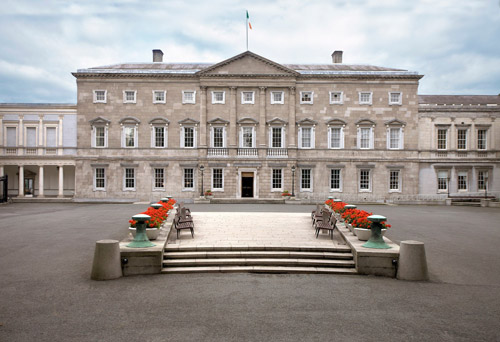
Leinster House.
Constituency and representation expenses are additional. Ordinary TDs can claim up to €20,350 annually, while ministers and ministers of state can claim up to €16,000. These allowances cover eligible work expenses, such as constituency office costs, and are subject to certification and audit. Unspent representation allowances must be repaid.
Ordinary TDs also have a travel and accommodation allowance ranging from €9,000 to €34,065, depending on the distance between their home and Leinster House and supposedly subject to attendance requirements. Ministers and Ministers of State cannot claim this allowance.
At the full allowance amounts, an ordinary TD’s salary plus these expenses totals €148,817 to €173,882 annually. A Cabinet minister’s salary plus the maximum representation allowance totals €233,136, before other eligible expenses or State-funded services. These combined amounts include money allocated for work costs.
Official transport adds a separate public cost. Freedom Of Information (FOI) reporting published on June 3rd, 2026, put the Ministerial Car Service’s cost for the preceding year at approximately €8.4 million, covering the Taoiseach, Tánaiste, ministers and other officeholders.
The reported breakdown was: ► €7.67 million for Garda driver salaries. ► €311,000 for fuel. ► €436,000 for maintenance.
The fleet contained 52 vehicles: 25 diesel vehicles, 25 plug-in hybrids and two fully electric vehicles. Purchase and disposal prices requested in that release were withheld on commercial confidentiality grounds. Certain security-related information was also withheld under Freedom of Information protections.
The available figures do not establish a complete salary, expenses, car and security total for each individual politician. The €8.4 million is a shared transport service cost; it cannot reliably be divided equally between ministers or described as their personal earnings.
An ordinary Irish TD earns €69,467 more per year than an average worker on €50,000; approximately 139% more, or 2.39 times as much. [As already stated the published basic TD salary is €119,467 annually, before tax and deductions.]
Gross Pay Comparison
Irish Worker
Ordinary TD
TD earns extra
Annual.
€50,000.
€119,467.
€69,467.
Monthly equivalent.
€4,166.67.
€9,955.
€5,788.92.
So for every €1 the worker earns, a TD earns approximately €2.39. The above compares only basic salaries. It excludes expense allowances and additional pay for holding office; the difference in take-home pay would depend on tax and other deductions.
Also take into account the €119,467 figure earned, is the TD’s own gross annual salary. It does not include the salaries of constituency staff, parliamentary assistants, private secretaries or ministerial advisers. Under the Oireachtas Scheme for Secretarial Assistance, TDs may employ an administrative assistant and either a parliamentary assistant or use the Special Secretarial Allowance. This support is separate from their personal salary.
Ministers have additional staffing arrangements. Private secretaries and ministerial office staff appear in departmental staffing accounts, while special advisers have their own contracts and pay arrangements. These ministerial roles are not an entitlement of every ordinary TD. My earlier €148,817–€173,882 salary-plus-expenses range also excluded separately funded staff salaries. It was therefore not the full taxpayer cost of supporting a TD’s work.
The comparison with a worker earning €50,000 remains a personal salary comparison; a TD earns approximately 139% more before tax. Staff costs would increase the cost to the State, rather than the TD’s personal earnings.
Fianna Fáil Senator Ms Imelda Goldsboro received €16,779 in travel and accommodation allowances in 2026 during an eight-month absence, through serious illness, according to an Irish Times report published today, 11th September 2026.
Ms Goldsboro said she continued working in Tipperary and while in hospital. Fianna Fáil subsequently said she was engaging with the Oireachtas to ensure her records and payments were accurate.
Ms Goldsboro’s political career includes serving on Tipperary County Council for the Carrick-on-Suir area from May 2014 until February 2025. She unsuccessfully contested the Tipperary constituency in the 2020 general election, Tipperary South in the 2024 general election, and the Agricultural Panel in the 2025 Seanad election. She also served on the South East Regional Drug and Alcohol Task Force. She became a senator in February 2025 last, following her nomination by An Taoiseach Mr Micheál Martin.
Following Ms Goldsboro’s appointment to the Seanad, her daughter Ms Amy Goldsboro, then 21 years of age, won a Fianna Fáil selection convention and was subsequently co-opted unto her mother’s vacant seat on Tipperary County Council, representing the Carrick-on-Suir area.
Travel and accommodation allowance payments continue automatically unless the member gives written instructions to stop them, according to an Irish Times report.
Oireachtas rules allow medically certified illness to be considered when assessing attendance requirements.
Why electricity prices are increasing from 9th October.
Bord Gáis Energy has announced electricity price increases from 9th October, pointing to two main reasons:-
Sustained increases in energy supply costs: The company says rising costs of supplying electricity are driving the price changes.
Ongoing volatility in global energy markets: Continued fluctuations in international energy markets are adding pressure to supply costs.
Bord Gáis Energy says these factors are outside its control and that its teams worked to avoid passing on the increases.
So what will change?
Electricity unit rates will increase by 9.1%.
Electricity standing charges will increase by 7.2%.
An average electricity bill will rise by an estimated €14.75 per month, equivalent to €177.00 per year.
The company acknowledges the pressure this will place on customers and says it will continue doing everything it can to limit the impact of rising costs.
The new rates will apply to bills from 9th October. Your plan contract discount and contract end date will remain unchanged, where applicable.
This website uses cookies to improve your experience. We'll assume you're ok with this, but you can opt-out if you wish.AcceptRead More
Privacy & Cookies Policy
Privacy Overview
This website uses cookies to improve your experience while you navigate through the website. Out of these, the cookies that are categorized as necessary are stored on your browser as they are essential for the working of basic functionalities of the website. We also use third-party cookies that help us analyze and understand how you use this website. These cookies will be stored in your browser only with your consent. You also have the option to opt-out of these cookies. But opting out of some of these cookies may affect your browsing experience.
Necessary cookies are absolutely essential for the website to function properly. This category only includes cookies that ensures basic functionalities and security features of the website. These cookies do not store any personal information.
Any cookies that may not be particularly necessary for the website to function and is used specifically to collect user personal data via analytics, ads, other embedded contents are termed as non-necessary cookies. It is mandatory to procure user consent prior to running these cookies on your website.






Recent Comments