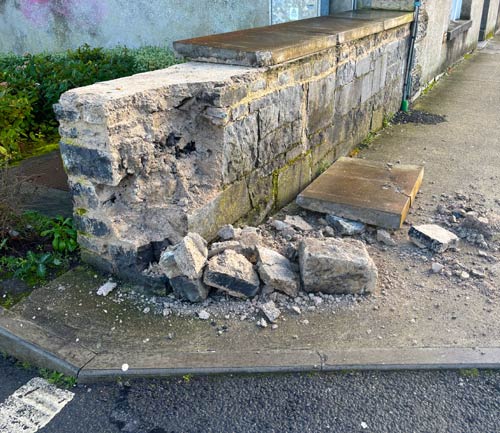
It started, as these things always do, with a local lad who had no reason to tell fibs, and every reason to be believed, because he said it with absolute conviction while pointing at the pile of rubble like he’d personally witnessed the fall of the ancient walls of Jericho.
“It was a pigeon,” he announced, solemn as a coroner. “Not your regular one either. Low-flying it was, doing eighty, like a feathery meteor.”
With the New Thurles Car Park entrance now widened, locals will also have noticed that the centre island/median at the mouth of the entrance has, for some time passed, also been demolished, leaving a cleaner, straighter run at the target.
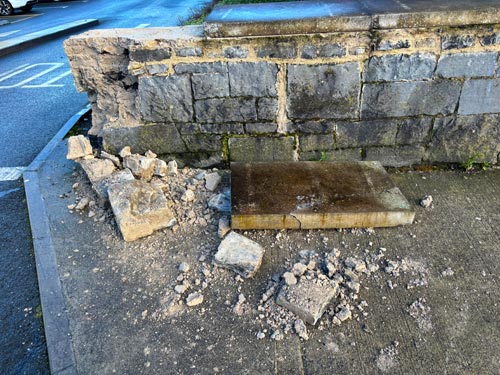
Now, anyone with a bit of sense would have laughed, but the trouble was, the scene had the exact energy of a freak incident. The corner of the wall looked as if it had been clipped by something with intent. The slabs were splayed out like dominoes and there, faintly, on the remaining stone, was a dusty smear that could’ve been… anything. Cement, chalk, or, if you were inclined toward truth, pigeon ‘powder’.
The lad described it in detail, because once a man says “eighty,” he most certainly owes you a full reconstruction.
He’d been walking past with a breakfast roll, half thinking about nothing, when the air changed, that strange hush you get before something ridiculous happens. Then he heard it: a sound like a wet umbrella opening in a gale, followed by a “thwack” so crisp it could’ve been a cue in a slapstick film.
And out of the morning light came that pigeon; not flapping so much as committing to the air. Wings tucked. Head down. The posture of a creature that had made a decision and was seeing it through kamikaze style, consequences be damned. It skimmed the footpath at shin height, missing a drainpipe by inches, before striking the corner of the wall, with the confidence of something that had fully comprehensive insurance.
There was a split second of silence, then the wall gave a small, offended cough before the corner exploded. A puff of dust. A clatter of stone. Bits of dry mortar letting go. The slab on top shifted with a slow, dramatic slide, not fast, but certain, the way a decision, finally made, gathers momentum.
The pigeon, according to the lad, didn’t even look back. It hit, rebounded slightly, before landing on the path with a soft, insulting plop. It shook itself once, the way a dog shakes off rain, except this was more like a boxer loosening his shoulders after a solid clean punch, and then it waddled away. Yes, waddled. Not stumbled. Not fled. Not panicked. It waddled away with the leisurely swagger of a creature heading to a meeting that it was already late for, as if collapsing masonry was just part of its morning routine.
A split second of silence, then the wall gave a small, offended cough, before the corner exploded.
Our lad swore there was a moment of eye contact too, the pigeon looking at him with one eye, giving him that sideways judgement look, which sent a message; “You saw nothing”.
He tried, naturally, to tell people immediately. But you can’t just say “pigeon doing eighty” without consequences. The first person he told laughed so hard they nearly swallowed their Voopoo Vape. The second person said, “It was probably a van.” The third said, “That wall’s been in a bad way for years. Sure they forgot to add water to the cement”
And that was the thing, the wall had been in a bad way. Everyone knew it. Old stone, dry mortar, a corner that had taken a full two years of weather and knocks from the occasional careless wheelie bin. So the sceptics had an easy explanation. But the lad had his own, far more convincing logic, “A van would’ve left tyre marks,” he said. “A car would’ve stopped.”“A pigeon? A pigeon has no paperwork. No road tax, no NCT or comprehensive insurance details. No apology. It just flew off… gone.”
Soon the story grew legs, as stories do. Someone said the pigeon had been training, drafting behind Local Link buses, doing sprints off rooftops, building speed like an athlete. Another said it wasn’t a pigeon at all, others felt that this “grey blur,” was possibly a pigeon that had eaten something experimental behind a local chipper. A woman up the road claimed she’d seen a flock in formation earlier that week, flying like they were under command.
One fella, too confident by half, suggested it was an “urban falcon strike” until he was reminded falcons don’t waddle. And then, right when everyone had almost settled back into boring explanations, a child walked past, looked at the rubble and said: “That’s where the pigeon landed, isn’t it.” Because there, on the cleanest slab, plain as a signature, was a small white mark, ‘pigeon powder’. Not conclusive, not scientific, but deeply, spiritually… pigeonish.
By lunchtime today, the pigeon had become a local legend. People started blaming it for other things. A dent in their gate? (The pigeon). A missing wheelie bin? (The pigeon). A traffic cone mysteriously stuck up a tree? (The pigeon). A cracked phone screen? (Sure you know yourself). But our lad, he stayed firm, unwavering. “Eighty,” he’d repeat, as if defending a sworn statement. “Low-flying. Like a feathery meteor. It hit it and walked away.” He paused, then added the final detail, the one that made you almost believe him: “And the worst part is,” he said, “it looked disappointed the wall didn’t put up more of a fight.”
Pigeon or no pigeon, after today’s minor earthquake, the remaining wall line now matches neatly with the partially demolished left-hand side of the entry, giving the whole approach a more uniform look. In the spirit of getting it repaired properly, maybe it’s time to float a modest (and no doubt wildly popular) idea; another 5% on business rates ring-fenced specifically for repairs, which, no doubt would make this wall look like it was only built once, and had been actually done properly in the first instance.
Motorists are being urged to remain on high alert after reports of a fraudulent website impersonating the National Car Test (NCT) booking service, designed to mislead people into making payments without actually securing any test appointment.
This scam site has been reported as closely resembling the legitimate NCT booking pages and is understood to be appearing through search engine results, where drivers searching to book a test may be diverted to the counterfeit platform.
Recent reports indicate victims have been charged amounts ranging from approximately €60 up to €600 for what is presented as an “NCT booking” or “service fee”, but no valid booking is then made.
Only use the official NCT booking site. The only official and legitimate website for booking or managing an NCT appointment is: ncts.ie
Motorists are advised to type the address directly into their browser rather than clicking on sponsored links or unfamiliar results.
How to protect yourself – Key advice for motorists Book only via ncts.ie(avoid lookalike sites and “booking agents” charging extra fees). Check the web address carefully before entering any personal or payment details. Be cautious of sites that demand unexpected additional payments or apply pressure to pay quickly. If in doubt, leave the page and go directly to ncts.ie in a fresh browser window.
If you think you have been scammed! Anyone who believes they may have made a payment to a fraudulent site should act immediately: Contact your bank or card provider without delay to report the transaction and seek advice on stopping or disputing payment. Report the matter to your local Garda station, bringing any relevant evidence (screenshots, emails, transaction confirmations, and the web address used).
Derelict site levies: €26.3m outstanding nationwide as councils collect small fraction of charges.
Local authorities imposed levies of almost €8.6 million on the owners of 778 derelict sites nationwide last year, but collected less than 10% of the amount billed in-year, according to newly published figures.
A report published by the Department of Housing, Local Government and Heritage shows that €26.3 million was outstanding in respect of unpaid levies at the end of 2024, while 1,916 sites were recorded on the statutory derelict sites register.
Under the Derelict Sites Act, councils may apply a levy of up to 7%, and unpaid amounts accrue interest at 1.25% per month. The report also records a total of 2,869 notices or demands issued by local authorities under the legislation, with Cork City accounting for more than 10% of that total.
Limerick City and County Council issued 267 notices or demands, while Dublin City Council issued 245. No notices or demands were issued in Leitrim, while only two were issued in Wicklow, and six each in Donegal, Offaly and Sligo.
By county and city, Limerick recorded the highest number of derelict sites on the register (427), followed by Mayo (284), Cork City (158) and Dublin City (109). The lowest numbers were recorded in Wicklow (two) and County Galway (three).
The report indicates that €7.9 million was owed to Dublin City Council in respect of levies imposed under the Derelict Sites Act 1990, with a further €5.9 million owed in Cork City.
In terms of outcomes, issues were resolved and no further action was required in 566 cases following the issuance of notices or demands. The report also records five sites acquired by agreement and 126 acquired compulsorily.
Tipperary: local levies and revenue measures in 2025. We understand that in 2025, Tipperary County Council issued derelict site levy notices to the owners of 77 properties on the county’s Derelict Sites Register.
Levy Notices: In July 2025, the council prepared to issue levy notices to 77 property owners. These notices involve an annual levy amounting to 7% of the property’s market value. Derelict Sites Register: As of October 15th, 2025, the Tipperary Derelict Sites Register listed a total of 115 properties. This represents a significant increase from the 71 properties registered at the end of 2023. Recent Additions: In late 2025, 25 houses in the Glen Court Estate in Emly were added to the register on October 1st. Earlier in July 2025, 22 properties in Clonmel were added. Enforcement Actions: In addition to levies, the council issued legal letters to 84 site owners in early 2025 reminding them of their obligations to carry out remedial works. Total Official Demands: According to data presented in the Oireachtas in November 2025, the total number of sites in Tipperary for which a notice or demand under the Derelict Sites Act was issued (historically up to that point) was 140.
Uisce Éireann is to submit a Strategic Infrastructure Development planning application, alongside a Compulsory Purchase Order (CPO) application, to An Coimisiún Pleanála for the Water Supply Project Eastern and Midlands Region, described as the largest-ever water project in Irish history.
What does the project propose? Uisce Éireann plans to abstract water from Parteen Basin (Lower River Shannon), treat it near Birdhill, Co Tipperary, and pipe treated water about 170km through counties Tipperary, Offaly and Kildare to a new termination reservoir at Peamount, Co Dublin, connecting into the Greater Dublin Area network.
How much water would be taken? Uisce Éireann says the scheme would abstract a maximum of 2% of the average/long-term average flow at Parteen Basin.
Why is it being pursued? Uisce Éireann says the Eastern & Midlands region is over-reliant on a single source (the River Liffey system) and that population/economic growth and climate pressures will increase demand; it says a new source is needed for resilience.
What is the cost and timeline? Subject to planning, Uisce Éireann proposes construction starting in 2028, completing within five years, with an estimated budget of €4.58bn–€5.96bn and more than 1,000 direct jobs at peak construction.
How many landowners are affected? Reporting on the scheme states the underground pipeline would cross lands belonging to about 500 owners.
What are objectors saying? 1) Environmental impact on the Shannon / Natura 2000 protections. A key objection is potential ecological impact on the Shannon system. Parteen Basin is within the Lower River Shannon SAC (site code 002165), and critics argue abstraction/infrastructure must be proven not to adversely affect protected habitats/species.
2)“Fix the leaks first”. Opponents argue Dublin’s deficit should be tackled primarily through leakage reduction and network upgrades. Uisce Éireann’s own figures state about 37% of treated water is lost through leaks nationally. (Analysis has cited 37% nationally and 33% in the Greater Dublin Area lost to leaks.)
3)Demand and climate assumptions. Some stakeholders have challenged the robustness and horizon of demand forecasts,raising issues such as planning beyond 2050, climate impacts and high-demand users (including data centres and large energy users), particularly during drought.
4) Cost escalation and value-for-money. Objectors highlight the multibillion price tag (often described as “about €6bn”) and warn of further escalation; reporting has referenced a worst-case risk scenario exceeding €10bn in official correspondence.
5) Land access, CPO concerns, disruption and compensation/tax. Landowner objections include disruption during construction, long-term land constraints, and concerns about compensation treatment (including tax/VAT implications).
What is Uisce Éireann’s response ?
It says the abstraction would be capped at 2% of Parteen Basin flows and that the application includes an EIAR and Natura Impact Statement. It says leakage reduction is part of the solution, but that a new source is still required for resilience. It points to landowner liaison and a negotiated voluntary wayleave/land package agreed with farming bodies.
What happens next ? Uisce Éireann says planning notices run from 12 December 2025 and planning documents will be available from 19 December 2025 once lodged. The project page states submissions/observations to An Coimisiún Pleanála may be made from January 6th 2026 until February 25th 2026 at 5.30pm.
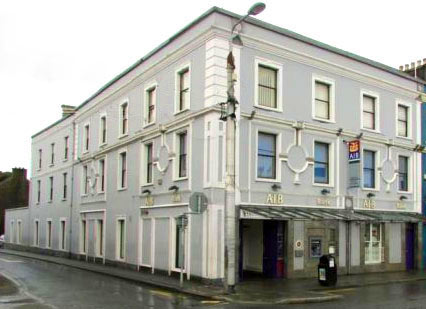
Fraudsters are becoming more sophisticated year on year, and scams are increasingly difficult to spot. AIB is urging customers and the wider public to stay vigilant by knowing the warning signs and taking a moment to verify unexpected messages, calls and offers.
AIB’s Financial Crime Prevention team has outlined the six most common fraud and scam types observed during 2025, along with practical tips to help people protect themselves.
The six top fraud scams seen in 2025. 1) Smishing — text message fraud. Fraudsters send convincing texts claiming to be from banks, delivery firms or government agencies, urging you to click a link, call a number, or share security codes. Tip:Never click links or call numbers in unexpected texts. Contact the organisation directly using trusted contact details.
2) Safe account scams. Scammers pose as bank staff and claim your account is compromised, pressuring you to move funds to a “safe” account that they control. Tip: AIB will never ask you to move your money for security reasons. Hang up immediately.
3) Investment scams. Fraudsters promise high returns to lure victims into fake schemes, often involving cryptocurrency, bonds or precious metals. Tip: If it sounds too good to be true, it probably is. Seek independent financial advice before investing.
4) Romance scams. Scammers create fake online identities to build emotional relationships, then ask for money or personal information. Tip: Never send money or gifts to someone you haven’t met in person.
5) Money mule recruitment. Criminals recruit people to move stolen funds through their accounts, often marketed as “easy money” jobs. Tip: Never agree to transfer money for someone else or allow anyone to use your bank account — this is illegal.
6) Shopping scams. Fraudsters create cloned websites or social media “shops” offering goods that don’t exist. Tip: Stick to platforms you trust, check independent reviews, and ask: is the price too good to be true?
AIB help. If you think you’ve been scammed, contact AIB immediately on the 24/7 fraud reporting line: 1800 24 22 27(or +353 1 771 5639 from outside Ireland). You can also find further guidance and contact options in the AIB Security Centre.
Security reminder. Unfortunately, some fraudsters send emails pretending to be from AIB. Please remember: AIB willnever ask you to provide your Personal Access Code (PAC) by email or via links in an email. AIB will never ask for Code Card or AIB Card Reader codes by email or via links in an email. AIB will never ask you to provide debit or credit card details by email or via links in an email.
Treat unsolicited requests for money, codes or personal information as a red flag – Wait a Sec, Double Check.
This website uses cookies to improve your experience. We'll assume you're ok with this, but you can opt-out if you wish.AcceptRead More
Privacy & Cookies Policy
Privacy Overview
This website uses cookies to improve your experience while you navigate through the website. Out of these, the cookies that are categorized as necessary are stored on your browser as they are essential for the working of basic functionalities of the website. We also use third-party cookies that help us analyze and understand how you use this website. These cookies will be stored in your browser only with your consent. You also have the option to opt-out of these cookies. But opting out of some of these cookies may affect your browsing experience.
Necessary cookies are absolutely essential for the website to function properly. This category only includes cookies that ensures basic functionalities and security features of the website. These cookies do not store any personal information.
Any cookies that may not be particularly necessary for the website to function and is used specifically to collect user personal data via analytics, ads, other embedded contents are termed as non-necessary cookies. It is mandatory to procure user consent prior to running these cookies on your website.







Recent Comments