|
|
 Free Tipperary Business Directory Businesses operating in Co Tipperary are now invited to join our ‘Local Directory‘, free of charge.
Over 120 product suppliers and service providers have already discovered this free directory and have signed up, in an effort to improve business by introducing themselves to over 1,000 readers each day.
Introduce Your Business To A Wider Audience
If you would like to put your business forward, for inclusion in this free directory, please follow the simple instructions given hereunder:-
- Click on the Thurles Directory Tab situated at the top of the Thurles.Info Home Page.
- Scroll down to the bottom of this page and click on Submit A Listing.
- In the box marked Title – place your Name or Business Trading Name.
- In the box marked Link – place your Website Address. (Ignore if you do not as yet have a website.)
- In the box marked Email – place your Email address.
- In the Category Box – click the down arrow symbol and choose a suitable category which best describes your business activity. (Note: If there is not a category already included, which adequately describes your business activity, ignore and we will be happy to add one for you.)
- In the Description Box include your Phone Numbers (Land Line and Mobile), your Fax Number, your Postal Address and any other information which you feel is relevant. Please also use this space to state what Category you would like to be included under, but only if a category is not as yet already available. Please also include here your Facebook address details also.
- Then press Submit.
Note: Your details submitted will not appear immediately in this Directory, as, in the interests of security, details will require the approval of our sites administration.
If you would like to include a picture of your Business Premises or Business Logo, please contact our Site direct, by clicking Here to arrange and discuss a Featured Listing.
Firstly, we would like to apologise and warn our readers in advance that the video hereunder contains some foul language, so if you are easily offended, please refrain from hitting the play button.
Foul language or not, Newport, Co.Tipperary born musician, investment banker and businessman Denis Ryan, through this video, possibly best expresses the thoughts and feelings of many of our Irish residents, unemployed or on the mimimum wage, sitting in their homes tonight.
“If the government is big enough to give you everything you want, it is big enough to take away everything you have.” President Gerald Ford.
Who is Denis Ryan?
Denis emigrated from Tipperary to Canada in the 1960s. In 1971, with Fergus O’Byrne and Dermot O’Reilly he formed the folk band Ryan’s Fancy. In 1983 the group disbanded and Denis moved to Halifax, Canada where he became an investment banker.
However, he still remained in music, releasing two solo albums and hosting the CBC Television show “Up on the Roof”
In 1994 he received an Honorary degree, Doctor of Letters, from St. Mary’s University in Halifax.
Over the years he has given a lot of his time acting as emcee for many charitable functions. And he continues to help create awareness and fund raising for organisations such as the D’Arcy McGee Chair of Irish Studies at St. Mary’s University.
His latest recording was “Newport Town” with his first cousin Denis Carey.
Oh and by the way, Michael Flatley was born Michael Ryan Flatley and his parents Michael and Eilish Flatley left Furteen, County Sligo, in 1947 to make a new life for themselves in America, so he is Irish.
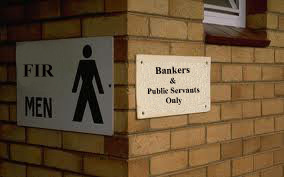 Irish Apartheid And he climbed with the lad up the Eiffelberg Tower.
“This” cried the Mayor,” is your town’s darkest hour!
The time for all ‘Whos‘ who have blood that is red
To come to the aid of their country !” he said.
“We’ve GOT to make noises in greater amounts!
So open your mouth, lad! For every voice counts!”
This verse comes courtesy of the great and late Theodor Seuss Geisel (Dr Seuss) – from his children’s poem ‘Horton Hears A Who!’
Reported details of €40 Million in bonuses being paid to bankers sparked widespread anger among the fair minded people of Ireland in the past few days. Readers will be aware that while workers on the minimum wage are about to have their pay slashed, those employed by one of the institutions who assisted in bankrupting our country has been rewarded. This reward is being dished out in the very same week that our country, which declares in its Proclamation to support “Cherishing the children of the nation equally“, has been downgraded to junk yard status.
Bonuses should be awarded, based on how much revenue individuals attracts, while operating in accordance with accepted ethical, responsible and regulated banking practices. If we as a nation can take 4% from retired pensioners and break the ‘contract’ they have, we can most certainly extract 90% of the current bonus paid to individual bank workers. But history now teaches us clearly that inequality is core to the Irish model of government.
In the decade when we had most and when we quadrupled our spending on our public health services, Ireland’s current political leaders and their supporters failed spectacularly to reform our Irish health system, which presently allows an almost apartheid system to exist.
By apartheid, I mean, if you have money to pay privately, you can get into public hospitals quicker than public patients. You will receive treatment more quickly and you are guaranteed consultant provided care, while recuperating in a single or semi-private room. In contrast a public patient is more likely to be viewed by a junior doctor and to remain in a multi-bed ward or on a trolley in a drafty hospital corridor.
Ireland is unique in Europe, in that we still permit private care to exist in our public hospital system. We allow the wealthy to skip past in the queue, ahead of our poorer public patients. The cost of the care of these private patients, passing through our public system, is largely subsidised by public money, while minimum wage patients remain verbally silent. This apartheid operated health system can also be seen clearly in our nursing homes, with two out of every three nursing home beds presently in the private sector.
We are well down the road of a privatised, double tiered provision of health-care which favours private patients over public patients, but we can undo the harm done and as citizens /patients, demand a quality and universal public health system to which we are all fully entitled too, under our constitution.
Our present government lives in fear of its public sector unions and work force and here apartheid also reigns. The cost of the public sector is currently €20 billion per annum and when their average 210 annual working days are divided into this €20 billion wage, the daily pay costs amount to around €95 million. Previously, the Department of Finance vowed to dock wages of public sector workers who would strike in protest over cutbacks. If even a fraction of public sector unions were to follow through on these threats to hold one day work stoppages, those protesting workers would be hit in their pockets and the Government’s Coffers would be boosted by millions per day. Our next government must confront the public service and their unions, head-on and take back the control that this present gutless administration have surrendered.
We were recently informed that we have an Automated Fingerprint Integrated System (AFIS) that cost €20m lying idle. Extra civilian staff, hired by the garda were expected to run this system, but these 50 staff at the GNIB headquarters, who are members of the Civil and Public Service Union (CPSU), have now refused to operate this system, saying it is inappropriate for clerical staff to do a job that gardai should do. However they will work the system in return for extra allowances. Meanwhile, Gardai openly admit that they have no idea how many people, recently arrived into Ireland, are now claiming entitlements to social benefits, using fake identities.
Where is Berty Ahern’s ‘Towards 2016’ ?
Was Sustaining Progress and Towards 2016 a contract? What happened to the Civil Service Verification Document Section 28 ‘Modernisation and Flexibility’?
The parties to this Agreement will co-operate with flexibility and modernization ……….,
The Public Service Pay Agreement provides that payment of these (pay) increases is dependent, in the case of each sector, organisation and grade, on verification of co-operation with flexibility and ongoing change.
There will be situations where existing work procedures must be adapted to respond to work requirements and traditional methods of performing particular tasks will have to be changed.
Under the terms of Towards 2016, payment of each of the four public service pay increases is dependent on verification of satisfactory achievement in relation to co-operation with flexibility and ongoing change.
Continue reading Apartheid Alive And Kicking In Collin’s Ireland
 The 2011 Budget passed its first test in the Dáil last night, with the Government having a comfortable majority of 82 votes to 77 on the first vote on the measures introduced. The Budget hit taxpayers hard through a reduction of 10% in the tax credits and bands, a new consolidated social charge of 7 % and the abolition of the PRSI ceiling. This combination of measures will lead to significant tax increases for almost all workers, with more people paying at both the standard and the higher rate. Changes are shown here at a glance:- The 2011 Budget passed its first test in the Dáil last night, with the Government having a comfortable majority of 82 votes to 77 on the first vote on the measures introduced. The Budget hit taxpayers hard through a reduction of 10% in the tax credits and bands, a new consolidated social charge of 7 % and the abolition of the PRSI ceiling. This combination of measures will lead to significant tax increases for almost all workers, with more people paying at both the standard and the higher rate. Changes are shown here at a glance:-
Motoring.
Petrol duty up 4c per litre and Diesel duty up 2c per litre and car scrappage scheme to be extended for further six months.
VRT relief for plug-in hybrid electric vehicles will continue at up to €2,500 until end of 2012.
Reform of the Ministerial State car system will see the cost of this fleet reduced by a third over the next two years.
Pay.
Taoiseach to take €14,000 pay cut, with Ministers to take €10,000 pay cut and President’s pay to be reduced to a maximum of €250,000.
A cap on public service pay of €250,000 with a maximum of €250,000 salary for judges and a 10pc cut in pay for new judges.
A 4% cut on public service pensions above €12,000 per year.
All Social welfare payments to be cut by 4%.
Those on the new reduced minimum wage not be brought into the tax net and top marginal tax rate to be kept at 52% for all taxpayers.
Income and health levies to be replaced by single universal social charge.
Old Reliables.
No duty rise on cigarettes and beer.
Pensions and Child Benefits.
No reduction in State Pension.
A €10 reduction to child benefit, with an additional €10 reduction for the third child.
Education.
Third-level registration fees will rise to €2,000, but families with more than one child in college will continue to pay the existing fee of €1,500 for the second and subsequent children.
Corporation tax.
No change to our 12.5pc Corporation tax rate.
Residential Property.
TA 1% stamp duty on all residential property transactions up €1m with a 2% stamp duty on all residential property transactions over €1m and property-based tax reliefs to be phased out by 2014.
Travel.
Travel tax reduced from €10 to €3 from March 2011 and only to remain if the airlines do not use it to raise their charges.
Banking.
The DIRT rate on ordinary deposit accounts increased by 2% to 27%, while the DIRT rate on longer-term deposit accounts increased by 2%c to 30%.
Capital Acquisitions.
Base for Capital Acquisitions Tax is being broadened by reducing the tax-free thresholds by 20%.
A middle-income family now stands to lose as much as €300 a month. A couple with three children and a household income of €75,000 who contribute €4,500 to their pension annually will see their net income fall by €1,815, or €151.25 a month.
There can be little doubt that persons on the lowest rung of society in Co Tipperary and countrywide stand to take the greatest pain.
The following story illustrates the reasons for the present financial crisis. I am not aware of its origins so no credits, but here it is, as explained to me.
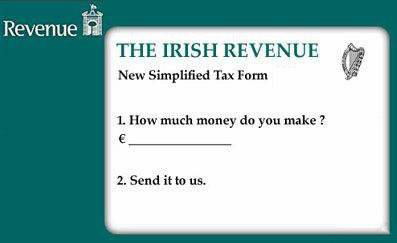 Irish Governments New Simplified Tax Return For 2011 “Paddy is the proprietor of a Public House in Tipperary. He realizes that virtually all of his customers are unemployed alcoholics and they can no longer afford to patronize his bar. To help alleviate his problem, he comes up with a new marketing plan that allows his customers to “Drink Now, and Pay Later“. He keeps a full track of all the alcohol consumed in a ledger, thus granting his customers loans.
Word quickly gets around about Paddy’s “Drink Now, Pay Later” marketing strategy and customers increase in very large numbers and very soon he has the largest drink sales volume for any bar in Ireland.
By providing his customers freedom from immediate payment demands, Paddy gets no resistance, when he substantially increases his prices for wine and beer and Paddy’s gross sales volume soon increases massively.
A young and bonus motivated vice-president at Paddy’s local bank recognizes that these customer debts constitute valuable future assets and increases Paddy’s borrowing limit. He sees no reason for any undue concern, since he has the debts of the unemployed alcoholics as collateral.
At the bank’s corporate headquarters, expert traders figure a way to make huge commissions, and transform these customer loans into PUKEBONDS, DRINKBONDS, and ALKIBONDS. These securities are then bundled and traded in the International Securities market.
Naive investors don’t really understand that the securities being sold to them, as AAA secured bonds, are really the debts of unemployed alcoholics. The bond prices continuously climb, and the securities soon become the hottest-selling items for some of the nation’s leading brokerage houses.
One day, even though the bond prices are still climbing, a Risk Manager at the original local bank decides that the time has come to demand payment on the debts incurred by the drinkers at Paddy’s bar.
Paddy now demands payment from his alcoholic patronage, but since being unemployed alcoholics they now cannot make payment on their past drinking debts. Since Paddy cannot now fulfill his loan obligations he is forced to declare himself bankrupt. The Pub closes and his seven employees lose their jobs.
Overnight, PUKEBONDS, DRINKBONDS, and ALKIBONDS drop in value by 90%. The collapsed bond asset value destroys the banks liquidity and prevents it from issuing new loans, thus freezing credit and economic activity in the immediate community.
Paddy’s suppliers, due to his massive business, had granted him generous payment extensions and in turn had invested their firms pension funds in these various BOND securities. They now find they are faced with having to write off his bad debt while losing over 90% of the presumed value of the bonds. His wine supplier also claims bankruptcy, closing the doors on a family business that had endured for three generations. His beer supplier is taken over by a leading competitor, who immediately closes the local plant and lays off the 125 workers.
Fortunately though, the bank, the brokerage houses and their respective executives are saved and bailed out by a multi-billion euro, no strings attached, cash infusion from their cronies in Government.
The funds required for this bailout are obtained by new taxes levied on employed, middle-class, non-drinkers who have never been in Paddy’s bar in their lives.
This tale should help you understand Irish economics as they exist in 2010.
|
Support Us Help keep Thurles.info online by donating below. Thank you.
Total Donated 2026: €40.00
Thank You!
Daily Thurles Mass Livestream
|





Recent Comments