Ratepayers’ Cultural Safety Briefing for the Maryland USA Mission (St Patrick’s Weekend Edition).
Tipperary ratepayers warmly welcome news of the proposed Maryland excursion by the CEO of Tipperary County Council, Ms Sinead Carr, along with the Cathaoirleach, Cllr Mr John Carroll and Mr Anthony Fitzgerald (Head of Enterprise and Economic Development and Tourism), latter a brave initiative in international relations, and an even braver initiative in free expensing, courtesy of Tipperary taxpayers.
However, before anyone is released into the wilds of a round of St Patrick’s weekend receptions, it is essential the travelling party completes the Maryland Compulsory Heritage Module, because nothing says “strategic engagement in quantum technologies” like being caught flat-footed on a 19th-century poem in front of a room of people who can quote it at you.
Pic L-R:Barbara Frietchie, & poet John Greenleaf Whittier.
Module 1:Barbara Frietchie (1766 – 1862), [Fritchie, Fritchie-ish, depending on who’s correcting you]. All delegates must demonstrate a working knowledge of the famous Frederick legend in which an elderly woman allegedly waves the Union flag, while Stonewall Jackson passes through, and he, like a well-trained character in a civic morale story, obligingly delivers the appropriate line on cue. Warning, this is not optional. In Maryland, this is basically local scripture, and you will be judged accordingly.
Module 2: Stonewall Jackson, not just a beard, a brand. You don’t have to agree with the legend, but you must be able to nod thoughtfully, while someone says “Of course you know the story…” and you respond like a person who has absolutely not spent the flight learning it from a laminated handout.
Module 3: Frederick’s “Shared Heritage”. Delegates are reminded that Frederick’s history has more edge than a brochure. For example, your hosts may be vaguely aware of the 1781 treason case in Frederick, (Mr Caroll please note), involving British loyalists, including Mr John Caspar Fritchie (Barbara’s father-in-law), convicted in a plot involving British prisoners and a rendezvous with Cornwallis in Virginia, resulting in their nasty executions two months later. This is the part of “people-to-people ties” that rarely makes the PowerPoint, but it does wonders for small talk, if the canapés are slow coming out of the kitchen.
Assessment: A short oral exam may occur at any point, possibly mid-toast, possibly in front of cameras. Passing grade requires:
Correct pronunciation of “Frietchie/Fritchie” without looking panicked.
Ability to smile as if you’ve always loved American Civil War folklore.
The restraint not to say “Sure we’ve our own rebels at home”(referring to ‘People Before Profit’ and ‘Sinn Féin’), unless you enjoy diplomatic incidents.
Anyway, thank God, we are getting some return on our Property Taxes and it’s so comforting, because for a moment there I worried our money was being used efficiently. Now, with the bar so low (it’s basically underground), yet we are still managing to trip over it. Absolutely, nothing says ‘value for money’ like spotting that single working streetlight and the knowing that the Thurles potholes are really just a normal street feature.
Finally, ratepayers would like to reassure this delegation, that if you accidentally confuse Barbara Frietchie with any other historic flag-waver, don’t worry, the room will correct you instantly, with great enthusiasm, at full volume, and for free.
Safe travels. Spend wisely. Reports of any major successes in tourism, business, of course will be required. Oh and for the love of God, do your homework.
Now, to add some educational context; read the poem by John Greenleaf Whittier (1807 – 1892) latter published in October 1863.
Barbara Frietchie.
Up from the meadows rich with corn, clear in the cool September morn, The clustered spires of Frederick stand green-walled by the hills of Maryland. Round about them orchards sweep apple and peach-tree fruited deep, Fair as a garden of the Lord to the eyes of the famished rebel horde, On that pleasant morn of the early fall when Lee marched over the mountain wall, Over the mountains winding down, Horse and foot, into Frederick town. Forty flags with their silver stars, forty flags with their crimson bars, Flapped in the morning wind, the sun of noon looked down, and saw not one. Up rose old Barbara Frietchie then, bowed with her fourscore years and ten; Bravest of all in Frederick town, she took up the flag the men hauled down; In her attic window the staff she set to show that one heart was loyal yet. Up the street came the rebel tread, Stonewall Jackson riding ahead. Under his slouched hat left and right he glanced: the old flag met his sight. “Halt!”, the dust-brown ranks stood fast, “Fire!”, out blazed the rifle-blast. It shivered the window, pane and sash, it rent the banner with seam and gash. Quick, as it fell, from the broken staff, Dame Barbara snatched the silken scarf; She leaned far out on the window-sill, and shook it forth with a royal will. “Shoot, if you must, this old grey head, but spare your country’s flag,” she said. A shade of sadness, a blush of shame, over the face of the leader came. The nobler nature within him stirred, to life at that woman’s deed and word. “Who touches a hair of yon grey head dies like a dog! March on!” he said. All day long through Frederick street, sounded the tread of marching feet, All day long that free flag tossed over the heads of the rebel host. Ever its torn folds rose and fell, on the loyal winds that loved it well, And through the hill-gaps sunset light shone over it with a warm good-night. Barbara Frietchie’s work is o’er, and the Rebel rides on his raids no more. Honour to her, and let a tear fall, for her sake, on Stonewall’s bier. Over Barbara Frietchie’s grave, flag of Freedom and Union, wave, Peace and order and beauty draw round thy symbol of light and law; And ever the stars above look down on thy stars below in Frederick town! End
St Patrick’s Day parade committees across Ireland are warning that escalating insurance costs and reduced availability of public liability cover are placing community celebrations under severe strain, raising the risk of cancellations, scaled-back routes and last-minute uncertainty for towns and villages.
Hereunder, Video of the Thurles, Co. Tipperary, St Patrick’s Day Parade Held 2025.
Volunteer-led committees say public liability insurance has become a barrier to participation, not just a safety requirement, with higher premiums, stricter conditions and growing administrative demands landing on groups that rely entirely on fundraising and unpaid work.
Public liability insurance, covering injury to spectators and participants, as well as third-party property damage, has become increasingly difficult to secure for volunteer-led events, with committees reporting that quotes are higher, conditions are tighter and the administrative burden has grown significantly.
Recent media reporting has highlighted the scale of the challenge, with one Wicklow parade committee facing insurance estimates in the €5,000–€10,000 range (with €6,500 cited), a cost that can exceed the entire fundraising capacity of smaller communities.
At the same time, local-authority event permissions typically require proof of insurance in advance, often at high indemnity limits and with specific policy wording, adding pressure to secure cover early and at a price communities can afford.
A spokesperson associated with the Thurles town St Patrick’s Day Parade Committee, has stated that;- “Insurance has always been a problem and ever since Covid it has doubled. This is a volunteer-run event. We’re proud of the work that goes into making it safe and welcoming, but the cost and complexity of insurance is now the single biggest threat to Irish parades. Without a workable solution, communities will lose events that bring people together and support local businesses. We’re told to produce more and more documentation and pay for more and more controls, which we do, but the quotes still rise and the uncertainty remains. At some point, towns are simply being priced out of their own national day. St Patrick’s Day shouldn’t become a luxury product available only to the biggest centres. If we don’t act, we’ll sleepwalk into a future where local parades quietly disappear, and once they’re gone, they’re hard to bring back.”
Committees stress that risk management standards have risen sharply in recent years. Organisers are now expected to produce robust event management plans, crowd control measures, stewarding and traffic management arrangements, important steps for safety, but often costly to implement.
National claims data shows improvements in the wider public-liability landscape, with the Injuries Resolution Board reporting a 40% reduction in public-liability claim volumes, between 2019 and 2023. Parade organisers are asking that progress be reflected in affordability and availability for well-managed community events.
Calls for action. Community parade organising committees are urging:
A dedicated community events insurance support mechanism, aligned with documented safety standards and transparent pricing.
Clear engagement from Government, insurers and local authorities to protect the viability of community parades, not just flagship events.
A simplified national template for parade risk management and event documentation to reduce administrative burden and improve consistency.
Engagement with insurers, brokers and Government to increase capacity for community events and prevent avoidable cancellations.
St Patrick’s Day belongs to every community and participants are asking for the implementation of practical measures, so that smaller towns and villages can continue to celebrate safely without being priced out of total existence.
Thurles Aldi launches exciting new winter attraction; “Aldi-on-Sea”.
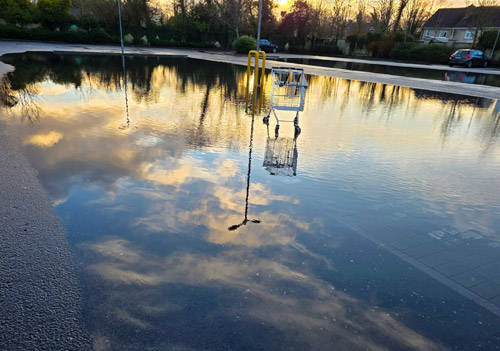
Delighted to see the Thurles Aldi carpark has once again been transformed into a seasonal water feature. Since 2023, it’s become a reliable annual tradition: you arrive for milk and end up needing a canoe.
And no, Storm Chandra had nothing to do with it; Tipperary for the most part escaped the major flooding experienced on the east coast. (But maybe Aldi Ltd, could apply for humanitarian emergency aid funding which was limited to €5,000 and now increased up to €100,000, because Co. Councils down the years successfully failed to maintain our clogged river channels, thus reducing water flow and capacity).
Sunlit and glass-still; Thurles’ Aldi “water feature” waits, like a love letter, for pintail ducks, whooper swans, and even the odd escaped feral mink.
A few helpful customer updates:
Trolleys now come with a complimentary reflection for your Instagram.
Parking bays are “first come, first served” and float-tested.
Shoppers are advised to wear wellies, or at least bring a lifebuoy.
All jokes aside: this happens every winter. It’s not a “once-off”, it’s a recurring problem that needs a proper fix. People shouldn’t have to dodge puddles the size of Liberty Square, in an effort to purchase a loaf of bread.
So, any chance we could upgrade from ‘Seasonal Lagoon‘ to ‘Normal Carpark‘ before winter 2027?
Seriously, following my complaints sent initiallyto Aldi Stores Ltd, I discovered an email waiting on my computer this morning.Same Read:-
Hi George, (Yes, we’re practically pen pals at this stage). Thanks so much for your patience. I can confirm the Area Manager has advised that the work for the car park had to wait for adjacent work to be completed first, organised via the local council. This was completed prior to the festive break. (Xmas 2026) They have confirmed that as a result, the work on the car park to fix appropriate drainage systems is scheduled to be completed by the end of February, (Which February remains unclear). If there is anything else we can assist you with, please don’t hesitate to reach back out. Thanks again for reaching out to us. Best wishes, …………
My reply: Madam: This flooding has been a recurring winter issue since at least 2023. It is particularly difficult to understand the continued problem at the main entrance area where the public drains are almost one metre lower than the Aldi site level itself. With that level difference at the point of outfall, it raises an obvious question as to why a lasting drainage solution was not implemented earlier, rather than allowing the same disruption to customers repeat itself year after year.
Your reply now begs the question, has your anonymous ‘Area Manager’ ever visited Aldi Thurles, since at least 2023 and have staff not repeatedly reported the issue year after year? Has this problem in Thurles not been reflected in Aldi Thurles branch profits? I find the explanation by your area manager both condescending and disappointing. Yours sincerely…………
Obviously Municipal District Officials and local elected Councillors don’t shop there, although Aldi are the only stockists of Ice Cream in Thurles Town, which containing no risky additives, less water and skim milk powder.
Switzerland didn’t “get lucky” with clean rivers. It decided, in law, in funding, and in enforcement, that clean water is basic infrastructure. After decades when wastewater and industrial pollution badly damaged waterways, Switzerland eventually hard-wired wastewater treatment into national policy. By 2005, some 97% of the population was connected to a central sewage treatment plant.
And Switzerland didn’t stop at “good enough”. A revised waters protection law took effect on January 1st 2016, requiring many treatment plants to add extra purification stages to tackle trace pollutants. Today, Switzerland’s own federal assessment says bathing water in lakes and rivers is generally very good, with more than 97% of assessed bathing waters at least “sufficient”.
That’s the core lesson; clean rivers don’t come from speeches. They come from a system that measures, funds, upgrades, and insists on outcomes.
Now let us look at the Suir in Thurles. A river described as “disgraceful” in a town that should be proud of a God given assett. Indeed, the positioning of the River Suir should be one of Thurles’s defining assets. Instead, the public record reads like a running argument, frustration, photos, political rows, and a river that locals and officials say is fast “slipping away”.
Video hereunder shows one area of River Suir in the heart of Thurles town.
At a Tipperary County Council meeting, one councillor described the Suir running through Thurles as “disgraceful, embarrassing and shocking”, alleging rubbish, trolleys and “raw sewerage”. Local radio carried similar comments in 2024, calling the river an “eyesore” and “an embarrassment to the town”. This is not just “bad optics”, it’s a signal to the people on the ground that local government, charged with keeping essential infrastructure working and keeping the environment protected, is now seriously broken.
Tipperary County Council says it has a remit. Residents are asking, “Where are the results?” A national newspaper reported that EPA sampling, at Thurles Bridge in 2023, found the river “poor”, and quoted the council saying it has “a statutory remit to maintain and protect the water quality status of rivers” and works with the Local Authority Waters Programme (LAWPRO). Fine, but “remit” isn’t recovery. LAWPRO’s own reporting at a public meeting in Templemore captured what many locals believe is happening in the Suir catchment around Thurles; declines in water quality, impacts on fish and aquatic life, and “river weed growth” and “general neglect”, much of it linked to excessive nutrients. So the public isn’t imagining that something is wrong. Multiple sources, local reporting, stakeholder meetings, and the council’s own statements about responsibility, all point back to the same uncomfortable truth; the river needs a plan that delivers measurable improvement.
The wastewater system is a known pressure point, and the utility admits it Here’s the part that should end the “who’s to blame” merry-go-round. Uisce Éireann’s own project page for Thurles states plainly that “the current wastewater infrastructure in the town is inadequate” and that upgrades are required to meet environmental compliance and “alleviate flooding issues”. When your own infrastructure provider says the network is inadequate, it’s no longer credible to treat river decline as a mystery. It becomes a delivery question, what is being done, by when, and how will the river show improvement?
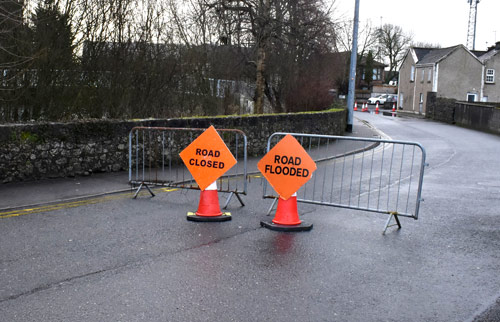
Robert Emmet Street, Thurles, closed today due to flooding for the second time in past 3 months.
Flooding, when the river rises, the same arguments return. This week, Tipperary County Council issued an operational update noting elevated levels on the Suir and overtopping in parts of the catchment area. Local press also reported flood scenes in South Tipperary, with the council saying water levels had risen and overtopping had occurred at several points. Thurles residents are familiar with what follows: the river rises, pinch points show up fast, and the anger sharpens around a simple claim, basic river management and preventative maintenance are not being done consistently enough.
A Thurles.Info article (November 2025) illustrates the Emmet Street riverside walkway and describes it as unserviceable due to flooding, arguing that repeated warnings over a 13-year period have not been matched by the maintenance needed to prevent blockages and overflow. To be clear, the precise causes of any single flooding incident, whether reeds, silt, debris, undersized drainage, or all of the above, require engineering assessment. But the political point is unavoidable, if people can’t see routine, transparent upkeep and enforcement, they assume it isn’t happening.
And here’s the paragraph Ireland can’t ignore: we have the money What turns this from local frustration into national hypocrisy is the scale of spending Ireland is willing to contemplate elsewhere. The Irish Government has backed the Water Supply Project for the Eastern and Midlands region, intended to bring a new long-term water source from the Shannon system towards the greater leaking Dublin area. RTÉ reported the proposal would take about 2% of the average flow and was estimated to cost €4–€6 billion. The Department’s own press release gives a preliminary cost estimate of €4.58bn to €5.96bn (verified through an expert review process).
So yes: Ireland can mobilise billions for water infrastructure for Dublin when it chooses. Which makes the Suir question harder to dodge: how can we plan to move vast volumes of water across Ireland while towns like Thurles are still fighting over basics; river health, monitoring, enforcement, and routine maintenance?
Switzerland vs Thurles: the difference is measurable accountability Switzerland’s lesson isn’t “be rich” or “buy better technology”. It’s this, treat water quality as a deliverable.
If Thurles wants a Suir that supports biodiversity, recreation, tourism, and doesn’t become a recurring source of anger, then the county needs to stop treating the river like a PR problem and start treating it like infrastructure with a public scoreboard:
Quarterly updates on the Thurles stretch (water quality trend points, incident reporting, actions taken).
A clear, named lead for publishing progress locally, one place the public can check.
Transparent milestones for the wastewater upgrades already acknowledged as necessary.
A preventative maintenance programme that is visible, scheduled, and publicly reported, so people aren’t left guessing until the next flood.
Switzerland didn’t fix its rivers by talking. It fixed them by building a system that delivers, and proving it, year after year. Thurles deserves the same axtion and seriousness.
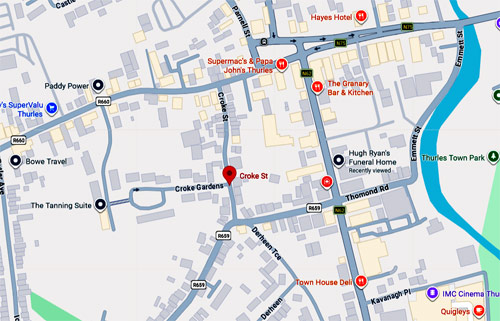
Tipperary County Council have granted planning permission for a new social housing development that will deliver six one-bedroom apartments on Lower Croke Street, (Formerly known as Stradavoher), Thurles, Co. Tipperary.
The board of directors of Thurles Lions Trust applied to the local authority to build the scheme on a vacant town-centre site. The development will comprise two new buildings providing a total of six one-bed apartments, all intended for social housing.
A number of local residents made submissions during the planning process, raising concerns about storm-water capacity and the potential for overlooking of neighbouring properties. One objection argued that a proposed balcony (on apartment 5), would allow direct overlooking into a private garden and negatively impact on privacy. Another submission warned the project could place added pressure on a storm drainage/sewerage system that, they claimed, is already struggling with surface-water run-off; contributing to flooding risk for older homes on the street.
Despite the objections, the council have approved the development subject to conditions. These include the removal of the proposed balcony for apartment 5, requirements to keep the public road clean and tidy during construction, and that all service cables be routed underground. The developer must also submit a public lighting scheme for council approval, agree details of external finishes in advance, and comply with restricted construction hours: Monday to Friday (8am–6pm) and Saturday (8am–2pm).
This website uses cookies to improve your experience. We'll assume you're ok with this, but you can opt-out if you wish.AcceptRead More
Privacy & Cookies Policy
Privacy Overview
This website uses cookies to improve your experience while you navigate through the website. Out of these, the cookies that are categorized as necessary are stored on your browser as they are essential for the working of basic functionalities of the website. We also use third-party cookies that help us analyze and understand how you use this website. These cookies will be stored in your browser only with your consent. You also have the option to opt-out of these cookies. But opting out of some of these cookies may affect your browsing experience.
Necessary cookies are absolutely essential for the website to function properly. This category only includes cookies that ensures basic functionalities and security features of the website. These cookies do not store any personal information.
Any cookies that may not be particularly necessary for the website to function and is used specifically to collect user personal data via analytics, ads, other embedded contents are termed as non-necessary cookies. It is mandatory to procure user consent prior to running these cookies on your website.







Recent Comments