Farmers Must Be Supported To Prepare For Ever More Compounding Climate Extremes Says Climate Change Advisory Council.
Council calls for farmers to be supported with land-specific climate information, technology and practical advice to prepare for a changing climate.
The Agriculture sector has not met its commitment to reduce emissions by 10% by 2025, and without a stronger push, will not meet its 2030 commitments.
Just 2,527 hectares of new forest were planted in 2025 against an annual target of 8,000 hectares.
Progress on bio-methane remains far behind the pace required.
Mr Alex White – (Chairperson Climate Change Advisory Council).
Launching the Agriculture and Land Use, Land Use Change and Forestry chapter of its Annual Review 2026 today, the Climate Change Advisory Council said farmers are increasingly having to manage very different risks throughout the year due to extreme conditions including excessive rainfall, heatwaves and drought.
Rather than reacting to individual weather crises as they occur, the Council says farmers should be better equipped to understand the long-term risks facing their land and businesses in a climate that is becoming increasingly extreme. It is calling on the Department of Agriculture, Food and the Marine (DAFM) to develop and deploy, within 12 months, a practical climate-risk toolkit tailored to individual land parcels.
Alongside better information, farmers need access to practical advice, financial support and viable alternatives to existing practices that are more climate resilient. Restoring soil, water and ecosystem functions can help farms absorb extreme-weather shocks and maintain productivity, while some farmers may choose to adapt existing practices or diversify into new sources of income.
The Review also warns that Ireland’s reliance on imported fruit and vegetables leaves the food system vulnerable to climate-related crop failures elsewhere and supply-chain disruption, and calls for a review of how domestic horticulture could strengthen food security.
Agriculture emissions fell by just 0.2% in 2025 and are now 4.7% below the 2018 baseline – less than half of the 10% reduction commitment from government for 2025. EPA projections indicate that the ‘with additional measures’ scenario would deliver an approximately 19% reduction in Agriculture emissions by 2030, compared with the 25% target. The Council notes that the 25% target remains achievable if additional diversification measures identified in the Climate Action Plan are also fully implemented.
To close this gap, DAFM should develop and begin implementing, a time-bound and properly resourced plan to accelerate emissions-reduction measures on farms, informed by structured dialogue with farmers, rural communities and workers.
The Forestry sector remains a particular concern. Ireland is not close to meeting its annual afforestation target of 8,000 hectares, leaving Ireland substantially off track for 18% forest cover by mid-century and contributing to a weakening forest carbon sink. The next Forestry Programme must address the financial, administrative and practical barriers preventing greater participation.
Significant public funding has been committed to anaerobic digestion under the Biomethane Strategy, but delays to the Renewable Heat Obligation are holding back the market certainty needed to unlock investment and demand. Progressing the obligation is essential if bio-methane is to support farm diversification and energy security.
Mr Alex White, (Chairperson of the Climate Change Advisory Council), said:
“Farmers are increasingly having to manage extremes – this year we have seen too much water at one time of year and too little at another. We cannot keep treating every prolonged wet period or drought as an isolated crisis. Climate change is challenging some of the established practices involved in agriculture and land management. Practical support will be essential, whether that means making land and farms more resilient, adapting existing practices or pursuing viable opportunities for diversification, including forestry, carbon farming and renewable energy. The transition has to be shaped in collaboration with rural communities and farmers, and not simply designed for them. Policy will be more effective if it reflects the practical realities, costs and opportunities on the ground, while delivering the emissions reductions Ireland needs.”
View News from the Climate Change Advisory Council HERE.
Congratulations to Thurles Councillor Mr Jim Ryan, who once again used Tipp FM local radio, this morning, to highlight the deplorable condition of the River Suir, as it passes through Thurles town centre.
Concerns about this important local waterway have reportedly been raised repeatedly since approximately November 2013. Yet, after almost 13 years, residents are still waiting for the sustained maintenance, environmental protection and accountability that the river urgently requires.
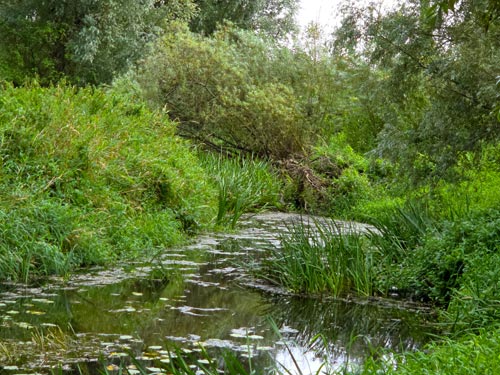
River Suir, for years, remains totally blocked by a fallen tree, reed and other vegetation.
Photographs and the short video hereunder, recorded yesterday, once again provide further evidence of the current situation. Shopping trolleys, bottles, discarded clothing and other litter, remain clearly visible, both in the riverbed and around affected sections of the river bank, totallydevoid of litter bins.
Years of excessive vegetation, severely restricted water flow and apparently uncontrolled effluent entering the river, provide stark evidence of prolonged and inexcusable neglect.
Short video hereunder, taken yesterday showing conditions recorded along the River Suir, with no action having taken place whatsoever, since contacted by EPA.
Thurles.Info has forwarded communications about the river to Tipperary County Council. The Environmental Protection Agency has also requested a written response from the said Council, outlining any action already taken or planned. According to the latest published update, that response remains awaited.
Despite the EPA’s intervention and continuing public complaints, no visible attempt had been made, up to yesterday, to remove the abandoned trolleys, bottles, clothing or other accumulated waste shown in the accompanying footage. This is not merely an appearance issue. The River Suir is an important natural habitat, public amenity and part of Thurles’s identity. Local people are entitled to know who is responsible, what work will be undertaken and when it will begin. Councillor Mr Jim Ryan deserves credit for continuing to raise the matter.
What Thurles now needs is a prompt, transparent and effective response from the responsible authorities.
When Plastic And Aluminium Become One Recycling Problem.
I want to sincerely thank Minister of State Mr Alan Dillon TD (through his Private Secretary Ms Michaela Sullivan), for taking the time to provide such a detailed and informative response. Unfortunately, many TDs these days fail to reply to constituents’ questions at all, so a meaningful response deserves to be publicly acknowledged.
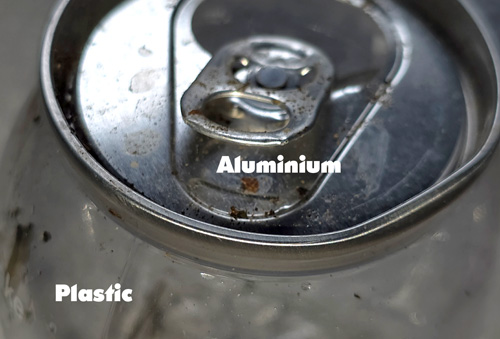
Although Ireland’s Deposit Return Scheme covers PET* bottles and aluminium or steel cans from 150ml to 3 litres, the Department has confirmed that this container is excluded because it is considered hybrid packaging, owing to its high aluminium-to-PET ratio.
The photograph below shows a 200ml BuzzBallz container made from a combination of plastic and aluminium.
Ireland’s new litter menace – same rejected by Reverse Vending Machines, since no Re-turn logo.
*PET stands for polyethylene terephthalate, a widely used plastic. It is a lightweight, durable plastic commonly used to make drinks bottles and is normally identified by the number 1 recycling symbol.
That creates a serious problem; the container may contaminate the aluminium recycling stream, while its metal content could also damage equipment used to process plastic. In other words, it is designed in a way that makes effective recycling extremely difficult.
The new EU Packaging and Packaging Waste Regulation is intended to address packaging like this. It requires packaging placed on the EU market to be recyclable, with reconcilability requirements beginning in 2030. Hopefully, this will bring an end to poorly designed hybrid containers that fall outside the deposit scheme and are too easily discarded on our streets and in our countryside.
The Minister’s office also explained that Re-turn works with local authorities, the LGMA and the Waste Enforcement Regional Lead Authorities to identify and investigate breaches of the Deposit Return Scheme rules. According to the Department, hundreds of inspections have taken place since the transition period ended, and 80% of the non-compliant stakeholders identified are now compliant or working towards compliance. Reports from members of the public remain an important part of that enforcement effort.
However, the wider question remains; why should any drinks container be allowed onto the Irish market, if it cannot be efficiently collected and recycled?
Packaging should be designed for a circular economy from the beginning, not become someone else’s environmental problem at the end.
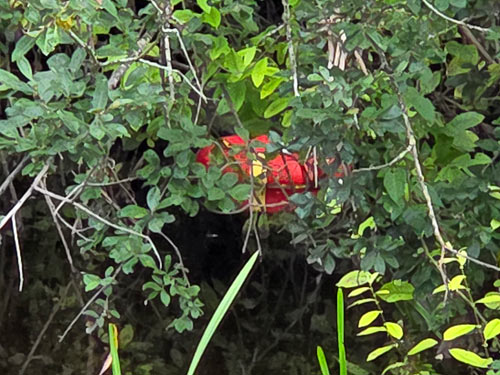
On 21st August 2026, Tipp FM reported Councillor Mr Jim Ryan’s warning that lives were being put at risk after a lifebuoy was thrown into the River Suir, behind the shopping centre in Thurles.
Sixteen days later following a report on August 21st 2026, the stollifebuoy remains floating in River Suir in Thurles town centre. The waste of taxpayers money by Municipal District Council officials continues. Pic: G. Willoughby.
Despite a new buoy being replaced, there appears to have been no successful effort to recover this vital piece of lifesaving equipment. If action has been taken, the public deserves to know why the buoy is still in the river and unavailable for use in an emergency.
Each lifebuoy reportedly costs approximately €55.00, with the rope adding further expense. More importantly, its absence from its proper station could have had life-or-death consequences.
Tipperary County Council has previously warned that damaging or taking a ring buoy is a criminal offence and has urged the public to report missing or damaged equipment to the council or Water Safety Ireland.
Condemning vandalism is not enough. This lifebuoy must now be recovered or replaced, the location made safe, and responsibility taken for ensuring that essential rescue equipment along the Thurles river walk is inspected and maintained.
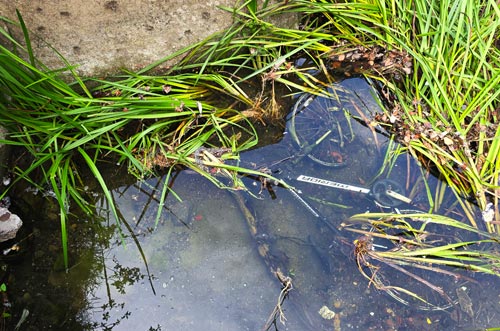
Anyone looking for a ride in Thurles, tonight, then an unwanted, submerged Crossway Merida bicycle could be your best bet.
Local wildlife was left baffled this week after a bicycle was discovered taking an unscheduled bath in the River Suir.
The bike, believed to be a Crossway Merida variety, was found lying beneath the water with all the dignity of a cyclist who had confidently shouted, “Watch this!” moments before disaster. As yet no body has been located.
Competition – Spot the Bike. Pic: G. Willoughby.
Witnesses say the bicycle may have entered the river after misunderstanding Ireland’s new transport policy. “It heard everyone talking about greener travel,” one duck explained, “and apparently decided to join the actual green overgrown rush bed.”
The River Suir is already famous for its salmon and brown trout. Now it can add mountain bikes to the list, although anglers are reminded that bicycles must be returned to the water if they are under eighteen gears. Fishing in Ireland has yet to confirm the correct bait, but experts recommend using a fluorescent jacket and shouting, “Who left this here?” The bicycle itself declined to comment, although one wheel appeared distinctly tired. Its chain is reportedly rusty, its brakes are feeling pressured, and the saddle has requested immediate relocation to somewhere less damp.
Thurles Municipal Council officials and local Councillors are considering several explanations; illegal dumping, a dramatic relationship breakup, or an ambitious attempt to cycle directly to France without paying ferry charges. Environmental campaigners “Refresh Thurles” have stressed that rivers are no place for unwanted bicycles. Anyone wishing to dispose of an old bike should use a proper recycling facility, or give it to someone who promises not to test whether it can swim.
At press time, and for several months previous the bicycle has remained submerged at low tide, awaiting rescue, repair, and a very stern lecture about not wearing its water wings.
Now with public transport prices being increased by 15% from January, an immediate rescue could be advantageous.
This website uses cookies to improve your experience. We'll assume you're ok with this, but you can opt-out if you wish.AcceptRead More
Privacy & Cookies Policy
Privacy Overview
This website uses cookies to improve your experience while you navigate through the website. Out of these, the cookies that are categorized as necessary are stored on your browser as they are essential for the working of basic functionalities of the website. We also use third-party cookies that help us analyze and understand how you use this website. These cookies will be stored in your browser only with your consent. You also have the option to opt-out of these cookies. But opting out of some of these cookies may affect your browsing experience.
Necessary cookies are absolutely essential for the website to function properly. This category only includes cookies that ensures basic functionalities and security features of the website. These cookies do not store any personal information.
Any cookies that may not be particularly necessary for the website to function and is used specifically to collect user personal data via analytics, ads, other embedded contents are termed as non-necessary cookies. It is mandatory to procure user consent prior to running these cookies on your website.




Recent Comments