Norovirus cases jump by more than 50% in a week as HSE urges public to follow hygiene advice.
The HSE has urged people to be alert to the signs and symptoms of norovirus after new figures showed a sharp weekly increase in reported cases. The latest data shows 86 cases in the week ending February 7th, up from 56 cases the previous week, a rise of 54%.
Norovirus Particles.
Norovirus, often called the “winter vomiting bug”, is one of the most common stomach bugs in Ireland and can spread quickly in settings such as hospitals, nursing homes and schools. The HSE said it has been notified of 676 cases so far this winter season, which began at the end of September, with 59% of cases reported this week occurring in people aged 65 and older. In a statement, the health service said that while norovirus is unpleasant but mild for many people, it can be very serious for older adults, young children and those with underlying health conditions, adding that seasonal winter viruses continue to place extra pressure on health and care services.
Symptoms. Norovirus typically causes sudden vomiting and diarrhoea, and may also be accompanied by stomach cramps, nausea and a general feeling of being unwell.
Public health advice to help stop the spread. The HSE is reminding the public to take the following steps:
Stay at home and do not return to work, school or social activities until 48 hours after symptoms have stopped.
Avoid visiting hospitals and care homes while unwell and for 48 hours after recovery.
Wash hands frequently and thoroughly with soap and water (especially after using the toilet and before preparing food).
Clean contaminated surfaces and objects using bleach-based household cleaners, following label instructions.
Avoid preparing food for others while sick, and take extra care with food hygiene, including avoiding raw, unwashed produce.
Comment: Dr Paul McKeown, Consultant in Public Health Medicine, said norovirus has been at high levels in recent weeks and that outbreaks in hospitals have increased, adding that while it is not always possible to avoid infection, people can help prevent further spread by following the guidance.
Further information: Up-to-date public advice is available from the HPSC HERE.
Tuesday (10th Feb): A dull, wet sort of day overall, with rain and drizzle around and the odd mist/fog patch lingering. Temperatures remain on the mild side for February.
Wednesday (11th Feb): Still mostly cloudy, with patchy rain or showers and only limited brighter breaks. Another day where it’s worth keeping the rain jacket and umbrella handy.
Thursday (12th Feb): Cloud dominates again, with outbreaks of rain/drizzle possible. Through the day it’s cool rather than cold, but the more important change is what happens after dark.
Thursday night (12th Feb) into early Friday: This is the key window for icy conditions. As clearer spells develop and colder air feeds down, temperatures are likely to dip close to, or below, freezing in places, allowing frost and ice to form on untreated surfaces. Take extra care on footpaths, bridges and shaded back roads.
Friday (13th Feb): A brighter, colder day for many, and in general drier than earlier in the week. A few showers may drift down, and on higher ground, they could turn a bit wintry at times. Daytime highs stay low, and the night looks cold again.
Saturday (14th Feb): Expect a very cold start with a continued frost/ice risk early on, (especially if you’ve forgotten what day it is and you’re sprinting to the shop for a “definitely-planned-in-advance” bunch of flowers. At least keep the love warm). Conditions will then turn wetter and breezier as the day goes on, with rain pushing in from the west later, meaning it can feel like two seasons in one day.
Sunday (15th Feb): More unsettled, with cloud and showers around (often earlier in the day), with temperatures lifting back up compared with Friday/Saturday.
Monday (16th Feb): Another mostly cloudy day with spells of rain developing again, a reminder that the cold snap is brief, not a long freeze.
What this means on the ground: quick practical tips: Driving: Watch for black ice early Friday and early Saturday, especially on minor roads and shaded stretches. Homes/farms: If you’re exposed, consider protecting outdoor taps/hoses and checking vulnerable pipes ahead of the coldest nights. Commuting: Give yourself a little extra time Friday morning, untreated footpaths can be deceptively slippery after a clear, cold night.
Remember, forecasts can shift a little as the week progresses, but the pattern is clear: damp first, then a short sharp chill, then back to Atlantic unsettled weather over the weekend.
Tarmac, Trolleys, Plastic Bags and Trampled Trees.
Double Ditch Obliterated, Then Abandoned.
Please first see the video immediately hereunder before preparing yourself to weep.
Now may I suggest you quickly grab a box of tissues.
Once upon a time, there was a place in rural Thurles, Co. Tipperary that had the cheek to be historic. They called it “The Double Ditch”; a raised path built through wet ground, faced with limestone, and rooted in the grim practicality of the once Great Famine, (1846-1849), to keep people working, to keep families alive, to keep feet dry enough to move. Yes, same was a civic scar, but an honest one, and a rare thing to be found in modern Ireland; a piece of lived history, a public walkway you could still walk on.
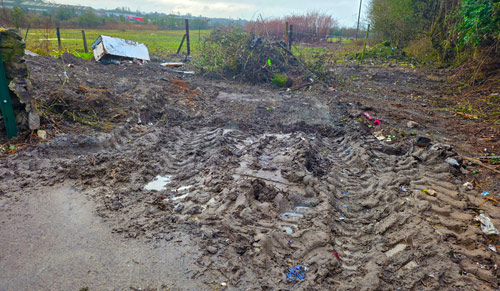
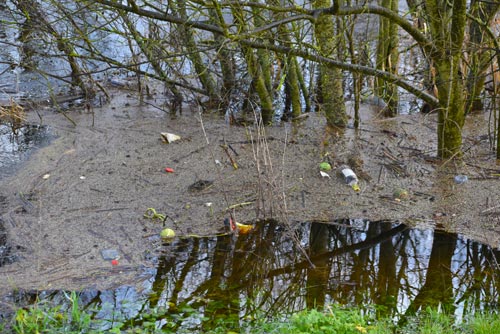
A recent abandoned attempt at cleaning the area.
Naturally, this could not be tolerated. So it became “connected”, “improved”, “enhanced”, “brought forward”, (whatever soothing verb local councillors, the local Municipal District Administrator and her officials would prefer), until all of it were “totally and wantonly obliterated”, its ancient hedgerows removed and the route flattened under heavy machinery, without so much as the courtesy of admitting what was being lost to the residents of our struggling town. Then, after much denial of its existence, with a straight face that would even shame a Victorian undertaker, it reappeared in planning language as being a “paved, pedestrian, walking route along a historical walking path”, despite being described by local councillors and politicians as not paved at all, before being levelled and left with only a temporary skin of tarmacadam.
And now we arrive at the masterpiece of their planning – “The Aftercare”.
Because nothing says “community amenity” like building a walkway and then abandoning it to rot, as if maintenance were an optional lifestyle choice, like decaf or seatbelts. The grand vision, a safe walking route on Mill Road, Thurles, tied into wider footpath plans, presented as “overdue” and “necessary”. The execution, however, appears to have followed the classic local-government model; do the ceremony; pour the tarmac; maximise the photocredit, then disappear vanishing into the mist.
So the area has now again begun its return to nature, that sacred Irish policy position otherwise known as “leaving it in a hape”. First came the willow saplings, same thrusting up through the tarmac like a botanical middle finger to uninterested municipal district officials, while rooting themselves into every crack that sheer neglect has kindly widened for them. Then arrived the briars and brambles, years of Autumn’s leaves, nettles and rank grass, all working in quiet co-operation like they’ve been awarded the contract. Soon enough, the walkway becomes less of a public route and more of a living demonstration of what happens when you build infrastructure with no real future plan to mind it, other than personal glorification.
And the litter, ah, the litter; not the dainty odd sweet-wrapper sort. No, this is the full rural-civic anthology, large plastic bags flapping like distressed flags; tyres slumped in the verge; broken wire fencing sagging like exhausted excuses. The occasional supermarket trolleys, thoughtfully dumped to ensure nobody confuses the place for cared-for land. If you’re lucky, a washing machine or two, because why wouldn’t you add white goods to a heritage corridor?
But the true flourish, the one that should make even the most hardened press-release writer blush, is how the site has been used as a stage for virtue, and then as a bin for its consequences.
In spring 2025, the area beside ‘Dun Muileann‘ on Mill Road, Thurles, became part of the One Hundred Million Trees planting push, funded locally by Allied Irish Banks’ Thurles branch, with students and the odd idle volunteer turning up to plant a dense mini-forest, using the Miyawaki Method; the whole point being fast-growing biodiversity and a carbon sink. The public reporting around it speaks of over two thousand native saplings planted at the site, a serious effort, and no small gesture of community buy-in.
And then, in the sort of anticlimax Ireland has successfully perfected; those young trees are left in a space now allowed to slide into total disorder, where over the past number of months horses are permitted to trample through the plantings that were meant to be protected long enough to establish themselves. A “green space”, promised and photographed, now reduced to a patch of scruff and horse manure, where the only thing thriving is the evidence of nobody being responsible.
That’s the moral of it, really, the fetish for the new, paired with the total inability to mind what’s then built.
Because it takes a special kind of civic arrogance to first flatten a famine-era landmark that once, literally, put bread into mouths, and then to shrug at the basic upkeep required to stop the replacement from becoming an overgrown dumping lane.
We are told, endlessly, about “heritage”, “biodiversity”, “active travel”, “community”. The words are always there; the maintenance however rarely is.
And so the Double Ditch, the real one, survives mostly as an idea: something that mattered, that was walkable, that carried memory in its stones. What’s left on the ground is the modern tribute: tarmac, blocked drains, weeds, rubbish, bent fencing, and the quiet certainty that nobody, supposedly in authority, will be held to account for any of it.
On behalf of myself, I offer my sincere apologies to Thurles Branch of AIB; (Sponsors), to MrRichard Mulcahy (Co-founder of the 100MT Project initiative) and to all those students who enthusiastically and eagerly took part in last April’s planting. Hopefully some of the trampled saplings will continue to survive, after all horse dung is a nutrient-rich organic fertilizer and soil conditioner.
We’re used to seeing Imbolc pinned neatly to 1st February. Handy, yes, but it can blur what these festivals originally were: not fixed diary dates, but season-markers tied to what people could observe overhead and around them.
Imbolc – Saint Brigid’s Day
In the old Gaelic seasonal rhythm, four great festivals sit at the “hinges” of the year, Samhain, Imbolc, Bealtaine and Lughnasadh, each signalling the beginning of a season. Imbolc, in particular, sits in that brightening stretch about halfway between the winter solstice and the spring equinox.
So when is Imbolc in 2026? If you define Imbolc astronomically as the midpoint between the December solstice and the March equinox, it doesn’t always land on the same calendar day. In fact, it generally falls somewhere between 3rd–6th February, depending on the year.
For 2026, we can anchor the calculation using the exact solstice/equinox instants:
December solstice (2025): 21 Dec, 15:03 UTC. [ UTC– Co-ordinated Universal Time ]
March equinox (2026): 20 Mar, 14:46 UTC.
That places the midpoint in the early hours of today 4th February 2026 (UTC), which means: 4th February in Ireland, while it can still be 3rd February in parts of the Americas, depending on time zone.
And if you’re reading this “down under”; some modern seasonal calendars flip the Wheel-of-the-Year festivals to match local seasons, so you’ll sometimes see Lughnasadh (the harvest hinge) marked instead.
Why does it “clash” with St Brigid’s Day? Because modern life likes fixed dates. Over time, Imbolc became closely associated with early February observances such as St Brigid’s Day (1st Feb) and Candlemas (2nd Feb), a blending of seasonal tradition and church calendar that made sense culturally, even if the astronomical midpoint drifts a little year to year.
What does “Imbolc” actually mean? Here’s the honest and interesting answer; we’re not 100% sure, and scholars have offered more than one plausible thread. “In the belly”: A common explanation traces Imbolc/Imbolg to Old Irish i mbolg (“in the belly”), often linked to pregnancy in livestock and the returning promise of life. Milk: Cormac’s Glossary (early 10th century) offers Oímelc, explaining it as “ewe milk”, though modern linguists often treat that as a later “made-to-fit” explanation rather than a definitive origin story. Cleansing: Another scholarly proposal links the word to ideas of washing/purification, which fits neatly with late-winter customs like tidying, clearing out, and preparing for spring work.
Either way, the feel of the season is clear; this is the turn toward light, the first real loosening of winter’s grip, a time of readiness, renewal, and “getting things in order”.
Stone Age Ireland was watching too: One of the most striking things about these seasonal hinge-points is how deep they seem to go in the Irish landscape, beyond medieval texts, beyond “Celtic” labels, and back into the Neolithic. At the Mound of the Hostages on the Hill of Tara, the passage alignment is such that the rising sun illuminates the chamber around Imbolc and again around Samhain. And the monument itself is ancient, built between roughly 3350 and 2800 BC, long predating the later royal and mythic fame of Tara, and long predating the arrival of Celtic culture in Ireland.
Whatever name people used, whatever language they spoke, they were clearly paying close attention to the turning year.
A simple way to mark “astronomical Imbolc”. If you want to honour the sky-timed moment (without arguing with the calendar), try something easy and meaningful:
Step outside at dawn (or just early morning) and notice the light, even a few minutes.
Do one small “spring clean”: a drawer, a shelf, the car, the inbox.
Light a candle, a nod to returning brightness and to the season’s links with Brigid and Candlemas.
Happy Imbolc, whenever you mark it, and happy hinge-of-the-year to anyone celebrating the season from the other side of the world.
While the Suir silts up and sewage claims persist, Tipperary’s “solutions” look like optics-first spending, paid for by the public, twice over.
The Flooding “Solutions” Scam: Councils Let Rivers Choke, Then Sell Us Flood Barriers.
We’re being asked to accept flooding as inevitable. Each time the water rises, we’re told it’s “unprecedented”, that there’s nothing to be done, and that the only answer is another costly flood barrier, another engineered scheme, another grand capital project.
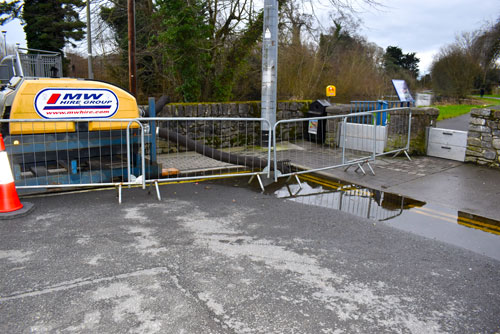
Although flood barriers are in place here and pumps are operating on Emmet Street, Thurles, flooding continues as water is rising through wastewater drains on the street surface, before being pumped again into the swollen river. In these circumstances, surface barriers offer little or no protection. Pic: G. Willoughby.
But for many towns, the more uncomfortable truth is this: a significant part of the problem is neglect, plain, predictable, year-after-year neglect, and it sits squarely with local authorities and the agencies they work alongside.
When river channels and outfalls are allowed to silt up, narrow, and clog, the river loses capacity. Water backs up sooner. “Manageable” rain becomes road flooding, business disruption, and damaged homes. That is not an act of God, it’s an act of governance.
Maintenance isn’t glamorous, so it gets skipped. Routine river maintenance is boring. It doesn’t lend itself to ribbon-cutting. It requires surveys, schedules, repeat work, and public reporting. And that’s exactly why it’s so often pushed down the list. Instead, we get the shiny alternative; manufactured flood barriers, the visible, photogenic, capital-heavy answer. They may have a place in specific settings, but far too often they’re treated as a substitute for basic poor river stewardship. Even professional bodies that caution against dredging as a universal fix still accept the basics: increasing channel conveyance can help reduce levels in smaller, more frequent floods. The key is that it must be targeted and properly managed, because indiscriminate dredging can speed flows and shift risk downstream. So nobody credible is demanding a reckless “dig everything” policy. What people are demanding is far more reasonable:
Why are we spending vast sums on barriers when the river’s basic capacity is being allowed to deteriorate in the first place?
Thurles: Tarmac by the river, while sewage flowed in plain view. Nowhere is the contradiction more glaring than in Thurles, Co. Tipperary.
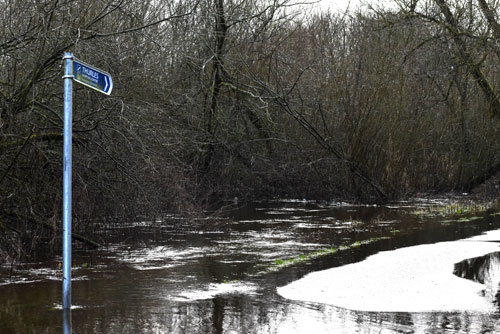
Flooded new Thurles tarmac pathway, while a tangle of willow trees and low, leaning branches stretch across the water, effectively blocking and constricting its flow. Pic: G. Willoughby.
In April 2022, a public district meeting heard claims that “raw sewage” was flowing into the River Suir along the extended Riverwalk area. The report quoted a councillor saying he had pictures and describing it as disgusting.
Read that again carefully: The issue wasn’t hidden away in a remote field. The allegation was that sewage was entering the river along the very walkway being promoted as an amenity. Then, in March 2024, a Thurles-based TD publicly questioned Uisce Éireann about discharges of raw sewage into the River Suir, in Thurles, and in September 2025, further local reporting again described sewage and pollution concerns in the town centre stretch. So let’s stop pretending this is a mere “perception issue”. If a town is paving and polishing riverside paths while the public is seeing (and smelling) pollution in the water, that’s not regeneration. That’s cosmetic spending beside a neglected system.
You also raise an accusation many locals will recognise: that some works were pushed through to use up available funding, especially after another walkway plan failed to materialise. I can’t independently prove the motive — but the pattern is familiar: when capital money appears, councils can scramble to spend it quickly on visible works, while harder, messier problems (pollution sources, maintenance regimes, enforcement) are left to drag on.
Stationary filth and litter in abundance as Thurles Municipal District provides river-side seating, without even one litter bin being placed in the vicinity. Pic: G. Willoughby.
Funding announcements don’t equal progress: In November 2025, a funding allocation of €447,300 for an extension of the Thurles River Suir walkway was publicly announced under the ‘Outdoor Recreation Infrastructure Scheme‘, including a planned looped walk.
Here’s the question that should be asked at every launch and photo-call: What is the point of extending a riverside amenity if the river itself is being allowed to degrade, and if flooding repeatedly makes sections unusable anyway? Local reporting at the time of that funding announcement explicitly linked renewed frustration to ongoing flooding and calls for proper maintenance of the river.
Who should be held responsible? Start with the council: This is where the gloves come off. Tipperary County Council cannot keep presenting flooding as a surprise while communities can see, year after year, the tell-tale signs of avoidable risk: silting, blocked channels, overgrowth, neglected outfalls, and the creeping sense that nobody is minding the basics.
And when the response defaults to barriers and big-ticket projects, rather than a published maintenance programme, people are right to feel played. Yes, extreme weather is real. But neglect is real too. And neglect is optional.
What Thurles (and every town) should demand now: If councils want to be taken seriously, the minimum standard should be:–
A published annual maintenance schedule for key watercourses: inspections, targeted desilting, vegetation management, debris clearance, and outfall/culvert checks, with dates and locations.
Before-and-after surveys at known pinch-points showing what capacity was restored and what risk was reduced.
A public pollution action list: identify suspect outfalls, state ownership/responsibility, publish remedial timelines (with named leads across council and Uisce Éireann).
A rule of priorities: no more “path-first, river-later” optics. If the water is compromised, fix the water first.
Independent oversight and reporting, including engagement with the Environmental Protection Agency and catchment structures like LAWPRO, which has recently hosted public discussions where concerns about the Suir around Thurles were raised.
And one final point: agencies such as the Office of Public Works can fund schemes and design defences, but if local maintenance and accountability are missing, we will keep paying twice: first in flood damage, then again in erecting flood barriers.
In the words of Forrest Gump, “Stupid is as stupid does”, meaning a person’s intelligence is defined by their actions and behaviour, rather than their appearance, reputation, or perceived abilities.
Again Three Questions: (1) Why have Rates in Tipperary increased by 5%? (2) Why are we forced, yes forced, to pay property tax on houses we worked hard to purchase, from already taxed incomes? (3) Why do we continue to elect and pay local councillors who make absolutely no contribution in dealing with the problems existing in our respective areas, while officials really make the decisions.
See link to PDF declaration HEREshowing salaries and expences over a 3 month period (12 weeks), of between €10,300.00 and €15,500 each.[Note: €15,500÷ 12 =€1 291.66 in costings per week, while double jobbing, per Tipperary Co. Council].
If we’re serious about flooding, stop buying flood barriers as being the first answer. Start with the river itself. Start with proper maintenance. Start with the truth.
This website uses cookies to improve your experience. We'll assume you're ok with this, but you can opt-out if you wish.AcceptRead More
Privacy & Cookies Policy
Privacy Overview
This website uses cookies to improve your experience while you navigate through the website. Out of these, the cookies that are categorized as necessary are stored on your browser as they are essential for the working of basic functionalities of the website. We also use third-party cookies that help us analyze and understand how you use this website. These cookies will be stored in your browser only with your consent. You also have the option to opt-out of these cookies. But opting out of some of these cookies may affect your browsing experience.
Necessary cookies are absolutely essential for the website to function properly. This category only includes cookies that ensures basic functionalities and security features of the website. These cookies do not store any personal information.
Any cookies that may not be particularly necessary for the website to function and is used specifically to collect user personal data via analytics, ads, other embedded contents are termed as non-necessary cookies. It is mandatory to procure user consent prior to running these cookies on your website.








Recent Comments