|
|
Volunteers taking part in the North Tipperary Volunteer Fair, held in Thurles Shopping Centre this evening, report the event as being an excellent public relations exercise for their various organisations.
This event, which was funded by the European Commission, was successfully organised by North Tipperary Volunteer Fair Steering Committee, led by the Europe Direct Information Centre here in Thurles Library.
Hundreds of shoppers stopped off to the various stands, who proudly explained their goals and the magnificent work being carried out by each of the organisation represented.
A wide variety of stands displayed their wares, including GIY, ICA, Thurles Fairtrade, Tipperary Regional Youth Service, Irish Girl Guides, Upperchurch-Drombane Development Association, Cabragh Wetlands, Irish Pilgrimage Trust, Rainbows, Thurles Toast Masters, Cava, An Taisce, Hidden Tipperary, St.Mary’s Famine Museum, Thurles Special Needs and many more.
Other similar Fairs will take place this month in Damer Court Hotel in Roscrea on Saturday 23rd from 12.00-3.00 p.m. and Nenagh Arts Centre on Sunday 24th from 12.00-3.00 p.m.
Congratulations to Ann Marie Brophy, Executive Librarian, here at Thurles Library for her excellent organisation of this event and to the many who pledged assistance goes the thanks of the organisations involved.
When food scraps were left out for some of our local feathered friends recently, some unexpected guests arrived.
Let’s meet Mrs Rowena Rat and her eldest daughter Rita, courtesy of regular subscriber to Thurles.Info, Mr Michael Bannon, (Thanks Michael.) who forwarded this rare close-up video clip to us for editing and sharing.
The Brown Rat or Common Rat, (Rattus Norvegicus) is one of the best known of rats found in Ireland. This brown rodent lives wherever humans live, in both rural and urban areas and in the absence of humans, prefer damp environments such as river banks. The animal came to Europe possibly from central Asia and most likely China.
One of the largest of the super family of rodents, which includes hamsters and gerbils, the common rat displays a brown or grey fur coat, while the underparts are lighter grey or brown. The rodent has a body length of up to 25 cm (10 ins) long, with a similar tail length. The species is a true omnivore and will consume almost anything, but cereals form a substantial part of its diet.
The brown rat can breed right through the year, with females producing up to five litters each year. The gestation period for a female rat is just 21 days and litters can number between six and fourteen in total. Rats do groom each other and usually sleep together in burrows. It’s life span can be up to three years, but most of them rarely survive past one year of age, due to human, other animal predators and inter-species conflict. Their yearly mortality rate is estimated as high as 95%.
Brown rats have very acute hearing, and are sensitive to ultrasound. Adult rats can emit ultrasonic vocalizations in response to predators or other perceived danger, which is unheard by the human ear. However they can also produce communicative noises capable of being heard by humans. Usually they are more active at night, but as this video confirms, they will also hunt during daylight hours. These rodents are also excellent swimmers, both on the surface and underwater.
Brown rats may carry a number of pathogens which can result in disease, such as the dreaded Leptospirosis (Weil’s Disease,) Rat Bite Fever, Cryptosporidiosis, and Viral Hemorrhagic Fever. Brown rats however are mistakenly believed to be a major reservoir for Bubonic Plague. Rats are normally very shy creatures, but in the wild will bite as a last resort of defence, if it feels cornered.
The brown rat is kept as a pet in many parts of the world e.g. United States, United Kingdom and Australia in particular, with countries forming Rat Associations similar in nature to our Kennel Clubs, which promote responsible pet ownership.
This video was captured on a Flip HD Video Camera ideal for capturing nature, upclose and personal.
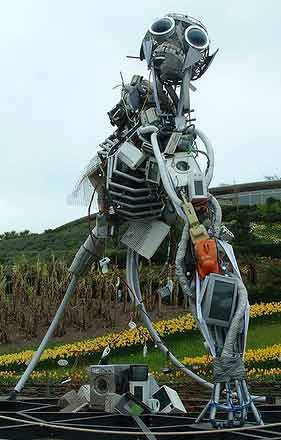 Our recent post on Illegal Dumping and Weee collection here in Thurles, forces Thurles native Proinsias Barrett to put ‘pen to paper ‘ or should I say, in his case, ‘fingers to keyboard.’ Our recent post on Illegal Dumping and Weee collection here in Thurles, forces Thurles native Proinsias Barrett to put ‘pen to paper ‘ or should I say, in his case, ‘fingers to keyboard.’
More is the pity that others of our discerning readers do not follow suit, (Hint, Hint ) and express their views, remembering the quote by Irish political philosopher Edmund Burke “All that is necessary for the triumph of evil is for good men to do nothing.”
(Note: Leave a Comment tag is directly under each daily Post and we do really love hearing your views.)
Proinsias Comments:
“Where do we recycle unwanted politicians, or indeed unsuccessful former City Council Managers?
In Ireland Seanad Éireann is a good hiding place for rubbish politicians. They can keep their heads down and draw a good salary, or as recently mentioned in a national press article, they can decide to slip away to spend more time with their outrageously generous pensions…. and reminisce on all those great deeds they performed for the sake of Ireland. City Council Managers who presided over numerous fiasco’s simply find a gullible County Council to take them on as ‘County Managers‘, it’s great!
I see Thurles now has a third recycling bin added lately, a brown bin for food waste and garden clippings, grass etc. We got the full three bin system here in Galway City back in 2000/2001 and in general we are told is working out well enough. But where is this ‘fly-tipping ‘ (illegal dumping) epidemic emanating from? Obviously there are people who don’t subscribed to any collection service and these facts are well known by Councils. If a household is not signed up to a collection service then what are they doing with their rubbish?
The simple remedy for this situation is to ensure that everyone is subscribing to a collection service, and if they are not then it is up to the Council to find out why? If it is for financial reasons, then some arrangement has to be made with these ‘go-it-alones‘ until such time as the three bin system evolves and recycling achieves an 80% re-use rate and charges are substantially dropped for the household. Recycling will have to become just another routine in everyone’s life.
But I have always disagreed with the flat charge for household waste collection. From the first introduction of the wheelie bin system here in Galway a decade ago, I submitted my ideas to the City Council (for all the interest they showed) when the public was invited to submit ideas relating to waste management etc. If households are properly separating their refuse, with intent, into the corresponding bins, the only charge on the household should be on the land fill bin, the one which contains items which cannot be recycled.
I went so far as to suggest that if households comply completely with recycling directives and recommendations, they should be paid for the raw materials they are giving the collection companies every week for free.
The Recycling industry is obviously a financially viable one, else no-one would be in the business. Why charge for what is essentially a raw material being collected and re-used (paper, cardboard, plastic, tin etc)
Again it’s a case of just not following through on introduced legislation. People are left to their own devices as usual. There are no inspectors (yep, bin inspectors, we had them in Galway for about two months when the bins were first introduced, then removed due to a lack of funding). Still almost twelve years on from the recycling initiative in Galway many apartment complexes are still operating a communal skip system … just throw in your black plastic sack full of everything and off it goes to land fill, and the Council aren’t interested. Some apartment dwellers share a three bin system with their neighbours resulting in one apartment making huge efforts to recycle everything and their neighbour dumping black sacks of mixed refuse into which ever bin appears least used.
Without a common sense approach backed up by information, encouragement and finally enforcement, our recycling system here in Ireland is becoming another half hearted attempt, handed over to private operators, and now there is a multinational demanding that an incinerator be opened at Poolbeg in Dublin which will require massive tonnage to ensure viability, this is a complete reversal of recycling initiatives…. one hand doesn’t seem to know what the other is doing! Oh Man! “
The arrival of just one new born baby, in any home, is an expensive occasion, especially in recessionary times, what with Pay Cuts, Rising Food Prices, Universal Social Charges and high Unemployment.
Imagine therefore the problems experienced by Thomas and Theresa Thrush, resident here in Thurles, when quadruplets arrived on Easter Sunday last, taking up residence in their one roomed mud dwelling.
It’s hard going, feeding four babies, whose mouths are constantly open, demanding to be fed, as the video hereunder demonstrates, however the parenting skills of Thomas and Theresa seem to be “up to the mark,” despite having no previous experience in child care.
Here in Ireland the Song Thrush (Turdus Philomelos) is a very common bird, usually found breeding in forests, gardens and parks. It is easily identified by its brownish upper-parts and black-spotted buff underparts.
The female Song Thrush builds a cup-shaped nest, beginning in the month of April. The nest is usually lined with mud and dry grass and on occasion these materials can include bits of twine and plastic paper, e.g. sweet wrappers that she finds lying about. The nests are usually found in tall hedges,trees or hidden in creeping plant such as Ivy, and approximately six feet above ground level.
Theresa this year laid four bright glossy blue eggs which were lightly spotted with black / purplish markings. She incubated her eggs, alone, for 15/16 days with occasional daily visits from her husband Thomas. The four fledgelings now born, are continuing to thrive, but their biggest threat, here in an urban setting over the coming days, will come from domestic cats and magpies.
Thomas and Theresa Thrush are both omnivorous, eating a wide range of invertebrates, but especially insects, earthworms and snails, as well as most soft fruit and berries. Garden pests such as snails are an important part of their diet during times of drought or harsh weather. These birds often use a favourite stone as an “anvil,” to smash the snail before extracting the soft fleshy interior, which it invariably wiped on the ground to remove bits of shell casing, before consumption. The Thrush can be easily observed skipping along the grass in search of food, with its head tilted to one side, since its eyes are on the side of its head.
It is easy to identify a Song Thrush by its sound which has repeated musical phrases. Indeed in the poem by the romantic poet, William Wordsworth, entitled “The Tables Turned,” he refers to the sound of the Song Thrush, and writes:
“Hark, how blithe the throstle sings, And he is no mean preacher,
Come forth into the light of things, Let Nature be your teacher.”
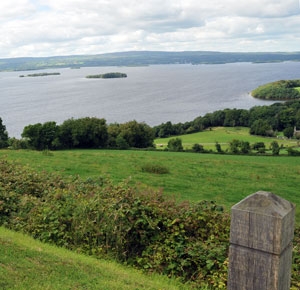 Part of Tipperary's Lough Derg shore line. The Shannon Protection Alliance will hold a public meeting next Thursday, April 28th at the Lough Derg Yacht Club in Dromineer.
The purpose of this meeting is to raise awareness and if possible also establish another branch of its group which are currently opposed to controversial plans by Dublin City Council to extract massive volumes of water from the river Shannon.
This proposed water extraction scheme is an attempt to boost dwindling water supplies in Ireland’s capital. The proposed plan is to extract water from Lough Derg, the largest of 3 lakes on the Shannon River, at the rate of 350 million litres per day, via a reservoir and treatment plant to be situated near Portarlington.
The Shannon Protection Alliance, which was founded at a public meeting in Athlone on April 20th 2007, state that this water extraction equates to the amount of water which leaks from the present day Dublin piped water system.
This €470 million scheme, if put into effect, would see water pumped from Lough Derg to the Dublin region and to other commuter towns along its path.
However according to Shannon Protection Alliance chairman Mr Gerry Siney, the scheme is unnecessary and the highly controversial plan has not considered the needs of local communities living along the Shannon /Tipperary border and any implementation would immediately effect the future economic development and ecosystem of this mid-west region.
As many people as possible are invited to attend and make their views known at the meeting on Thursday next.
|
Support Us Help keep Thurles.info online by donating below. Thank you.
Total Donated 2026: €300.00
Thank You!
Daily Thurles Mass Livestream
|



Recent Comments