Sinn Féin, like Father Murphy, will attempt to “Spur up the rocks with a warning cry”, here in Thurles.
There is no doubt that households in Thurles, across Tipperary, and throughout Ireland are under real pressure. Electricity bills, grocery prices, rents, mortgage repayments, insurance, childcare and transport costs have all eaten into family budgets. Nobody in Government should dismiss that. But equally, nobody in Opposition should pretend that reliefs, credits, freezes and subsidies come without a cost.
That is the part of the cost-of-living debate that too often gets lost. The crisis Ireland has faced was not invented in Leinster House, Dublin. It came from a series of international shocks; the aftermath of Covid-19, supply-chain disruption, the surge in gas and oil prices, Russia’s invasion of Ukraine, higher food and fertiliser costs, and interest-rate rises across the eurozone. Ireland, as a small open economy, cannot simply opt out of global energy markets or European monetary policy. The Government can cushion the blow, and it has done so, but it cannot abolish reality.
Budget 2026 shows the Government trying to do that difficult balancing act. It increased most weekly social welfare payments by €10, increased Fuel Allowance by €5 per week, extended the 9% VAT rate on electricity and gas to the end of 2030, extended the Rent Tax Credit, and adjusted the USC band so minimum-wage workers would not be pulled into the higher rate because of the minimum-wage increase. These are not slogans; they are practical measures aimed at helping people, while keeping the public finances under control.
That is the difference between responsible government and permanent protest. Government has to decide not only what people would like to receive, but how it is paid for, who pays for it, and what is sacrificed elsewhere.
Sinn Féin’s alternative budget proposed a €2.5 billion cost-of-living package, including €450 energy credits, a double child benefit payment, higher welfare and pension increases, rent measures and the abolition of USC on the first €40,000 of income. Those proposals may sound attractive when listed at a public meeting. Who would not like lower bills, higher payments, lower taxes and cheaper rent? But politics is not a wishing well. A €2.5 billion package must be funded by someone.
And that “someone” is usually the worker, the taxpayer, the business owner, or the next generation.
If the State pays for broad energy credits, the money comes from taxation, borrowing, or less spending elsewhere. If taxes are raised on “someone else,” they rarely stay neatly confined there. Business taxes can affect investment and jobs. Higher taxes on workers reduce take-home pay. Borrowing passes today’s relief bill to tomorrow’s taxpayers. Cutting or delaying spending elsewhere means less money for housing, schools, hospitals, roads, disability services, Garda resources, water infrastructure and energy investment.
This is why the Government is right to be cautious about turning every pressure into a permanent spending commitment. Ireland’s public finances look strong on paper, but independent watchdogs have repeatedly warned that the headline figures hide real risks. The Irish Fiscal Advisory Council warned in June 2026 that Ireland remains heavily reliant on corporation tax from a small number of foreign-owned multinationals. It also said that, excluding excess corporation tax, the State is forecast to have an underlying deficit of €11 billion this year. That means we are not as flush with money as some political speeches expected from Sinn Féin suggest.
The same watchdog warned that most corporation tax receipts are being spent rather than saved, with only €1 in every €6 being set aside under the Government’s plan. It also warned that spending growth is running faster than the sustainable growth rate of the economy. These are not Fine Gael or Fianna Fáil talking points. They are warnings from Ireland’s independent fiscal watchdog.
The Central Bank has also warned that Ireland faces downside risks to exports and corporation tax receipts if US tax or industrial policy changes, with possible effects on investment and incomes. In plain English, the tax money we are relying on today may not be guaranteed tomorrow.
That is why the Government cannot responsibly govern as though every surplus is permanent and every demand can be met by writing another cheque.
Of course, Opposition parties will always say more should be done. That is their job. But there is a danger in turning every genuine hardship into a rallying cry against the State. Public meetings can easily become exercises in stirring-up anger, rather than solving problems. The old cry of “Arm, arm” may be poetic, but it is not an economic policy. Ireland does not need a politics that spurs up resentment while avoiding the hard question: who pays?
The responsible answer is that support should be targeted, temporary where possible, and affordable. Help should go to those most exposed: pensioners, carers, low-income workers, families with children, people with disabilities, and households facing energy poverty. But permanent giveaways funded by unstable revenues or future borrowing are not compassion. They are deferred taxation.
The Government’s position should be defended because it recognises both sides of the truth: people need help, but the State must remain solvent; households need relief, but workers cannot be taxed into the ground; today’s pressure is real, but tomorrow’s taxpayers also matter.
There is no such thing as free cost-of-living relief. There is only a choice about who pays, when they pay, and whether politicians are honest enough to admit it.
Ireland needs action, yes. But it also needs prudence, honesty and responsibility. Demanding everything immediately may win applause in a public meeting. Governing requires asking whether the applause today becomes the tax bill tomorrow.
Thurles (Templetuohy Region) Named On EPA Drinking Water Remedial Action List Q4 Of 2025.
Five areas in Co. Tipperary appear on Remedial Action List; Thurles (Templetuohy); Kilcash; GalteeRegion; Clonmel Poulavanogue; Carraig-On-Suir.
The quality of drinking water from public supplies continues to be high, with 99.8% of samples compliant with standards.
The EPA’s list of ‘at-risk’ supplies has decreased from 45 supplies in 2024 to 35 supplies in 2025, serving 467,000 people.
The number of boil water notices and water restriction notices both increased during 2025, impacting almost 200,000 people.
The Environmental Protection Agency (EPA) today published its Drinking Water Quality in Public Supplies 2025 report, which shows that Ireland’s drinking water continues to meet high standards for over four million people. Compliance with microbiological limits reached 99.8%, while chemical standards were met in 99.7% of samples analysed, which means our public water is safe to drink.
Despite this good level of compliance, the EPA has identified a list of ‘at-risk’ supplies – the Remedial Action List (RAL) – where improvements are required to ensure a safe and secure drinking water supply for consumers. Ten ‘at-risk’ supplies were resolved during 2025, reflecting sustained progress by Uisce Éireann in upgrading their drinking water treatment infrastructure. However, 35 public water supplies still remain on the Remedial Action List at the end of 2025 and must be addressed as soon as possible.
Launching the report, Mr Patrick Byrne, EPA Director of the Office of Radiation Protection and Environmental Monitoring, said: “Public drinking water quality remains high, so people can be confident that the water supplied to their homes is safe to drink. While the EPA welcomes the reduction in the number of ‘at-risk’ supplies, EPA audits and enforcement continue to identify supplies which cannot guarantee safe and secure drinking water. Uisce Éireann must allocate necessary resources to complete the required upgrades at ‘at-risk’ supplies to ensure drinking water remains safe and public health is protected into the future.”
Water restrictions must be imposed by Uisce Eireann to protect human health when they cannot provide safe drinking water due to contamination or inadequate treatment. In 2025, 100 supplies affecting almost 200,000 consumers were impacted by boil water notices or water restriction notices, an increase from 84 supplies in 2024. Uisce Éireann must improve treatment plant resilience to respond to changing weather conditions, raw water quality or malfunctions in the treatment process, so that water restrictions are not needed in the first place.
Regarding water restrictions on drinking water supplies, Mr Noel Byrne, EPA Programme Manager, said: “It is worrying that almost 200,000 people were affected by water restrictions in 2025. While necessary to protect public health, they are a considerable inconvenience for consumers and point to a lack of resilience in water treatment. Uisce Éireann must make water treatment plants more robust, so they can withstand treatment challenges and continue to provide a safe water supply for consumers. Where restrictions are necessary, Uisce Éireann must respond quickly so that a compliant water supply is restored as soon as possible.”
The EPA’s report also highlights wider challenges across the supply network, including the level of leakage and the replacement of lead pipe work. Thirty six percent of treated water is lost daily through leakage, and people continue to be at risk from exposure to lead in drinking water due to lead in water pipes. More action is needed by Uisce Éireann and other stakeholders to address these issues in the supply network.
Ann (Anne) Marie Blyth, the singer and Oscar-nominated actress remembered for her unforgettable performance as Veda Pierce in the 1945 classic Mildred Pierce, has died at the age of 98.
Ann Blyth (1927–2026). R.I.P.
The Hollywood Golden Age star died of natural causes on Wednesday, according to US media reports.
Blyth became widely known as Joan Crawford’s spoiled and scheming on-screen daughter in Mildred Pierce, a role she played as a teenager. Her performance earned her an Academy Award nomination for Best Supporting Actress and helped make her one of the standout young stars of the era.
The film also brought Crawford the only Oscar of her career, for Best Actress, and remains one of the defining melodramas of 1940s Hollywood.
Born Ann Marie Blyth in Mount Kisco, New York, on 16 August 1928, Blyth began performing at a young age, first as a singer and stage performer before moving into films. Her soprano voice later helped her move naturally into musical roles.
Across the 1940s and 1950s, she appeared in a wide range of films, including Brute Force, Mr Peabody and the Mermaid, The Great Caruso, One Minute to Zero, The World in His Arms, The Student Prince, Kismet and The Helen Morgan Story.
Her career was briefly halted after she suffered a serious back injury in a toboggan accident, but she later returned to the screen and continued to work in film, theatre and television.
After stepping away from cinema in the late 1950s, Blyth made occasional television appearances, including roles in The Twilight Zone and Murder, She Wrote. Her final screen appearance came in a 1985 episode of Murder, She Wrote.
Blyth was married to James McNulty from 1953 until his death in 2007. The couple had five children. In 1973, she and her husband, both Roman Catholics were accorded the honorific rank of Lady and Knight of the Holy Sepulchre in a ceremony presided over by Cardinal Cooke.
She now leaves behind her a legacy as one of the last stars of Hollywood’s Golden Age, remembered for her grace, versatility and a chilling performance in Mildred Pierce that remains a landmark of classic American cinema.
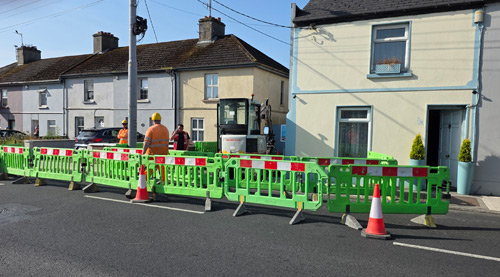
Residents and motorists using Kickham Street, Thurles, Co. Tipperary, faced fresh disruption this morning after crews moved in to carry out further fibre/telecoms-related works along the street.
Newly installed footpaths ripped up yet again, with no notice of single lane Stop & Go traffic delays by Tipperary Co. Council; by Virgin Media or by WhiteKight Civils & Utilities latter undertaking the work.
The works, understood locally to be connected with Virgin Media infrastructure, involved barriers, cones and a mini-digger fitted with a jackhammer operating immediately outside homes and businesses. The activity has caused concern among residents, particularly as the pavements affected were only newly installed in recent weeks.
Locals claim no written warning or advance notification was given to householders before machinery arrived. Residents also expressed frustration that one of the busiest routes into and out of Thurles was reduced to a single lane, creating delays and raising fears of heavier congestion later in the day, particularly when parents travel to collect children from local schools.
Concerns have also been raised about the manner in which the works were being carried out. Residents reported personnel operating in a confined roadside area, with traffic moving nearby, while householders said vibrations from the jackhammer caused homes to shake. Some also complained of difficulty contacting Tipperary County Council, with one resident claiming it took roughly 20 minutes to get through, but without receiving any satisfactory clarification. Directly on a triple junction personnel have no radios and no con saw, resulting in stop signs not in use and an incessant vibrating high pitched hammering sound.
This latest disruption follows earlier concerns reported on Thurles.info regarding fibre/telecoms cabling repairs and the lack of written notice to affected homeowners. That earlier report also highlighted questions around responsibility, communication and delays linked to fibre infrastructure in the area.
The immediate issue for Kickham Street residents is not simply the inconvenience of roadworks. It is the apparent lack of communication, the repeated disturbance to recently completed public footpaths, and the effect on householders, pedestrians, businesses and motorists.
With evening school traffic expected to add further pressure, motorists are advised to avoid the Kickham Street area where possible and use alternative routes until the works are completed.
Residents are now calling on Tipperary County Council and Virgin Media, or their appointed contractors, to explain why newly laid pavements are being disturbed, why householders were not notified in advance, and when the street will be fully restored.
People’s awareness levels of Radon and associated health risks is declining, says the EPA.
Radon gas is Ireland’s largest source of radiation exposure and is a leading cause of lung cancer.
A new EPA survey of attitudes toward radiation showed awareness of radon gas has dropped from 82% in 2020 to 71% in 2025.
More than half of respondents were unaware of the link between radon and lung cancer. Even when people are aware of radon gas, fewer than half are likely to test their homes.
The most significant sources of radiation exposure in Ireland arise from natural radiation in the environment, including radon, and medical exposures. However, people are more concerned about nuclear facilities abroad and damage to the environment.
The Environmental Protection Agency (EPA) today published the findings of a national survey on attitudes to radiation in Ireland. Over a thousand adults were surveyed, on behalf of the EPA, to understand public awareness of, and concerns about, radiation.
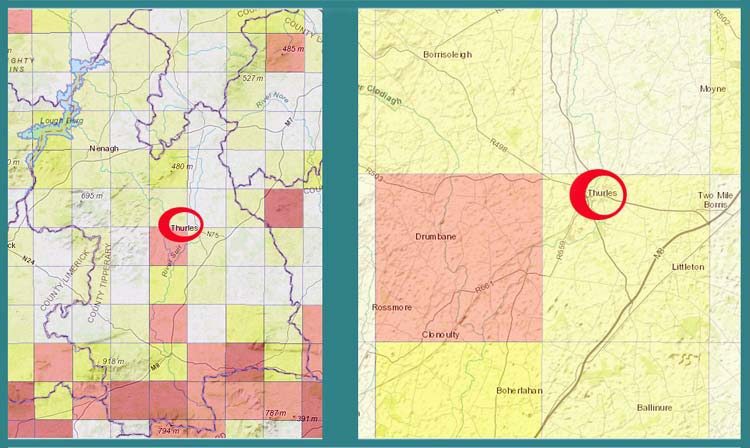
The survey indicates that only 31% of respondents are concerned about radiation. Worryingly, the findings revealed the level of awareness of radon had dropped from 82% in 2020 to 71% in 2025. Radon gas is Ireland’s leading source of radiation exposure. It accounts for more than half of the radiation dose received by the Irish population and is the leading cause of lung cancer, after smoking. Radon gas can enter your home from the ground through small cracks in floors and through gaps around pipes or cables.
The survey found most people are:- ► Not concerned about the health risk of radon. ► Unaware that radon exposure is linked to lung cancer. ► Unlikely to test their home for radon levels.
Commenting on the survey, Mr Patrick Byrne, (EPA Director of the Office of Radiation Protection and Environmental Monitoring), said: “The EPA is concerned to see a decline in radon awareness, and the continued reluctance among householders to test their homes. We found that many believe that their property is not affected. This is particularly worrying given that radon is our largest source of radiation exposure and a leading cause of lung cancer. Testing for radon in your home is simple and we urge all households to take this step to protect themselves and their families. It costs about €50 and the EPA website has a list of companies that supply the monitors. Reducing you and your family’s exposure to this harmful gas can be achieved using simple and effective methods.”
The survey found that one of the top radiation-related concerns was how nuclear facilities abroad affect Ireland. Dr Kevin Kelleher, (EPA Senior Scientific Officer), responded to this, noting: “Although our survey indicates public concern over such facilities, our research indicates that a nuclear emergency abroad would not have a significant radiological impact on Ireland. However, it is reassuring to see that the public would follow guidance from Government and expert bodies in the event of such an emergency.”
The National Radon Control Strategy which is led by the Department of the Climate, Energy and the Environment, brings together departments and state agencies to take action to reduce radon risk. The EPA will use the findings of this survey to strengthen its awareness work under the Strategy to drive testing and remediation to reduce radon risk to people’s health.
This website uses cookies to improve your experience. We'll assume you're ok with this, but you can opt-out if you wish.AcceptRead More
Privacy & Cookies Policy
Privacy Overview
This website uses cookies to improve your experience while you navigate through the website. Out of these, the cookies that are categorized as necessary are stored on your browser as they are essential for the working of basic functionalities of the website. We also use third-party cookies that help us analyze and understand how you use this website. These cookies will be stored in your browser only with your consent. You also have the option to opt-out of these cookies. But opting out of some of these cookies may affect your browsing experience.
Necessary cookies are absolutely essential for the website to function properly. This category only includes cookies that ensures basic functionalities and security features of the website. These cookies do not store any personal information.
Any cookies that may not be particularly necessary for the website to function and is used specifically to collect user personal data via analytics, ads, other embedded contents are termed as non-necessary cookies. It is mandatory to procure user consent prior to running these cookies on your website.




Recent Comments