Met Éireann has issued a ‘Moderate Weather Advisory’, for Co. Tipperary as exceptionally warm weather is forecast across Ireland this week.
Temperatures possibly reaching 30°C. Daytime temperatures are expected to rise above 27°C in many areas, with temperatures possibly reaching 30°C on Thursday. Nights will also remain very mild and humid, with temperatures generally staying above 15°C. This may lead to uncomfortable sleeping conditions, particularly for older people, young children, those with health conditions and anyone living in homes that are difficult to keep cool.
Thunderstorms. Thunderstorms are also possible, especially on Thursday, and conditions may change quickly. Residents are advised to keep an eye on the latest forecasts and official updates from Met Éireann through the met.ie website or app.
Take extra care around water. The warm weather may increase the number of people visiting lakes, rivers, beaches and other bathing areas. Please take extra care around water. Swim only where it is safe to do so, supervise children closely at all times, and never enter the water after drinking alcohol.
Check in on vulnerable neighbours, family members and friends, especially those living alone. Heat stress is another potential risk during this spell of warm weather. Drink plenty of water, avoid overexertion during the hottest part of the day, wear light clothing, use sunscreen and seek shade where possible.
Pet owners should also take precautions. Make sure animals have access to shade and fresh water, and never leave pets in parked vehicles, even for a short time. Outdoor workers and sports groups should consider breaks, cooler start times and access to drinking water throughout the day where possible.
This advisory is a reminder to enjoy the fine weather safely and responsibly. Please plan ahead, stay hydrated, avoid unnecessary risks near water, and continue to monitor official weather updates over the coming days.
There has been little change in water quality indicators in 2025. Overall water quality remains unsatisfactory in many areas.
Excess nutrients from agriculture and wastewater remain the greatest challenge to water quality improvements, with phosphorous and nitrate levels still too high in many of our waters.
Some areas show improvements which is promising, but these are being offset by declines elsewhere. The scale and pace of implementation of actions to protect and restore water quality needs to be increased.
The message could not be clearer, and it should be a wake-up call for every community living beside a river in Ireland, including those of us along the River Suir.
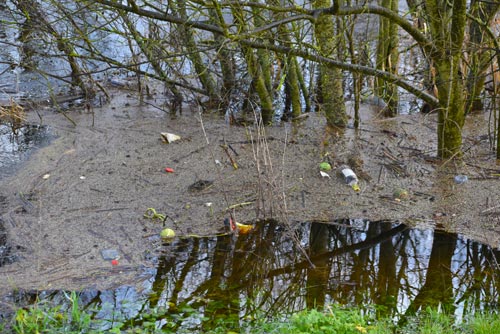
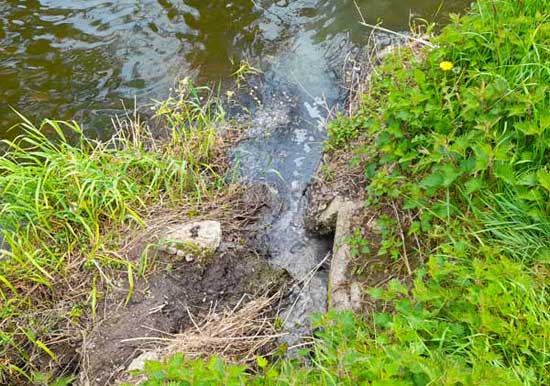
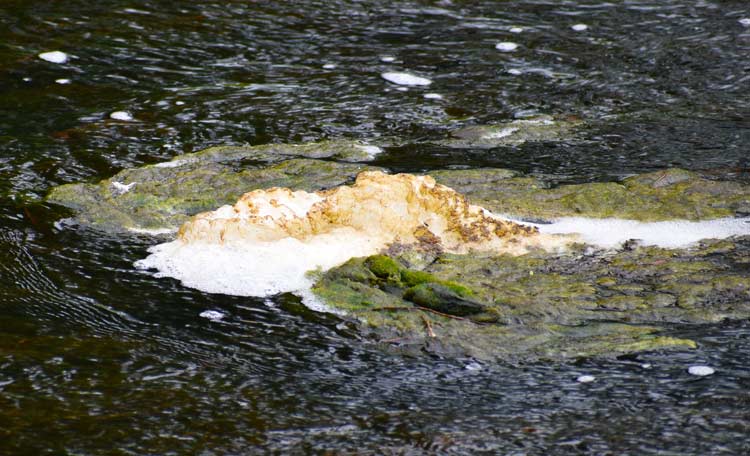
The EPA’s Water Quality in 2025: An Indicators Report shows that there has been little change in water quality indicators in 2025, with overall water quality still unsatisfactory in many areas. Nutrient levels remain too high in a large proportion of water bodies, and slightly more than half; 54% of rivers and lakes are in good or better biological quality. So the question must be asked locally: why is the River Suir still being neglected? For the past 14 years, we have heard promises, plans, meetings, schemes, visits and announcements, but the visible condition of parts of the Suir, particularly around Thurles, remains totally unacceptable.
River Suir, Thurles, Co. Tipperary. Pic: G. Willoughby.
On 25 May 2026, Tipp Mid West Radio reported that North Tipperary TD Mr Michael Lowry said he was submitting a funding application for works on the River Suir between Templemore and Ballycamas. That announcement is indeed welcome, but it also raises a very simple question: after so many years of concern about the condition of the Suir, why are we still at the stage of applications, announcements and proposed works?
We are also told that the Government has amended the Minor Works Scheme, that Tipperary County Council has been allocated €150,000 for river conveyance works, and that funding applications of up to €2 million may be made to cover remedial works. Mr Lowry has said he will work with Cllr Micheál Lowry to progress a plan for the River Suir, and Minister Kevin “Boxer” Moran is expected to visit Thurles to view the river’s condition. That is welcome, but it cannot become yet another photo opportunity, followed by another decade of delay.
The EPA is clear that excess nutrients from agriculture, wastewater and run-off remain the greatest challenge to improving water quality. It has also said that while some areas are improving, those gains are being offset by declines elsewhere, and that the scale and pace of action must increase.
LAWPRO is working across the wider River Suir catchment to reduce damaging discharges, while community groups and Rivers Trust initiatives are encouraging local people, landowners and stakeholders to get involved in protecting the Suir and its tributaries. That community involvement is important, but communities cannot do this alone.
The missing ingredient for the River Suir is not more talk, it is delivery.We need clear answers:
► What works will be carried out? ► When will they begin? ► Who is responsible for delivery? ► Has the funding application now been submitted? ► What section of the river will be prioritised first? ► How will pollution and damaging discharges be reduced? ► How will progress be measured and reported publicly?
River Suir, Thurles, Co. Tipperary. Pic: G. Willoughby.
The River Suir is one of this region’s greatest natural assets. It should not be treated as an afterthought. Clean water supports biodiversity, public health, recreation, tourism, farming, fishing and local pride.
After 14 years of discussion, the people of Thurles and the wider Suir catchment area deserve more than statements of concern. They deserve action, visible funded and accountable.
Ireland must accelerate investment in reliable public transport and EV infrastructure to reduce emissions and exposure to fossil fuel shocks, says Climate Change Advisory Council.
Transport remains Ireland’s largest source of energy demand, accounting for 42.3% of total final energy demand in 2024 and 21.8% of national emissions.
Transport emissions fell by only 1.3% in 2024, while the sector is estimated to have exceeded its first sectoral emissions ceiling (2021-2025) and is projected to exceed its second sectoral emissions ceiling (2026-2030) if urgent action is not taken.
The Climate Change Advisory Council has warned that Ireland’s dependence on fossil fuels in transport is leaving people, businesses, public services and the wider economy exposed to repeated fuel price shocks, as geopolitical instability continues to disrupt global energy markets.
Launching the Transport chapter of its Annual Review 2026 today, the Council said Ireland must reduce this exposure by accelerating investment in public transport, active travel, electric vehicle charging infrastructure and the grid capacity needed to support cleaner transport.
The Council says recent temporary emergency responses to fuel price increases have not been sufficiently targeted. It recommends that Government addresses the regressive components of emergency measures and introduce targeted supports within the transport sector for those most exposed and least able to avoid fuel costs, while maintaining planned carbon tax increases and continuing to ring-fence revenues for climate action and a just transition.
The Council is calling for targeted measures to increase EV uptake among lower-income households, particularly in areas with limited access to public transport and high car dependency. The Government’s recent pilot ICE2EV grant to incentivise the purchase of new electric vehicles by owners of 13 year or older fossil fuel cars is welcome.
In the review, the Council also warns that Ireland needs to accelerate the expansion of EV charging infrastructure, including the real time mapping of EV charging points to give people and businesses confidence in the alternatives to fossil fuel use.
However, continued grid constraints and charging infrastructure gaps are hampering Ireland’s ability to fully embrace electric vehicles. Publicly accessible charging infrastructure remains well below the EU average, while further investment is needed to support the electrification of cars, buses, school transport and commercial fleets.
Public transport passenger journeys increased by 6% in 2025, with TFI Local Link services recording a 19% increase. However, largely unchanged passenger journey data across some bus, rail and Luas services may indicate that parts of the public transport system are operating close to capacity.
The Council is calling for increased funding for public transport and for existing Public Service Obligation services in Budget 2027. Accelerated delivery of priority projects such as DART+ South West, Luas Finglas and the National Transport Authority’s Park and Ride Investment Programme are necessary to increase capacity and to cater for the projected population growth in these areas. Ireland must deliver a modern, reliable and cost effective public transport system to encourage commuters out of their cars and onto lower emission alternatives.
The Council also warns that Ireland’s transport network must be made more resilient to extreme weather. Storm Chandra and prolonged rainfall in early 2026 exposed the vulnerability of road and rail infrastructure, underlining the need for climate risk to be built into transport planning, investment and design standards.
The Council is also calling for the updated National Ports Policy to be finalised and published, for greater investment in climate-resilient regional and local roads, and for vulnerable sections of the rail network to be assessed and climate-proofed.
Mr Alex White, (Chairperson of the Climate Change Advisory Council), said: “Fossil fuel shocks are not one-off events. As long as Ireland remains heavily dependent on petrol and diesel for transport, people, businesses and public services will remain exposed to global price volatility and geopolitical crises. The way to reduce that exposure is to give people real alternatives. That means sustained investment in public transport, a charging network people can rely on, and the grid capacity needed to support the switch to electric across cars, buses and commercial fleets. This transition also has to be fair. Supports should be targeted at those most exposed to transport fuel costs, particularly people on lower incomes and those who are car-dependent because they do not have access to practical alternatives. The Government has set the right ambition to end Ireland’s reliance on fossil fuels, the test now is delivery.”
In the middle of a housing crisis, it is unacceptable that Tipperary County Council collected not one wafer-thin copper cent in derelict property tax in 2024.
Across the country, millions in derelict-site levies remain uncollected while homes lie idle, streets are blighted, and families continue to wait for secure housing. Tipperary was reportedly the only local authority in Munster not to collect any derelict property tax in 2024/25.
Even Tánaiste Mr Simon Harris has now acknowledged the failure, saying the new derelict property tax is being driven by frustration at the lack of action and that local authorities have not done enough to tackle dereliction. If Government itself can see the system is failing, then Tipperary County Council must explain why no derelict property tax was collected here in 2024 while so many people remain in housing need.
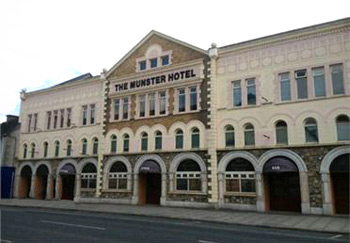
The derelicteyesore that is the Munster Hotel, Thurles, Co. Tipperary.
This is not good enough. Derelict and vacant properties are not just an eyesore. They are a wasted public resource at a time when people are struggling to rent, young families cannot buy, and many are waiting years for social housing.
In Tipperary alone, 1,358 households were recorded in 2024 as qualifying for social housing support whose need was not being met. The latest homelessness figures also show 98 adults in emergency accommodation in Tipperary during one week in April 2026.
What are our sleepy Municipal District Councillors & Politicians doing to correct this situation?Answer – Absolutely Nothing. Every suitable derelict property should be identified, pursued, taxed where appropriate, and brought back into use. Where owners refuse to act, the Council should use every legal power available, including compulsory purchase orders where necessary.
A housing crisis demands action, not excuses. Tipperary needs enforcement, accountability, and urgency. Leaving homes idle while people are desperate for housing is indefensible.
We learn that the Government is preparing to introduce a new Derelict Property Tax across 107 cities and towns, with plans to expand it further to 171 locations.
The stated aim is to bring long-term derelict buildings back into use, restore communities and create more homes. On paper, few people would disagree with that goal. Dereliction is a blight on towns, villages and city streets across Ireland and here in Thurles, Co. Tipperary, one only has to look at the Munster Hotel on Cathedral street, to fully understand the negligence in fulfilling same obligation.
Munster Hotel, Thurles, Co. Tipperary.
But there is a bigger question here: how much more can people and property owners be taxed before Government admits that taxation has become its default answer to every problem? We already have property taxes, vacant property measures, levies, charges, stamp duty, planning costs, compliance costs and endless layers of bureaucracy. Now, once again, the solution being offered is yet another tax.
The new Derelict Property Tax will replace the current Derelict Sites Levy, which is charged at 7% of the market value of a property, and the new rate is expected not to be lower. In other words, this is not a light-touch measure. It is another significant financial burden, this time once again to be administered by Revenue.
Munster Hotel, Thurles, Co. Tipperary.
Of course, owners who deliberately allow buildings to rot, while communities suffer should be held accountable. No one wants to see usable homes and buildings left idle during a housing crisis. But the Government must also recognise that not every derelict property is being held by a wealthy investor or speculator. Some are tied up in probate, in legal disputes, planning delays, lack of services, structural costs, family circumstances or impossible refurbishment expenses.
Punishing everyone with another tax risks missing the real issue. Ireland does not need a Government that simply keeps finding new things to tax. It needs a Government that removes barriers, speeds up planning, supports realistic refurbishment, cuts red tape and makes it financially possible to bring properties back into use. Success should not be measured by how much money Revenue collects. It should be measured by how many buildings are restored, how many homes are created and how many communities are revived.
If this tax becomes just another revenue stream, then it will be another example of a Government that taxes first and solves later.
This website uses cookies to improve your experience. We'll assume you're ok with this, but you can opt-out if you wish.AcceptRead More
Privacy & Cookies Policy
Privacy Overview
This website uses cookies to improve your experience while you navigate through the website. Out of these, the cookies that are categorized as necessary are stored on your browser as they are essential for the working of basic functionalities of the website. We also use third-party cookies that help us analyze and understand how you use this website. These cookies will be stored in your browser only with your consent. You also have the option to opt-out of these cookies. But opting out of some of these cookies may affect your browsing experience.
Necessary cookies are absolutely essential for the website to function properly. This category only includes cookies that ensures basic functionalities and security features of the website. These cookies do not store any personal information.
Any cookies that may not be particularly necessary for the website to function and is used specifically to collect user personal data via analytics, ads, other embedded contents are termed as non-necessary cookies. It is mandatory to procure user consent prior to running these cookies on your website.







Recent Comments