An Coimisiún Pleanála’s decision to push back its ruling on Uisce Éireann’s massive Shannon water abstraction project is not just a planning delay. From a Tipperary perspective, it is a crucial breathing space.
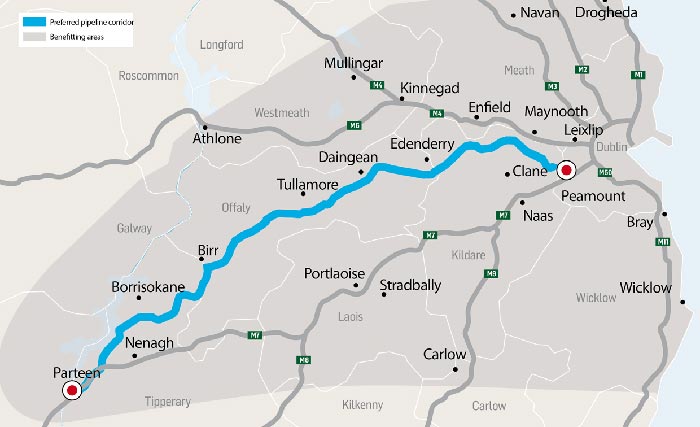
The proposed Water Supply Project for the Eastern and Midlands Region would see more than 300 million litres of water a day abstracted from the River Shannon at Parteen Basin, below Lough Derg, before being treated and piped across the country to serve the Midlands, the east and the Greater Dublin Area. It has been described as the largest water infrastructure project in the history of the State, with estimated costs in the region of €4.6 billion to €5.9 billion.
For communities in north Tipperary, this is not an abstract national infrastructure debate. The intake point is at Parteen Basin, and the project includes a major treatment plant close to the extraction point in Co Tipperary. That means local people are being asked to host the front end of a project whose main benefits will be felt far away, particularly in Dublin and the wider eastern region.
Uisce Éireann argues that the project is critical to providing a safe, secure and resilient water supply for up to 50% of the State’s population. It says planning permission has been lodged with An Coimisiún Pleanála and that the project is central to future housing, population growth and economic development. Those are serious national objectives, and nobody in Tipperary should dismiss the need for proper water planning.
But a project of this scale cannot be waved through simply because Dublin needs water. The Shannon is not just a line on an engineering map. It is an ecological, recreational, economic and cultural resource for Tipperary, Clare, Limerick, Galway, Offaly and many other communities along its course. Any long-term abstraction must be judged not only by what it delivers to the east, but by what it risks taking from the west and midlands.
The fact that 114 submissions have been made to An Coimisiún Pleanála shows the level of public concern. Environmental groups have warned about climate, ecological and sustainability risks, while business groups have urged approval on the basis of security of supply. That divide is exactly why the Commission is right to take more time.
The new decision deadline, now expected before July 2nd 2027, should be used properly. It should not become a procedural pause while the same assumptions remain in place. It must allow for deeper scrutiny of the project’s environmental impact, climate resilience, cost, alternatives, local consequences and long-term governance.
Tipperary needs clear answers. How will Lough Derg and the lower Shannon be protected during drought conditions? What guarantees will there be that abstraction levels will not damage habitats, fisheries, tourism or water quality? What permanent benefits will host communities receive? How will local voices be represented after construction begins? And what happens if the project costs rise beyond current estimates?
There must also be a fairer national conversation about water conservation. Before rural and regional communities are asked to carry the burden of supplying the east, the State must show that leakage reduction, demand management, rainwater harvesting, wastewater reuse and sustainable urban planning have been pursued with real urgency.
This delay is therefore welcome, not because Ireland does not need infrastructure, but because infrastructure must be done right. Tipperary should not be treated as the convenient source for a Dublin solution. The county has a legitimate stake in the future of the Shannon and deserves more than reassurances.
An Coimisiún Pleanála now has time to examine the evidence fully. Uisce Éireann has time to answer local concerns openly. Government has time to prove that this is part of a balanced national water strategy, not simply another example of regional resources being redirected towards the capital.
The Shannon belongs to the communities who live with it every day as much as it belongs to the State. If this project is to proceed, Tipperary must be heard, protected and respected from the very start.
Tipperary is set for a prolonged spell of very warm or hot weather this week, lasting into next week, with heatwave conditions expected.
Daytime temperatures are forecast to widely exceed 25°C, with values possibly climbing into the high 20s or low 30s in places from Friday. The UV Index is expected to be high to very high, so please take care if spending time outdoors.
Warm and humid nights are also expected, with night-time temperatures remaining at 15°C or higher. Some areas may even experience tropical nights over the weekend. There is also a chance of thunderstorms later in the week.
Please keep up to date with the latest forecasts and warnings from Met Éireann at met.ie, and follow safety advice from Water Safety Ireland and relevant Government updates.
Is the weather actually becoming more extreme? – R. Saravanan
Potential impacts include: ► Increased water safety risks due to more people using rivers, lakes, waterways and beaches ►Uncomfortable sleeping conditions, especially during warm and humid nights ►Heat stress and dehydration, particularly for older people, vulnerable people, young children and pets ►Possible disruption to public transport ►Animal welfare concerns ►Potential drought concerns ►Increased risk of wildfires and forest fires
Please check in on neighbours, family members and anyone who may be vulnerable during the hot weather. Stay hydrated, avoid the strongest sun where possible, use sun protection, and take extra care around water.
Do please watch the attached video above for more information on understanding extreme weather.
Thurles has great history, strong community spirit and huge potential, but like many towns, it can sometimes look tired because of small things left unattended.
Grass and weeds growing out of pavements. Untidy frontage outside homes and businesses. Litter caught along kerbs. Faded and decaying walls, neglected planters, shabby entrances and streets waiting for overstretched council workers to get to every corner.
Maybe the answer is not to wait. Maybe the answer is for each of us to look after the few metres outside our own front door. That is the idea that comes to mind behind the notion of a Thurles Front Door Challenge. For one day, or better still one full week, householders, businesses, schools, clubs, residents’ groups and volunteers could be encouraged to clean, weed, sweep, wash, paint, plant and tidy the visible area outside their own homes, shops, estates and community buildings.
The idea is simple: If every person improves the small patch in front of them, the whole town improves. This should not be about blame. Some people are elderly, unwell, busy, struggling or unable to manage outdoor work. In those cases, neighbours, clubs and volunteers could step in and help. It should be a positive community effort, practical, friendly and visible.
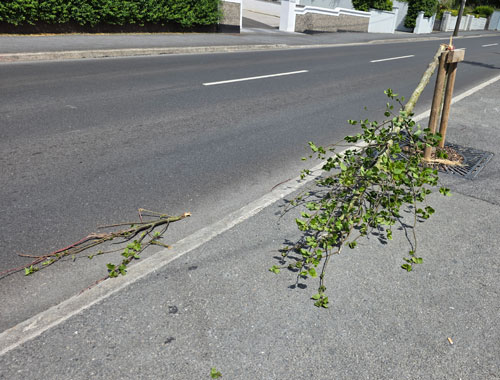
A newly planted broken tree on Dublin Road out of Thurles, left for the past number of weeks unattended.
Tipperary already has a strong base to build from. Tipperary County Council has supported Tidy Towns and community groups through grant schemes, including support for local enhancement works, and the Thurles Municipal District Tidy Towns grant scheme is aimed at recognised community and Tidy Towns groups visibly working to improve their local area. The National Spring Clean campaign also provides free clean-up kits to registered groups, including items such as bags, gloves, high-vis vests and posters. A Thurles Front Door Challenge could work alongside those existing supports, but with a sharper local focus: the front of every house, shop, street, estate and approach road.
There should also be rewards. Local businesses, event organisers and community sponsors could offer incentives such as free or reduced entry to music events, youth discos, local concerts, cinema nights or family activities for those who actively take part. A volunteer wristband or certificate could give participants a discount in participating cafés, shops or takeaways for the chosen week.
There could also be prizes for: Best Improved Street. Best Improved Estate. Best Shopfront. Best Youth Team. Best School Effort. Best Before-and-After Transformation. Best Pollinator-Friendly Frontage. Best Community Volunteer Group. Best Overall Thurles Front Door Challenge Area
Cash prizes, paint vouchers, garden-centre vouchers, planters, tools, event tickets or small street-improvement grants could all make a real difference.
A special part of the challenge should also involve Thurles Municipal District Council officials organising a review of public signs around the town; especially the enormous amount of signs that remain turned the wrong way, left facing inwards, are damaged, are hidden, or are no longer clearly visible due to overgrown hedging etc. A town can look neglected when signage is crooked, confusing or pointing nowhere. Correcting these small details would immediately improve the appearance, safety and welcome of Thurles.
The council workforce cannot be expected to be outside every door every day. But every door has someone who can care about the space just in front of them.
This is not a grand or complicated idea. It is a simple one. Sweep the path. Pull the weeds. Wash the gate. Paint the wall. Clean the window. Tidy the planter. Fix the sign. Help the neighbour.
Improve your street. That is how pride spreads. One front door at a time. The Thurles Front Door Challenge — your patch, your pride, your town.
These photographs were taken on the R659, close to and north of Mid Tipperary Co Operative Livestock Mart at Ballycurrane, Thurles, Co. Tipperary. Mid Tipp Mart describes itself as a farmer co-operative, “run by farmers for farmers,” and a major cattle-trading centre serving Tipperary and surrounding counties.
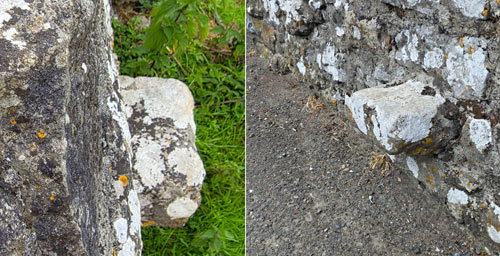
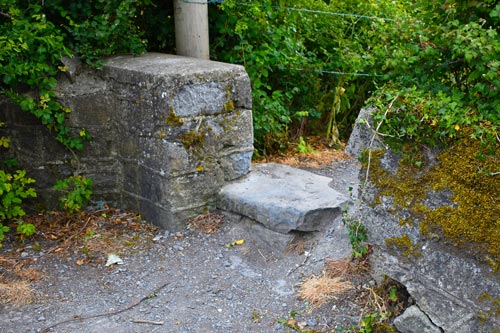
Built into this possibly early 19th-century roadside wall is what appears to be a stone stile; a simple arrangement of projecting stones that allowed a person to climb over a boundary without opening a gate. Such features were practical, durable and stock-proof. They belonged to a world of footpaths, fields, fairs, churchyards, wells and farm boundaries, where people moved on foot through a working rural landscape.
A stone stile near Mid Tipperary Co Operative Livestock Mart at Ballycurrane, Thurles, Co. Tipperary.
The wall itself cannot be dated from the above photographs alone, but its rough stone construction, weathering, lichens and traces of whitewash suggest considerable age. The projecting step stones are the key detail. They were not decorative, but functional, forming a small built-in ladder through the boundary.
Stone stiles are recorded elsewhere in Tipperary’s architectural heritage. The National Inventory of Architectural Heritage records a double stile in the boundary wall at Ballingarry Church, dated 1855–1860, and also records a random stone boundary wall “with stile” at Castletown near Coolbaun. These examples show that such modest access points were once a recognised part of the county’s built landscape.
A sadly related loss should also be remembered. On Mill Road, Thurles, a stile confirmed locally to have been built in 1846, at the beginning of the Great Famine period of 1845–1849, once stood as part of the historic landscape associated with the Great Famine now eradicated “Double Ditch.” Local reports on Thurles.info recorded warnings about the need to retain this heritage feature and later reported the destruction of the Great Famine Double Ditch area by Tipperary County Council officials and and Thurles Municipal District elected Councillors. Its loss underlines why surviving small structures like this R659 stile deserve notice before they too are dismissed as ordinary roadside stonework.
No longer in existence, the once rare stone stile; despite numerous warnings, eradicated by Tipperary Co. Council, at the entrance to the now also demolished historic Great Famine Double Ditch.
These stiles also belong to the wider Irish tradition of stone walling. Teagasc notes that Ireland has an estimated 400,000 km of dry stone walls and 210,000 km of stone-earthen banks, while in 2024 Ireland’s dry stone construction tradition was officially inscribed by UNESCO on the Representative List of the Intangible Cultural Heritage of Humanity.
This little stile on the R659 is easy to pass without noticing. But it may mark an older line of movement: a field path, a local crossing point, or an access route used before cars, marts and modern road traffic changed the rhythm of the countryside. It is a modest feature, but a valuable one; a reminder that heritage is not only found in castles, churches and big houses, but also in the small, practical details built into ordinary walls.
Ireland is set to introduce tougher penalties for littering, with on-the-spot fines increasing by €100 from September 1st 2026. The current fine of €150 will rise to €250 as part of a renewed effort to protect towns, villages, beaches, parks, green-ways and other shared public spaces.
Minister of State for the Circular Economy Mr Alan Dillon said the increase is intended to send a clear message that littering and dog fouling will not be tolerated. The move comes alongside the publication of the 2025 National Litter Pollution Monitoring System results, which show that litter levels across the country have improved.
New Support for Cleaner Communities. A new €250,000 fund is also being introduced to help local authorities keep public areas clean. Councils will be able to apply for funding to support practical measures such as extra dog waste bins and bag dispensers in places where they are most needed. Here in Thurles, a few extra bins at the lower end of the public park and river walk might encourage people from dumping directly into the river Suir.
The aim is to make it easier for responsible dog owners to clean up after their pets and to reduce the amount of dog fouling in public spaces. Local authorities will receive a circular outlining how they can apply for the funding.
Dog Fouling Enforcement Under Review. Dog fouling remains a major challenge, despite only 48 fines being issued nationwide last year. Minister Dillon said officials are examining whether DNA testing of dog droppings could help identify owners who fail to clean up after their pets.
One idea being considered is linking dog DNA samples with dog licences, so enforcement officers could trace fouling back to registered animals. However, the minister said the cost and practicalities must be reviewed before any such system could be introduced. He added that Ireland should look at examples from other European countries before deciding whether DNA-based enforcement is workable here.
This website uses cookies to improve your experience. We'll assume you're ok with this, but you can opt-out if you wish.AcceptRead More
Privacy & Cookies Policy
Privacy Overview
This website uses cookies to improve your experience while you navigate through the website. Out of these, the cookies that are categorized as necessary are stored on your browser as they are essential for the working of basic functionalities of the website. We also use third-party cookies that help us analyze and understand how you use this website. These cookies will be stored in your browser only with your consent. You also have the option to opt-out of these cookies. But opting out of some of these cookies may affect your browsing experience.
Necessary cookies are absolutely essential for the website to function properly. This category only includes cookies that ensures basic functionalities and security features of the website. These cookies do not store any personal information.
Any cookies that may not be particularly necessary for the website to function and is used specifically to collect user personal data via analytics, ads, other embedded contents are termed as non-necessary cookies. It is mandatory to procure user consent prior to running these cookies on your website.





Recent Comments