Reducing Food Waste is the Climate Action YOU can do three times a day, as well as saving you money.
Reducing food waste is one of the most effective actions you can undertake to address climate change – it’s simple, it’s free and makes a real difference. The EPA are challenging everyone to reduce food waste in order to combat climate change.
Do you stop and think when you scrape half-full plates into your waste bin; or throw away food that has been lurking at the back of the fridge?
Not only are we wasting food, but also the resources used to produce, transport and supply it. All of this waste causes unnecessary greenhouse gas emissions and scientists estimate that food waste produces up to 10% of all global carbon emissions. In terms of addressing climate change, reducing food waste is an action in which everyone can become involved.
You might be surprised to learn that reducing food waste is one of the most important day-to-day actions we can take, to tackle climate change and it won’t cost you anything. In Ireland over 200,000 tonnes of food is wasted at home, and this waste has a greater impact on the environment given the energy consumed in processing, transport, packaging and preparation. To help you to reduce your food waste the EPA have some great tips and advice, with same available to view HERE.
Ms Mary Frances Rochford(EPA Programme Manager) has stated:
“We talk about climate change and the need for action, but often it is hard to know where to start. Reducing food waste is an immediate and effective way to reduce your personal carbon footprint. If every household in Ireland takes steps to reduce their food waste, this would be a great achievement towards reducing our national footprint. We as a nation are best when we work together to tackle issues and collectively, our individual actions will make a real difference.”
More than one quarter of all food produced is wasted worldwide. Here, in Ireland, we generate more than one million tonnes of food waste every year, with same representing a carbon footprint as high as 3.6 million tonnes of carbon dioxide equivalent. The EPA has three simple steps that individuals and families can take to get started in your food waste battle:
(1) Make a shopping list, and stick to it. (2) Make the most of the food you buy; don’t forget the leftovers. (3) If and when plans change, freeze your food and use it later.
We are encouraging everyone to join us in our Stop Food Waste pledge to go a week without wasting food.
Ms Rochford added: “As part of the Climate Action Plan, Ireland has committed to halving food waste by 2030. We will do this by working with food producers; retailers and restaurants; but we also need every person in Ireland to take their own action. So make the pledge, get involved and begin to reduce the food you currently waste.”
Facing up to Climate Change: Where next for Climate Science? – EPA Climate Change Lecture Series
Dame Professor Julia Slingo will present the next EPA Climate Change Lecture as part of the National Dialogue on Climate Action. This will take place on Wednesday 20th November in the Round Room at the Mansion House in Dublin. The event will also be live streamed here at: https://bit.ly/2fR7y72. In this public lecture, Dame Julia will discuss what is next for climate science, as we tackle the climate challenges that lie ahead.
Dame Professor Julia Slingo commented: “The work of the climate scientist is never done as the science continues to evolve. Our knowledge and understanding of how the climate system works and how it’s going to change continues to depend on answering fundamental scientific questions. I look forward to delivering the EPA’s climate change lecture and setting out the ongoing role of climate science in addressing the greatest challenge of the 21st century.”
Ms Laura Burke, (EPA Director General) said,
“The role for climate science is greater than ever before, as we face the challenges of how to mitigate global warming, how to adapt to a changing climate, and how to make ourselves more resilient to weather and climate hazards. We are delighted to welcome Dame Julia Slingo, an esteemed climate scientist, to deliver the EPA’s climate change lecture and we look forward to hearing where next for climate science which continues to shape our knowledge and understanding of the climate system”.
Dame Slingo is a distinguished climate scientist and has worked in many of the leading international meteorological and climatological institutions, including a period as Chief Scientist in the United Kingdom Meteorological Office, from 2009 to 2016. She was chosen as Laureate of European Meteorological Society Silver Medal in 2017, its highest award, for outstanding contributions to meteorology and climate predictions.
Met Éireann will partner with the EPA in hosting this public Climate Change lecture by Dame Julia Slingo.
Mr Séamus Walsh (Head of Climatology and Observations in Met Éireann) stated:
“Met Éireann is delighted to co-host this event. It is a great privilege to have a scientist of Dame Professor Julia Slingo’s standing deliver a public lecture on the future of Climate Science, I would encourage anyone with an interest in Climatology to attend”.
This free event requires registration and tickets can be booked at https://bit.ly/34kqiTn. People can also follow the discussion on Twitter using the hashtag #ClimateLecture2019.
Further information: Contact Niamh Hatchell/ Emily Williamson, EPA Media Relations Office Tel: 053-9170770(24 hours) or media@epa.ie.
Repeated delays in the elimination of raw sewage are unacceptable and pose a risk to our environment and public health, according to the Environmental Protection Agency.
We are aware that raw sewage and other contaminates are flowing from some areas including the local authority sewage treatment plant in Thurles, directly into the River Suir, both up and downstream. This was confirmed back in late October of this year, by the Director of Services for Water, currently stationed with Tipperary County Council, Mr Marcus O’Connor, who finally admitted that double standards are permitted, when it comes to environmental issues affecting the River Suir here in Thurles, Co. Tipperary.
Sewage from the equivalent of 77,000 people in 36 towns and villages is being released into the environment every day without treatment. The pace of improvements needed to protect our environment and public health is too slow. Raw sewage discharges will continue past 2021 in 13 locations.
The EPA report on Urban Waste Water Treatment in 2018, only released today, shows there have been some improvements in waste water treatment in the past year, including the elimination of discharges of raw sewage from two areas.
However, the pace at which Irish Water is fixing the legacy of deficiencies in Ireland’s waste water treatment infrastructure is too slow, and many areas continue to release inadequately treated waste water into the environment. Raw sewage from 36 towns and villages is still released into our coastal waters and rivers today.
Commenting on the report Dr. Tom Ryan, (Director of the EPA’s Office of Environmental Enforcement) has stated: – “Inadequately treated waste water can pollute our environment and is a risk to people’s health. We are seeing repeated delays in providing treatment for many areas and it is not acceptable that 13 towns and villages will still have no waste water treatment by the end of 2021. Irish Water must speed up its delivery of key infrastructure.”
Mr Andy Fanning, (Programme Manager of the EPA’s Office of Environmental Enforcement) has commented that: – “The underlying problem in many cases is a lack of adequate treatment infrastructure. This is a legacy issue which must be solved by investment in new treatment systems. However, some towns that already have the necessary treatment in place did not perform as well as they should. We require Irish Water to continue to improve how it operates and maintains waste water treatment systems to get the best performance from them”.
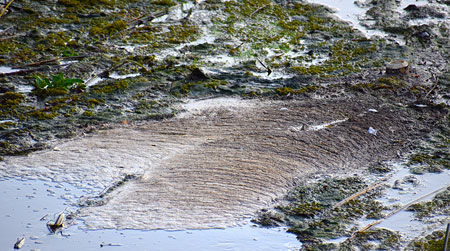
Raw sewage is flowing from the local authority sewage treatment plant in Thurles, Co. Tipperary; directly into the River Suir, downstream.
Section of River Suir beyond Cabra Bridge, Thurles, Co. Tipperary, as observed on September 19th, 2019.Photo: G.Willoughby.
The Director of Services for Water, currently stationed with Tipperary County Council, Mr Marcus O’Connor, has finally admitted that double standards are permitted, when it comes to environmental issues affecting the River Suir here in Thurles, Co. Tipperary.
As our readers will be aware, the River Suir first rises on the slopes of the Devil’s Bit Mountain, north of Templemore in north Co. Tipperary. It flows through the village of Loughmore before encountering the towns of Thurles, Holycross, Cahir, Clonmel and Carrick-on-Suir, before entering the sea in Co. Waterford.
The river stretches for some 184km in total length and less than 30km from Thurles begins a 53km stretch, now known as the Suir Blueway, strongly recommended I might add to tourists who enjoy water sports.
Tipperary Tourism – The Suir Blueway The Suir BluewayTipperary is the perfect escape for all the family to savour some of Ireland’s most beautiful countryside and fascinating history. Enjoy a paddle on flowing waters, go for a cycle along river banks, take a hike up nearby mountains, or a more sedate stroll in the bustling medieval towns and villages, from Cahir to Clonmel and on to Carrick-on-Suir. Popular with anglers, this area holds plentiful reserves of brown trout, we are informed.
Speaking on TippFM Radio this morning, Mr O’Connor stated; “It is not an everyday occurrence. There are a number of overflows and in times of high intensity rainfalls those overflows operate and you do get sewage getting into the river Suir and that’s not ideal”.
Further according to Mr O’Connor; a plan is in the design stage however the solution will be “a couple of years before anything is done on the ground”.
We understand that the Food Safety Authority of Ireland(FSAI) have again issued a recall of Celtic Pure bottled water products, due to microbiological contamination.
The Irish watchdog’s second recall of products comes after batches of Celtic Pure Water were pulled from shelves on Monday last, after they were found to contain Pseudomonas aeruginosa; Enterococci and E. coli bacteria.
Today it was confirmed that further bacteria had been detected in other additional batches. Again, Pseudomonas aeruginosa, Enterococci or E. coli bacteria were detected in implicated batches.
It should be noted that Pseudomonas aeruginosa poses a serious risk to people whose immune system has been severely compromised e.g. transplants or chemotherapy patients. The Enterococci and E. coli, contamination indicates that the bottled water has interacted with some faecal material.
The brands in question relate to Celtic Pure Still and Sparkling waters, contained in one-litre; two-litre; five-litre; 19 litre and 500ml containers. Find link to the affected brands and points of purchase HERE.
People who have already purchased the affected product are being advised not to consume same.
This website uses cookies to improve your experience. We'll assume you're ok with this, but you can opt-out if you wish.AcceptRead More
Privacy & Cookies Policy
Privacy Overview
This website uses cookies to improve your experience while you navigate through the website. Out of these, the cookies that are categorized as necessary are stored on your browser as they are essential for the working of basic functionalities of the website. We also use third-party cookies that help us analyze and understand how you use this website. These cookies will be stored in your browser only with your consent. You also have the option to opt-out of these cookies. But opting out of some of these cookies may affect your browsing experience.
Necessary cookies are absolutely essential for the website to function properly. This category only includes cookies that ensures basic functionalities and security features of the website. These cookies do not store any personal information.
Any cookies that may not be particularly necessary for the website to function and is used specifically to collect user personal data via analytics, ads, other embedded contents are termed as non-necessary cookies. It is mandatory to procure user consent prior to running these cookies on your website.




Recent Comments