Reliable sources close to Thurles.Info have confirmed that the west side of Liberty Square, Thurles, will not now be completed as part of the current promised upgrade, latter which it was hoped would be completed by early 2022.
Part of the south side (Money Side) of Liberty Square is almost fully completed, with the exception of work for which the Electricity Supply Board (ESB) is mainly responsible. This includes the removal of the old, shabby ESB lamp standards etc, on which the ESB are currently working. No further works will be undertaken, travelling west, to the entrance to Slievenamon Road and finishing outside Executive Men’s Wear.
On the north side (Sunny Side) of Liberty Square, work will cease at the corner of the junction with O’Donovan Rossa Street, ( previously Pudding Lane, and Jail Street), beside AIB Bank. No lighting standards, to date, has been introduced on the North Side, with the more recent modern and attractive lamp standards introduced, removed to ‘God knows where’.
The east side of Liberty Square, running perpendicular to Barry’s Bridge and the Butler Castle; like the remainder of the overall town centre area, same over one year on, still awaits final finishes.
We are informed that work on the west side of Liberty Square, including the exit unto Westgate/ Friar Street has yet to go to tender. We also learn that Slievenamon Road is to be further street-scaped and is to be narrowed to vehicle traffic, under plans which have, as far as we are aware, not been revealed to local residents.
Tipperary County Council’s Mission Statement:
Our Vision:“To lead and deliver on sustaining, promoting and improving the social, community, cultural and economic well being of all citizens in the county of Tipperary, through a positive proactive partnership approach to service delivery.”
With parking now greatly reduced on Liberty Square, major questions are being asked by the public; latter who claim that the Liberty Square project to date, includes none of their personal recommendations, which had been requested in a survey carried out and discussed by principal British landscape architects LUC, (landuse.co.uk).
This project, to update Liberty Square, [not including the demolition of J. Griffins newsagent shop; latter which began in February, 2020] and which began in mid-August 2020, has taken to date 13 months, with work continuing non-stop during the Covid-19 pandemic. As viewers can see from the video shown above, confusion still remains (last pictures in the above slide-show taken on Tuesday last September 14th) and will continue to do so for at least another 3 months.
Two junctions; (A) Slievenamon Road / Liberty Square, Thurles and (B) Slievenamon Road / Clongower Road, Thurles. Pic G.Willoughby
Some of the questions being asked by residents and business people are as follows:-
(A) With no designated parking areas for invalided persons in the new south-sided car park, (exited via Checkpoint Charlie)and with invalid parking promised on Liberty Square; what space has been allocated for delivery trucks conveying daily goods for supermarkets, restaurants, public houses and the few other businesses, each with no alternative but to struggle on, in Liberty Square?
(B) Why has this information not been announced by local councillors through local press; through local radio and their social media outlets?
Junction at Slievenamon Road and Liberty Square, Thurles. Pic. G.Willoughby.
(C) With Liberty Square further narrowed for heavy vehicle traffic which prohibits even the opening fully of a vehicle door and the now proposed narrowing of Slievenamon Road, how are Fire Brigade Units, Paramedics and Ambulances expected to go about their most urgent business?
(D) While we are aware that taxpayer funding remains available for to complete the next western phase of the Liberty Square project and the southern Slievenamon Road project, should the few remaining businesses not yet forced out of Liberty Square, be asked to put up with yet further traffic congestion for at least another 6 to 9 months, as engineers seated in back offices, dream-up other ways of how to spend hard earned taxpayers money?
(E) With 4 very mature trees removed from Liberty Square over the past 12 months; where are the new promised trees to be planted? In the initial plans many trees were to be planted. Then in a more recent update we are informed only 6 trees are due to be installed, the variety to be sown was to be “subject to the street soil quality”. However, to date no street spaces appear to be allocated to trees, unless they are destined to replace ESB poles. So where will TDs and Councillors hang their photoshopped posters?
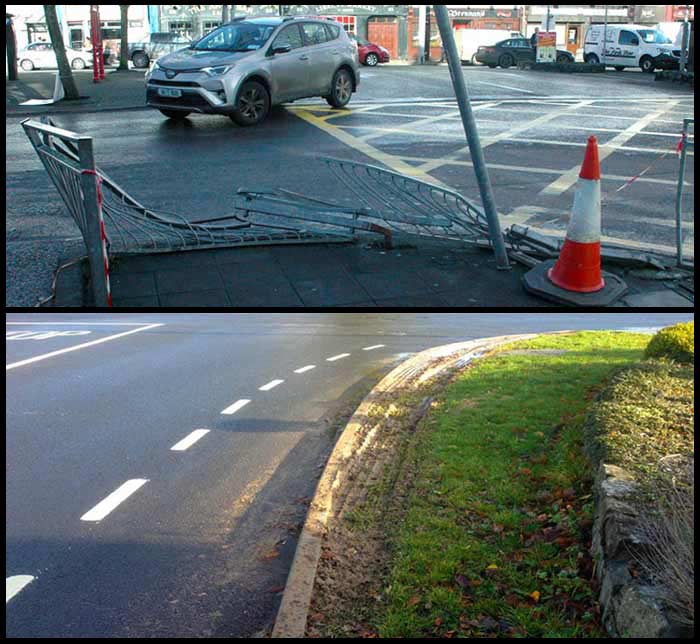
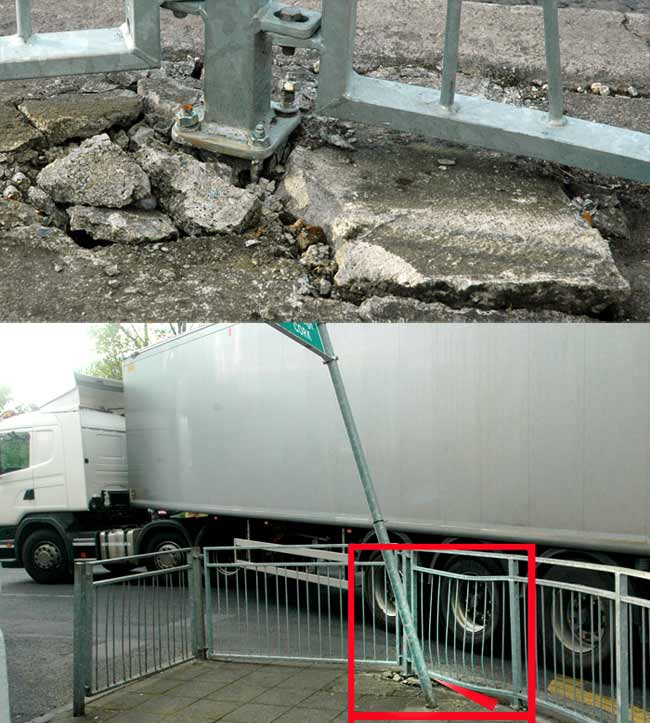
Any plans available for narrowing Slievenamon Road, will be interesting to observe, (See Pictures above) based on past experience, which saw several times a year, large trucks removing existing so called safety railings, not to mention, sadly, one fatal traffic accident in that immediate area, back in January 2014.
Finally, despite local protests, some of which became underhanded, using dirty tricks; we can fully and reasonably understand why An Post; seeing what was coming down the track on Liberty Square, regrettably beat a hasty retreat to the comfort of Thurles Shopping Centre.
EPA publishes Green Public Procurement: Guidance for the Public Sector
Minister Mr Ossian Smyth today launched the EPA’s revised Green Public Procurement: Guidance for the Public Sector at the EPA’s Circular Economy Conference 2021.
Green Public Procurement is a process where public authorities seek to source goods, services or works with reduced environmental impact.
Annual public sector purchasing accounts for up to 12 per cent of Ireland’s GDP (approximately 20 Billion Euros annually).
The public sector has the opportunity to stimulate the provision of more resource-efficient, less polluting goods, services and works within the marketplace.
This EPA guidance provides step-by-step instructions and criteria for implementing green public procurement and should be the go-to guide across the public sector when procuring goods, works and services.
Minister Mr Ossian Smyth,TD.
Mr Ossian Smyth TD, [Minister of State with responsibility for Public Procurement and eGovernment at the Department of Public Expenditure and Reform (DPER) and with special responsibility for Communications and Circular Economy at the Department of Environment, Climate and Communications (DECC)], today launched the Environmental Protection Agency’s (EPA) Green Public Procurement: Guidance for the Public Sector at the EPA’s online Circular Economy Conference 2021.
This EPA guidance provides step-by-step instructions and criteria for implementing green public procurement in line with policy and legislation for use when procuring goods and services across the public sector.
Speaking at the launch, Minister Smyth stated: “Each year the State spends billions of euro on goods and services to support the delivery of vital services to the public. Our Climate Action Plan sets out an ambition to ensure that this significant expenditure is managed in an environmentally responsible way. The Office of Government Procurement, for which I am responsible, is leading on this work through including Green Public Procurement in its framework agreements, for example by providing alternatives to single use plastics. This new guidance from the EPA will be of assistance to all public servants who find themselves procuring goods and services by providing practical support on how to include realistic and measurable green targets in their contracts with suppliers.”
The guidance is aimed primarily at those responsible for procurement in the public sector in central and local government, state agencies and other public bodies such as universities, hospitals and schools. It will also be of interest to the private sector when responding to tenders or applying green criteria in their own procurement.
Addressing the conference today, Ms Laura Burke, Director General of the EPA stated: “Green public procurement has an important role in Ireland’s move to a green and circular economy, where waste and resource use are minimised and the value of products and materials are maintained in the economy for as long as possible. The EPA Green Public Procurement: Guidance for the Public Sector supports this transition.” Ms Burke further added: “This guidance is timely with an increased focus on policy measures to expand and strengthen the usage of green public procurement. With a purchasing power of approximately €20 billion annually, the public sector has significant opportunity to stimulate the provision of more resource-efficient, less polluting goods, services and works within the marketplace by implementing green public procurement.”
The guidance forms a part of a suite of EPA supports to deliver green public procurement, which include developing and delivering green public procurement training, and monitoring and reporting on green public procurement implementation by government departments.
The EPA’s Circular Economy Conference 2021: Ireland’s move to a new economy takes place online on today and tomorrow, (15th & 16th September) and today featuring a session focussing on Green Public Procurement to coincide with the launch of the guidance.
Its Irish name is ‘Odhrach bhallach’; its Scientific name is ‘Succisa pratensis’, but you may know it as ‘Devil’s Bit Scabious’;
Devils Bit Scabious is a tall plant with rounded purple-blue flowers that resemble a pincushion. It is a close relative of the Teasel family and like its relative, it is a rich and valuable late source of nectar and pollen for insects.
Tortoiseshell butterflies feasting on the nectar of the ‘Devil’s Bit Scabious’ plant. Picture: G.Willoughby
As Tipperary wildflower and insect expert, Mr John Fogarty, explained to me yesterday; all butterflies love it as indeed do all bees, with same a major food-plant for so many insects, both as adults and larvae, attracted to its pincushion-like head. Indeed, this wildflower is the main larval food-plant of the now seriously threatened Marsh Fritillary butterfly, latter said to prefer where the ‘Devil’s-bit scabious’ plant chooses to grow.
Blue-violet Devil’s Bit Scabious growing on the Double Ditch, Mill Road, Thurles, Co. Tipperary. Picture: G. Willoughby.
Blue-violet in colour, this medium sized perennial with deep green, blotchy, oval shaped leaves can be located in marshes and pastures, brightening up areas where it flowers, (in this case on the Great Famine Double Ditch, Mill Road, Thurles, Co. Tipperary) from June to October. Sadly this plant can be scarce presently in areas where intensive farming in being carried out.
Mr Fogarty points out that the plant’s more common name ‘scabious’ comes from the herb’s traditional usage as a folk medicine to treat scabies, latter a rather itchy skin condition caused by a tiny burrowing mite called Sarcoptes scabiei. Legend states that this plant, ‘Devils Bit Scabious’ got its name due to the fact that it has an abruptly truncated, short root which folklore dictates that the Devil bit off in a fit of annoyance, at the medicinal properties of this most attractive plant.
The ‘Devil’s Bit Mountain‘, north of Thurles has no bearing on the plant’s name, but it does confirm that the Devil spent an inordinate amount of time here, over the years, in and around Thurles, with some people claiming that he has actually never vacated the area; and can be seen influencing political outcomes, during years when local and general elections occur.
More packaging waste, plus falling recycling rates for plastic, together with a heavy reliance on exports, mean that Ireland is missing opportunities to foster a circular economy.
Ireland generated over 1.1 million tonnes of packaging waste in 2019, an increase of 11% on 2018 and the third year in a row it has exceeded one million tonnes.
Largest increases were seen in the generation of plastic and paper/cardboard packaging waste.
Less than one third (28%) of Ireland’s plastic packaging waste was recycled in 2019, with almost all remaining plastic packaging being sent for incineration.
The share of plastic packaging waste incinerated for energy recovery has grown year on year from 44 % in 2017 to 69% in 2019.
We need to rethink how we make, transport and use products, cutting down on unnecessary packaging and maximising reuse and recycling.
The reintroduction of soft plastics to Ireland’s recycling list and the forthcoming deposit return scheme for plastic drinks bottles and aluminium cans are positive steps towards increasing Ireland’s collection of packaging waste for recycling.
The EPA has today published its latest figures on packaging waste in Ireland. They indicate that Ireland generated over 1.1 million tonnes of packaging waste in 2019, up 11 per cent on 2018. This is the third year in a row that packaging waste in Ireland has exceeded one million tonnes. Most of this consisted of plastic and paper/cardboard, with smaller amounts of glass, wood and metal packaging. Almost all plastic and paper/cardboard, and most metal packaging waste, was sent abroad for recycling.
The data shows that while Ireland continued to meet all current EU targets and achieved high recycling rates in some packaging material streams, in particular glass, paper/cardboard and wood, we are seeing negative trends continue in other areas. Less than a third (28%) of Ireland’s plastic packaging waste was recycled in 2019, while the share of plastic packaging that Ireland incinerates has grown year-on-year and now stands at 69 %.
The data indicate the increase in plastic packaging recycled is offset by an even greater increase in the amounts of packaging waste being generated and incinerated and, as a result, Ireland’s recycling rates have shown a generally declining trend since 2013.
Commenting on the figures, Ms Sharon Finegan, (Director of the EPA’s Office of Environmental Sustainability), has stated: “The latest EPA data highlight the need for Ireland to implement measures at policy, industry and individual level to halt the rise in packaging waste. Businesses need to place less packaging on the market. We need to rethink how we make, transport and use products and move to a system where unnecessary packaging is avoided and any remaining packaging is designed either for re-use or recycling. Policy commitments to support this shift such as those outlined in Ireland’s Waste Action Plan for a Circular Economy need to be implemented without delay”.
The data also shows opportunities for improvement as many readily recyclable plastic items, such as drinks bottles, are still being put in the general waste bin and then end up being incinerated instead of recycled.
EPA Senior Scientist Dr. Tara Higgins noted: “In 2019, over 13,000 tonnes of aluminium packaging and nearly 39,000 tonnes of recyclable plastic were sent for incineration. Improving how we separate waste at home, in businesses and on-the-go can have a big impact on Ireland’s recycling rate. Allowing soft plastics such as films and wraps into our recycling bins and new deposit-return schemes are positive actions that are now being rolled out to support an increase in the capture of high quality material for recycling into new products”.
Reversing these trends requires action, including:
implementation of the Waste Action Plan and forthcoming Circular Economy Strategy;
targeted measures to phase out packaging that is difficult to recycle , including implementation and enforcement of bans and restrictions on certain single use plastics;
Tipperary County Council’s Mattress Bonus Give-Away
Local Councillors and a Senior Executive Officer from “Environment and Climate Action”, stationed within the local Tipperary Authority, rushed out last week to announce on Facebook; on Local Radio and on local Press that an opportunity had arisen to dispose of unwanted mattresses at Civic Amenity sites across Tipperary.
With politicians on holiday, news and political self-promotional announcements, within Tipperary as a whole, were down to a mere trickle at the end of August. It was no surprise therefore that Local Radio; Local Press, together with Local Councillors, all of whom do not get out much anymore, should go into a ‘feeding frenzy’, with news of this “Super Mattress Bonus Give-Away” announcement, taking place only during the month of September 2021.
Well actually folks, readers need to read the fine print, it is only happening on 3 days during September – note 3 dates, are Friday 10th; Friday 17th and Friday 24th.
This event is being lauded as part of Tipperary County Council’s new anti-dumping initiative, with the mattresses to be taken in free of charge at Civic Amenity sites, instead of at the normal costs of €20 for a double mattress and €18 for a single.
You will remember that previously, the council, had discussed equipping themselves with MQ-9 Reaper drones to identify and annihilate fly tippers. One hoped that sufficient training would be given to councillors, when R9-X variant missiles were being used, so as to avoid collateral damage to ordinary unemployed local civilians. [Well you saw what happened recently in landlocked Afghanistan.]
OK, let’s examine the logic of this great “Tipperary County Council “September Mattress Bonus Saver”.
Firstly Remember, Thurles is the only town in all of Co. Tipperary that does not have a Council Civic Amenity Site, despite the town currently having the second largest population in the county. (Estimated Population 10,000). The result is that Thurles residents must therefore use the facilities enjoyed by other more influential upmarket towns in Co. Tipperary.
Clonmel(Estimated Population 17,500)Civic Amenity Site: Mattresses accepted only on Friday, September 17th, 2021 only from 8:30am-12:30pm and 1:00pm-3:30pm at their Carrigeen facility, Business Park, Clonmel, Co. Tipperary. The return trip to Thurles is 99 km taking approximately 90 min driving time.
Nenagh (Estimated Population 9,500) Civic Amenity Site: Mattresses accepted on Friday September 10th, 2021 only, from 8:30am-12:30pm and 1:00pm-3:30pm, at their Limerick Rd, facility, Stereame, Nenagh, Co. Tipperary. The return trip to Thurles town is 80km taking approximately 80 min driving time.
Roscrea(Estimated Population 5,500)Civic Amenity Site: Mattresses accepted also on Friday September 10th, 2021 only from 8:30am-12:30pm and 1:00pm-3:30pm at their Roscrea Civic Amenity Site, on Dublin Road, Roscrea, Co. Tipperary. The return trip to Thurles is 70km, taking approximately 80 min driving time.
Donohill Tipperary(Estimated Population 5,500)Civic Amenity Site: Mattresses accepted only on Friday September 24th, 2021, from 8:30am-12:30pm and 1:00pm-3:30pm at their Garryshane facility. Donohill, Co. Tipperary. The return trip to Thurles is 70 km, taking approximately 75min driving time.
And finally, Cashel(Estimated Population 4,500)Civic Amenity Site: Mattresses accepted only on Friday September 24th, 2021, only from 8:30am-12:30pm and 1:00pm-3:30pm at their Wallers’ Lot facility Clonmel Road, Cashel, Co. Tipperary. The return trip to Thurles is 50 km, taking approximately 45 min driving time.
Mattress Transport: Since double or indeed single spring or memory foam mattresses will not fit in most motor vehicles; a van or trailer is actually required to transport your mattress.
Then the first three questions that you need to ask yourself is:- (1) “Do I own a car or is the husband or wife gone to Dublin to work, using it”? (2) “Have I got a hitch on my car”?, and finally (3) “Do I hold a licence to tow a trailer”?
With Irish Amazon’s ‘fulfilment centre’, set to create 500 jobs, no longer coming to the Munster Hotel area in Thurles, thanks to useless self-promoting and nest feathering politicians, can the man or woman in your life inform their Dublin employer that “I need to take Friday off, to get rid of a badly stained double or single (or both), mattress“?
[Of course if you work in the Public Service, you should be OK. Unlike every other employment in our State you will be allowed, without question, to “pull a 3 day sicky” a couple of times each year, without a request for a medical practitioner‘s cert.]
Since we are informed that a maximum of 4 mattresses are only allowed per customer, how will they know that 4 mattresses were not brought to more than one Civic Amenity facility?
Will the neighbouring counties of Waterford, Cork, Limerick, Offaly, Laois, Galway and Kilkenny, jump at the opportunity to suddenly traverse our badly defended borders, using false addresses and spreading the Covid-19 virus, in their effort to rid themselves of their smudged, splattered and urine blemished mattresses?
Assuming that you now use one of the many individuals currently licenced to operate a “material recovery business”, (latter businesses of which there are many in Thurles), a brief check today confirms that one double mattress and one single, cost €40 in transport costs.
Now, I can see why people wait until after dark to dump their trash out in the wilds of Templetuohy bog; in Littleton bog or here in Thurles on the “Double Ditch”, before then setting it alight to avoid detection through letters and other paper being accidentally included; thus causing “Wild Fires”.
However, what now leaves me suffering from cold sweats late at night, is the thought that the back office individual who dreamed up this great ‘Tipperary Council Super Bonus Giveaway’, could actually get elevated to a higher station, when their next annual increment is given the “nod and the wink”.
This website uses cookies to improve your experience. We'll assume you're ok with this, but you can opt-out if you wish.AcceptRead More
Privacy & Cookies Policy
Privacy Overview
This website uses cookies to improve your experience while you navigate through the website. Out of these, the cookies that are categorized as necessary are stored on your browser as they are essential for the working of basic functionalities of the website. We also use third-party cookies that help us analyze and understand how you use this website. These cookies will be stored in your browser only with your consent. You also have the option to opt-out of these cookies. But opting out of some of these cookies may affect your browsing experience.
Necessary cookies are absolutely essential for the website to function properly. This category only includes cookies that ensures basic functionalities and security features of the website. These cookies do not store any personal information.
Any cookies that may not be particularly necessary for the website to function and is used specifically to collect user personal data via analytics, ads, other embedded contents are termed as non-necessary cookies. It is mandatory to procure user consent prior to running these cookies on your website.





Recent Comments