|
|
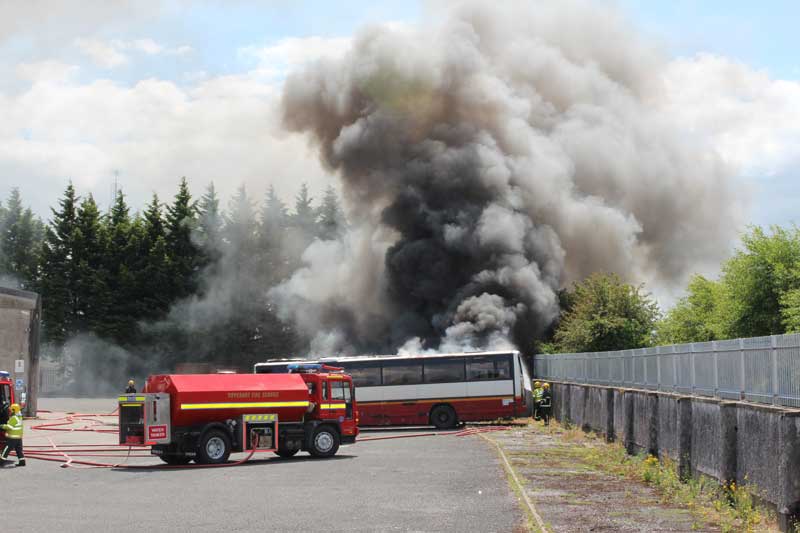
Applications are currently being invited by Tipperary County Council for the post of a ‘Part Time Fire-Fighter’ with Thurles Fire Brigade.
Note, a panel may be created from which vacancies arising during the lifetime of this panel, will be filled.
Possible annual financial income relating to this part-time position is estimated on average to be approx €22,000, and depending on the number of applications received, a short listing of candidates will be formed, same based on the information supplied on all / any forwarded application forms.
Application Forms and further particulars are available HERE and also from the Customer Services Desk or by Email from humanresources@tipperarycoco.ie.
NOTE: All Completed Application Forms must be lodged not later than 4.00 pm on Friday, 9th September 2016, with the Human Resources Section, Civic Offices, Clonmel, Co. Tipperary.
Central Statistics Office (CSO) Live Register Figures, recently published for the month of July 2016, based on the figures for the previous month, June once again have increased, all be it marginally, by 44 persons; 41 of which were added in the north of the county.
Thurles, North of the county, saw the largest increase of 44 persons, while Carrick-On-Suir, situated in the South, added a further 28 persons.
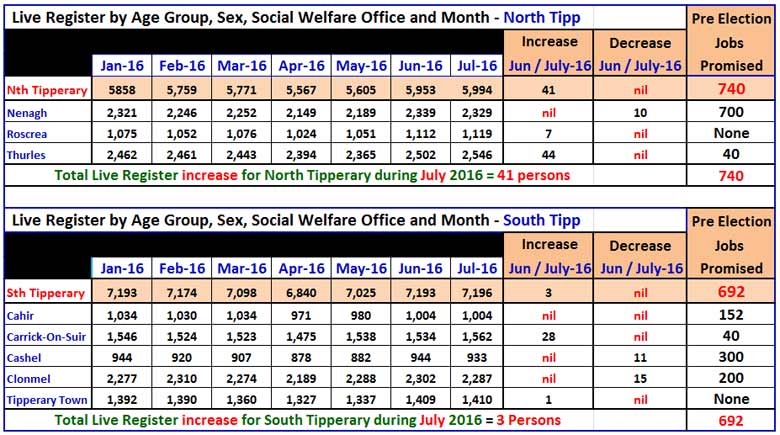
When compared with the CSO’s independent figures for January 2016; the July tally reveals that the Live Register has increased overall for Co. Tipperary as a whole, by a further 139 persons.
We note that minor decreases were recorded in Nenagh (10 persons), Cashel (11 persons), and Clonmel (15 persons), during July 2016; however of these same 36 persons removed from the Tipperary Live Register, we cannot confirm how many of same can be attributed to emigration, migration or indeed unfortunate recent deaths.
We can confirm however, that of the 1432 jobs highlighted and published by former Tipperary Minister Alan Kelly, (700 Nth Tipp & 692 Sth Tipp) in mid to late 2015 and prior to the last General Election held on 26 February 2016; no such employment prospects have as yet materialised.
The Live Register Figures, recently published for the month of June 2016, based on the similar figures for the previous month, May, show an overall increase of 516 persons extra, now depending on various Social Welfare payments in Co. Tipperary.
Note these figures shown hereunder, are accessed using the search criteria; All Ages, Both Sexes, Social Welfare Office and Month. Carrick-on-Suir was the only Social Welfare Office (S.W.O.) in Co. Tipperary last month, recording a reduction of some 4 claimants.
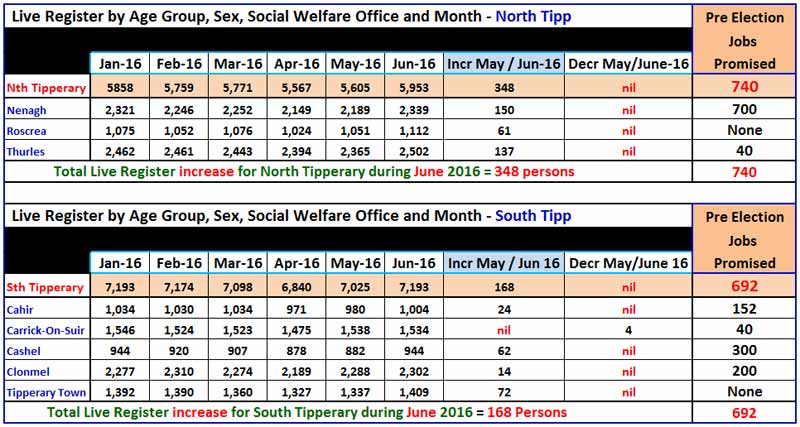
We are aware that Live Register figures are is not designed to measure employment solely, but figures provided here are most certainly a strong indication of Tipperary Urban and Rural trends.
When figures are compared using June 2016 against January 2016 statistics; for both North and South of the county, same show a disappointing rise of some 95 persons.
If we compare the combined Tipperary Live Register figure of 13,146, shown for June 2016, against the combined similar January 2015 figure of 14,176; (18 months); the figures show an overall decline of some 1,030 persons. This 1,030 figure equates to just 57.2 persons per month leaving the Social Welfare system over this same 18 month period.
According to figures from the CSO, the number of persons claiming Welfare Benefit in Co. Tipperary, have increased by 223 persons during the month of May 2016. Note these figures shown hereunder, are accessed using the search criteria; All Ages, Both Sexes, Social Welfare Office and Month.
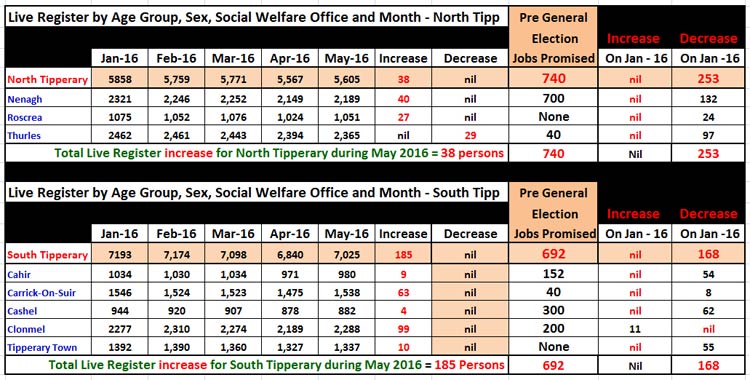
Thurles was the only Social Welfare Office (S.W.O.) in Co.Tipperary last month, recording a reduction of some 29 claimants, with Clonmel and Carrick-on-Suir recording the highest number of claimants of all eight S.W.O. centres.
Clonmel is now the only town in Tipperary which has increased its Social Welfare dependants over the past 5 months, (11 persons) with an increase of 99 persons during May and despite 200 extra jobs being promised, pre-election, for the area.
Some 1,432 jobs promised for Tipperary by Fine Gael /Labour, leading up to six months prior to the 26th February 2016 General Election, still remain elusive or non-existent.
Nationally 26,500 young people line up in Social Welfare queues every week; more than 16,000 of which remain in long term unemployment.
Lowry calls on 32nd Dáil to engage in urgent constructive debate on rural Ireland
Independent TD Michael Lowry has called for an immediate, focused and balanced debate by all elected TD’s, with regard to planning a future for rural Ireland. Commenting on recent radical proposals for Ireland’s development by Mr John Moran (Former Secretary-General at the Department of Finance), Deputy Lowry stated that he disagreed with many of the views expressed by Mr Moran, with regard to his future vision for rural Ireland.
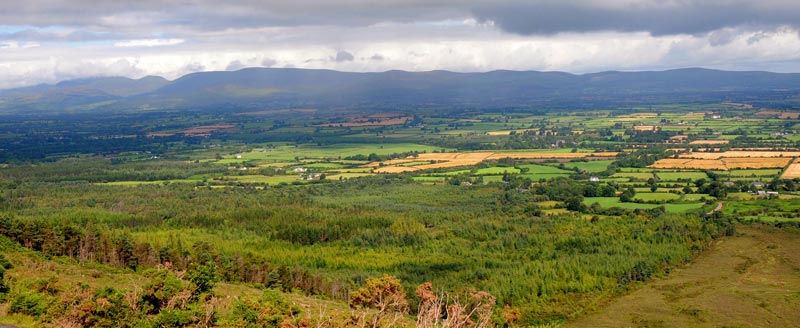
Using the comparative example of Ireland versus France; Mr Moran had declared that France was “pulling back services from less efficient parts of their country and encouraging those areas to develop a different business model.”
“How can rural Ireland attract a ‘different business model’, when such areas have been totally stripped of infrastructure and investment, with little attempt at supporting regional development. To advance a ‘different business model’ would entail a modern rural road network as part of other required infrastructure. Mr Moran appears to be unaware that the National Roads Fund decreased from €608 million in 2008 to a current figure of €294 million in 2015. In 2011 Tipperary received €45 million for roads. In 2016 this had fallen to €25 million. Also in 2015 some €439 million was made available to the semi-State utility Irish Water; taken from motor tax payment and local property tax.”
Deputy Lowry continued: “The IDA must immediately begin to invest in advance industrial infrastructure in places like Co. Tipperary; providing ready-to-go turnkey facilities with access to high-speed broadband being a priority. Neglect of infrastructure and investment in turn has had a domino effect in relation to the lack of job opportunities for a highly skilled and well educated workforce. The previous government and national agencies have done little or nothing to correct this current urban / rural imbalance. Young people are being forced to leave their homes, families and communities daily. Emigration has also had a massive impact on close local communities; particularly on sports clubs, who are suffering from decimation by the forced flight of its younger membership.
Back during the emergence of our Irish State; using our then fiscal capabilities, we established one industry after another. Ensuring not to make new developments simply localized affairs; we spread new factories as wide as possible throughout the State. This was done to avoid the problems of the over-centralization of industry; becoming part of a plan to make industry conform to the general well-being of rural areas. Same industries were predominantly placed in agricultural based areas, sharing in an industrial revival, offering work to those who otherwise would have departed via an emigrant ship. During this same period our Irish economy saw the net value of industrial products increased from over €18.25 million to over €28.25 million; while wages paid to production workers increased by €4.25 million and placed eighty thousand additional workers into steady regular employment.
Year after year, small shops, post offices and Garda Stations are shrinking. Fewer homes are being constructed, resulting in no work for builders and associated trades. Fewer children are being born; school numbers and teachers are reduced leading to inevitable school closures. The shortage of priests is leading to parishes becoming clustered with grave implications for church communities.
Urban centres must not forget that our valuable agricultural exports continue to emanate from a currently neglected rural Ireland” concluded Deputy Lowry
|
Support Us Help keep Thurles.info online by donating below. Thank you.
Total Donated 2026: €290.00
Thank You!
Daily Thurles Mass Livestream
|





Recent Comments