Tipperary County Council has approved the rezoning of 161 hectares, (approximately 397 acres), for housing at its September plenary meeting.
The changes to the county development plan took immediate effect following the vote. Public consultation had attracted more than 100 submissions.
Councillors who welcomed the changes: Mr John Crosse (Fine Gael): Highlighted the urgent need for housing across Tipperary and the opportunity for landowners and developers to deliver more homes. Mr Jim Ryan (Independent, Thurles): Welcomed the restoration of residential zoning to lands in Thurles and thanked the planning team for listening to local councillors. However he felt an opportunity had been missed for the village of Littleton.
Councillors who raised concerns during the earlier June discussions: Ms Phyll Bugler (Fine Gael, Ballina): Said she had not been given enough time to raise issues during the process. Mr Seamie Morris(Former Sinn Fein and now Independent, Nenagh): Questioned the inclusion of certain lands in Nenagh, saying they should not have been considered for housing.
This agreed rezoning now makes additional land immediately available for potential housing development, although no construction timetable or confirmed number of homes has been publicly made known.
Irish Political Pay, Expenses And Official Cars; What the Published Figures Show.
Ireland’s published salary rates put annual gross pay for the Taoiseach at €256,311, the Tánaiste at €236,427, and a Cabinet minister at €217,136.
Position.
Published Annual Gross Pay.
Ceann Comhairle. (Head of Council – Dail Speaker)
€268,522.
Taoiseach,
€256,311.
Tánaiste.
€236,427.
Cabinet Minister.
€217,136.
Minister of State attending Cabinet.
€181,573.
Minister of State.
€167,759.
Ordinary TD.
€119,467.
These figures above include the basic TD salary and any salaried allowance attached to the listed office. They are before tax and deductions.
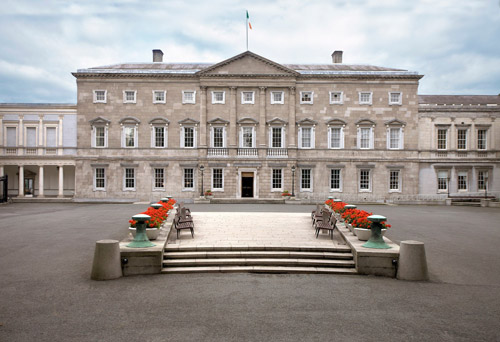
Leinster House.
Constituency and representation expenses are additional. Ordinary TDs can claim up to €20,350 annually, while ministers and ministers of state can claim up to €16,000. These allowances cover eligible work expenses, such as constituency office costs, and are subject to certification and audit. Unspent representation allowances must be repaid.
Ordinary TDs also have a travel and accommodation allowance ranging from €9,000 to €34,065, depending on the distance between their home and Leinster House and supposedly subject to attendance requirements. Ministers and Ministers of State cannot claim this allowance.
At the full allowance amounts, an ordinary TD’s salary plus these expenses totals €148,817 to €173,882 annually. A Cabinet minister’s salary plus the maximum representation allowance totals €233,136, before other eligible expenses or State-funded services. These combined amounts include money allocated for work costs.
Official transport adds a separate public cost. Freedom Of Information (FOI) reporting published on June 3rd, 2026, put the Ministerial Car Service’s cost for the preceding year at approximately €8.4 million, covering the Taoiseach, Tánaiste, ministers and other officeholders.
The reported breakdown was: ► €7.67 million for Garda driver salaries. ► €311,000 for fuel. ► €436,000 for maintenance.
The fleet contained 52 vehicles: 25 diesel vehicles, 25 plug-in hybrids and two fully electric vehicles. Purchase and disposal prices requested in that release were withheld on commercial confidentiality grounds. Certain security-related information was also withheld under Freedom of Information protections.
The available figures do not establish a complete salary, expenses, car and security total for each individual politician. The €8.4 million is a shared transport service cost; it cannot reliably be divided equally between ministers or described as their personal earnings.
An ordinary Irish TD earns €69,467 more per year than an average worker on €50,000; approximately 139% more, or 2.39 times as much. [As already stated the published basic TD salary is €119,467 annually, before tax and deductions.]
Gross Pay Comparison
Irish Worker
Ordinary TD
TD earns extra
Annual.
€50,000.
€119,467.
€69,467.
Monthly equivalent.
€4,166.67.
€9,955.
€5,788.92.
So for every €1 the worker earns, a TD earns approximately €2.39. The above compares only basic salaries. It excludes expense allowances and additional pay for holding office; the difference in take-home pay would depend on tax and other deductions.
Also take into account the €119,467 figure earned, is the TD’s own gross annual salary. It does not include the salaries of constituency staff, parliamentary assistants, private secretaries or ministerial advisers. Under the Oireachtas Scheme for Secretarial Assistance, TDs may employ an administrative assistant and either a parliamentary assistant or use the Special Secretarial Allowance. This support is separate from their personal salary.
Ministers have additional staffing arrangements. Private secretaries and ministerial office staff appear in departmental staffing accounts, while special advisers have their own contracts and pay arrangements. These ministerial roles are not an entitlement of every ordinary TD. My earlier €148,817–€173,882 salary-plus-expenses range also excluded separately funded staff salaries. It was therefore not the full taxpayer cost of supporting a TD’s work.
The comparison with a worker earning €50,000 remains a personal salary comparison; a TD earns approximately 139% more before tax. Staff costs would increase the cost to the State, rather than the TD’s personal earnings.
The Irish Prison Service has launched its 2026 recruitment campaign for Prison Officer positions.
This is an opportunity to build a meaningful public-service career while helping to keep communities safe and supporting individuals through rehabilitation and positive change.
The role is demanding and challenging, but it is also highly rewarding. Prison Officers play an essential part in maintaining safe and secure prisons, while encouraging those in custody to make positive changes in their lives.
If you are responsible, resilient and motivated to make a difference, this could be the career for you.
Applications are being managed through Irish Prison Service and must be submitted by October 8th 2026.
Ireland’s First-Home Divide: A Six-Figure Salary Is Now Required in Three Irish Counties.
A single first-time buyer now needs to earn more than €100,000 a year to buy a typical home in Dublin, Wicklow or Kildare, according to new research from Chill Insurance. Last year, Dublin was the only county where a six-figure salary was needed.
The estimated salary required is €108,000 in Dublin, €101,250 in Wicklow and €100,238 in Kildare. Yet the current national median salary is only €44,816. Even in Longford, the country’s most affordable county, a single buyer would need to earn €48,375.
The figures assume that buyers have a 10% deposit and can borrow four times their annual income; the usual Central Bank limit. They are estimates and do not include personal debts, household bills or other circumstances.
There is no easy answer to this problem. State schemes can help some people with their deposit or the gap between their mortgage and the purchase price. However, Ireland also needs many more affordable homes, including smaller homes and apartments for people buying alone.
Simply allowing people to borrow more could push prices even higher. Research from the OECD’s Economic Survey suggested in 2025, that the lasting solution is to build more homes by speeding up planning, making serviced land available, lowering construction costs and building more suitable housing near/close to places of employment and public transport.
The real warning is clear: an average single worker can no longer today afford a typical first home in any Irish county. Home ownership is increasingly limited to couples, high earners or people who can get financial help from their families or the Irish State.
‘Not simply an equality issue’ – Network Ireland seeks Budget 2027 investment in women-led businesses.
Women-led businesses should be given greater priority in Budget 2027, with targeted measures needed to help female entrepreneurs overcome barriers to growth and support Ireland’s wider economic performance, according to Network Ireland.
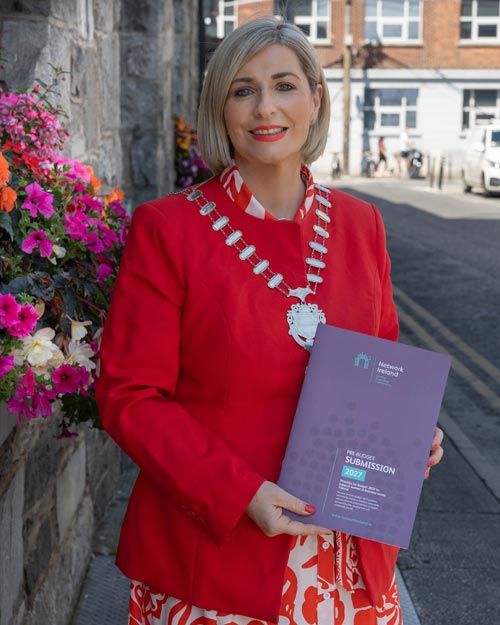
Ms Karen Ronan(Network Ireland National President)
The organisation, which represents more than 1,400 members through 17 branches nationwide, has called on Government to recognise women-led enterprise as a key driver of productivity, resilience and sustainable economic growth.
In its first national pre-Budget submission, Ireland’s longest-established women-only business network has identified seven priority areas for Budget 2027, including reducing the cost of doing business, improving access to finance for female entrepreneurs, expanding childcare supports, investing in skills and artificial intelligence, strengthening innovation, and addressing housing and infrastructure challenges.
The submission is based on a survey of members which found inflation and rising operating costs remain among the biggest challenges facing businesses. It also highlighted the growing use of artificial intelligence, with almost seven in ten members already using the technology and many expecting to increase their use of the technology in 2027.
Network Ireland National President Ms Karen Ronan said women-led businesses were making a significant contribution to the Irish economy but continued to face barriers that limited their ability to grow.
“Women-led businesses are creating jobs, driving innovation and making a significant contribution to Ireland’s economy. Budget 2027 is an opportunity to remove barriers that continue to limit business growth while unlocking the full potential of female entrepreneurship,” she said. “Investing in women in business is not simply an equality issue; it is an economic one. The right supports will strengthen businesses, increase workforce participation and enhance Ireland’s competitiveness.”
Among its recommendations, Network Ireland is calling for targeted tax measures for SMEs, improved access to finance, increased investment in childcare, and stronger supports for innovation and skills development.
Ms Ronan, who is also CEO of Galway Chamber, said the measures would help create the conditions for more women to start, grow and scale successful businesses.
“Our recommendations are practical and achievable and focused on helping businesses thrive. By investing in female entrepreneurship, childcare, innovation and workforce participation, Government can deliver lasting benefits for businesses, communities and the wider economy,” she said.
Founded in 1983, Network Ireland supports entrepreneurs, SME owners, professionals and business leaders through 17 regional branches and a virtual branch. See www.networkireland.ie.
This website uses cookies to improve your experience. We'll assume you're ok with this, but you can opt-out if you wish.AcceptRead More
Privacy & Cookies Policy
Privacy Overview
This website uses cookies to improve your experience while you navigate through the website. Out of these, the cookies that are categorized as necessary are stored on your browser as they are essential for the working of basic functionalities of the website. We also use third-party cookies that help us analyze and understand how you use this website. These cookies will be stored in your browser only with your consent. You also have the option to opt-out of these cookies. But opting out of some of these cookies may affect your browsing experience.
Necessary cookies are absolutely essential for the website to function properly. This category only includes cookies that ensures basic functionalities and security features of the website. These cookies do not store any personal information.
Any cookies that may not be particularly necessary for the website to function and is used specifically to collect user personal data via analytics, ads, other embedded contents are termed as non-necessary cookies. It is mandatory to procure user consent prior to running these cookies on your website.






Recent Comments