Today, Japan offers an example worth examining. VIEW HERE. Its school lunch approach brings together nutritionally balanced meals and shokuiku(Translated – Food Education). This connects what children learn about food with what they experience at mealtimes.
The lesson for our leaders is practical; make nourishing meals accessible and give children the knowledge to understand their food.
Delivering nutritious school meals and practical food education will require substantial investment in ingredients, facilities and trained staff. However, the potential returns extend well beyond the classroom. Research modelling stronger school meal standards suggests that healthier childhood diets could reduce diet-related illness and healthcare costs later in life. Over time, this could mean fewer avoidable hospital visits and admissions, less need for costly treatment and reduced pressure on our health service. These savings would take time and depend on the programme’s effectiveness, but investing in children’s nutrition today offers a valuable opportunity to prevent illness and its human and financial costs tomorrow.
We should work towards a school meal programme built around these priorities:
Nutritious, appealing meals: Support balanced menus developed with qualified nutrition professionals, with attention to children’s ages, allergies and dietary needs.
Access with dignity: Ensure that children from families facing financial hardship can participate without embarrassment or exclusion.
Practical food education: Help pupils learn about ingredients, cooking, food hygiene and reducing waste through activities suited to their age.
Support for local communities: Explore partnerships with local farmers and suppliers where these can meet quality, affordability and reliability requirements.
Resources and accountability: Give schools the funding, kitchen facilities and trained staff they need, then assess meal quality, participation, costs and food waste.
The lesson for our government leaders is practical; make nourishing meals accessible and give children the knowledge to understand the food they eat.
The purpose should be to nourish children and help them build a positive relationship with food. Success should include whether pupils enjoy their meals, have equitable access and gain useful knowledge.
Our political leaders can begin by bringing together educators, nutrition professionals, parents and pupils to design a practical pilot programme. Publish the findings, improve what needs work and expand what proves effective.
Finally, Ireland has shown before what determined political leadership can achieve for public health; from Dr Noel Browne’s leadership in the campaign against tuberculosis (TB) to Mr Micheál Martin’s introduction of the workplace smoking ban in 2004. Both demonstrate the importance of government taking responsibility for protecting people’s health. That same commitment should now inspire a sustained investment in nutritious school meals and practical food education. By making healthy food accessible to every child and teaching habits that can last a lifetime, today’s leaders have an opportunity to leave their own enduring legacy. Let us bring that ambition to our schools, giving every child a healthier start and a fairer chance to thrive.
Every school day offers an opportunity to invest in children’s wellbeing. Let us make the most of it; one nourishing meal and one useful lesson at a time.
Minister for Finance Mr Simon Harris’s statement, today, that he has no plans to change stamp duty, raises a question; could targeted relief for people over 50 years, buying a smaller home and selling their larger family home, help ease housing pressures?
Ireland should perhaps consider removing stamp duty for people over 50 years old, who choose to buy a smaller home and sell their larger family home.
In 2025, total Stamp Duty receipts collected by the Irish Exchequer amounted to approximately €1.695 billion, representing only about 2% of the total net tax receipts for the year.
Some economists believe that this suggestion could make a useful contribution to easing housing pressures, including here in Co. Tipperary. It would help some homeowners move into accommodation that better suits their needs, while bringing larger homes into the market place, for families who need more space. While it would not solve the housing crisis on its own, it could be a practical proposal worth examining and testing.
When the family home becomes larger than needed For some parents, life changes considerably once their children grow up and move away. A house that once felt crowded can become much larger than they need. There may be several spare bedrooms, a garden that takes considerable work, and more space to heat, clean and maintain. Some parents indeed would welcome a smaller, more manageable home, particularly if they could remain close to friends, family and familiar services.
Selling a larger house and buying a less expensive property could also release money for retirement or other needs. Yes, moving also comes with costs. Solicitors’ fees, estate agents’ fees, removal expenses and stamp duty can all reduce future financial benefit, however removing stamp duty would take away one of those expected costs.
What difference could the saving make? Under Ireland’s standard residential stamp-duty rates, the first €1 million of the purchase price is taxed at 1%. For an ordinary purchase of an existing smaller home, this means:
A €200,000 home carries €2,000 in stamp duty. A €250,000 home carries €2,500 in stamp duty. A €300,000 home carries €3,000 in stamp duty, A new-build home priced at €300,000 costs €2,595 because Stamp Duty is charged on the price minus the VAT.
These above examples assume no special relief applies. A saving of a few thousand euro will not persuade everyone to move. But it could make a difference to someone already considering down-sizing, especially when added to the other expenses involved. For example, a couple selling their larger house and buying an existing smaller home for €250,000 would save approximately €2,500 under a full exemption. That money could help pay for removals, legal costs or changes needed in their replacement home. This is a proposal for a new relief, rather than a description of an existing general entitlement for people over 50.
How could it help other families seeking homes? When a homeowner down-sizes and sells their larger house, that property then becomes available to another household. A family living in a smaller home might buy it, potentially putting their own property up for sale. A first-time buyer might then have an opportunity to purchase that smaller property. The precise chain will vary, but one move can allow several households to find homes that suit them better. There is an important limit: down-sizing does not, by itself, create an extra dwelling. The person selling the larger home still needs somewhere to live. The benefit is that existing homes can become better matched to the households occupying them. That is useful, but it should not be confused with increasing the total number of homes.
How should the proposed relief work? Economists would support a scheme with clear conditions linking the tax saving to a genuine move: ►The larger property must have been the applicant’s main home. ►The smaller replacement property must become their main home. ►The former home must be sold within a reasonable, clearly stated period. ►There should be a limit on the relief and rules preventing repeated claims or abuse. ►The scheme should accommodate people who need to buy before completing the sale of their previous home.
Putting the larger house on the market would start the process. Final entitlement should normally depend on completing the sale, with sensible provisions for genuine delays. Relief could be provided through a refund after the sale, or conditionally at purchase with repayment required if the conditions are not met. An upfront arrangement would offer more immediate help, although it would need careful administration. The meaning of “smaller” would also need a clear definition. A home with less floor space may cost more if it is newer, accessible or in a convenient location. Price alone would not be a reliable measure. An over-50 threshold could be considered, but the Government should explain why that age is appropriate. Household needs differ, and similar support may also be justified for some younger people whose circumstances have changed.
Suitable smaller homes must be available. The biggest practical question is where people would move? A homeowner may be willing to down-size but unable to find a suitable property nearby. A tax saving will achieve little if the available homes are unaffordable, difficult to access or far from the person’s community.
For Tipperary and other counties, economists appear to recommend combining the proposed relief with: ► More accessible smaller houses and apartments near shops, healthcare and transport. ► Renovation of vacant and derelict properties that can become safe, comfortable homes. ► Practical moving advice and limited help with essential costs for households with low incomes. ► More social, affordable and rental housing, alongside the infrastructure needed to support construction.
The aim should be to make a wanted move easier. Parents may still need space for visiting children, grandchildren or care arrangements.
Would it be a solution to the housing crisis? This could be one useful measure within a wider housing programme. It has a clear purpose; reducing a moving cost for people willing to release a larger home for sale. However, the scale of the benefit is uncertain. Some recipients would have moved without the relief. More buyers seeking smaller properties could increase competition for those homes, and sellers could capture part of the tax saving through higher prices. A time-limited pilot would help establish whether the scheme encourages additional moves and represents good value for public money. Its success should be measured by completed moves, larger homes released for sale and the cost of achieving those results.
People would welcome a serious examination of this proposal. Helping people move into homes that suit their changing lives could benefit both the sellers and the families who buy their former homes, while Ireland continues the essential work of building and restoring more housing.
Primary school teachers represented by the Irish National Teachers’ Organisation (INTO) are set to begin industrial action on October 5th, amid delays in securing a new public sector pay agreement.
The action will begin with a work-to-rule, with members also due to join other public sector workers in a proposed nationwide strike on Wednesday, October 14th next.
According to the INTO, members in primary and special schools will restrict their work to contracted daily teaching hours. They will withdraw co-operation with additional hours, including those introduced under the Croke Park Agreement, until further notice.
The decision follows a ballot in which 99.5% of participating members supported industrial action. Turnout stood at 57.5%. INTO General Secretary Mr John Boyle said the result demonstrated a strong mandate from teachers facing financial pressures. He said uncertainty over salaries, alongside the cost-of-living crisis, was fuelling members’ frustration. The INTO is the latest public sector union to support industrial action, accusing the Government of failing to put forward a meaningful pay offer.
The previous public sector pay agreement expired on June 30th, and formal negotiations on a replacement have yet to begin. Responding to the announcement, the Department of Public Expenditure expressed disappointment that unions had not taken opportunities to engage in recent weeks.
A spokesperson urged both sides to return to negotiations, saying progress towards a new agreement would require constructive, sustained engagement without preconditions.
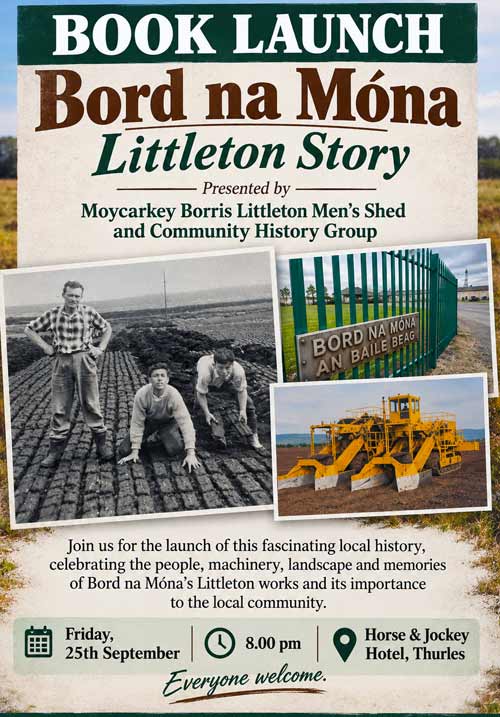
Local History Group Celebrates Littleton’s Bord na Móna Heritage.
The people, places and memories of Littleton’s peat industry will take centre stage at the book launch of “Bord na Móna: Littleton Story” in the Horse & Jockey Hotel, Thurles, on Friday, 25th September, at 8.00 pm.
Presented by the Moycarkey / Borris Littleton Men’s Shed and Community History Group, this local history publication celebrates the men and women whose working lives helped shape the community, preserving stories of the bogs, the machinery and a legacy that reaches far beyond the workplace. Former employees, their families and everyone with an interest in the area’s heritage are warmly invited to attend.
The Littleton Bog complex is a term used by the Moycarkey / Borris / Littleton Men’s Shed and Community History Group to outline the area of peatlands worked on an industrial scale by Bord na Móna since the company was founded in 1946. With the cessation of works at the the Littleton Briquette Factory and milled peat operations in April 2018, it brought to a close sixty-two years of peat extraction works at this area of peatlands.
This book, while not endeavouring to be an in-depth historical analysis of Bord na Móna operations in the middle of Tipperary; provides a snapshot of its impact on the parish of Moycarkey / Borris / Littleton. Other parishes in the area such as Moyne / Templetuohy; Gortnahoe / Glengoole and Killenaule also had very important roles in the growth and development of the bogs as areas of employment and add greatly to the overall story of the relevance and importance of Bord na Móna to these communities. People from Thurles and other surrounding parishes were also employed on the bog or in the briquette factory. Indeed, it must also be recognised that the site of Littleton Briquette Factory is in the townland of Killeens, which is part of Killenaule parish.
This booklet gives a brief overview of the turf cutting operations at the outset of the development of the bogs, with the main focus being on the offices and yard at Ballybeg. This new industry meant that many men were required to get operations up and running, with the result that several of these came from outside Tipperary, many of whom resided in a billet camp, which was sited across the road from the main office and yard. It is not meant to be an exhaustive account of the work which took place in the Littleton Bog complex or within the area of work associated with the briquette factory. For a comprehensive overview of the history of Bord na Móna readers are encouraged to read Brown Gold: (A History of Bord na Móna and the Irish Peat Industry by Donal Clarke).
The type of work engaged on the bogs is explored, as is a brief exploration of the various machines which were required to work the bogs on such an industrial scale. Coupled with the influx of workers and families was a need for social housing and this is also chronicled with an overview of housing schemes, school development and an associated impact on sporting and social organisations across the parish.
It is also recognised that the peatlands of mid-Tipperary have a rich and vibrant history, which have engaged all peoples across the generations. A sample overview of the flora and fauna of the bogs, its relevance as a carbon sink in the modern era and how the rich tapestry of its past can be used to educate and inform people as the impact of climate change is felt locally and globally.
Many parts of the bog were given local place names, which were readily identifiable to the Bord na Móna workers. Many of these are also recorded so that this local knowledge is not lost and can continue as part of the vibrant folklore associated with a lifetime for many of working on the bogs.
Lastly, an overview of archaeological finds in the bog, both before and during Bord na Móna operations are also recorded. These assist in demonstrating the relevance of the bogs as spiritual, votive, social, energy and recreational areas, which are all intertwined across the generations.
Acknowledgments The Moycarkey Borris Littleton Men’s Shed and Community History Group are thankful to everyone who assisted with this Bord na Móna story in the parish community. To those who supplied articles and photographs: Colm Dempsey BnM, Ray Yates, Tommy Maguire, Frank Connolly, Liam Dempsey, Fr. Tomás O’Connell, Christy Bracken, Ann Slattery, Billy Loughnane, Peggy Kirby, Billy Ryan, M. Skehan Ruddy, Tom Kelly, Ed. O’Shea, Sean Ryan, Sadie Dwyer, John O’Loughlin, Martin Cooney and members of the group who also contributed articles. A special word of thanks to Clare McNamara, Image Library Officer, National Museum of Ireland for her support and for the kind permission of the National Museum to reproduce images of some items discovered in the Littleton Bog Complex. Thanks to Dr. Charles Mount for his kind permission to reproduce a ‘Togher/Tocher’ (wooden trackway), following excavation at Longfordpass. The MBL Men’s Shed and Community History Group are Michael Dempsey, Jim Flanagan, Seamus Bourke, John Fogarty, Liam O’Donnchú, Mary Ryan, Mary and Frank O’Regan, Billy Purcell, Joe Moran and Pat Bracken. Thanks also to Tommy Britton for his support and a special word of thanks to Bernie Lonergan who co-ordinated the project at the outset.
Dedication This overview of the impact of the bogs of mid-Tipperary on the community of Moycarkey / Borris / Littleton could not have been possible without telling some of the stories of the life and times of the men and women who worked in the Littleton Bog complex under the employment of Bord na Móna. This booklet is dedicated to all these people, and to the legacy which they have left behind. To those still living, we salute and thank you. To those who have gone to their eternal reward; Ar dheis dé go raibh a n-anamacha. (Irish translation – “May their souls be on the right hand of God”).
Tipperary County Council has approved the rezoning of 161 hectares, (approximately 397 acres), for housing at its September plenary meeting.
The changes to the county development plan took immediate effect following the vote. Public consultation had attracted more than 100 submissions.
Councillors who welcomed the changes: Mr John Crosse (Fine Gael): Highlighted the urgent need for housing across Tipperary and the opportunity for landowners and developers to deliver more homes. Mr Jim Ryan (Independent, Thurles): Welcomed the restoration of residential zoning to lands in Thurles and thanked the planning team for listening to local councillors. However he felt an opportunity had been missed for the village of Littleton.
Councillors who raised concerns during the earlier June discussions: Ms Phyll Bugler (Fine Gael, Ballina): Said she had not been given enough time to raise issues during the process. Mr Seamie Morris(Former Sinn Fein and now Independent, Nenagh): Questioned the inclusion of certain lands in Nenagh, saying they should not have been considered for housing.
This agreed rezoning now makes additional land immediately available for potential housing development, although no construction timetable or confirmed number of homes has been publicly made known.
This website uses cookies to improve your experience. We'll assume you're ok with this, but you can opt-out if you wish.AcceptRead More
Privacy & Cookies Policy
Privacy Overview
This website uses cookies to improve your experience while you navigate through the website. Out of these, the cookies that are categorized as necessary are stored on your browser as they are essential for the working of basic functionalities of the website. We also use third-party cookies that help us analyze and understand how you use this website. These cookies will be stored in your browser only with your consent. You also have the option to opt-out of these cookies. But opting out of some of these cookies may affect your browsing experience.
Necessary cookies are absolutely essential for the website to function properly. This category only includes cookies that ensures basic functionalities and security features of the website. These cookies do not store any personal information.
Any cookies that may not be particularly necessary for the website to function and is used specifically to collect user personal data via analytics, ads, other embedded contents are termed as non-necessary cookies. It is mandatory to procure user consent prior to running these cookies on your website.






Recent Comments