Dare any of you lovers out there, forget that St. Valentine’s Day, is on Tuesday next, February 14th.
Talking of people in recent history, who fell in love, let’s not forget the sadly unrequited* love story of that great Irish poet, Patrick Kavanagh (1904-1967), and Ms Hilda Moriarty in 1944.
* Unrequited love occurs when one person yearns for unconditional love, from another individual who doesn’t always feel the same way.
It was sometime in the Autumn of 1944, while living on Raglan Road, in Ballsbridge, Co. Dublin, that the poet Kavanagh spotted Ms Hilda Moriarty, herself a native of Co. Kerry, as she wended her way to attend Dublin City University, where she was studying to become a medical doctor.
Ms Moriarty was then 22yrs old, while Kavanagh was some 20 years her senior. For Kavanagh, it was love at first sight, and though she would regarded him as a close friend, her true feelings toward him were never of a romantic nature.
In 1947 Hilda would marry the handsome Mr Donogh O’Malley, a rugby union player, who later served as Parliamentary Secretary to the then Minister for Finance (1961 to 1965); Fianna Fáil Minister for Health (1965 to 1966), and Minister for Education (1966 to 1968). It was the same O’Malley who first announced the notion of free education for Irish students, on September 10th, 1966, unknown to his cabinet colleagues; thus updating Ireland’s antiquated educational system, same unchanged since Irish independence.
Sometime later, Kavanagh was inspired to write the poem, that we refer to, today, as, “On Raglan Road”, published in the Irish Press in 1946, under the title, “Dark Haired Miriam Ran Away”. Kavanagh’s poem was later set to the melody of an old Irish song called, “Fainne Gael an Lae”; (Irish loose translated, “The Dawning of the Day”).
ON
OnRaglan Road.
Lyrics: Irish Poet and Novelist, Patrick Kavanagh(1904-1967). Vocals: Singer, Folk Musician, Banjoist and Actor, the great Luke Kelly(1940 – 1984).
On ‘Raglan Road’ of an Autumn day, I saw her first and knew, That her dark hair would weave a snare, That I might one-day rue. I saw the danger and I passed, Along the enchanted way, And I said, “Let grief be a fallen leaf, At the dawning of the day.” On Grafton Street in November, We tripped lightly along the ledge, Of a deep ravine where can be seen, The worth of passion play. The Queen of Hearts still making tarts, And I not making hay. Oh, I loved too much and by such, by such, Is happiness thrown away. I gave her gifts of the mind, I gave her the secret sign, That’s known to the artists, who have known, The true gods of sound and stone. And word and tint, (I did not) without stint. (For) I gave her poems to say, With her own name there and her own dark hair, Like clouds over fields of May. On a quiet street, where old ghosts meet, I see her walking now, Away from me so hurriedly, My reason must allow, That I had loved, not as I should, A creature made of clay, When the angel woos the clay, he’d lose, His wings at the dawn of day.
Today, February 7th, 2023, is Safer Internet Day. School’s across Tipperary and Ireland will be marking the day with various activities.
The theme of this year’s EU-wide initiative is promoting respect and empathy online. 2023 marks the 20th year of Safer Internet Day and its goal to ensure that everyone experiences positive and safe learning, interaction and collaboration online.
For more information on Safer Internet Day and staying safe and respectful online, please visit: HERE — HERE — HERE and finally HERE.
The Environmental Protection Agency (EPA) has today announced €10.7 million of research funding for 42 research projects addressing climate change and other emerging, complex environmental problems. This funding will contribute to the delivery of high-quality research, evidence-based policy development and further build Irish environmental research capacity. The funding is an important element of the EPA 2030 Research Strategy which delivers essential scientific support for environmental policy development, implementation and broader decision making across four thematic areas:-
Addressing climate change evidence needs,
Facilitating a green and circular economy,
Delivering a healthy environment,
Protecting and restoring our natural environment.
This funding will support more than 200 researchers across the higher education sector. University of Galway had the highest success rate and was awarded more than €2.3 million of funding for projects related to greenhouse gas emissions, ozone levels, radon, human bio-monitoring and earth observation. University College Dublin followed with €1.9 million of funding in the areas of Strategic Environmental Assessment, extreme climatic events, peatlands, DNA-based assessment, and soil quality.
Announcing the awards, Ms Laura Burke, EPA Director General said: “EPA-funded research delivers trusted scientific evidence to address key knowledge gaps and support environmental policy development and implementation. Environmental challenges such as climate change are complex and require an integrated, cross-sectoral approach and we are delighted to be working in partnership with a number of organisations, including the Geological Survey Ireland; the Department of Agriculture, Food and the Marine and Met Éireann, to co-fund environmental research.”
The EPA places a high priority on promoting the uptake of funded research to inform policy development and implementation and to maximise the impact of research and innovation. To this end, the EPA supports and fosters linkages between the public research system and policymakers to address key environmental challenges.
Professor Jim Livesey, Vice-President Research and Innovation at University of Galway, said: “This investment by the EPA is a testament to the success of research across higher education in Ireland. It is a huge bonus to see such a high level of achievement for our researchers in University of Galway, where we lead eight of the EPA-backed projects and partner on another four. The focus of this funding on environmental research further demonstrates the drive among our researchers to collaborate for the public good and the ambition to respond to the challenges facing humanity and society, now and in the years ahead.”
The EPA Research Programme is a Government of Ireland initiative funded by the Department of the Environment, Climate and Communications. The EPA has been funding research in Ireland since 1994 and is currently funding more than 200 on-going research projects. EPA Research Calls are designed to support the development and implementation of environmental policies in Ireland. The EPA’s 2023 Research Call will open in April 2023. Details will be made available on the EPA website. Further information: Emily Williamson, EPA Media Relations Office Tel. No. 053-9170770(24 hours) or media@epa.ie
The winners of 59th BT Young Scientist & Technology Exhibition (BTYSTE) have been announced.
Mr Shane O’Connor and Mr Liam Carew, both aged 19 and in sixth year at The Abbey School, Station Road, Tipperary, have won this years (2023) BT Young Scientist & Technology Exhibition, with their project “Assessing the impact of second-level education on key aspects of adolescents’ life and development”.
Shane O’Connor and Liam Carew being presented their award by Education Minister Ms Norma Foley and BT Managing Director, Mr Shay Walsh. Picture : BTYSTE Twitter
Their project entailed a three-year study, which covered the years of Covid (2020, 2021 and 2022), assessing students throughout those years in a longitudinal way, on the impacts of Covid, but also on the impacts of school on its students.
Professor Mr Joe Barry(Chairperson of the Social and Behavioural Sciences Group Judging Panel), described the winning entry as an extremely impressive undertaken survey.
As winners of the 2023 BT Young Scientist, Shane and Liam received the BTYSTE perpetual trophy and a prize of €7,500. They will now attend the 64th Annual London International Youth Science Forum this coming summer season.
Our sincere congratulations to pupils, teachers and The Abbey School, Tipperary.
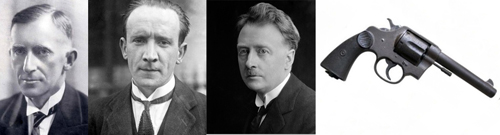
Following the killing of the Cork born Irish revolutionary, Michael Collins in an ambush at an isolated area known as Béal na Bláth, on August 22nd 1922, the Free State provisional government, under the new leadership of MrW. T. Cosgrave, MrRichard Mulcahy and MrKevin O’Higgins, took the stance that the Anti-Treaty IRA were conducting an unlawful rebellion against a legitimate Irish government.
Left-right: Richard Mulcahy, MrKevin O’Higgins, W. T. Cosgrave& a hand gun used during Tipperary civil war period.
Mr Kevin O’Higgins had voiced the opinion that the use of martial law was the only way to bring this civil war to an end. So by imposing capital punishment for anyone found in possession of either firearms or ammunition; without a lawful reason, Republican fighters would now be treated as criminals rather than as army combatants, thus introducing martial law for the duration of the then conflict.
To this end, on September 27th 1922, the Irish Free State’s Provisional Government put before the Dáil the Army Emergency Powers Resolution, proposing legislation to try suspects by military court martial.
It should be noted that on October 3rd, 1922 the legitimate Free State government offered an amnesty to any Anti-Treaty fighter who surrendered their arms and recognised the government. This amnesty offered, sadly saw little response.
A final version, of the motion, first put to the Dáil, by then Minister for Defence, Mr Richard Mulcahy, on September 26th, was passed on October 18th 1922, which stated: “The breach of any general order or regulation made by the Army Council and the infliction by such Military Courts or Committees of the punishment of death or of penal servitude for any period or of imprisonment for any period or of a fine of any amount either with or without imprisonment on any person found guilty by such Court or Committee of any of the offences aforesaid. Provided that no such sentence of death be executed except under the countersignature of two members of the Army Council”.
This new legislation, referred to as the “Public Safety Bill”, which empowered military tribunals with the ability to impose penal servitude of any duration, or the death penalty, for a variety of offences including; aiding/abetting attacks on state forces; persons found in possession of arms, ammunition or explosives, without the proper authority; looting; the destruction of public or private property, and arson.
Excommunication A supportive Catholic Hierarchy issued a pastoral letter condemning Anti-Treaty fighters (known as ‘Irregulars’). The letter stated that: “All who are in contravention of this teaching, and participate in such crimes are guilty of grievous sins and may not be absolved in Confession nor admitted to the Holy Communion if they persist in such evil courses”. Devout Roman Catholics saw this pastoral letter as a powerful social pressure being applied and at an opportune time for the then Provisional Government. Same pastoral letter would serve to understand and indeed excuse the close connection developed in later decades between Church and State.
This Order was later strengthened in the following month of January, 1923, allowing execution for several other categories of offences not previously clearly identified. These included non-combatant Republican supporters carrying messages; assisting in escapes; using army or police uniforms; together with desertion from the existing National Army. It further stipulated that all sentences passed on military prisoners, taken by Provisional Government forces before the passing of the Act, were retrospectively remain valid. January 1923 also saw this policy of executions being further extended throughout 10 Irish counties, namely; Tipperary, Dublin, Louth, Carlow, Kerry, Limerick, Westmeath, Waterford, Offaly and Laois, each county serving as the location for such executions. Kevin O’Higgins had got it right; soon afterwards the anti-Treaty IRA recognised that prolonging their campaign would only further inevitably result in further executions of their imprisoned fighters.
Executions during the Irish Civil War took place during the guerrilla phase of the Irish Civil War (June 1922 – May 1923). By the first two months of the Civil War (July–August 1922), Free State forces had successfully taken all the territory held by Republicans and the war seemed all but over. However, the loosing Anti-Treaty side moved to using guerrilla tactics in August–September, and National Army casualties began to mount.
Many people today, appear to forget that during this phase of the war both sides; the Government forces of the Irish Free State and the Anti-Treaty Irish Republican Army (IRA) insurgents, both used executions and terror in what developed into a cycle of atrocities.
From November 1922, the Free State Government justified embarking on a policy of executing Republican prisoners in order to bring the war to a successful end.
Tipperary Executions
On January 15th 1923 four men were executed by firing squad for the illegal possession of arms and ammunition, at Ross Cottage, Borrisoleigh, Co. Tipperary, on December 23rd 1923. The four men; Mr Frederick Burke, Curnaboola, Ileigh, Borrisoleigh, Co. Tipperary, aged 28; MrPatrick Russell, Summerhill, Borrisoleigh, Co. Tipperary, aged 26; Mr Martin O’Shea, Garrangrena, Borrisoleigh, Co. Tipperary, aged 22, and MrPatrick McNamara, Killarey, Ballina, Killaloe, County Clare, aged 22, were all executed in Roscrea Castle Barracks, Roscrea, Co. Tipperary.
MrFrederick Bourke, a farm labourer had served with the IRA from 1919 onwards. MrMartin O’Shea, who helped out on his family’s small farm and worked as a casual labourer for the local Council, had served with the Irish Volunteers and IRA from 1917 onwards. MrPatrick Russell, was a farmer’s son had also served with the Irish Volunteers and IRA from 1917 onwards.
According to the official report issued after their execution, Frederick Bourke, Martin O’Shea and Patrick Russell were tried and convicted, on January 2nd 1923, for being in possession of arms and ammunition and for the armed hold up of a Mail Car at Ross Cottage, Borrisoleigh, Co. Tipperary.
The bodies of the executed were not handed back to family members until the middle of 1924. Ugly scenes would accompany the handover of the bodily remains of those executed in some areas, as military displays and the discharging of weapons at re-interments were totally banned.
The pro-Treaty government remained unapologetic about their execution policy during the Civil War; as did the Anti-Treaty Irish Republican Army (IRA) insurgents; the former maintaining that they had simply done what was necessary in order to save the new Irish state. Anti-Treaty Irish Republican Army (IRA) insurgents refused to support some of its members, latter who had been executed for basic armed robbery crime, while endorsing as martyrs others that were executed.
In typed and handwritten communications sent to Fianna Fail TD Mr Andrew Fogarty (April 1879 – April 1953) on some 10 years later on November 11th 1933 to his home in Cashel; [latter a farmer, first elected on the 15th count to the 5th Dáil, as a Fianna Fáil Teachta Dála (TD) in 1927], we learn the strong feelings with regards to failure to get compensation for the living, destitute family members of those executed. One such communication came from within the local Borrisoleigh, Fianna Fáil Club.
To Andy Fogarty, (TD) Cashel. Co. Tipperary.
Borrisoleigh Fianna Fáil Club Castlequarter, Borrisoleigh, Thurles November 11th 1933
A Chara, Just a few lines in connection with the claims of the mothers of Russell, Bourke and O’shea, who were executed by the Cosgrave Government on January 15th 1923 at Roscrea Military Barracks. We are sure there’s no need for us to put before you the necessity of having the claims of these three poor women attended to immediately. Perhaps it would be well to give you an outline of the happenings that led up to the execution of those young men. They were under orders from their Commanding Officer to hold up the Mail Car at least twice per week & it was during the progress of one of these searches at a place called Ross Cottage, Borrisoleigh, that they were surrounded by ‘Crown Forces‘. They put up a most desperate fight for about three hours, and it was only when their supply of ammunition became exhausted that they were reluctantly compelled to surrender. Then after a time in prison the government decided to put them against the wall and there and then ended the lives of three gallant young men. In conclusion we would ask you to make a strong appeal to the government on behalf of these three old widowed mothers and to see that they get a reasonable amount of Compensation. We do not propose to suggest to the government the amount they should pay. but we do suggest that they should consider every aspect of their claims. They should consider very carefully the loss of these fine young fellows to their poor widowed mothers and above all they should consider the large pensions they are paying to some of the men that were responsible for their executions, We would ask you to see that those claims are attended to immediately, as the poor old women are very old and feeble.
Thanking you in anticipation. Yours Faithfully, Borrisoleigh Fianna Fáil Club. (Timothy Shanahan. Sec.)
The recipient of the above communication, Tipperary TD Mr Andrew (Andy) Fogarty*, forwarded the letter, shown above, to the Department of Defence, together with his own representations, clearly indicating the strength of local feeling within the Borrisoleigh area, since the three executed men were under orders at the time of their capture. The reference ‘captured by Crown Forces’ in the letter, above, is possibly a deliberate insult aimed at the then operating Pro-Treaty forces.
* In the 1948 General Election, the same long serving Fianna Fail TD for Tipperary, Mr Andrew Fogarty lost his seat. In other correspondence we learn that a presentation was organised and subscriptions collected amounting to donations of £542-4s-0.
The names on the list of contributors includes Sean Lemass (£25); Dan Breen, (Tipperary £10); WJ Magner (£10); together with many more TDs and Senators including a number of clergies. Many of the subscribers included were from Thurles, Co. Tipperary. Amongst them were Mr Bill Dwan, Holycross, Thurles (£10); Mr J, Hogan, Liberty Square, Thurles, (£10); Mr James Maher, Parnell Street, Thurles, (£5-5s-00p); Mr Dan Brady, Archerstown Mills, (£5); Mr J. Hanafin, Corner House, Parnell Street, Thurles (£5); Mr J.P Carrigan, Solicitor, Thurles, (£5); Mr Pierce Moloney, Racecourse, Thurles, (£2-2s-00p); and Mr P.J. OMeara, Solicitor Thurles, (£2-2s-00p).
In respect of the 3 executed Borrisoleigh natives; claims made by their mothers seeking compensation, received a partial dependents’ gratuity of £112.10.00 (one hundred and twelve pounds and ten shillings sterling) in 1934, under the Army Pensions Acts in respect of their sons, possibly helped by a serious threat by the Borrisoleigh, Fianna Fáil Club to resign and distance themselves from the Fianna Fáil political party.
[In the case of the fourth executed man, namely Mr Patrick McNamara; a file relating to a request by a John McNamara, with an address at Killarey, Ballina, Killaloe, County Clare, for an application form to make a claim in respect of his unnamed brother, executed on January 1923, most likely relates to the Patrick McNamara executed in Roscrea Castle Barracks; however, the individual allegedly executed is not named in the documentation]
This website uses cookies to improve your experience. We'll assume you're ok with this, but you can opt-out if you wish.AcceptRead More
Privacy & Cookies Policy
Privacy Overview
This website uses cookies to improve your experience while you navigate through the website. Out of these, the cookies that are categorized as necessary are stored on your browser as they are essential for the working of basic functionalities of the website. We also use third-party cookies that help us analyze and understand how you use this website. These cookies will be stored in your browser only with your consent. You also have the option to opt-out of these cookies. But opting out of some of these cookies may affect your browsing experience.
Necessary cookies are absolutely essential for the website to function properly. This category only includes cookies that ensures basic functionalities and security features of the website. These cookies do not store any personal information.
Any cookies that may not be particularly necessary for the website to function and is used specifically to collect user personal data via analytics, ads, other embedded contents are termed as non-necessary cookies. It is mandatory to procure user consent prior to running these cookies on your website.





Recent Comments