Urgent action required to address household emissions and reduce exposure to fossil fuel price volatility says Climate Change Advisory Council.
The Built Environment sector accounted for 12.5% of total greenhouse gas emissions in 2025.
Residential building emissions fell year-on-year by 5.0%, while emissions from commercial and public buildings fell by 3.5%, primarily due to a warmer winter.
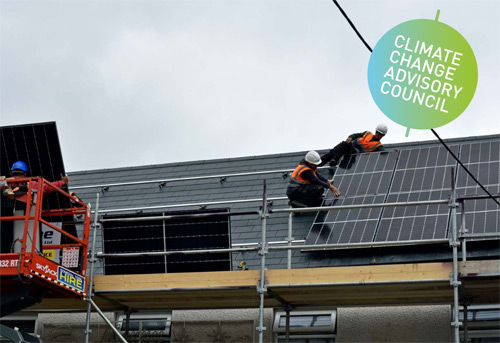
Launching the Built Environment chapter of its Annual Review 2026 today, the Council said increased investment and faster rollout is needed in retrofitting, heat pumps, solar PV and district heating to reduce emissions, improve comfort and health outcomes and to protect citizens against volatile energy costs.
Although there has been a reduction in built environment emissions, the Council says these reductions should not be mistaken for structural progress. While residential and commercial/public buildings remained within their first sectoral emissions ceilings for 2021–2025, the outlook for the next carbon budget period is much more challenging. Both residential buildings and commercial and public buildings are projected to exceed their second sectoral emissions ceilings for 2026–2030 by 22% and 62% respectively.
The review warns that progress on local authority social housing retrofits remains too slow, with only 10,370 homes retrofitted since 2021. Approximately 5,000 retrofits are needed on average each year between now and 2030. The Council is calling for increased, sustained and ring-fenced multi-annual funding in Budget 2027 to allow local authorities to accelerate retrofit delivery and meet the Government’s own targets of 36,500 social houses brought to BER B2 or cost-optimal standard by 2030. The review also highlights solar PV as one of the fastest routes to lower bills and widen participation in the energy transition. It recommends the roll out of solar PV across local authority housing stock and that a national framework should also be put in place for plug-in solar to allow apartment dwellers to benefit from solar energy.
The Council says delayed and incomplete policy frameworks are now creating uncertainty for households, local authorities, industry and investors. For example, the delayed National Building Renovation Plan, due last December, has prompted the European Commission to open infringement proceedings in March. The plan should be published immediately, with a clear pathway to phase out fossil fuel boilers by 2040 as required under the EU Energy Performance of Buildings Directive. The Council identifies the requirement for a National Heat Strategy based on spatial planning, system diversity and resilience, to identify where district heating, geothermal energy, heat pumps and other low-carbon heating solutions can be most effectively deployed. The Council acknowledges Cabinet approval for revisions to the General Scheme of the Heat (Networks and Miscellaneous Provisions) Bill, but the legislation has slipped repeatedly and must now be finalised and enacted to give district heating the regulatory certainty it needs.
On resilience, the Council wants to see a clear programme of work so the Built Environment and Planning sector can develop and implement a dedicated Sectoral Adaptation Plan in the next plan cycle. Ensuring our built environment is resilient to immediate and future climate change impacts, such as heatwaves and flooding, is paramount to securing the future of our communities. In addition, the Council also recommends that Government expedite the development of coastal change management plans in priority vulnerable areas. Mr Alex White, Chairperson of the Climate Change Advisory Council, said: “As long as Ireland remains heavily dependent on fossil fuels to heat homes and buildings, our households, businesses and public services will remain exposed to global price volatility and energy insecurity. The Government has set the right ambition to end Ireland’s reliance on fossil fuels. The test now is delivery. We have the solutions and we know there is an appetite for them, but they must be enabled through policy and legislation. These solutions must be funded to deliver lower-cost clean energy for Ireland. Our communities also need plans and solutions to prepare for the impacts of climate change, especially coastal areas and those that are at risk of flooding. This transition must be fair. Social housing retrofit is one of the clearest tests of delivery. The State owns this housing stock, the targets are clear, and the benefits for households are immediate. To meet the 2030 target, local authorities will need to retrofit around twice as many homes each year as were delivered in 2025.”
Parents and guardians across Ireland are being urged to speak to their children about dangerous online networks that manipulate young people into harming themselves, committing violence or producing sexually explicit material.
Irish cases connected to this disturbing online culture have reportedly been referred to Tusla, while An Garda Síochána has participated in an Europol operation targeting a network known as “The Com.” One of the best-known groups associated with this network is called “764.”
These are not necessarily organised groups with easily identifiable members. They operate through changing usernames, private chats and online communities. Children may encounter those involved through social media, messaging services or online games. Gardaí have specifically warned that individuals associated with groups such as 764 may encourage or pressure children to commit crimes, self-harm or adopt violent and radicalised beliefs. The manipulation can begin with friendship, attention or a shared interest. An offender may then obtain private information or intimate images and use threats, humiliation or blackmail to control the child. Demands can escalate into self-harm, violence, cruelty towards animals or abuse of another person.
Warning signs for parents – Watch for sudden changes such as: Secretive online activity or several new accounts. Panic when a phone or gaming device is removed. Messages from unknown people at unusual hours. Unexplained injuries, self-harm or violent behaviour. Threats involving private photographs or personal information. A child being instructed to record, photograph or livestream something. Sudden withdrawal, fear, shame or extreme anxiety. The above signs do not necessarily prove that a child is involved, but they should never be ignored.
What parents should do. Have a calm conversation rather than immediately blaming or punishing the child. Make it clear that they will not be in trouble for telling you what has happened. Do not confront suspected offenders yourself. Preserve usernames, messages, dates and links where it is safe to do so. Do not download, copy or forward sexual images involving anyone under 18. Report an immediate threat to life or safety by calling 999 or 112. Other suspected criminal activity should be reported to your local Garda station.
Suspected illegal online material, sexual exploitation or sexual blackmail can also be reported confidentially and where appropriate anonymously, through Hotline.ie latter who has reported a sharp increase in sexual material created by children themselves, demonstrating why regular, non-judgmental conversations about images, privacy and online pressure are essential.
The most important message for every child is: No online threat is too serious to tell a trusted adult about. Images can be reported, accounts can be blocked and help is available. They do not have to obey the person threatening them.
Please share this warning with other Irish parents, schools, clubs and youth organisations. Awareness and early intervention could protect a child from serious harm.
Get ready to squish, splash, scoop and explore at our Messy Play Session in The Source Library, Thurles, Co. Tipperary!
Designed for children aged 0 – 4years, this fun sensory activity encourages little ones to discover new materials, textures, sounds and smells through hands-on play. It’s a wonderful way to spark creativity, build confidence and support early learning.
Date: Wednesday, August 5th. Time: 11:30am. Venue: The Source Library, Thurles. Suitability: Suitable for ages 0 – 4 years.
Note: Places are limited and advance booking is essential. Call Tel. No. 052 616 6131, to reserve your child’s place.
One Council Restores History While Another Erases It – The Loss of Thurles’s Famine Double Ditch.
The decision by Dún Laoghaire-Rathdown County Council to spend approximately €660,000plus VAT restoring a historic ha-ha wall in Marlay Park (latter a sunken landscape boundary that uses a hidden trench and a vertical retaining wall), has understandably generated debate. The 197-metre structure, believed to date from the early nineteenth century, was designed to separate landscaped gardens from grazing animals without interrupting views across the estate. Much of its original locally sourced granite survived beneath vegetation, but the wall had fallen into disrepair. Restoration required specialist conservation work, dismantling and rebuilding sections of dry-stone wall, repairing the ditch and incorporating drainage infrastructure. The original contract was valued at €625,398 excluding VAT, with the final estimate rising to €660,374 following delays, unsuitable ground material, severe weather and difficulties obtaining appropriate stone.
Local construction professionals and taxpayers are entitled to question whether that represents value for money. Public bodies must explain how costs are calculated, why projects exceed their initial budgets and whether procurement arrangements adequately protect the public purse. Dún Laoghaire-Rathdown County Council has already faced criticism over the €753,528 cost of works at an entrance to Deerpark in Mount Merrion. That project is frequently described as the construction of “14 steps”, although the council says it also included a wheelchair-accessible ramp, retaining walls, granite paving, seating, landscaping, pedestrian crossings, road resurfacing, drainage, traffic-signal equipment and other public-realm works. The criticism of these costs is legitimate. Nevertheless, one important fact should not be forgotten: Dún Laoghaire-Rathdown County Council recognised that an historic structure was worth preserving.
That approach stands in painful contrast to what happened in Thurles.
The Thurles Great Famine Double Ditch was regarded locally as a rare surviving famine-era landscape feature. Local historical accounts date its construction accurately to 1846 and associate it with relief work provided to men and boys during the Great Famine. Rather than representing the landscaped elegance of a wealthy Dublin estate, this Double Ditch recalled hunger, poverty and the desperate struggle of local families to survive. It was not simply an old embankment. It was a physical connection with one of the darkest periods in Irish history. For generations, the route was also described locally as a public walkway and Mass path. Campaigners argued that it formed part of the social history of Thurles and should have been incorporated into a protected heritage trail.
Despite repeated warnings, the entire section of the Double Ditch was cleared in March 2022 supported by local councillors, as part of works connected with as yet a non existent, only proposed Thurles inner relief road. Contemporary photographs and local reporting showed mature vegetation being removed and the historic landscape feature being levelled by machinery.
Historic Thurles Double Ditch Eradicated in 2022. Pic. G.Willoughby.
Once such a structure is destroyed, it cannot truly be recreated. A replica might reproduce its approximate appearance, but it cannot restore the original stones, soil, boundaries and physical connection with the people who constructed it during the Great Famine.
This is the real loss suffered by Thurles. Tipperary County Council regularly speaks about protecting heritage and connecting communities with their past. Yet the treatment of the Double Ditch demonstrates the gulf that can exist between heritage policies and decisions taken on the ground. Roads and development are necessary, but heritage protection does not require a complete rejection of progress. It requires imagination, consultation and a willingness to examine alternative designs before destruction becomes inevitable.
The contrast between the two councils is striking. In Dublin, hundreds of thousands of euro are being spent restoring an aristocratic landscape feature. In Thurles, a structure associated with ordinary people surviving the Great Famine was treated as totally expendable. The Marlay Park bill deserves detailed scrutiny. So does every major publicly funded project. But the principle of conserving historic structures should be welcomed.
Led by the denials of elected councillors; mainly Mr Michaél Lowry (Non Party), Mr Sean Ryan (FF) and Mr Seamus Hanafin (FF), together with senior council officials, through wilful ignorance, self-deception, blind persistence and despite knowing better oversaw this reckless destruction. Thus the tragedy in Thurles is that the debate never reached the question of restoration costs.
The Double Ditch was not protected long enough for restoration to become an option. Dún Laoghaire–Rathdown County Council may reasonably be criticised for excessive costs. Tipperary County Council should be criticised for allowing irreplaceable local history to be destroyed.
One council appears willing to spend too much preserving history. The other did too little before all of that history was totally eradicated and lost forever.
Neither approach represents good stewardship of public money or public heritage, and the waste continues without the consent of the Irish taxpayer.
Most of Ireland’s Local Authorities Strengthen Environmental Enforcement in 2025.
Ireland’s local authorities delivered a strong environmental enforcement performance in 2025, with 83% of assessments under the National Enforcement Priorities rated Strong or Excellent. The EPA’s latest performance report shows that environmental teams across the country carried out more than 252,000 inspections, responded to 85,500 complaints, took 23,550 enforcement actions and initiated 386 prosecutions during the year.
Dún Laoghaire-Rathdown County Council, Galway City Council and South Dublin County Council achieved the required standard across every National Enforcement Priority. All 31 local authorities also met the required standard for tackling illegal waste. Despite the positive overall results, the EPA identified areas where enforcement must improve. Seventeen per cent of assessments fell below the required standard, while Leitrim County Council and Sligo County Council did not meet the required standard across several priority areas. Particular attention is now needed in relation to waste segregation, discharges to water and transport noise. The EPA has called on local authorities to maintain momentum, allocate sufficient resources and ensure that enforcement is consistent across the country.
Tipperary County Council. While Tipperary County Council recorded positive results across several environmental enforcement priorities in 2025, the EPA assessment indicates that improvement is needed in two important areas.
The council received yellow ratings for its performance under the Environmental Noise Directive and for discharge licences and Misconnections. These ratings indicate that the work carried out did not reach the required Strong or Excellent standard.
The Environmental Noise Directive requires local authorities to identify harmful transport-noise exposure, prepare action plans and demonstrate that appropriate measures are being implemented. Tipperary County Council should clarify what actions are planned, when they will be completed and how progress will be measured.
The rating for Discharge Licences and Misconnections is also a concern. Incorrect wastewater connections and poorly controlled discharges can result in pollution entering surface-water drains, rivers and streams. Stronger inspections, licence reviews, investigations and enforcement follow-up may be required to protect water quality.
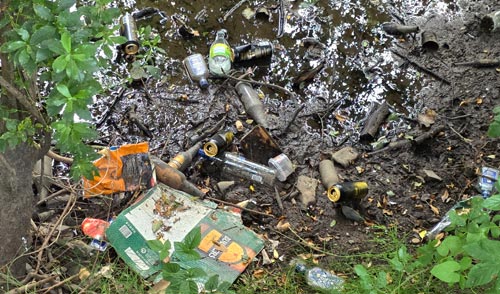
Visual Confirmation:State of the Suir River setin the heart of Thurles today; left uncleared since the recent Liberty Music Festival, which was held on Saturday July 4th and Sunday 5th, 2026 last.
These findings do not suggest failure across the council’s entire environmental programme. They do, however, show that enforcement must be consistent across every priority area. Tipperary County Council should respond by publishing clear corrective actions, measurable targets and realistic timelines for improvement. The report also highlights targeted work carried out in Tipperary’s firewood sector. Eleven firewood producers were contacted and provided with information on their obligations under solid-fuel legislation, including EPA registration and certification requirements. Following this engagement, three producers registered with the EPA and six began working towards certification through the Wood Fuel Quality Assurance Scheme. Two newly identified producers remain subject to further follow-up.
The Tipperary initiative demonstrates how inspections, education and sustained engagement can improve compliance. It also shows that continued oversight is necessary to ensure firewood meets the required quality and moisture standards, protects air quality and supports responsible producers.
The EPA will continue to monitor local-authority performance and work with councils to improve environmental outcomes for communities throughout Ireland.
This website uses cookies to improve your experience. We'll assume you're ok with this, but you can opt-out if you wish.AcceptRead More
Privacy & Cookies Policy
Privacy Overview
This website uses cookies to improve your experience while you navigate through the website. Out of these, the cookies that are categorized as necessary are stored on your browser as they are essential for the working of basic functionalities of the website. We also use third-party cookies that help us analyze and understand how you use this website. These cookies will be stored in your browser only with your consent. You also have the option to opt-out of these cookies. But opting out of some of these cookies may affect your browsing experience.
Necessary cookies are absolutely essential for the website to function properly. This category only includes cookies that ensures basic functionalities and security features of the website. These cookies do not store any personal information.
Any cookies that may not be particularly necessary for the website to function and is used specifically to collect user personal data via analytics, ads, other embedded contents are termed as non-necessary cookies. It is mandatory to procure user consent prior to running these cookies on your website.






Recent Comments