|
|
Yesterday, Friday, November 10th 2023, the HSE updated the status of its warning in relation to heroin overdose clusters in the Dublin Region.
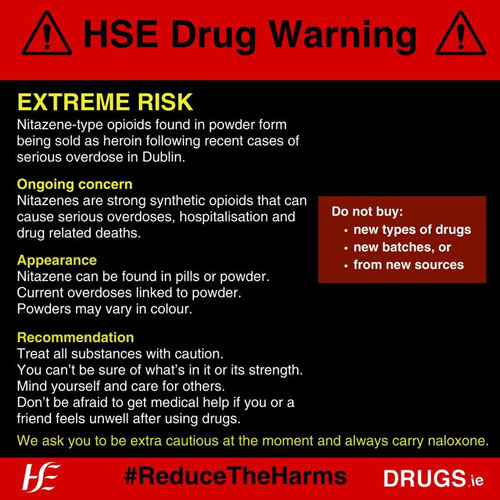
It has been confirmed through analysis conducted by Forensic Science Ireland (FSI) that a trace amount of a Nitazene type substance has been identified in a brown powder, associated with a Dublin overdose. Ongoing analysis is being conducted on the sample to identify the exact composition of the substance.
The HSE advises that there is “Extra Risk” at this time and strongly recommend that people do not try new types of drugs or new batches being sold on the market.
It is accepted that the Dublin to Cork train service, which passes through Thurles, is used regularly by drug dealers to transport their illegal product into the Tipperary area and beyond.
Professor Eamon Keenan, HSE National Clinical Lead, Addiction Services, said: “We are urging extreme caution following a sharp rise in the number of overdoses related to a powder being sold as heroin in the Dublin region. Preliminary laboratory analysis has confirmed that recent overdoses may be caused by heroin mixed with nitazene, a potent and dangerous synthetic opioid.These pose a substantial risk of overdose, hospitalisation and death.”
A total of 40 drug related overdoses have been reported to the HSE in the last 36 hours. We are reminding people to be extra careful, and avoid using new drugs, new batches of drugs or buying from new sources. It is safer not to use drugs at all. Your well-being is important, remember to look after yourself and care for others.
Naloxone is available free from every Dublin Addiction Service. Naloxone temporarily reverses the effects of opiate-type drugs like heroin, keeping the person alive until emergency services arrive.
The HSE asks people who use drugs to follow harm reduction steps, which can help reduce the harm if they are using substances.
Be aware, be extra vigilant at this time, there is increased risk at present and a number of overdoses have occurred in Dublin City yesterday morning.
Avoid new batches of heroin, avoid buying from new suppliers and avoid trying new batches or new types of drugs. This brings unknown risks.
Access Naloxone, talk to your local service or doctor about accessing naloxone as soon as you can.
Avoid using alone and make a rescue plan, and let someone know you are using and where.
Test the dose, start low and go very slow, there is an increased risk of overdose at this time. Avoid using other drugs, including methadone, benzodiazepines or alcohol.
Get medical help immediately, look out for the signs of overdose and don’t be afraid to get medical help if someone is unwell. Stay with the person until help comes.
Due to this concerning rise in opioid overdoses in the Dublin area and the risks posed by nitazene type substances, the HSE is continuing to collaborate with various partners, including Hospital Emergency Departments, Dublin Fire Brigade, non-governmental organisation (NGO) service providers, An Garda Síochána, and laboratories at the National Drug Treatment Centre and Forensic Science Ireland to monitor the situation closely. Laboratory tests are underway to identify the substances involved.
Science Events for Aged 6+ In Cashel Library – Ms Maura Barrett, (Cashel Library) Reports:-
Two Science Week events are taking place in Cashel Library, this coming week, on dates Wednesday 15th and 16th of November 2023.
The first Science Week event will take place in Cashel Library, on Wednesday, November 15th, when “Professor Egghead”, aka Jay Ryan, will celebrate the wonder of Science, by exploring the air around us.
The programme targets young people aged 6 years plus and will begin at 3:30pm running until 4:15pm
The second Science Week event entitled “How Science Could Help You Be Superhuman”, takes place also in Cashel Library, on Thursday November 16th, in association with Mary Immaculate College and Tipperary Festival of Science.
This programme begins sharp at 4:00pm.
Note: For admission to both programmes booking is essential, so please do contact Cashel Library in advance on Tel: 062 63825.
[ You can locate the Cashel Library building, situated on Friar Street, Lady’s Well, Cashel, Co. Tipperary, HERE. (G487+RX) ].
Here on Thurles.info, [Which today celebrates having been viewed by over 4 million readers to date], we regularly highlight unhealthy foods that receive health warnings from the Food Safety Authority of Ireland (FSAI).
In this modern age of ultra processed foods, it is often hard to know what exactly we are eating, since it often is so far removed from its natural origins. Foods are replete and well supplied with additives and other ingredients and it is hard to know what is truly safe and what is unsafe.
If you want to know more about the foods you eat and whether or not they are healthy, then you should download, to your Smartphone, the Yuka Application, (App).
But first do take the time to view the video shown hereunder.
This Yuka App is totally free and unsponsored, and will inform you on the levels of additives, saturates, proteins and sugars in your food, by simply scanning the barcode on all food packaging offered for sale.
What’s more, it will tell you how hazardous any additives are and why. It also tells you what is to be found in your shampoos, soaps and other cosmetics.
How to download the Yuka Application unto all phones.
To download the Yuka App, simply visit the iTunes App Store or Google Play Store and search for Yuka, [ https://yuka.io/en/ ]. From now on take a little time with your shopping and use your Smartphone to scan barcodes on packaging and instantly learn if any intended item should be purchased.
With rising prices, time has come for consumers to dictate to Supermarket chains what products they should stock and which are most healthy; rather than what it is they deem as being most profitable.
Remember, Yuka’s information and recommendations should not replace a healthy balanced diet. Always consult a GP for advice on the best diet for you, as an individual.
Fianna Fáil Minister for Education Ms Norma Foley TD, has announced that she is bringing a policy to Cabinet that will support parents not to buy ‘Smartphones’ for primary school children. Many in society will welcome this move, given mounting evidence that so called “Smartphones” are NOT a smart choice for our children.
The term ‘Smartphone’ refers to the now ubiquitous touchscreen phone that is so ‘smart’ it can perform any number of diverse functions; including stream movies, access the internet, email, access social media, take high quality video and photos, pay your bills and show you how to get from ‘A‘ to ‘B’ with built-in satellite navigation tools. Indeed, the potential of smartphones is unlimited given their ability to download applications (apps) for just about anything.
Despite their benefits and utility, increasingly, scientists, educationalists and parents are highlighting that they have the capacity to cause real harm, when put into the hands of children and teenagers (and some adults too). Smartphones enable unlimited access to social media platforms with multiple studies highlighting links between social media and increased levels of anxiety, depression and bullying.
Dove recently launched its “Cost of Beauty” campaign, and a short film, that is a stark warning to all parents about the devastating impact various platforms can have on young minds when these platforms enable them (and some would argue encourage them) to scroll through thousands of images of impossible beauty standards.
We are repeatedly warned of the dangers of excessive screen time and with apps purposely designed to keep users online and engaged, it’s impossible for adults, let alone young minds, to get offline. As well as spending too much time online, smartphones enable anyone to access anything online. You may think “that’s fine my kids only watch YouTube and Tiktoks”, but even these familiar apps can lead children to dark and strange content.
Please do take the time to watch, to the very end; this ‘Ted Talk’ video, shown immediately hereunder:
As well as the dangers of social media, screen time and exposure to inappropriate content, smartphones and apps are potentially invading our privacy. Our actions are constantly monitored and our data used and misused. It’s worth watching the documentary “The Social Dilemma” to get an insight into this area of danger.
Less dangerous, but troubling all the same, are the warnings about smartphones and the damage they are doing to our intelligence and creativity. We never get bored, never need to remember anything and never experience quiet solitude when in the presence of our smartphones.
Boredom and offline time is essential to learning, imagination and creativity. Indeed, back in 2018 “The Times” published an article entitled “Why the Silicon Valley titans who got our kids addicted to screens are sending their own children to tech-free schools”. Why? The Silicon Valley titans know the value of tech free time, hands-on learning, boredom, imagination and creativity and they want this, not their high tech, for their kids. It is even said that Steve Jobs, creator of the iPhone and iPad, did not allow his own children to use the very devices he created.
Many parents get their child a smartphone for understandable reasons. They want to be able, for example, to contact their child about ever changing after school activities, sports matches or visits with friends. This is important but you don’t need a smartphone to achieve this.
All you need for children is what’s known as a “dumb phone”, [View here for “dumb phone” ]. Dumb phones are so-called because their functions are limited. All you can do is make a call, receive a call and send and receive texts (some readers may remember these prehistoric devices). With all the negatives associated with smartphones these days, maybe “dumb phones” aren’t that dumb after all.
And whilst politicians don’t always get things right (“Do they ever”, I hear some of you say), Minister Norma Foley may be making a ‘smart’ move/decision here, and if her advice is followed, one that will really benefit our children into the future.
Sufferers of respiratory diseases and asthma please note.
- The Environmental Protection Agency (EPA) has today launched a national air quality forecast available on airquality.ie.
- The forecast will provide maps showing the predicted daily air quality for up to three days -“Today”, “Tomorrow” and the “Day after Tomorrow”.
- The air quality forecast is an important resource for everyone, but especially people who may be sensitive to poor air quality (e.g. those with asthma and heart conditions).
- The air quality forecast will help people plan their activities to follow public health advice, such as reducing physical activity when air pollution levels could affect their health.
The Environmental Protection Agency (EPA) has today launched a national air quality forecast to provide greater information to the public regarding expected air quality in Ireland for up to three days – “Today”, “Tomorrow” and the “Day after Tomorrow”.
Forecasts include daily Air Quality Index for Health (AQIH), Particulate Matter (PM), nitrogen dioxide (NO2) and ozone (O3). PM, NO2 and O3 are the three main air pollutants impacting human health in Ireland. All pollutants mapped are presented on the Air Quality Index for Health (AQIH) scale (1 – 10).
Marking the launch of the forecast, Dr Micheál Lehane, Director of the EPA’s Office of Radiation Protection & Environmental Monitoring, said: “Air pollution can seriously impact people’s health; the air quality forecast will provide an important health and air quality resource for everyone, and will be even more impactful for those of us who are particularly affected by poor air quality, including those suffering from respiratory disease and asthma. The forecast will also serve policy makers as a valuable tool for analysing air quality in Ireland.’’
There are concerning localised air quality issues in Ireland. Fine particulate matter (PM 2.5) from burning solid fuel and nitrogen dioxide (NO2) from vehicle emissions are the main pollutants impacting on people’s health. This forecast will help people plan their activities in line with the Air Quality Index for Health (AQIH) recommendations, such as reducing physical activity when air pollution levels are predicted to increase. The forecast maps will be uploaded twice daily, once in the morning and once in the evening.
The CEO of the Asthma Society of Ireland, Ms Eilís Ní Chathnia, welcomed the forecast launch: “The air quality forecast will be an important resource for our members and everyone with respiratory conditions. Ireland has the highest incidence rate of asthma in Europe with one in ten children and one in thirteen adults developing the condition – with 890,000 people likely to develop asthma in their lifetimes. The Asthma Society welcomes the opportunity to be associated with the launch of the forecast.’’
The forecast and further information on air quality and the Air Quality Index for Health are available on HERE.
The air quality forecast maps are produced by computer models which have been developed under the EU LIFE Emerald project. The models use Irish and European data such as air quality measurements, forecast weather and land cover data. The EPA has partnered on this with the Department of the Environment, Climate and Communications (DECC), the Health Service Executive (HSE), VITO, a Belgian research institute, University College Cork (UCC) and the Asthma Society of Ireland.
|
Support Us Help keep Thurles.info online by donating below. Thank you.
Total Donated 2026: €300.00
Thank You!
Daily Thurles Mass Livestream
|





Recent Comments