|
|
Ms Maura Barrett, (Cashel Library) Reports:
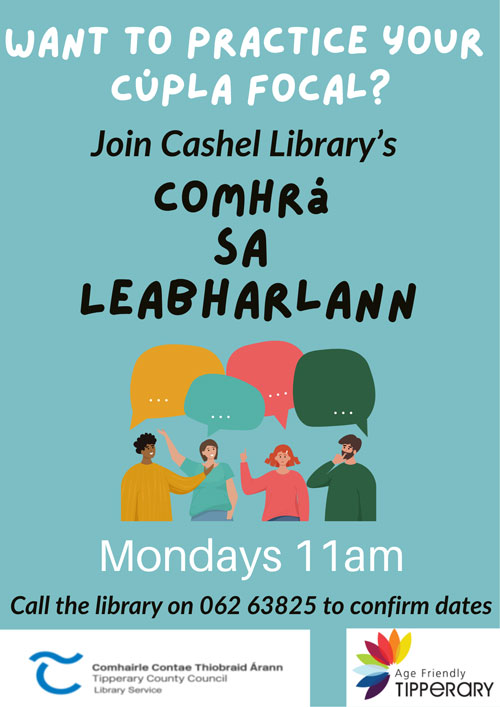
Bain triail as do chúpla focal sa leabharlann Chaiseal Mumhan. Tá fáilte roimh gach duine.
[Try your hand at a few words in the Cashel Munster library. Everyone is welcome.]
Visitors attending this informative event can locate the Cashel Library building; situated on Friar Street, Lady’s Well, Cashel, Co. Tipperary, HERE. (Eircode E25 K798).
Cashel Branch Librarian Ms Maura Barrett Reports:–
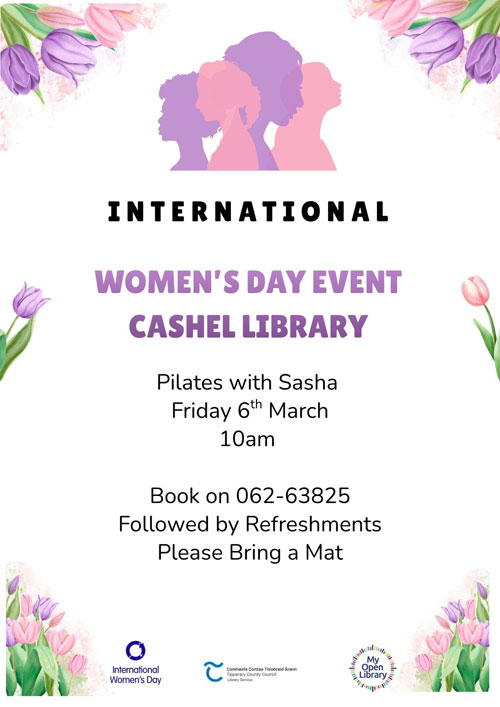
As we celebrate International Women’s Day we invite you to our free Pilates Session with Sasha, followed by refreshments.
Pilates is a form of exercise developed by Joseph Pilates that focuses on core strength, flexibility, and overall body conditioning through controlled movements. It can be performed on a mat and is suitable for people of all fitness levels.
Please Do remember: Spaces are limited, bring your own mat and note
booking is essential to Tel: 062-63825
International Women’s Day falls on March 8th and it honours the achievements of women and promotes women’s rights.
Sasha is committed to seeing her clients grow in confidence and ability as they develop a shared understanding of the benefits of precise and mindful movement.
Visitors attending this event can locate the Cashel Library building; situated on Friar Street, Lady’s Well, Cashel, Co. Tipperary, HERE. (Eircode E25 K798).
Just 5 days ago, (February 27th 2026), the Competition and Consumer Protection Commission (CCPC), issued an urgent consumer alert following recalls of toys sold in a number of retailers across Ireland due to the possible presence of asbestos.
Asbestos is banned across the EU because it poses a risk to health. The CCPC said a My Living World – Worm World Kit was recalled last week after laboratory testing detected tremolite asbestos in some samples of the sand included with the product. The kit is intended to house worms so children can study them.
The CCPC has also highlighted a separate recall being carried out by HTI Toys involving Stretcherz Toys, where the sand inside the product may contain asbestos.
Consumer advice.
The CCPC is advising anyone who has the affected products at home to:
- Stop using the product immediately.
- Seal the product in a heavy-duty plastic bag, label it clearly, and store it securely out of reach of children.
- Contact your local authority for advice on collection and disposal.
- Contact the retailer where the item was purchased to request a refund before disposal.
- Full batch code details are available on the CCPC website.
Irish Retailers confirmed to date for the Worm World Kit.
The CCPC confirm the My Living World – Worm World Kit has been sold and distributed through a number of Irish retailers, including:
- Oliver Douglas & Sons, Roscrea Road, Birr, Co Offaly.
- Banba Toymaster, 48 Mary Street, Dublin 1.
- Hopkins Toymaster, Main Street, Wicklow Town.
- Toy Corner, Moycullen, Galway.
- Eamonn Fahey Toymaster, Crossmolina Road, Ballina, Co Mayo
- Kellys Toymaster, Church Road, Tullamore, Co Offaly
The CCPC also confirm it has been in contact with the Health and Safety Authority (HSA), Scientific Laboratory Supplies Limited (SLS Ltd) and relevant schools regarding the Worm World Kit recall.
Sinn Féin leader Ms Mary Lou McDonald has condemned the recent/latest US and Israeli strikes, calling them “an act of unprovoked military aggression” and urging a halt to military action and a return to diplomacy.
Wrapped in the sanctimony of condemning ‘unprovoked military aggression,’ Sinn Féin’s moral certainty jars with a past in which civilians were too often treated as collateral.
That phrase, “unprovoked military aggression”, is designed to do a lot of work in a very small space. It tells you who the villains are, who the victims are, and who holds the moral high ground. It’s a clean sentence. A righteous sentence. The kind of sentence that fits neatly into a clip for an evening news bulletin.
The problem for Sinn Féin is that Ireland’s memory is not short, clean and neat, and neither is modern Sinn Féin’s own history. Because, while Sinn Féin is a political party, it was long widely regarded as the political wing of the Provisional IRA, even if both have emphasized separateness since the 1990s. That association matters, not as a cheap talking point, but because it drags out a very specific set of ghosts into any conversation about violence and legitimacy. And those ghosts have names, dates, and places, where civilians paid the ultimate price.
Civilians in the crosshairs: Provisional IRA (PIRA)
If readers want to understand why some people hear “unprovoked aggression” and immediately wince; you don’t need to reach for ideology. You just need a calendar of factual events .
- 21st July 1972 – Belfast (“Bloody Friday”): 22 bombs in 75 minutes. 9 killed, around 130 seriously injured.
- 31st July 1972 – Claudy, Co. Londonderry (“Bloody Monday”): Three car bombs, 9 civilians killed, 30 injured.
- 17th February 1978 – La Mon House Hotel/Restaurant, near Comber, Co. Down: an incendiary device killed 12 and injured 30 in a restaurant setting.
- 27th August 1979 – Mullaghmore, Co. Sligo (Mountbatten assassination): a bomb on a boat killed four, including teenagers Nicholas Knatchbull (14yrs) and Paul Maxwell (15yrs).
- 8th November 1987 – Enniskillen, Co. Fermanagh (Remembrance Day bombing): a bomb at a ceremony killed 11 people initially, most of them civilians.
- 20th March 1993 – Warrington, England: bombs in litter bins killed two children (Jonathan Ball, 3yrs; Tim Parry, 12) and injured 56 persons.
- 23rd October 1993 – Shankill Road, Belfast: a bomb detonated prematurely in a fish shop; 10 killed, including eight civilians and two children.
These aren’t “military operations.” They’re not “surgical strikes.” They’re the messy, brutal reality of what happens when violence is sold as strategy and civilians are treated as collateral, or as leverage.
So when Sinn Féin’s leader uses the language of moral clarity about foreign wars, people are entitled to ask: where was that clarity when Irish and British civilians were being blown apart in pubs, streets, shops, at ceremonies, and in restaurants? Again, ordinary people, normal venues, lives ended in pieces.
Real IRA: Omagh and the moral bankruptcy of “after”.
Then there’s Omagh, the moment that shattered any illusion that mass-casualty bombing belonged to the past.
15th August 1998 – Omagh, Co. Tyrone: the Real IRA bombing killed 29 and injured 200 plus.
Whatever someone wants to call it; be it ‘war’, ‘resistance’, ‘conflict’, Omagh made one thing undeniable; there is no political argument that redeems the slaughter of civilians in a town centre.
The point isn’t “whataboutism.” It’s credibility.
Defenders will say, “Sinn Féin today is not the Provisional IRA”. True, in the direct operational sense. But Sinn Féin can’t have it both ways, it can’t trade on a revolutionary heritage when it suits, then act offended when that heritage is raised as a moral mirror. Britannica’s phrasing is blunt for a reason: “Sinn Féin was long widely regarded as the political wing of the Provisional IRA”.
So yes, Ms McDonald can condemn foreign strikes as “unprovoked military aggression.”
But if Sinn Féin wants to speak like an international referee, it should expect people to replay their tapes, and on their tapes, watch as civilians scream, burn, bleed and die.
No, it’s not ancient history. No, it’s the price paid by ordinary people who never got to vote on anybody’s future “strategy.” And it’s why moral language, used cheaply, can sound less like principle, and more like a theatre performance, for the less informed.
“Unprovoked Military Aggression”, said Ms Mary Lou McDonald.
Let us take a look at Iran’s weapons support and who it armed, and roughly for how long, up until this year (2026).
Hezbollah (Lebanon): since1982 – (44 years).
Hamas + Palestinian Islamic Jihad (PIJ) associated with Sinn Féin: the former commonly described as armed/supported since the 1990s era – (30–36 years).
Major war-theater pipelines.
Houthis / Ansar Allah (Yemen): at least since 2014 (and UN panels have identified Iranian-origin missile/UAV remnants in Yemen) – (12+ years.)
Syrian government / pro-Assad forces: widely reported military support since 2011 – (15 years).
Newer state-to-state channel.
Russia: transfers tied to the Ukraine war since 2022; UK/France/Germany have publicly condemned Iran’s ballistic missile transfers – (4 years).
Hezbollah timeline:
1982: Hezbollah emerges, founded in the context of Israel’s invasion of Lebanon with Iranian support.
18th Apr 1983: U.S. Embassy bombing, Beirut: 63 killed. Frequently attributed in U.S. accounts to Hezbollah-linked networks / “Islamic Jihad Organization
23rd Oct 1983: U.S. Marine barracks bombing, Beirut: 241 U.S. service members killed.23rd Oct 1983: French paratrooper barracks bombing, Beirut: 58 French soldiers killed.
20th Sep 1984: U.S. Embassy annex bombing (Aukar), Beirut: 23 killed.
3rd Dec 1984: Kuwait Airways Flight 221 hijacking: 2 killed (two U.S. passengers murdered).
14th–30th Jun 1985: TWA Flight 847 hijacking (Athens): 1 killed (U.S. Navy diver Robert Stethem).
12 Apr 1985: El Descanso restaurant bombing (Spain): 18 killed.
7th Mar 1992: Assassination of Ehud Sadan (Israeli Embassy security chief), Ankara: 1 killed, 3 injured; claimed by “Islamic Jihad Organization,” Hezbollah suspected/denied.
17th Mar 1992:Israeli Embassy bombing, Buenos Aires: 29 killed, 242 injured; claim of responsibility by “Islamic Jihad Organization,” which has been linked to Iran/Hezbollah in many accounts.
28th Jan 1993: Attempted murder of Jak Kamhi (prominent Turkish Jewish figure): shot and survived; discussed in intelligence/terrorism reporting as part of Iran/Hezbollah-linked activity.
17th Mar 1994: Attempted bombing of the Israeli Embassy, Bangkok: failed after suspects’ car crash; C4 reportedly found.
18th Jul 1994: AMIA bombing, Buenos Aires: 85 killed; widely attributed by Argentine judicial/official actions and major reporting to Hezbollah with Iranian backing, (Iran denies).
19th Jul 1994: Alas Chiricanas Flight 901 bombing (Panama): 21 killed; long unresolved, later treated publicly by U.S. sources as Hezbollah-linked.
Apr 1996: Hezbollah rocket fire into northern Israel (Grapes of Wrath period): Hezbollah fired Katyusha rockets; exact counts/precise injury figures vary by source.
25th Jun 1996: Khobar Towers bombing (Saudi Arabia): 19 killed; attribution often tied to Saudi Hezbollah/Hezbollah al-Hejaz, but it is politically disputed in some accounts.
7th Oct 2000: Abduction of three Israeli soldiers: abducted, later confirmed dead; remains returned in 2004 exchange.
14th Feb 2005: Assassination of Rafik Hariri (Beirut): 22 killed. International legal proceedings convicted Hezbollah members (in absentia), while also noting limits on proof regarding leadership direction.
12th Jul 2006: Cross-border raid: 8 Israeli soldiers killed, 2 captured; triggers the 2006 Lebanon War.
26th May 2011: Attempted assassination of Israel’s consul in Istanbul: some reporting ties it to Iran/Hezbollah; treated as alleged.
Feb 2012: India/Georgia diplomat attack attempts: widely discussed as an Iran-linked campaign, sometimes described as Iran/Hezbollah-linked.
2012: Bulgaria (Burgas) bus bombing: 6 killed (+ bomber); Bulgarian/EU assessments attributed involvement to Hezbollah operatives; Hezbollah denies.
2012: Azerbaijan plot against Israeli ambassador / Chabad-linked targets: widely described as Iran-linked; “Iran/Hezbollah” appears in some reporting/claims.
Apr 2014: Bangkok plot targeting Israeli tourists (Passover/Songkran period): Thai authorities arrested suspects described in reporting as Hezbollah members/agents.
May–Jun 2015: Cyprus ammonium nitrate seizure: Reuters reported Cyprus believed it foiled a major attack; Israel said it bore Hezbollah hallmarks.
2015: London-area ammonium nitrate cache, widely reported as a 2015 discovery later revealed publicly.
Nov 2023: Brazil: foiled plot targeting Jewish-linked sites: Brazilian federal police said suspects were recruited/funded by Hezbollah; treated as alleged pending full public case details.
27th Jul 2024: Majdal Shams (Golan Heights) strike: 12 killed; a rocket attack. Israel/U.S. blamed Hezbollah; Hezbollah denied responsibility.
So should the USA and Israel attack be therefore described as “Unprovoked Military Aggression”?
If a strike is responding to an armed attack carried out by an Iran-backed aggressor, supporters can surely argue that it’s actions are not “unprovoked.”
Thurles, Co. Tipperary’s Former Pupil Ms Jessie Buckley Wins BAFTA Leading Actress Award.
Ms Jessie Buckley has won Leading Actress at the BAFTA Film Awards in London for her performance in Hamnet. A former pupil of Ursuline Convent Thurles, Ms Buckley becomes the first Irish actress to take the top honour in the category at the main BAFTA Film Awards.
Ms Buckley received the award from fellow Irish actor Mr Cillian Murphy on stage at Royal Festival Hall.
Accepting her award, Buckley said: “As a little girl, I never in a million years thought I would get to make a film.” Reflecting on her early days as an actress, she added: “I had nuclear bad fake tan on, white hoop earrings, a polka-dot red skirt, and had the audacity to say one day I wanted to be like Judi Dench.”
Buckley continued: “This is nuts, this really does belong to the women past, present, and future who taught me and continue to teach me how to do it differently.”
Addressing her fellow nominees, she said: “You are all just radical and you are doing it for the naughty girls, and I’m in awe of all your incredible performances.”
She added: “I love films and I believe in storytelling. I believe in women’s voices to tell those stories.”
Sharing the moment with her daughter, she said: “It’s the best role of my life being your mum and I promise to continue to be disobedient so you can belong to a world in all your complete wildness as a young woman. I am very grateful for this.”
Hamnet was also named Outstanding British Film and had been nominated in 11 categories.
Winners on the night
Best Film: “One Battle After Another“.
Leading Actress: Jessie Buckley, – “Hamnet”.
Leading Actor: Robert Aramayo, – “I Swear”.
Director: Paul Thomas Anderson, – “One Battle After Another”.
BAFTA Fellowship Award: Donna Langley.
EE Rising Star Award (public vote): Robert Aramayo.
Outstanding British Film: “Hamnet”.
Film Not in the English Language: “Sentimental Value“.
Adapted Screenplay: “One Battle After Another”, – Paul Thomas Anderson
Original Score: “Sinners“, – Ludwig Göransson
Cinematography: “One Battle After Another”, – Michael Bauman
Animated Film: “Zootropolis 2”, – Jared Bush, Byron Howard, Yvett Merino
Casting: “I Swear”, – Lauren Evans
Editing: “One Battle After Another”, – Andy Jurgensen
Outstanding British Contribution to Cinema: Clare Binns
Outstanding Debut by a British Writer, Director, or Producer: My Father’s Shadow, Akinola Davies Jr, Wale Davies
British Short Animation: “Two Black Boys in Paradise”, – Baz Sells, Dean Atta, Ben Jackson
Original Screenplay: “Sinners”, – Ryan Coogler
British Short Film: “This Is Endometriosis”, – Georgie Wileman, Matt Houghton, Harriette Wright
Documentary: “Mr Nobody Against Putin”, – David Borenstein, Helle Faber, Radovan Síbrt, Alzbeta Karaskova
Costume Design: “Frankenstein”, – Kate Hawley.
Production Design: “Frankenstein”, – Tamara Deverell, Shane Vieau
Sound: F1, Gareth John, Al Nelson, Gwendolyn Yates Whittle, Gary A. Rizzo, Juan Peralta.
Children’s & Family Film: “Boong” – Lakshmipriya Devi, Ritesh Sidhwani
Make Up & Hair: “Frankenstein”, Jordan Samuel, Cliona Furey, Mike Hill, Megan Many
Supporting Actor: Sean Penn, – “One Battle After Another”.
Supporting Actress: Wunmi Mosaku, – “Sinners”.
Special Visual Effects: “Avatar” Fire and Ash – Richard Baneham, Daniel Barrett, Joe Letteri, Eric Saindon.
|
Support Us Help keep Thurles.info online by donating below. Thank you.
Total Donated 2026: €290.00
Thank You!
Daily Thurles Mass Livestream
|






Recent Comments