|
|
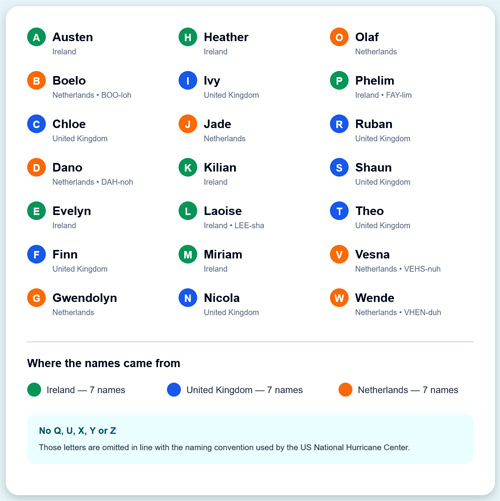
Austen, Boelo and Chloe are first in line to name major storms affecting Ireland, the UK and the Netherlands during the 2026/27 season.
Met Éireann unveiled the list alongside the UK Met Office and Dutch forecasting service KNMI after the public submitted more than 40,000 suggestions. The official list contains 21 names, beginning with Austen and ending with Wende.
Met Éireann confirmed the names on 1st September 2026.
Many of the nominations pay tribute to loved ones, pets and notable figures from meteorological history.
Chloe, the third name on the list, was suggested more than 120 times. One nomination came from the mother of a five-year-old weather enthusiast who is fascinated by forecasts but, according to her family, can “create a storm by herself” when tired.
Finn was proposed for a two-year-old boy described by his family as wild and a force to be reckoned with. Ivy commemorates a nine-month-old Labrador puppy affectionately nicknamed “the absolute destructor”.
Nicola honours a mother who has “weathered many a storm and only come out stronger”, while Theo was inspired by a cat that would hide before thunderstorms, leading its owner to joke that it could predict the weather.
Shaun also appears on the list after winning a public vote held through a partnership between the Met Office and Aardman, the British animation studio behind Shaun the Sheep and Wallace & Gromit. The collaboration is intended to introduce weather preparedness to new audiences through Aardman’s storytelling.
Met Éireann selected several names connected to the history of Irish weather forecasting as it celebrates the 90th anniversary of the establishment of the Irish Meteorological Service.
Austen honours Austen Nagle, its first director, while Evelyn recognises Evelyn Murphy, the first woman to present a weather forecast on RTÉ.
KNMI chose its names from more than 3,000 public suggestions. They include Boelo,pronounced “Boo-loh”—a traditional but now almost extinct name from the eastern Groningen region. The name has been passed through the nominator’s family for generations.
Although the stories behind the names are often warm and personal, meteorologists emphasise that storm naming serves a serious purpose. Giving a potentially dangerous weather system a distinctive name helps the public follow forecasts, understand warnings and prepare for possible disruption.
A storm is named when forecasters believe it could produce medium or high impacts in Ireland, the UK or the Netherlands. Strong winds remain the main consideration, although the potential effects of heavy rain and snow are also assessed.
The three forecasting organisations have named storms jointly since 2015. Each annual list operates from the beginning of September until the following August.
The letters Q, U, X, Y and Z are omitted in keeping with North Atlantic naming conventions.
Adults found with a small quantity of controlled drugs for personal use may now be referred to the Health Service Executive instead of being prosecuted under Ireland’s new Health Referral Scheme.
The nationwide pilot scheme took effect on 1 September 2026. It gives An Garda Síochána an alternative response when dealing with an eligible person’s first drug-possession offence.
To qualify, a person must:
- Be at least 18 years old.
- Have no previous drug-possession conviction or adult caution.
- Admit that the drugs were intended for personal use.
- Agree to participate in the voluntary referral process.
The person must then contact the HSE and arrange an appointment with a trained SAOR practitioner. The appointment includes screening, discussion of the person’s substance use and support needs, and practical information and advice.
Further treatment or specialist support may be recommended where appropriate.
This is therefore not necessarily a compulsory rehabilitation programme. It begins with a screening and brief intervention, followed by additional support when needed.
The Health Research Board explains the intervention.
Anyone who declines the referral may instead be prosecuted under existing drugs legislation. Possession of a controlled drug remains a criminal offence under Section 3 of the Misuse of Drugs Act; the scheme does not legalise or decriminalise drug possession.
Garda Commissioner Mr Justin Kelly welcomed the initiative, saying it would allow Garda members to support harm reduction by directing eligible first-time offenders towards health services instead of the criminal justice system.
The Government says the scheme is designed to encourage early engagement with support services, reduce drug-related harm and limit the potentially lasting consequences of a first possession offence. It is also intended to allow Garda resources to remain focused on drug dealing, organised crime and exploitation. The Department of Health describes it as a new health-led pathway.
Potential benefits:
- It may help people address risky or problematic drug use at an early stage.
- It can prevent a first offence from resulting in a conviction that affects employment, education or travel.
- It treats some personal drug use as a health matter while retaining penalties for supply and trafficking.
- It may reduce unnecessary pressure on Gardaí, prosecutors and the courts.
- It can connect people with specialist services they might not otherwise approach.
Potential drawbacks:
- Eligibility is limited to first-time offenders, leaving little scope for people whose repeated offending may be connected to addiction.
- The decision depends partly on Garda discretion, which may raise concerns about consistency.
- There is no single fixed quantity defining personal use; Gardaí assess factors such as the amount and how the drugs are packaged.
- The scheme could place additional demand on already stretched health and addiction services.
- Because possession remains illegal, critics may regard the initiative as too limited and argue that broader legal reform is needed.
- Referral information remains relevant to how any later offence is handled, even though the first incident is diverted from prosecution.
The scheme represents a significant change in Ireland’s response to first-time personal drug possession, but its impact will ultimately depend on consistent implementation, adequate HSE resources and whether participants meaningfully engage with the support offered.
However, questions remain. Could participants be pressured to reveal the source of the drugs, and is the scheme genuinely focused on public health, or partly intended to ease pressure on Ireland’s overcrowded prisons?
Official information describes the scheme as voluntary and focused on screening, advice and support; it does not state that participants must identify a supplier. There is also no published evidence that reducing prison overcrowding is one of its stated objectives.
A multi-million-euro investment has been sanctioned for Coláiste Mhuire Co-Ed in Thurles, delivering a significant improvement in facilities for its growing school community.
The project was advanced by the school and its patron and managing authority, Tipperary Education and Training Board.
Funding has been sanctioned by the Department of Education, while Tipperary County Council is responsible for the relevant local planning decisions.
This development will provide 11 classrooms, including three additional general classrooms and new specialist facilities for Home Economics, Design and Communication Graphics, and Science.
Five prefabricated classrooms that have been in place for more than 35 years will now be replaced. A purpose-built ASD classroom with a dedicated sensory space will also be provided, supporting a more modern and inclusive learning environment.
In addition to the new accommodation, the existing school building will undergo a comprehensive roof retrofit.
This substantial public investment represents an important milestone for Coláiste Mhuire Co-Ed and will provide improved facilities for students, staff and the wider Thurles community for many years to come.
Twenty-three children under the age of 16 were killed or seriously injured on roads in County Tipperary between 2021 and 2025, according to newly released Road Safety Authority figures.
Tipperary accounted for approximately 3% of the 658 child casualties recorded across Ireland during same five-year period. The county-level data provide a combined figure and do not specify separately how many of the 23 children died and how many suffered serious injuries.
Nationally, 38 children aged from birth to 15 were killed and another 620 were seriously injured. Children represented 5% of all road deaths and 8% of serious injuries recorded during that period.
The RSA Child Casualties Report 2021–2025 found that almost half of the children killed or seriously injured were pedestrians. Passengers accounted for 26% of casualties, cyclists for 17% and e-scooter users for 5%.
The research also highlighted the risks children face on roads with lower speed limits. Almost three-quarters of child casualties occurred on roads with limits of 60km/h or less, while 72% were injured between noon and 8:00pm.
Boys accounted for 61% of the children killed or seriously injured, compared with 39% for girls. Friday was the most dangerous day of the week, accounting for one in five child casualties.
One in eight casualties was travelling to or from school when the collision occurred.
The RSA released the figures as pupils across Tipperary and the rest of the country prepared to return to school. It is urging motorists to slow down, eliminate distractions and allow children sufficient time and space when walking or cycling.
Parents are also being asked to ensure children use appropriate restraints when travelling by car and to avoid parking on footpaths during school drop-off and collection times.
Stena Line and Irish Ferries are introducing stricter identification requirements for passengers travelling by ferry between the Republic of Ireland and Britain.
From Monday, September 28th, 2026 next, passengers, including children, will need to present a valid passport when checking in for affected sailings.
Stena Line says the requirement will apply in both directions on its Dublin–Holyhead route and Rosslare–Fishguard route.
No alternative forms of identification will be accepted by Stena Line.
The company is contacting customers who already have bookings.
Irish Ferries has similarly announced that all passengers, including Irish and British citizens, travelling between the Republic of Ireland and Britain in either direction must carry a valid passport. Its announcement also advises Irish passengers to check that their passport or Irish passport card is in date.
The operators say the change is required to comply with UK Border Force rules concerning the accuracy and integrity of passenger information collected before boarding.
This new passport rule appears to be part of the UK’s move towards a more digital, automated border system, requiring ferry operators to provide accurate, verifiable passenger information before departure. Passports make it easier to confirm travellers’ identities, nationalities and immigration permissions, so the measure is connected to immigration and border security in that operational sense; however, authorities have not linked it to any particular immigration incident or increase in illegal migration. It does not alter the Common Travel Area rights of Irish and British citizens, who remain exempt from visas and the UK’s Electronic Travel
What were the previous rules?
Under the Common Travel Area, Irish and British citizens are not generally legally required to present a passport when travelling between the two countries.
UK government guidance still says that Irish and British citizens travelling from Ireland to Great Britain may establish their identity and nationality using documentation other than a current passport.
Previously, ferry companies could accept alternative identification from Irish and British passengers. Depending on the operator and passenger’s age, this could include a driving licence or other official photographic ID.
Irish Ferries’ earlier guidance also said that British and Irish passengers under 18 without photographic identification could usually travel with a birth certificate.
This new requirement is therefore principally a stricter carrier check-in policy. It does not remove the travel and residency rights enjoyed by Irish and British citizens under the Common Travel Area.
Government guidance also makes clear that ferry operators may impose their own documentary requirements.
The change does not affect Stena Line’s services from Belfast to Liverpool, Cairnryan or Heysham. Passengers using other routes or operators should check the identification rules applying to their particular booking before travelling.
|
Support Us Help keep Thurles.info online by donating below. Thank you.
Total Donated 2026: €300.00
Thank You!
Daily Thurles Mass Livestream
|





Recent Comments