Mr Tim Maher (PRO),Bournea Reaching Out Historical Societyreports:-
The Bournea Reaching Out Historical Society has announced an upcoming public lecture examining the foundation and early years of Ireland’s national police service, An Garda Síochána. The event will take place in Lismackin Community Hall, on Monday, April 28th at 8:00 pm sharp, and all members of the public are warmly invited to attend.
The lecture will be delivered by renowned historian Dr John Reynolds, a former member of the Gardaí who trained at Templemore Garda College. Drawing on both academic research and personal insight, Dr Reynolds will explore the dramatic and often challenging beginnings of the force during a pivotal moment in Irish history.
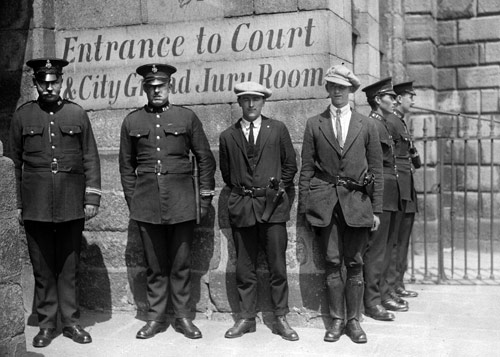
Early Civic Guards. Note:In 1922 many recruits didn’t yet have standard uniforms.
An Garda Síochána traces its origins to February 1922, when the newly formed Provisional Government established the Civic Guard to replace the disbanded Royal Irish Constabulary (RIC) and take responsibility for policing the emerging Irish Free State . The initiative, closely associated with Michael Collins, aimed to create a national police service rooted in the community rather than the militarised traditions of the past.
The lecture will highlight key milestones in the formation of the force, including the early organisational meeting held in Dublin’s Gresham Hotel in February 1922 , the appointment of Michael Staines as the first Commissioner, and the transfer of authority symbolised by the Gardaí taking over Dublin Castle in August of that year.
Dr Reynolds will also examine the significant challenges faced during the early months, such as the Kildare Mutiny, which exposed tensions within the new force and ultimately shaped its development as an unarmed police service relying on public trust and moral authority . The transformation of the Civic Guard into An Garda Síochána under legislation in 1923, and its later unification with the Dublin Metropolitan Police in 1925, will also be discussed.
This promises to be an engaging and informative evening for anyone interested in Irish history, policing, or the foundations of modern Ireland.
(1) Comhrá sa Leabharlann. Bain triail as do chúpla focal sa leabharlann Chaiseal Mumhan. Tá fáilte roimh gach duine. [Try your hand at a few words in the Cashel Munster library. Everyone is welcome.]
(2)Memory Cafe in Cashel Library. The next meeting of the Memory cafe will meet Tuesday 14th April, 11am–12.30pm. All are welcome to attend.
(3)Cashel Juvenile Book Club. The next meeting of the juvenile book club in Cashel library will take place Tuesdayevening,14th April 6.30pm, suitable for those Aged 9-11years.
(4)Cashel Craft Circle. Join the Cashel Craft Circle every Wednesday from 10am-12pm for their social gathering. Bring along your own project to work, share ideas, patterns and enjoy a chat and cuppa with others. No need to book just come along.
People wishing to attend the above events can locate the Cashel Library building; situated on Friar Street, Lady’s Well, Cashel, Co. Tipperary, HERE. (Eircode E25 K798).TEL: 062-63825.
The EPA announces funding of €10.5m for new environmental and climate research inviting innovative solutions to address medium- to longer-term environmental research needs.
Research proposals are invited for research across the following areas:
Addressing Climate Change Evidence Needs
Delivering a Healthy Environment
Facilitating a Green and Circular Economy
Protecting and Restoring our Natural Environment
Policy Implementation, Effective Regulation and Innovative Governance Models
Successful researchers will be supported by EPA to engage with policy makers to ensure that the research is impactful and effectively informs environmental policy in Ireland.
Yesterday, the Environmental Protection Agency (EPA)announces research funding of up to €10.5 million for new environmental research. The EPA is inviting proposals from the research community for innovative projects to support the development and implementation of environmental policies in Ireland. In particular, multi- and trans-disciplinary teams are welcomed to bring diverse perspectives to complex environmental challenges.
Announcing the EPA funding call, Ms Roni Hawe, Director of the EPA’s Office of Evidence and Assessment said: “The launch of the EPA Research Call 2026 marks a significant opportunity for the research community to contribute to addressing Ireland’s most pressing environmental challenges. This investment will support the generation of robust evidence needed for good policy and for more efficient and effective decision-making, as well as building skills and expertise in critical areas related to climate, the environment and sustainability.”
Opportunities for research are identified in areas such as how to bring mitigation and adaptation together to support Ireland achieving its climate and environmental goals; understanding antimicrobial resistance in the environment; how to accelerate our transition to a circular economy and how we can protect the environment while accelerating infrastructure and simplifying environmental regulation.
Dr Ms Caroline Wynne, EPA Research Manager, said: “This year, we are pleased to invite proposals for larger scale projects that will allow researchers to develop new and innovative solutions as well as supporting the recruitment and training of highly skilled PhD students. We are particularly interested in supporting a wide cohort of the research community to bring social, economic and environmental perspectives together, which is essential to address complex societal challenges.”
The EPA Research Programme is a Government of Ireland initiative funded by the Department of Climate, Energy and Environment. Under this year’s call, the EPA is delighted to be partnering with Met Éireann to co-fund projects in areas of mutual interest.
The deadline for proposals is May 28th 2026.
Further funding: Other EPA funding opportunities this year include EPA Fast-track to Policy Funding; Fulbright-EPA Scholarships and Fellowships; the Research Ireland Public Service Fellowship, as well as opportunities supported through EPA’s participation in European Partnerships. Details are available on our Research Funding webpage.
The Climate Change Advisory Council’s latest report finds that climate change, driven by greenhouse gases, is having measurable impacts in Ireland. There is clear evidence in 2025 of rising temperatures and more frequent extreme weather events, with growing risks for communities, infrastructure, essential services and the economy.
The Council today launched Our Changing Climate 2025, the first publication in its Annual Review 2026 series, highlighting accelerating climate trends and the urgent need for Ireland to simultaneously reduce its dependency on fossil fuels and strengthen its preparedness for climate impacts. Our continued reliance on economically volatile imported fossil fuels leaves households, communities and businesses acutely vulnerable to shocks such as the current conflict in the Middle East. The Council has repeatedly stressed that there are viable alternatives which must be urgently pursued that would increase our economic resilience, reduce our dependency on the actions of others and simultaneously reduce our contributions to global warming.
The Council has identified gaps in how the economic, social and environmental consequences of extreme weather events are monitored, noting that robust data and evidence are essential to inform effective policy, planning and investment.
New attribution capabilities highlight the direct link between continuing greenhouse gas emissions and the weather we are experiencing today. Rainfall during Storm Claudia in November 2025 for example was made twice as likely and nearly 12% more intense than it would have been in a pre-industrial climate. This points directly to the impact of climate change on our weather patterns. Extreme conditions continued into 2026, with Storm Chandra bringing prolonged rainfall and severe flooding, as saturated ground conditions significantly increased flood risk.
The report also identifies impacts across natural systems, including shifts in the seasonal lifecycles of insects and wildlife, signalling broader ecological change. This can result in an increased risk of outbreaks of diseases such as ash dieback and avian influenza, invasive species such as the Asian Hornet, harmful algal blooms, and an increased risk of wildfires.
Key climate observations from the report include:
2025 was the second warmest year on record, with average summer temperatures 1.94°C above the 1961–1990 long-term average
Seven of the ten warmest years have occurred since 2005.
The meteorological autumn was the fourth wettest on record, and six of the ten wettest autumns have occurred since 2001, pointing to a clear trend of increasing rainfall.
Ireland experienced record-breaking warm conditions in spring and summer, with Uisce Éireann declaring 49 water supplies in 15 counties to be in drought status.
Ireland recorded its highest ever wind gust of 184km/h in January 2025
A record high minimum temperature for any calendar month of 19.0°C was also recorded in June.
Storm Éowyn, an event with record-breaking wind speeds, was the most expensive storm-related insurance event in Irish history with claims in excess of €301m. The storm exposed vulnerabilities in critical infrastructure and essential services, including energy, water and telecommunications.
Globally, the 10 most costly extreme weather events in 2025 caused damage exceeding €100bn.
The Council has emphasised that adaptation must now become a central national priority, particularly in strengthening flood resilience and critical infrastructure. Protecting people, infrastructure and the economy will require sustained investment in climate resilience, alongside coordinated policy and long-term planning.
The report warns that future risks will intensify without action, with continued warming and more frequent and severe extreme weather events expected. Delaying action will increase future costs, risks and disruption for society.
Prof. Mr Peter Thorne, Chair of the Adaptation Committee of the Climate Change Advisory Council, said: “Climate change is no longer a future issue. Its damaging impacts are being felt across the environment, the economy and our communities. We are seeing clear evidence that a warming climate is leading to more frequent and severe extreme weather events. Ireland remains underprepared for these impacts. We must shift from reacting to extreme weather events to anticipating and preparing for them. Effective adaptation measures that tangibly increase resilience are essential to protect people, our economy and our way of life. This must be underpinned by better data, stronger infrastructure and sustained investment to ensure we are ready for the challenges ahead. Improving our resilience must also go hand-in-hand with reducing our reliance on fossil fuels, not only to address climate change, but also to protect households and businesses from volatile energy costs and strengthen Ireland’s energy security in an increasingly uncertain global context.”
As part of the Annual Review series in 2025, the Council has called for coordinated Government action, including investment in climate monitoring and infrastructure systems, strengthened policy and legislative frameworks, and a systemic approach to improving national resilience.
This Wednesday, April 1st, history comes alive across Ireland, but nowhere more vividly than in the heart of Tipperary. As part of the popular “Free Wednesday” initiative, visitors are invited to step beyond the everyday and into centuries of rich heritage, with free access to nearly 40 iconic sites nationwide. From majestic castles to hidden architectural gems, this unique opportunity opens doors, literally and figuratively, to Ireland’s past, offering unforgettable experiences for families, explorers, and culture enthusiasts alike.
The Swiss Cottage, Cahir, Co. Tipperary.
In Co. Tipperary, the spotlight shines brightly on a remarkable collection of historic landmarks, including Cahir Castle, Ormond Castle, Roscrea Castle, and the enchanting Swiss Cottage. These sites, steeped in stories of medieval power, elegant design, and rural life, showcase the county’s extraordinary contribution to Ireland’s built heritage. Many locations across the country have also recently reopened following conservation efforts, adding a renewed sense of discovery for returning and first-time visitors alike.
With no booking required and access granted on a first-come, first-served basis, this is a rare chance to immerse yourself in Ireland’s cultural legacy; completely free of charge. Whether wandering through ancient halls, admiring intricate craftsmanship, or simply soaking up the atmosphere of centuries gone by, tomorrow Wednesday promises a journey through time not to be missed.
This website uses cookies to improve your experience. We'll assume you're ok with this, but you can opt-out if you wish.AcceptRead More
Privacy & Cookies Policy
Privacy Overview
This website uses cookies to improve your experience while you navigate through the website. Out of these, the cookies that are categorized as necessary are stored on your browser as they are essential for the working of basic functionalities of the website. We also use third-party cookies that help us analyze and understand how you use this website. These cookies will be stored in your browser only with your consent. You also have the option to opt-out of these cookies. But opting out of some of these cookies may affect your browsing experience.
Necessary cookies are absolutely essential for the website to function properly. This category only includes cookies that ensures basic functionalities and security features of the website. These cookies do not store any personal information.
Any cookies that may not be particularly necessary for the website to function and is used specifically to collect user personal data via analytics, ads, other embedded contents are termed as non-necessary cookies. It is mandatory to procure user consent prior to running these cookies on your website.






Recent Comments