Few shrubs in the gardening world command attention quite like ‘Telopea speciosissima‘, the celebrated New South Wales Waratah.
More than just a plant, this stunning evergreen stands as a vibrant symbol of drama, colour, and botanical heritage. Native to Australia, it grows as a robust shrub reaching up to three metres in height, adorned with leathery green foliage that forms the perfect backdrop to its unforgettable large blooms.
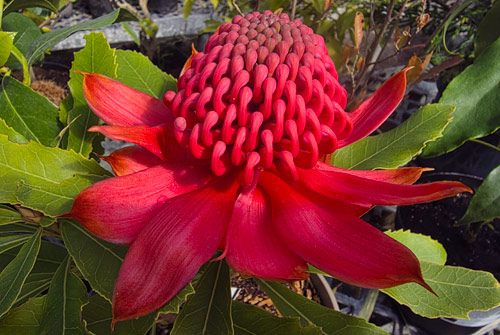
Telopea speciosissima – New South Wales (NSW) state emblem. Photo: G. Willoughby.
For those seeking something truly special, this magnificent shrub is currently available on sale at O’Driscolls Garden Centre. This same Garden Centre is renowned for its exceptional selection of rare and unusual shrubs, earning a reputation among discerning gardeners for sourcing plants that elevate any landscape.
What truly sets the Waratah apart is its extraordinary large flower head. Each dome-shaped bloom is composed of hundreds of tightly packed individual flowers, forming a rich crimson spectacle that can measure up to 15 cm across . These blooms appear in spring, lighting up gardens with a vibrancy that is visible from afar; a quality reflected in its name, derived from Greek meaning “seen from a distance”. It is no surprise that this plant holds pride of place as the floral emblem of New South Wales and is widely regarded as one of Australia’s most iconic native species.
Beyond its beauty, Telopea speciosissima offers real horticultural value. It thrives in well-drained soil with ample sunlight and rewards gardeners with long-lasting blooms that are equally prized as cut flowers. Its architectural form and bold colouring make it an outstanding focal point in any garden design.
If you wish to introduce a touch of the extraordinary to your garden, the Waratah is an inspired choice; bold, beautiful, and yes utterly unforgettable.
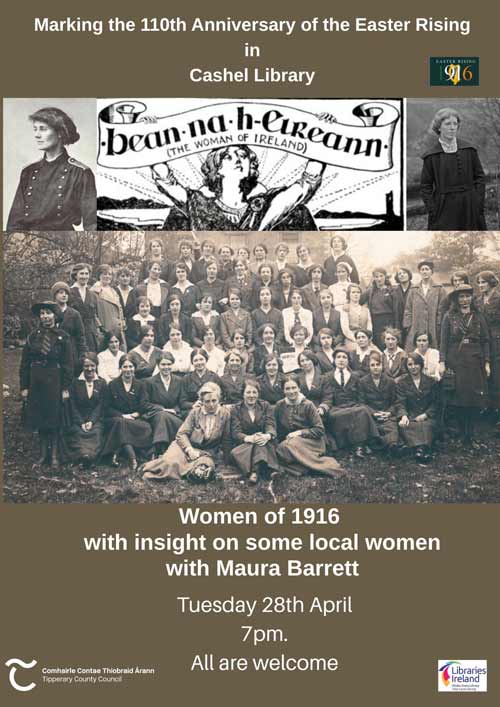
Cashel Library, Co. Tipperary will host a special commemorative lecture marking the 110th anniversary of the 1916 Easter Rising on Tuesday, 28th April 2026 at 7:00pm sharp.
This event will honour the vital yet often overlooked contributions of women to Ireland’s struggle for independence. During the Easter Rising, women played a central role across a wide range of activities, including combat, intelligence gathering, medical support, and communications, many as members of organisations such as Cumann na mBan and the Irish Citizen Army. Despite their significant involvement, their contributions have historically received limited recognition.
The lecture will be delivered by Ms. Maura Barrett, Cashel Librarian, and will focus particularly on women with connections to Cashel and the wider Tipperary region.
NOTE PLEASE: Booking is essential. To reserve your place, please contact Cashel Library at Tel: 062-63825.
People wishing to attend the above events can locate the Cashel Library building; situated on Friar Street, Lady’s Well, Cashel, Co. Tipperary, HERE. (Eircode E25 K798).
All are welcome to attend this insightful and commemorative event.
With energy costs still unpredictable, Irish households are being encouraged to take a more active role in understanding and managing their electricity use.
Why this guide matters now. Energy affordability remains a real concern across Ireland. Much of the country’s electricity still depends on imported natural gas, leaving households exposed to global price swings. Against this backdrop, the guide is designed to give consumers more control, both in how they understand their bills and how they use energy day to day.
Understanding what you’re actually paying for. One of the biggest challenges for consumers is simply decoding their electricity bill. The guide explains key components such as:
Unit rates (cost per kilowatt-hour).
Standing charges (daily service cost).
Levies and taxes like VAT.
Overall consumption measured in kWh.
It also highlights that factors like home insulation, appliance efficiency, and household size all influence energy usage. In short: the bill isn’t just about how much electricity you use, it’s also about when and how you use it.
Smarter usage equals lower costs. A major focus of the guide is helping households shift their habits. One simple but effective tip is to avoid peak hours. Electricity is typically most expensive between 5:00pm and 7:00pm, when demand is highest. Running high-energy appliances, like showers, ovens, or tumble dryers, outside these times can make a noticeable difference over time. Instead, households are encouraged to move usage to off-peak periods, such as late evening or overnight.
The role of Smart Meters. Smart meters are central to this shift. Already installed in more than two million Irish homes, they provide real-time data on energy use and open the door to new pricing options. With a smart meter, households can access time-of-use tariffs, where electricity is cheaper during off-peak hours. This means you can actively choose when to use energy, and save money by doing so. However, the guide also makes it clear: savings depend on behaviour. If most of your energy use still happens during peak hours, costs could remain high.
New ways to save (and even earn). Beyond smart meters, the guide points to emerging options for households:
Smart tariffs tailored to usage patterns.
Electric vehicle plans with cheaper overnight charging.
Microgeneration schemes, where solar panel users can sell excess electricity back to the grid.
These options reflect a broader shift toward more flexible, consumer-driven energy systems.
The bigger picture. While short-term savings matter, the guide also looks at long-term solutions. Reducing Ireland’s reliance on imported fossil fuels, through electrification and renewable energy. Same is seen as key to stabilising costs in the future. For households, that means small changes today, like better insulation or smarter energy use, which can contribute to both lower bills and a more sustainable energy system.
Final thought. Energy bills don’t have to feel like a mystery. With clearer information and smarter tools, households now have more power than ever to control their costs. And in a world of fluctuating energy prices, that control could make all the difference.
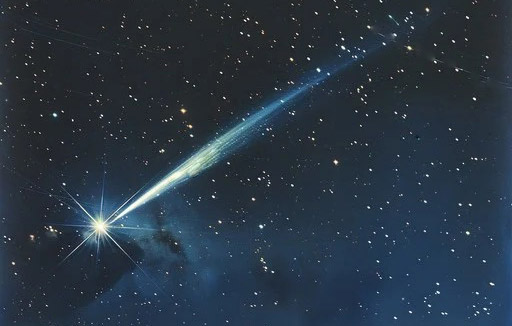
Irish stargazers are being urged to look skyward this week as the Lyrid meteor shower reaches its annual peak, bringing a striking display of shooting stars visible across the country, including Tipperary.
A Rare Celestial Display. The Lyrids are one of the oldest recorded meteor showers, occurring each April as Earth passes through debris left by Comet Thatcher, last seen in 1861. In 2026, the shower is active from mid-April through to April 25–26, with peak activity expected on the night of April 22 into the early hours of April 23.
Under ideal conditions, observers can expect:
Around 10–20 meteors per hour.
Occasional bursts of higher activity.
Bright streaks and occasional “fireballs” lighting up the sky.
Strong Viewing Conditions in Ireland.
This year offers particularly favourable viewing conditions. A crescent moon will set early, leaving darker skies for much of the night, latter ideal for spotting meteors.
The best time to watch is: After midnight through to dawn, when the constellation Lyra rises higher in the eastern sky. No special equipment is needed, just clear skies and patience.
Viewing Potential in Tipperary. Tipperary is well positioned to enjoy this celestial event, particularly in rural areas where light pollution is low.
Key Advantages:
Dark countryside skies improve visibility
Elevated and open landscapes provide wide viewing angles
Distance from major urban lighting enhances contrast
Best Practice for Viewing:
Travel to rural or elevated areas such as hills or open farmland
Avoid towns and artificial lighting
Allow 20–30 minutes for your eyes to adjust to darkness
Lie back or use a reclining chair for a full-sky view
Meteor activity will appear across the sky, not just near Lyra, so a broad, unobstructed view is essential.
What to Expect. While the Lyrids are considered a moderate meteor shower, they are known for fast, bright meteors, occasional dramatic fireballs and short bursts of increased activity. Even outside the peak night, the shower remains active for several days, offering multiple chances to witness the display.
Final Outlook. If skies remain clear, observers across Tipperary should have an excellent opportunity to see more shooting stars than on a typical night. With favourable conditions and minimal moonlight, 2026 could be one of the better years to catch this historic meteor shower, right from your own doorstep.
The publication of the 1926 Census marks a defining moment in Ireland’s historical record, offering a vivid and deeply personal insight into life during the formative years of the Irish Free State.
Conducted just four years after the establishment of the Irish Free State in 1922, the 1926 Census captured a population of approximately 2.97 million people. It reflects a country emerging from a decade of profound change, including the Easter Rising, the War of Independence and the Civil War, and beginning to shape its national identity.
Taoiseach Mr Micheál Martin described the release as an opportunity for people to “step back in time” and connect with their families, communities and the everyday lives of those who lived nearly a century ago. He highlighted the census as a bold and visionary undertaking by a young state committed to nation-building.
The digitisation project, completed over three years, ensures the long-term preservation of these records while making them accessible to historians, genealogists and the wider public. Minister for Culture, Communications and Sport Mr Patrick O’Donovan said the release is of particular importance to people across Ireland and the global Irish diaspora seeking to explore their heritage.
Director of the National Archives Ms Orlaith McBride emphasised that the census represents more than statistics, describing it as “the story of us”, a record of individuals, families and communities whose lives collectively shaped our modern Ireland.
To mark the release, a major exhibition titled The Story of Us: Independent Ireland and the 1926 Census has opened at Dublin Castle. Running until August 2027, the exhibition explores life in Ireland in 1926 through original records, photographs and immersive displays before touring internationally and across Ireland.
The 1926 Census stands as a vital resource for understanding Ireland’s past, offering people at home and abroad, an opportunity to rediscover their roots and engage with the lived experiences of a generation that helped shape the nation.
Irish Touring Exhibition As part of its national tour, the exhibition will visit Thurles, Co. Tipperary at Source Arts Centre, Thurles, from 2nd – 21st November 2026, bringing this important chapter of Ireland’s history directly to local Tipperary communities.
This website uses cookies to improve your experience. We'll assume you're ok with this, but you can opt-out if you wish.AcceptRead More
Privacy & Cookies Policy
Privacy Overview
This website uses cookies to improve your experience while you navigate through the website. Out of these, the cookies that are categorized as necessary are stored on your browser as they are essential for the working of basic functionalities of the website. We also use third-party cookies that help us analyze and understand how you use this website. These cookies will be stored in your browser only with your consent. You also have the option to opt-out of these cookies. But opting out of some of these cookies may affect your browsing experience.
Necessary cookies are absolutely essential for the website to function properly. This category only includes cookies that ensures basic functionalities and security features of the website. These cookies do not store any personal information.
Any cookies that may not be particularly necessary for the website to function and is used specifically to collect user personal data via analytics, ads, other embedded contents are termed as non-necessary cookies. It is mandatory to procure user consent prior to running these cookies on your website.






Recent Comments