AIT-LIT consortium welcomes the appointment of Professor Vincent Cunnane as founding President of the Technological University of the Shannon: Midlands Midwest
The chair of the joint Governing Body of the AIT-LIT Consortium, Professor Mr Tom Collins, has today welcomed the announcement by Minister for Further and Higher Education, Research, Innovation and Science, Mr Simon Harris TD, that Professor Vincent Cunnane is to be the first President of the Technological University of the Shannon: Midlands Midwest.
The appointment was announced by the Minister following an international recruitment process. The term of the appointment is eight years and Professor Cunnane will take up his post from the commencement of the new Technological University, on October 1st next.
Commenting on the appointment of Professor Cunnane, Professor Collins said, “All in the consortium are very pleased that Vincent Cunnane is to be the inaugural President. He has a distinguished record of achievement in the academic, research and development spheres. He is eminently qualified to lead the development of the TU and its contribution to the economic, social and cultural life of the Midlands, Midwest and beyond. In that task he will be greatly assisted by the quality and commitment of the leadership team and staff of the TU.”
Mr Liam Rattigan, outgoing Chair of AIT Governing Body also welcomed the appointment. “I want to wish Vincent and all in the new TU every success as it embarks on this new phase of higher education in the Midlands and the Midwest,” he stated. “I also want to pay tribute to the legacy of Prof Ciarán Ó Catháin who has led AIT for the past two decades and under whose leadership the Institute achieved university status”, he added.
Mr Tony Brazil, outgoing Chair of LIT also paid tribute to Prof Cunnane. “I have worked closely with Vincent over the past three years since I became Chair”, he said, “and have been hugely impressed by his vision, energy and leadership. He will be an outstanding first President for the new TU.”
The Technological University of the Shannon: Midlands Midwest will commence on October 1st, next, with campuses in Thurles, Athlone, Clonmel, Ennis, and Limerick.
“Barney” and “Beakey” are two barn swallows temporally residing here in Thurles, Co. Tipperary, which we have been carefully watching.
In the last few days they have produced their second brood of chicks, having built two nests, the most recent construction within about 3.66meters (12ft) of their previous abode.
“Barney” and “Beakey Swallow” hatch second brood, as a spider and his web remain in residence next door.
Swallows spend their winter in southern Africa, migrating across the Mediterranean Sea and the Sahara Desert to Ireland in spring to return home using the same return route in early September.
They build cup-shaped nests in barn rafters, under roofs, using mud pellets, hair, grass, and feathers as seen here above. It can take a pair of swallows up to 1,100 journeys to build their nest, with the female only permitted to line it; in the case shown above “Beakey” used a layer of dried grass on top of the mud pellets, before covering it in a mixture of soft feathers.
Most of our Irish swallows try to rear two broods each summer and some early arrivals succeed in raising three. The male swallow in this case “Barney” arrived back in the Thurles area first and was heard singing over his territory awaiting to attract a mate. Females, (like most women) don’t mind keeping their men waiting, generally arriving up to a week late, looking virtually identical in appearance to their male counterparts. [Males have longer outer tail-streamers than females and have also more gloss to their outer feathers.]
Swallows always return to the same location to nest every year, so the number of birds nesting in any one area can grow year after year.
Not even distantly related to their somewhat look alike Swift family; having watched them year after year, the true home of barn swallows is in our skys where they feed almost exclusively on midges and flies caught during their erratic, high speed flight. They can be observed even drinking on the wing, flying low to sip water.
Swallows nests, their eggs and chicks are protected under the Wildlife Act 1976 and Wildlife (Amendment) Act 2000 and European-level legislation. The penalties for tampering with swallows or disturbing their active nests consists of heavy fines and even imprisonment.
IPCC Report echoes key findings of EPA publications on Ireland’s projected greenhouse gas emissions.
For Ireland to transform to a climate resilient, biodiversity rich and climate neutral economy by 2050, there needs to be a significant and immediate increase in the scale and pace of greenhouse gas emission reductions.
Irish authors and scientists contributed to the new report.
The EPA welcomes the publication of the latest report from the Intergovernmental Panel on Climate Change (IPCC). The report reaffirms and strengthens the findings in previous reports on the human impacts on climate change. This latest IPCC report provides new and important insights on the current state of the global climate system, and the steps needed to halt human-induced climate change. The EPA also welcomed the contributions by authors and scientists from Ireland to the report. The work of the IPCC relies on information and analysis provided by research and sustained systematic observations of the climate system. Commenting on the report Mr Frank McGovern, (EPA Chief Climate Scientist), said: “This is an important and timely report, which will be considered by policymakers at the COP26 meeting in November. However, the information it provides can inform decision making on climate change at all levels. It is essential that we maintain and develop targeted climate change research in Ireland. This is needed to inform actions here and, in particular, the responses that we require. This includes enhanced management of greenhouse gas emissions and removals, as well as the adaptation responses needed to ensure that we can manage the impacts of climate change”. Ms Laura Burke, (EPA Director General), said: “For Ireland the report underlines the key messages from the recent EPA publication on Ireland’s greenhouse gas emission projections, which states that the next decade needs to be one of major developments and advances in relation to Ireland’s response to climate change and there needs to be a significant and immediate increase in the scale and pace of greenhouse gas emission reductions. In addition, the IPCC report makes it clear that we must chart a course to achieve net-zero carbon dioxide emissions in the coming decades”.
The EPA leads in the development and coordination of national climate change research in Ireland. It works with other agencies and research bodies in development of key climate related observations including observations of greenhouse gases, aerosols, river flows and fresh water levels. The EPA provided support for Prof. Peter Thorne, Maynooth University, who acted as a coordinating lead author on the chapter on observations in the Working Group I (WGI) report of the 6th Assessment Cycle. The EPA has also supported the research at Mace Head cited in the report, and the work of Dr Jurgita Ovadnevaite, who was an author on the chapter on air pollution in the WG1 report. The EPA has supported work on the 6th Climate Modelling Inter-comparison Project (CMIP-6) used throughout the IPCC report through the work of Dr. Paul Nolan in ICHEC. The EPA hosts the Climate Ireland information portal which provides interactive access to climate information for Ireland.
The Department of Health has confirmed a further 1,110 cases of Covid-19 in the Irish Republic. They also confirm that there are 89 patients in hospital, with 21 of these in ICUs. Same amounts to almost 7,700 cases of Covid-19 reported in the Republic within the past seven days, an increase of 88% on the previous 7 days.
One in five of Covid positive people being admitted into our hospitals are vaccinated.
A further 1,138 cases of Covid-19 have been confirmed in Northern Ireland today, with, sadly, 1 further death of a patient previously having tested positive for the virus.
In total there are now 2,248 cases of the virus on the whole island of Ireland.
Meanwhile, here in the Irish Republic, the Irish Pharmacy Union are calling on the Health Service Executive to supply Pfizer-BioNTech vaccines to all pharmacists, to allow Covid-19 vaccinations to further continue without interruption, as supplies of the Janssen vaccine begins to slow down.
Persons aged between 18-24 are again reminded to register for the AstraZeneca Covid-19 vaccine, which opened since yesterday. [Tel:1800 700 700 or register online through the HSE Vaccine Portal].
EPA survey highlights need for everyone to do a simple radon test in their homes
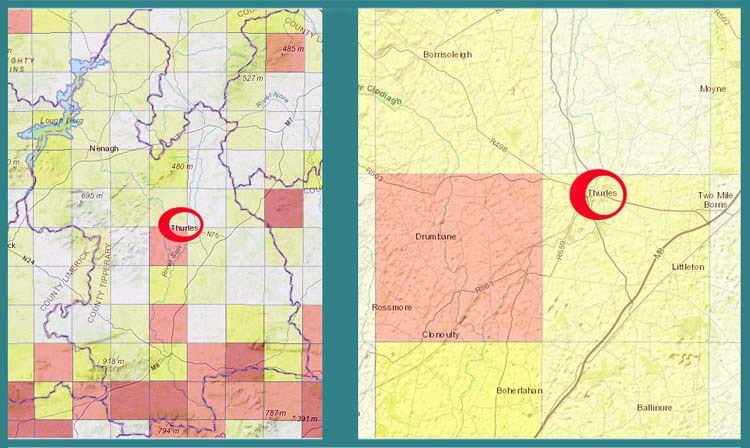
Radon is a cancer-causing radioactive gas and every year in Ireland 300 lung cancer cases are linked to radon exposure.
EPA commissioned a survey of over 1000 people on their attitudes to radiation.
28 per cent of people surveyed were concerned about radiation.
While 82 per cent of people have heard of radon 66 per cent of them said they are unlikely to test their homes.
Testing your home and fixing a radon problem can reduce the risk to your health from this radioactive gas.
A survey exploring Irish attitudes towards radiation found that 28% of people are concerned about radiation. In Ireland, radon accounts for more than half of our radiation exposure. However, while awareness of radon gas is high, two out of three people said that they are unlikely to test their home, believing their homes to be unaffected by radon.
Commenting on the survey, Ms Stephanie Long, (EPA Senior Scientist) said, “Many people don’t know that radon is the largest contributor to radiation dose in Ireland. If there is a high radon level in your home, it is exposing you and your family to unnecessary radiation. While radon levels in certain parts of the country are higher than, others the gas can be found in homes of all types and ages throughout the country. Yet, despite the risks there continues to be a reluctance amongst householders to protect their health by testing their homes for radon.”
Reducing radon levels in homes and other buildings is simple and inexpensive and immediately reduces the risk of developing lung cancer. For moderate levels of radon, improving indoor ventilation may reduce the level by up to half. For higher levels, a fan assisted sump can be installed which can reduce radon levels by over 90%. The sump can be installed in one day by a contractor with little disruption to the home.
Clinical psychologist Dr. Clare Kambamettu is a homeowner who found high levels of radon in her home, which she acted on and remediated. Dr. Kambamettu had a radon sump installed in her Galway home which addressed the high radon levels.
Dr. Kambamettu commented: “We were worried when our test showed high levels of radon in our home. We soon found out that the solution was surprisingly easy. Most of the work was done quickly from the outside of our home with very little disruption. And the best part was that once the work was done, the risk was gone too, as our radon levels were reduced so much.”
For more information on radon and to find a list of registered radon testing and remediation services, visit www.radon.ie, or freefone 1 800 300 600.
This website uses cookies to improve your experience. We'll assume you're ok with this, but you can opt-out if you wish.AcceptRead More
Privacy & Cookies Policy
Privacy Overview
This website uses cookies to improve your experience while you navigate through the website. Out of these, the cookies that are categorized as necessary are stored on your browser as they are essential for the working of basic functionalities of the website. We also use third-party cookies that help us analyze and understand how you use this website. These cookies will be stored in your browser only with your consent. You also have the option to opt-out of these cookies. But opting out of some of these cookies may affect your browsing experience.
Necessary cookies are absolutely essential for the website to function properly. This category only includes cookies that ensures basic functionalities and security features of the website. These cookies do not store any personal information.
Any cookies that may not be particularly necessary for the website to function and is used specifically to collect user personal data via analytics, ads, other embedded contents are termed as non-necessary cookies. It is mandatory to procure user consent prior to running these cookies on your website.






Recent Comments