|
|
Many of the activities that families typically enjoy at Christmas time are not possible this year. Trips to visit Santa in shopping centres and a trip to the cinema to see the latest Christmas movie won’t take place in 2020.
Although we are somewhat limited in what we can get up to outside our homes this Christmas, there are lots of fun Christmas crafts and games we can enjoy in the warm comfort of our own homes.
December 8th traditionally marks the start of Christmas in Ireland and many families begin decorating their homes from this date.
Why not add a bit of family fun to your Christmas decorating this year and try and make some of these fun and traditional Christmas paper crafts?
All you need is Sellotape or Glue, Paper, a Stapler and a Scissors.
If you want more examples why not try out these links hereunder: –
3D Paper Snowflake – https://www.youtube.com/watch?v=B4wK8l_0On0
3D Paper Christmas Trees – https://www.youtube.com/watch?v=TZAsOQiZMEs
Paper Snowflake Templates – https://www.firstpalette.com/printable/snowflake.html
Christmas Tree Garland – https://www.youtube.com/watch?v=9BD_EZDcutg
Enjoy making your 3D Paper Snowflake and please do be careful with that sharp, pointed Scissors.
Multiple coronavirus cases have been confirmed in urgent correspondence forwarded to parents on Tuesday, November 24th last, from a primary school here in Co Tipperary.
According to the Irish Mirror today, school officials have stated that the children who had tested positive, were in two separate classes and had NOT been in school for a number of days.
The letter sent to parents and guardians reads:
“I am writing to inform you that two pupils in separate classes have tested positive for Covid-19 today.
These pupils have not been in school for a number of days and they were both asymptomatic over the weekend. You will appreciate the school has to respect the confidentiality of the families involved and has to abide by Data Protection Laws.
If your child has not been identified as a close contact, he/she does not need a test and he/she can safely continue to attend school as normal. No further actions are required on your part.”
Figures, published today, show schools are the third most likely place to record clusters of the virus.
Clonmel and Thurles on course to become University Towns by September 1st 2021, as AIT-LIT Consortium’s TU application goes to Government.
Combined Economic Impact of LIT and AIT found to be close to €420 million
Clonmel and Thurles are on course to become university towns as early as September 2021, following confirmation that the AIT-LIT Consortium has formally submitted its Technological University application to Government.
The new Technological University for the Mid-West and Midlands is expected to comprise a student population of up to 15,000 and a staff complement of approximately 1,200 people across six campuses – Thurles, Clonmel, Ennis, Athlone and two in Limerick.
An economic impact study commissioned by the consortium has found that the combined impact of the two institutions on the Irish economy is close to €420 million euros in economic output, while they support more than 800 jobs in addition to their own staff complement.
The consortium, which formally commenced in October of 2019, has targeted a date of September 1st next year for the new university to open, and is today (Monday) also embarking on a broad consultation process to name the new Technological University.
Academic unions in both LIT and AIT have voted overwhelmingly in favour of measures contained in the Technological University project plan.
Commenting on the application, President of LIT, Professor Vincent Cunnane has stated, “We are on a pathway to deliver a unique new Technological University that will cross regions and transcend geography. While this will be an institution of scale, it will retain the familiarity of local campuses across two significant regions. This enables us to act as a regional development powerhouse into the future, delivering education and research that will benefit students, educators, communities, business and industry in a strategic way. Our approach is based on partnership and consensus, and is indeed underpinned by consultation with staff, students and other stakeholders. The consortium has a strong set of shared values and a shared ethic that provides a firm foundation to deliver on our future strategy.”
President of AIT, Professor Ciaran Ó Catháin said, “This is a transformational development for the Midlands, and once it comes to fruition, it will provide significant social and economic benefit to communities across the region and beyond. Becoming a TU will broaden access to higher education and create opportunities in areas that have previously been underserved with respect to apprenticeships right through to PhD. I am immensely proud of the progress that have been made since the formation of the AIT – LIT Consortium a little over a year ago and of our staff, who have worked together in the spirit of common purpose to share knowledge and expertise. This has culminated in us reaching and surpassing the substantive TU metrics set out by Government and increasing our research capacity. Our commitment to our technological mission is resolute and will result in a talent pipeline of professionally and technically skilled graduates capable of propelling regional and national growth.”
Professor Tom Collins, AIT-LIT TU Consortium Project Facilitator congratulated the “management, staff and students of both institutes, who in a short time and through all the challenges of the current year, have re-imagined the future of the two institutions around a compelling vision for a new Technological University in the Irish Midlands and Mid-West.”
The Director General of the Environmental Protection Agency (EPA), Laura Burke; and the Chief Justice, the Hon Mr Justice Frank Clarke, will provide the opening addresses at this year’s virtual conference on Environmental Law Enforcement: Emerging Challenges 2020 which will take place on Wednesday on November 11th 2020, with the event timed for 9.00am until 1.15pm.
Note: Advance registration for this event is essential.
To view the full conference programme, please use the link shown HERE.
To register for this event, please use the link shown HERE.
The conference, which is co-hosted by the EPA and the Irish Centre for European Law (ICEL), will explore some of the challenges and potential opportunities that are emerging through experience with environmental enforcement; recent developments in the case law; as well as new policy initiatives.
Commenting on the conference, Ms Laura Burke (EPA Director General), stated: “This conference is an important opportunity for practicing legal professionals, leading academics and researchers, policy makers, concerned stakeholders as well as professional regulators to come together to explore emerging challenges in Ireland with regard to enforcement of environmental law. It also has an important role in supporting the development of competency and capacity in environmental law and its enforcement.”
The conference will explore experience, challenges and recent case law in relation to the Environmental Impact Assessment Directive; the Environmental Liability Directive and the Habitats Directive; as well as the implications of the recent judgment of the Supreme Court in ‘Climate Case Ireland’ for climate and wider environmental protection.
There will also be contributions providing different perspectives and experience in the context of establishing a specialist court for planning and the environment.
Dr Áine Ryall, (ICEL and Centre for Law and the Environment UCC) stated: “The conference is very timely. The Programme for Government includes a commitment to establish a Planning and Environmental Law Court managed by specialist judges. There is also a commitment to reform the judicial review process. These proposals raise important issues concerning the right of access to justice and merit close attention. Furthermore, the pandemic has created challenges for the exercise of rights guaranteed under the Aarhus Convention, in particular the right to participate in environmental decision-making.
The conference provides a forum for informed debate. It will explore how to use the law to protect the environment and improve environmental quality.”
- Radon is a radioactive, cancer-causing gas.
- 300 lung cancer cases in Ireland each year are linked to exposure to radon.
- The risk of developing radon related lung cancer is particularly high for smokers. In fact, smokers are at about twenty-five times greater risk than non-smokers.
- It is easy to test your home for this indoor air pollutant and to reduce high levels.
- The highest level home tested in Ireland this year had over 22 times the acceptable level. This level could give a radiation dose equivalent to receiving 15 chest X-rays a day.
On European Radon Day, 7th November, the Environmental Protection Agency (EPA) are calling on all householders to test their homes for this cancer-causing radioactive gas. Radon is the second biggest cause of lung cancer after smoking. In Ireland, it is estimated that about 300 lung cancer cases each year are linked to radon exposure.
What is Radon?
Radon is a radioactive gas formed in the ground from the radioactive decay of uranium which is present in all rocks and soils. It has no smell, colour or taste and can only be detected using radon detectors. Outdoors, radon quickly dilutes to harmless levels but when it enters an enclosed space, such as a house or other building, it can accumulate to unacceptably high levels. Radon is a lung carcinogen and is linked to some 300 lung cancer cases each year in Ireland making it a serious public health hazard.
About a third of Ireland is classified as a high radon area by the EPA. However, the EPA recommends that homeowners in all areas of Ireland test their homes for radon. You can check if you are living in a high radon area on the EPA’s interactive radon risk map on www.radon.ie. Ireland has relatively high indoor radon levels, with an average indoor level of 77 Bq/m3, compared to the worldwide average of 39 Bq/m3.
Radon gas can seep into your home through small cracks and gaps in the foundations of the building or openings around service pipes. It comes from the rocks and soil in the ground under your home. Radon has no colour, taste or smell, so the only way to know how much of this pollutant is in your home is to carry out a radon test.
The test costs about €50 and is all done by post using one of the services registered with the EPA. The test kit includes two radon detectors – one should be placed in the bedroom and one in the living room. After three months, the detectors are posted back to the provider and analysed to see how much radon they have been exposed to in your home. The results are posted back to you, with advice on how to deal with any high radon readings.
Stephanie Long, (Manager of the EPA’s Radon programme) has stated: “Exposure to high levels of radon can cause lung cancer and many families are unknowingly living with this indoor air pollutant. Earlier this year, one home was found to have over 22 times the acceptable level. Living with this level of radon gives a radiation dose equivalent to getting 15 chest x-rays a day.”
You can visit www.radon.ie to find out how to test your home and keep you and your family safe. Reducing radon levels is simple and inexpensive and will immediately reduce the risk of developing lung cancer.
For moderate levels of radon, improving indoor ventilation may reduce the level by up to half, the cost of which is low. For higher levels, a fan assisted ‘sump’ can be installed which can reduce radon levels by over 90 per cent. The sump can be installed in a day by a contractor with little disruption to the home.
Alison Dowdall (EPA) has stated, “Radon is everywhere but is only a problem if it is ignored. Testing for radon – where high levels are found – and fixing the problem are both relatively straightforward and easy to do. Now more than ever, as people spend more time at home, we would urge everyone to take action on radon, improve your indoor air quality and keep your home safe from this cancer-causing gas.”
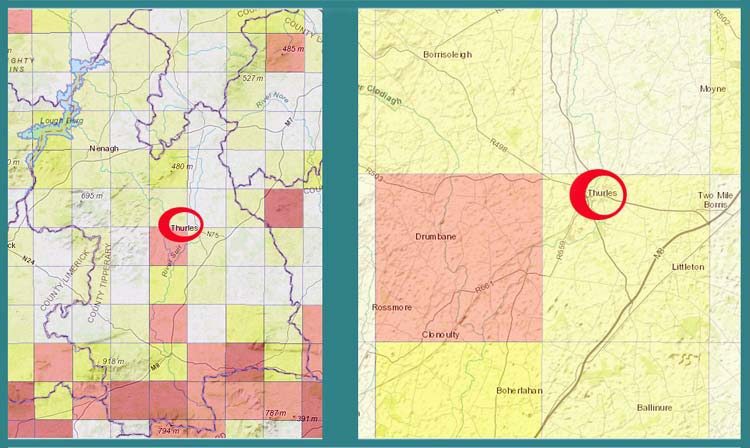
Thurles is not regarded as a ‘High Radon Area’.
|
Support Us Help keep Thurles.info online by donating below. Thank you.
Total Donated 2026: €300.00
Thank You!
Daily Thurles Mass Livestream
|





Recent Comments