The grave of George Plant still attracts annual republican commemorations, while his story remains one of the most striking and contested in Tipperary’s revolutionary past.
Early March each year holds a particularly haunting place in Tipperary history because it marks the anniversary of the execution of Mr George Plant, one of the most controversial republican figures of the early 20th century. On Thursday March 5th 1942, George Plant was executed by military firing squad in Portlaoise jail, bringing a dramatic and deeply disputed chapter of Irish history to a close.
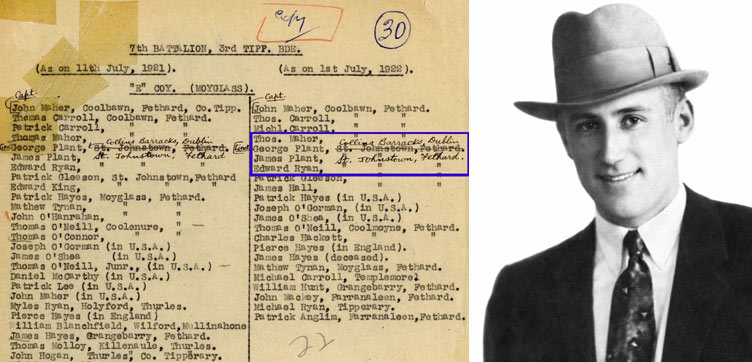
Pictured Left → E Company (Moyglass), 7 Battalion, 3 Tipperary Brigade, IRA, membership list. Pictured Right → George Plant executed by military firing squad in Portlaoise jail, March 1942. The above shows George Plant’s membership during the War of Independence and Civil War, and his change of address to “Collins’ Barracks, Dublin”,where he was tried, convicted and sentenced to death. The James (Jimmy ) Plant also on this list above was George’s brother.
Born on January 5th 1904, at St Johnstown, Fethard, Co. Tipperary, George Plant grew up in a Protestant farming family. The Plant family were known locally as hardworking, strict, and largely removed from politics. Yet George’s life took a decisive turn in 1916, when he and his older brother James were harshly interrogated by the local constabulary about their associations with local republicans including Seán Hayes and Dan Breen. That experience appears to have had a lasting effect on both boys.
By 1918, George and James had joined Na Fianna Éireann, and during the War of Independence and Civil War George served in the Moyglass unit of the 7th Battalion, 3rd Tipperary Brigade, IRA. He earned a reputation for bravery and reliability. Captured near the end of the Civil War, he escaped from Templemore jail and made his way home across country.
After the 1923 ceasefire, George and James emigrated, living and working in Scotland and later across North America. But Plant’s involvement with republican activity did not end. In 1929 the brothers were sentenced to seven years for their part in an IRA bank robbery in Tipperary town. After serving time in Limerick and Portlaoise, George eventually returned to the United States. In 1938, as Seán Russell steered the IRA in a more militant direction, Plant came back to Ireland and by 1940 was on full-time IRA service.
The event that sealed his fate was the killing of Michael Devereux, quartermaster of the IRA’s Wexford battalion. Devereux, wrongly suspected of informing to the gardaí, disappeared in September 1940. His body was not discovered until a year later, after the sensational escape of IRA chief-of-staff Stephen Hayes from IRA custody triggered fresh revelations and investigations.
Plant and IRA Southern Division commander Joseph O’Connor were first charged with Devereux’s murder in the Special Criminal Court. That case collapsed when key witnesses withdrew their statements, claiming they had been beaten and intimidated into making them. However, the government then took extraordinary steps under emergency legislation to retry the matter before a special military court. In a highly controversial move, normal rules of evidence were effectively suspended, allowing previous witness statements to be read into evidence even when those witnesses refused to testify.
On February 27th 1942, George Plant, along with Patrick Davern and Michael Walsh, was convicted and sentenced to death. O’Connor was acquitted on a technicality. Amid widespread public appeals for mercy, the sentences of Davern and Walsh were commuted to life imprisonment, but Plant’s was not. He was executed just days later, on March 5th 1942.
Even decades later, the Plant/Devereux affair remains clouded in controversy. The legal process used to convict Plant has long been criticised as one of the most troubling episodes in Irish judicial history. Later research suggests that Michael Devereux was likely innocent of informing and that Plant was probably involved in his murder. Yet debate continues, shaped by the turbulent politics, secrecy, and emergency powers of that period in wartime Ireland.
In September of 1948, Plant’s remains were returned to his family and reburied at St Johnstown, where his grave still attracts annual republican commemorations.
Gardaí based in Thurles became aware of a stolen vehicle in the town yesterday morning and immediately launched an investigation. A short time later, two people were arrested in Clonoulty, and the vehicle was recovered along with a quantity of suspected stolen property. One male is now due to appear before Nenagh District Court in connection with a number of alleged offences. Follow-up searches were carried out in the Thurles and Limerick areas, and investigations are ongoing.
EU Internet Forum endorsed a revised EU Online Crisis Response Framework, to enable a joint response to protect users online in times of crisis, and ensure the timely removal of content related to suspected terrorist or violent extremist attacks.
Discussed addressing the emerging threat of nihilistic extremism.
Discussed collective actions to protect minors from being radicalised online.
Exchanged views on innovative approaches to tackling antisemitism and anti-Muslim hatred online.
Mr Niall Collins TD, (Minister of State with special responsibility for International Law, Law Reform and Youth Justice), represented Ireland at a Ministerial Meeting of the EU Internet Forum in Brussels yesterday.
The EU Internet Forum (EUIF) was launched by the Commission in December 2015 and addresses the misuse of the internet for terrorist purposes through two main actions:
reducing accessibility to terrorist content online
increasing the volume of effective alternative narratives online
The Forum’s activities also cover the fight against child sexual abuse online (since 2019), drug trafficking online and trafficking in human beings online (since 2022).
The Forum brings together relevant EU Ministers, technology companies and experts to discuss and advance responses to terrorism, violent extremism and illegal content online.
At the meeting, Ministers endorsed a revised EU Online Crisis Response Framework for the rapid removal of online content relating to terrorist attacks. This new Framework builds on the EU Internet Forum Protocol which was developed in the aftermath of the Christchurch terrorist attack in 2019, footage of which circulated widely online at the time.
The new Framework includes additional measures to enable Member States’ law enforcement authorities to share early warning alerts with other EU Internet Forum members in case of a suspected terrorist or violent extremist attack. This will allow for better monitoring and quicker action in case the situation develops into an online crisis.
The meeting also contained two round table discussions, the first of which opened with a presentation by Professor Ms Maura Conway (Dublin City University and member of the EU Knowledge Hub Research Committee) on the threat landscape and risks to minors stemming from terrorism and violent extremism online.
Increasingly, these risks are interlinked with other harms, such as exploitation, self-harm, child sexual abuse and recruitment into organised crime. The presentation served as an introduction for the round table discussion on innovative actions and cooperation to better protect children online.
The second round table session opened with a presentation by Ms Sasha Havlicek, [Co-Founder and CEO of the Institute for Strategic Dialogue (ISD)], on the increase of anti-Semitism and anti-Muslim hatred online. Ministers and industry representatives then discussed actions being taken and required to effectively tackle this issue.
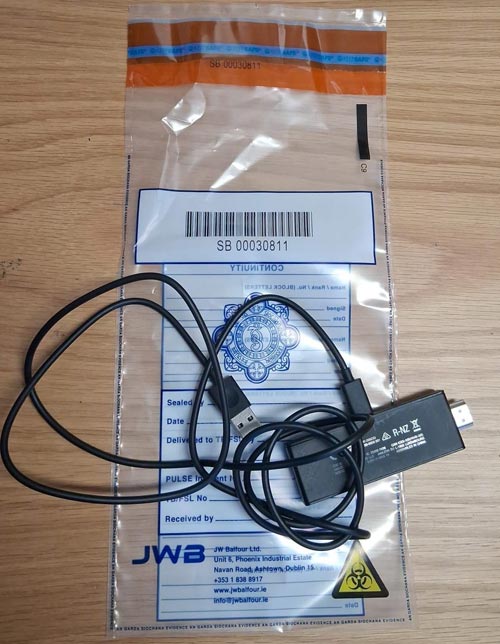
Gardaí Shut Down Over 500 Suspected Illegal IPTV Accounts Following Thurles Search Operation.
An Garda Síochána has confirmed that more than 500 accounts, suspected of accessing illegal TV streaming services, have been shut down following an intelligence-led operation conducted in Thurles, Co. Tipperary.
Gardaí searched a domestic residence in the Thurles area on Monday, March 2nd 2026, as part of an operation targeting the alleged provision of illegal streaming services and money laundering offences.
During the search, electronic devices were seized for examination. No arrests have been made at this time. However, a file is being prepared for submission to the Director of Public Prosecutions.
Background. Internet Protocol Television (IPTV) delivers TV content over broadband or internet connections. The use of unauthorised IPTV services, often accessed through modified streaming devices commonly referred to as “dodgy boxes”, which may constitute a copyright offence under Irish law.
Under Section 140 of the Copyright and Related Rights Act 2000, certain copyright offences can carry significant penalties, including fines and imprisonment upon conviction on indictment.
Wider Context. In separate reporting, Ireland’s Data Protection Commission (DPC) has confirmed it has been engaging with Sky regarding the company’s efforts to tackle illegal streaming, including the proposed use of personal data in anti-piracy activity, subject to data protection requirements.
Tipperary County Council has introduced additional security measures at two public buildings in Clonmel following incidents of anti-social behaviour.
Security personnel have been deployed at Clonmel Library and the Motor Tax Office at Town Hall, Parnell Street, in order to support a safe environment for members of the public and staff using these services.
The Council has said it has a duty of care to ensure that public facilities remain welcoming and secure, and that the matter has been brought to the attention of An Garda Síochána.
These arrangements have been put in place as a preventative measure and will continue to be monitored. The Council will keep the situation under review and will adjust security and operational measures as appropriate in the coming weeks.
Tipperary County Council thanks the public for their understanding and cooperation and encourages anyone who witnesses anti-social behaviour at public facilities to report it to An Garda Síochána.
This website uses cookies to improve your experience. We'll assume you're ok with this, but you can opt-out if you wish.AcceptRead More
Privacy & Cookies Policy
Privacy Overview
This website uses cookies to improve your experience while you navigate through the website. Out of these, the cookies that are categorized as necessary are stored on your browser as they are essential for the working of basic functionalities of the website. We also use third-party cookies that help us analyze and understand how you use this website. These cookies will be stored in your browser only with your consent. You also have the option to opt-out of these cookies. But opting out of some of these cookies may affect your browsing experience.
Necessary cookies are absolutely essential for the website to function properly. This category only includes cookies that ensures basic functionalities and security features of the website. These cookies do not store any personal information.
Any cookies that may not be particularly necessary for the website to function and is used specifically to collect user personal data via analytics, ads, other embedded contents are termed as non-necessary cookies. It is mandatory to procure user consent prior to running these cookies on your website.






Recent Comments