Government increases justice funding by €400 million, with major investment in Garda recruitment, prison expansion, legal aid, youth justice and domestic violence services.
The Minister for Justice, Home Affairs and Migration, Mr Jim O’Callaghan, has announced a €5.9 billion allocation for Ireland’s justice sector under Budget 2027, representing an increase of more than €400 million compared with 2026. The investment aims to strengthen frontline policing, improve public safety, expand prison capacity, enhance access to justice and support reforms within Ireland’s immigration system. Current expenditure will increase by €363 million to €5.46 billion, while capital expenditure will rise by €40 million to €430 million.
€2.76 Billion for Gardaí and Crime Prevention An Garda Síochána will receive €2.758 billion, an increase of €167 million, or 6.4%, to strengthen policing across the country. The additional funding will support the recruitment of up to 1,000 new Gardaí in 2027, alongside the continued rollout of body-worn cameras, enhanced training, cybersecurity and intelligence capabilities. The Criminal Assets Bureau will also receive an additional €1.9 million, bringing its total allocation to €15.7 million.
€686 Million to Expand Prison Capacity The Irish Prison Service will receive €686 million, an increase of €106 million, or 18%, compared with 2026. The prison capital budget will rise by approximately 40% to €95 million, supporting the Government’s commitment to delivering 1,500 additional prison spaces by 2031. Major projects include expansions at Midlands Prison, Castlerea, Cloverhill and Dóchas. The funding will also support the recruitment of more than 200 prison officers, improvements in training and digital infrastructure, and the introduction of electronic monitoring for certain prisoners. Investment in prisoner care and rehabilitation will increase by 22% to €66 million.
Major Investment in Legal Aid and Domestic Violence Services Budget 2027 includes an additional €14.5 million to begin reforming the Civil Legal Aid Scheme, making legal assistance accessible to more people through expanded financial eligibility. The Legal Aid Board will receive €74.6 million, while funding for Free Legal Advice Centres will increase by 67%. Overall, more than €90 million has been secured for civil legal aid and access-to-justice initiatives, described as a historic investment. Funding to combat domestic, sexual and gender-based violence will also increase by €5.3 million to €84.4 million. The allocation will support Cuan and frontline organisations providing refuge accommodation, protection and assistance to victims and survivors. The Courts Service will receive €228 million to support the administration of justice.
Migration Reforms to Deliver €682 Million in Savings The Government expects to save €682 million in migration-related accommodation expenditure during 2027, representing a 38% reduction in the overall migration budget. This includes €430 million in reduced accommodation costs for people from Ukraine receiving temporary protection and €252 million in savings within the International Protection Accommodation System. The reductions are linked to accommodation reforms, improved financial oversight and implementation of the EU Migration and Asylum Pact. Additional staffing resources will support faster processing of immigration, visa and international protection applications. Funding for immigration enforcement measures will also increase by €2 million, or 27%.
Increased Support for Youth Justice and Rehabilitation Youth justice initiatives will receive an additional €11.5 million, bringing total funding to almost €50 million. The investment will strengthen Youth Diversion Programmes, helping young people avoid criminal activity through early intervention and community-based support.
Other allocations include an additional €2.9 million for the Probation Service, €3.6 million for the Data Protection Commission and €3.2 million in current funding for Forensic Science Ireland.
Government Prioritises Safer Communities The Government is committed to reducing crime, strengthening public safety, improving access to justice and confronting domestic, sexual and gender-based violence. Mr Jim O’Callaghan highlighted Garda recruitment, prison expansion, modernised policing and immigration reform as central priorities.
The €5.9 billion investment represents a significant commitment to Ireland’s justice system, with its success depending on effective implementation, frontline recruitment and the timely delivery of planned reforms and infrastructure projects.
A new law raising the minimum age for e-scooter users in Ireland has officially come into effect.
From today 2nd October 2026, anyone under the age of 18 is no longer permitted to use an e-scooter in a public place. The minimum age had previously been 16.
The change was introduced by Minister for Transport Mr Darragh O’Brien and Minister of State with responsibility for Road Safety Mr Seán Canney as part of a series of measures aimed at improving safety for e-scooter users and other road users.
According to the Road Safety Authority, e-scooters became legal on Irish public roads in May 2024, subject to a range of conditions. The latest age restriction means 16 and 17 year-olds who were previously allowed to ride compliant e-scooters can no longer do so on public roads or in other public places.
The age change follows new safety requirements introduced on September 4th 2026. E-scooter riders must now wear a securely fastened helmet as well as high- visibility clothing covering at least the front and back of the torso.
Other rules remain in place. E-scooters are limited to a maximum speed of 20km/h, and riders must follow the rules of the road applying to cyclists. They may use cycle lanes, bus lanes and local, regional and national roads, but they are prohibited from footpaths, pedestrianised areas and motorways. Riders are also prohibited from carrying passengers or goods and from holding or using a mobile phone while travelling. E-scooters must have working brakes, lights, reflectors and a bell or other audible warning device.
The new minimum-age requirement represents another significant tightening of Ireland’s rules governing the use of e-scooters.
Ireland’s wild Atlantic salmon are in serious decline.
Scientific estimates indicate that well over one million salmon returned to Irish rivers annually during much of the 1970s; in recent years that figure has fallen below 200,000. Inland Fisheries Ireland’s Technical Expert Group says the decline reflects pressures both at sea and in freshwater.
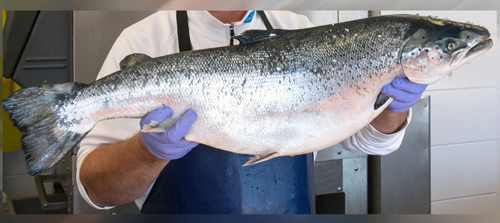
Atlantic Salmon.
For Tipperary and the River Suir, this is not an abstract national problem. The Suir is one of Ireland’s great salmon rivers and Atlantic salmon is a protected qualifying species within the Lower River Suir Special Area of Conservation, which extends through Tipperary, and Waterford.
The latest scientific assessment for the 2026 season groups the Suir, with the river Clodiagh near Holycross, and river Lingaun latter part of the border between Kilkenny and Tipperary, and Waterford Blackwater. At the standard 75% probability of achieving its conservation limit, the stock was recommended for catch-and-release fishing only, rather than having a harvestable surplus. Under more precautionary probability thresholds, the advice is now to close it.
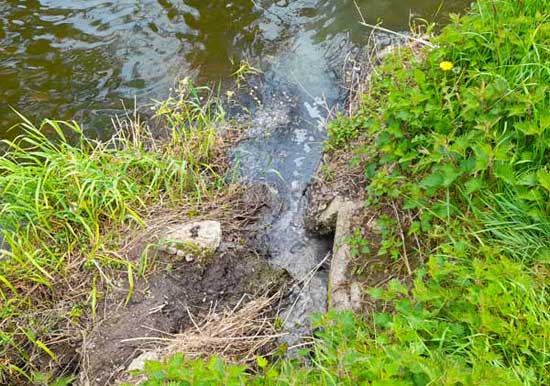
Domestic effluent allowed to flow into the River Suir for past 10 years unabated.
What is happening to our salmon? There is no single cause. Poor survival at sea certainly is a major part of the national decline, with changing ocean temperatures, food availability and wider changes in the North Atlantic affecting salmon after they leave Irish rivers. But what happens inside rivers such as the Suir also matters enormously. Salmon need clean, cool, well-oxygenated flowing water and clean gravel beds in which to spawn. The female buries her eggs among the stones. Water must circulate freely through that gravel to supply oxygen. When fine soil, silt and other sediment fill the spaces between the stones, the gravel can become clogged. Water circulation falls and the supply of oxygen to salmon eggs can be reduced. In badly affected spawning beds, eggs and newly hatched fish can die even though the surface of the river may look relatively normal.
Pollution and excessive nutrients are therefore important concerns. The EPA says agriculture and wastewater remain the greatest challenges to Irish water quality, with nitrogen and phosphorus still too high in many waters. In 2026 the EPA also reported that nitrogen remains particularly high across much of the south and southeast, with agriculture the main national source of nitrogen entering rivers. Environmental Protection Agency Tipperary has had direct examples of pollution affecting the Suir. In 2025 Inland Fisheries Ireland secured a conviction following a September 2024 incident at Holycross, where harmful matter entered the River Suir and approximately 400 metres of river bed was reported as having a yellowish-cream deposit. IFI warned that aluminium sulphate entering a river poses a major threat to aquatic ecosystems. Inland Fisheries Ireland
That incident should not be taken as the explanation for the long-term decline of the Suir salmon stock, but it demonstrates how vulnerable the river remains to individual pollution events on top of longer-term pressures.
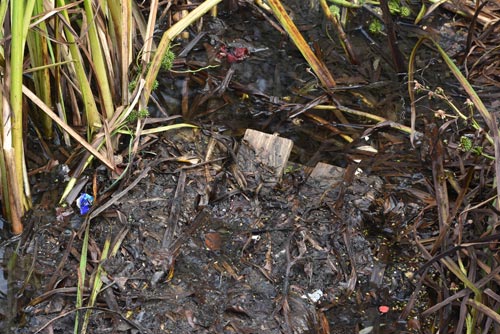
Rubbish blocking the river while an over abundance of reeds steal the oxygen.
Barriers are another major issue on the Suir Weirs, dams, culverts and other structures can prevent or delay salmon reaching spawning grounds. They can also change river flows and alter the natural movement of gravel and sediment. A very relevant Tipperary example is Bakery Weir in Cahir. IFI assessed the structure in 2018 and found it to be a significant barrier to migrating salmonids, as well as lamprey and coarse fish. Eight years later, a project is now being progressed to partially remove the weir and improve the natural river channel and fish passage. IFI explains more generally that barriers can stop fish reaching breeding habitat, increase the energy salmon need to expend during migration and interfere with the movement of the gravels and sediment needed to create healthy spawning beds.
So is pollution, lack of oxygen and clogged gravel responsible? They are certainly a large part of the problem and they are factors we can actually do something about locally. But the scientific evidence points to several pressures acting together:
poor survival of salmon at sea;
agricultural and wastewater pollution;
excess nutrients;
fine sediment clogging spawning gravel;
loss and alteration of river habitat;
barriers such as weirs and culverts;
warmer water, drought and extreme floods associated with climate change;
and other pressures including disease, predation and aquaculture.
The worrying point for Co. Tipperary is that we cannot control what happens to salmon throughout the North Atlantic, but we can improve the River Suir and its tributaries. That means protecting spawning gravel from excessive silt, reducing nutrient and pollution losses, improving sewage and wastewater treatment, restoring damaged river habitat, protecting river banks and riparian vegetation, and removing or modifying unnecessary barriers so that salmon can once again reach as much good spawning habitat as is possible. If young salmon leave the Suir in greater numbers and in better condition, they have a better chance of surviving the increasingly difficult journey at sea. The River Suir has supported wild Atlantic salmon for thousands of years. Their decline should be treated as a warning about the health of the entire river system, not simply as an angling issue. Protecting the salmon means protecting the River Suir, its tributaries, its spawning gravels and its water quality throughout County Tipperary and beyond.
Consent, Responsibility and the Conversation Tipperary Needs to Have.
New research from the Dublin Rape Crisis Centre should prompt a serious conversation about attitudes to rape, consent and responsibility in Ireland. According to its latest national survey, 15% of adults believe that someone raped, while under the influence of alcohol or drugs, is at least partly responsible for what happened to them. Among men under 25 years, that figure rises sharply to 37%. Among women under 25 years, it is 25%.
The wider findings are equally concerning. Almost half of men under 25 years surveyed believe there are “a lot” of false rape allegations, while roughly one in three say a rape should not be believed without either a criminal conviction or a report to Gardaí. These attitudes matter because sexual violence does not always result in an immediate report, prosecution or conviction. The same research found that among people who had experienced rape, only 17% reported it to Gardaí, while 19% told nobody at all.
Alcohol or drug use does not transfer responsibility for rape from the perpetrator to the victim. Consent must still be freely given, and a person’s vulnerability is never permission for another person to violate them. But simply condemning young people who hold these views will not solve the problem either. We need to understand where these beliefs are coming from; what young people are learning about sex and consent, what they are seeing online, how pornography, peer culture and social media may shape expectations, and whether our education system is giving young people the tools to recognise healthy sexual relationships and boundaries.
The encouraging finding is that 88% of adults agree that a perpetrator who is intoxicated should remain just as responsible for their actions. That principle should be equally clear on the other side of the equation; being intoxicated does not make a victim responsible for somebody else’s decision to commit sexual violence. Education about consent cannot be a one-off classroom lesson. It needs to involve families, schools, universities, sporting organisations, online platforms and, importantly, men speaking with other men.
Changing attitudes is part of preventing harm and the starting point should be simple; responsibility for rape lies with the person who commits it, not with the person who experiences it.
Criminal Proceeds Redirected to Community Safety Projects – Tipperary Has Benefited in Previous Years.
More than €4.8 million seized through the proceeds of crime is being redirected into community projects across Ireland under the 2026 Community Safety Fund. Minister for Justice, Home Affairs and Migration Mr Jim O’Callaghan has announced funding of €4.84 million for 56 projects nationwide, supporting initiatives aimed at improving community safety, assisting vulnerable groups, encouraging youth participation and promoting greater inclusion and integration.
The Community Safety Fund uses proceeds of crime seized by the Criminal Assets Bureau and An Garda Síochána to support community-led projects. The 2026 allocation represents a 10% increase on the €4.4 million awarded in 2025 and is €2.84 million higher than the €2 million allocated when the fund was first introduced in 2022. The number of successful projects has also grown significantly, with 56 projects receiving support this year, more than double the number funded in the first year of the scheme.
The organisation has been awarded €74,000 for its Safe Neighbourhood Project, which aims to tackle social isolation and concerns around community safety in disadvantaged inner-city areas. The initiative will bring younger and older residents together through volunteering, community activities and storytelling projects involving art and media, with the aim of building trust and strengthening relationships between generations. Minister O’Callaghan said the Community Safety Fund was designed to turn the proceeds of criminal activity into positive investment in communities. He said the record €4.84 million allocation would support community-led initiatives working to make communities safer and more inclusive, while helping vulnerable groups, engaging young people and supporting crime prevention.
Projects funded nationally this year cover areas including community engagement, inclusion of minority and marginalised groups, domestic, sexual and gender-based violence, youth safety, addiction recovery, reducing reoffending, digital safety and online harm, and supports for LGBTQI+ communities.
Tipperary has previously received funding Tipperary has benefited directly from the Community Safety Fund in previous years. In 2025, Tipperary County Council and Youth Work Ireland Tipperary were awarded €137,750 for the Cashel Traveller Education Initiative. A further €45,300 was awarded in 2025 to the Killaloe/Ballina Community and Family Resource Centre for its Power without Violence programme, with the project listed as operating across Tipperary and Clare. Tipperary also featured among areas benefiting from earlier rounds of the fund. In 2023, Waterford LEADER Partnership received €149,820 for a South East Farming Pilot operating across South Tipperary, Wexford, Carlow, Kilkenny, and Waterford. The project was aimed at providing vulnerable young people with social and care-farming placements. Another 2023 project, the Community Safety Weapons Awareness Programme, led by Moyross Development CLG, was listed as operating across Tipperary, Limerick and Clare . In 2024, Tipperary was again included in a multi-county project listed among the 33 successful Community Safety Fund projects, with an initiative operating across Tipperary, Limerick and Clare .
The Department of Justice says the fund has expanded substantially since its introduction, rising from €2 million for 22 projects in 2022 to the record €4.84 million allocation for 56 projects announced for 2026.
The National Office for Community Safety is responsible for administering the fund.
This website uses cookies to improve your experience. We'll assume you're ok with this, but you can opt-out if you wish.AcceptRead More
Privacy & Cookies Policy
Privacy Overview
This website uses cookies to improve your experience while you navigate through the website. Out of these, the cookies that are categorized as necessary are stored on your browser as they are essential for the working of basic functionalities of the website. We also use third-party cookies that help us analyze and understand how you use this website. These cookies will be stored in your browser only with your consent. You also have the option to opt-out of these cookies. But opting out of some of these cookies may affect your browsing experience.
Necessary cookies are absolutely essential for the website to function properly. This category only includes cookies that ensures basic functionalities and security features of the website. These cookies do not store any personal information.
Any cookies that may not be particularly necessary for the website to function and is used specifically to collect user personal data via analytics, ads, other embedded contents are termed as non-necessary cookies. It is mandatory to procure user consent prior to running these cookies on your website.




Recent Comments