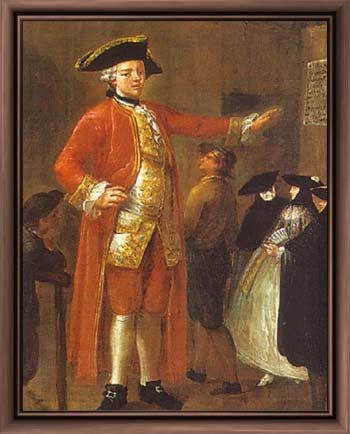
Cornelius Magrath the Silvermines Co. Tipperary giant.
Trinity College Dublin claim that they have no immediate plans to release the skeleton of a giant, born in March 1736, near the Silvermines, Nenagh, Co Tipperary to assist in his burial.
Cornelius Magrath who suffered from gigantism was 7ft 3in tall when he died in 1760. Legend recalls that Trinity students stole his body the day he died and it has been kept at the University ever since.
Of course body snatching was a lucrative business back in the 18th century and those who were involved were often called “resurrectionists” or “resurrection-men”, who often benefited on the double, stealing personal effects from the corpses sold on for dissection or anatomy lectures in medical schools. Because the only bodies legally available for medical dissection back then were the remains of executed criminals, demand soon outpacing supply.
Such body snatching activity possibly lends itself to the use of the phrase “The Graveyard Shift”. Graveyards started running out of places to bury people. So coffins were often dug up and bones sent to a “bone-house” allowing for the reuse of grave space. When opening such coffins, it was discovered that a considerable number were found to have scratch marks on the inside lid, confirming that individuals were being burying alive. Based on this evidence it was agreed that a piece of string be tied to the wrist of certain corpses; to be lead through the coffin and up through the ground before being tied to a bell. An individual would sit out in the graveyard all night (the “graveyard shift”) to listen for bell; sounds, hence someone could be “saved by the bell” or was considered to be a “dead ringer.”
The Magrath skeleton today is viewed only by those doing research and continues to inspire scholarship through teaching a great many students, scientists, professors and experts studying his disease.
While it is claimed that Tipperary locals are calling on Cornelius’s skeleton to be released for burial; certainly Thurles.Info has heard nothing about it and Trinity College have released a statement also confirming it also had not been approached by any Tipperary individuals who are requesting his burial. The University in the past admits putting Cornelius’s skeleton on public display, but there are no plans for such similar displays into the future; leaving Cornelius to be only visited by medical students or associated groups involved in research or other educational activities.
Looks like our Dublin Media were stuck for front page sensationalism and national debate again.
You can read all about the Tipperary Giant Cornelius Magrath simply by clicking HERE
Wearing dark trousers, blue and white trainers and a navy jumper, the accused Mr Outram was brought before Dungarvan district court this morning, having been charged with the murder last night. Mr Outram had previously been arrested on Monday afternoon in Clonmel and detained under Section 4 of the Criminal Justice Act.
He was later questioned during Monday evening and into Tuesday, at Dungarvan garda station, in relation to the death of the 90 year old pensioner. Detective Sergeant Shay Keevans told Dungarvan district court that he had charged Mr Outram at the Garda station at 11.55pm on Tuesday night.
Judge Finn granted the accused legal aid, while remanding him in custody to appear before Dungarvan district in seven days, on Wednesday, March 8th next.
No application was made for bail since, being on a murder charge, bail application can only be dealt with by the High Court and not at District Court level.
The passing of Mrs Fogarty is most deeply regretted by her loving sons Sean and Donal; daughters Maura & Colette, sons-in-law; daughters-in-law; grandchildren; brother; sister; extended relatives and friends.
A Cremation Service will take place at Glasnevin Crematorium on Saturday next, 4th March, at 12.00 noon.
It was with a great personal sadness that I learned of the death on Thursday last, 23rd February 2017, of Mr John McGinley, Limerick Road, Nenagh, Co. Tipperary and for many years County Manager of Tipperary N.R, County Council.
Retired for some time while remaining a great friend and benefactor of the Thurles area; Mr McGinley passed away peacefully in the loving care of Our Lady’s Hospice, Harold’s Cross, Dublin.
Beloved husband of the late Mairead; the recent passing of Mr McGinley is most deeply regretted by his loving daughters Jacinta, Edel, Fiona and Sinead; sons-in-law Simon, Paul, Andrew and Michael; grandchildren Cillian, Aoife, Andrew, Ciara, Lauren and Daniel; brother-in-law Brendan; sister-in-law Maura; nephews; nieces; extended relatives and a wide circle of friends.
The earthly remains of Mr McGinley reposed at Our Lady’s Hospice, Harold’s Cross last Saturday evening from 6.00pm to 7.30pm. His remains again reposed at Keller’s Funeral Home, Nenagh, on the following day Sunday from 10.30am, followed by removal at 11.30am to the Church of St. Mary of the Rosary, Nenagh, for funeral Mass at 12.15pm.
Cremation took place on Monday last at 2.00pm in Mount Jerome Crematorium, (Reilig Chnoc Ieróim), Harold’s Cross, South Co. Dublin.
Initial design drawing of the ‘Stannix Homes’ produced before building in 1889.(Photo colour toning G. Willoughby.)
The Stannix family appear to have spent comparatively little time here in Co. Tipperary. We are aware they were of the Protestant faith and left us a legacy which involved the setting up of the charitable almshouses known today here in Thurles as ‘The Stannix Homes’.
In the mid 1870’s the representatives of Jeremiah Stannix held 2,054 acres in county Tipperary. What we can reliably ascertain is that Emma Stannix held townlands in the parish of Moycarkey, Thurles in barony of Eliogarty, Co. Tipperary. There is a reference to the provisions of the will of Miss Emma Stannix in a letter in the papers of Archbishop Thomas William Croke of Thurles, dated 1st December 1886. There are references to the representatives of Emma Stannix holding untenanted lands at Ashhill and Knocknanuss, in the parish of Moycarkey, in 1906.
We believe that Emma herself showed some talent as an artist and spent much of her time overseas in Versailles in the Île-de-France region of France. Tipperary press reports appear to constantly conflict with the spelling of her name; e.g. Stannix and Stanwix.
Stannix Homes September 2016
However Ema’s philanthropic soul passed away in 1857; and her will makes provision for the Stanwix Almshouses to be financed and subsidised by her deceased estate. She is also understood to have made generous provision for the remaining tenants on her various Moycarkey agricultural properties.
Here in Thurles the Emma Stannix Charity left a sum of money to build alms-houses for what were referred to as “reduced female widows aged over sixty years”. The site was provided on ground (Thurles Townparks) to the south east of Thurles with frontages overlooking and facing west towards the town.
The terrace of two-bay single and two-storey former almshouses, were built 1889, and featured open gable-fronted porches. The central house is a higher two-bay gabled erection, while the two storey director’s house attached to the north side of the terrace features a small spire with roundels on a turret.
The pitched slate roofs have rendered chimney stacks while the buildings themselves are constructed of red brick, with half-timbered gables and verandas. Each resident was then provided with two rooms, a yard and sanitary accommodation. Gate piers with alternating bands of brick and stone, together with wrought-iron gates and cast-iron railings are features of the boundary surrounding the site.
The building work was initially carried out by Mr. J. Kiernan, of Talbot-street, at a cost of about £2,500, using the designs and under the superintendence of Mr. Albert E. Murray[1], F.R.I.B.A., architect, Dawson-street.
Albert Edward Murray (1849-1924)[1]. Interesting to note that when Queen Victoria (1819-1901) visited Dublin in 1900, Mr. Albert E. Murray was responsible for the decorations in Sackville Street, now O’Connell Street, Dublin and also for those in Clyde Road, Ballsbridge where he then resided.
Ceremonial gateways had been erected on Queen Victoria’s route into Dublin from Kingstown (Dun Laoghaire). It was on the occasion of this same trip by Queen Victoria that it was reported that the Irish Times supposedly printed a typo stating, “a large crowd cheered as Queen Victoria pissed over Carlisle Bridge.” (Now O’Connell Bridge). Even though they had only gotten one letter wrong the entire type room staff were supposedly sacked.
Albert Murray would also decorate Sackville Street (O’Connell Street) for the visit by Queen Victoria’s eldest son Edward VII (1841-1910), during his visit to Dublin in 1907.
This website uses cookies to improve your experience. We'll assume you're ok with this, but you can opt-out if you wish.AcceptRead More
Privacy & Cookies Policy
Privacy Overview
This website uses cookies to improve your experience while you navigate through the website. Out of these, the cookies that are categorized as necessary are stored on your browser as they are essential for the working of basic functionalities of the website. We also use third-party cookies that help us analyze and understand how you use this website. These cookies will be stored in your browser only with your consent. You also have the option to opt-out of these cookies. But opting out of some of these cookies may affect your browsing experience.
Necessary cookies are absolutely essential for the website to function properly. This category only includes cookies that ensures basic functionalities and security features of the website. These cookies do not store any personal information.
Any cookies that may not be particularly necessary for the website to function and is used specifically to collect user personal data via analytics, ads, other embedded contents are termed as non-necessary cookies. It is mandatory to procure user consent prior to running these cookies on your website.
 Mr Ross Outram, aged 26, with an address at Ferryland, Waterford Road, Clonmel, Co. Tipperary, has been
 It is with great sadness we learned of the death on Monday 27th February 2017, of
 It was with a great personal sadness that I learned of the death on Thursday last, 23rd February 2017, of





Recent Comments