|
|
Sunday last, July 22nd 2018 marked the 116 anniversary of the death of Archbishop Thomas William Croke (D.Div.) [28 May 1824 – 22 July 1902], the second Catholic Bishop of Auckland, New Zealand (1870–74) and later to become the Irish Archbishop of Cashel and Emly. A former patron of the Gaelic Athletic Association, with the largest GAA stadium situated in Dublin, Croke Park, named in his honour.
 Dr Thomas William Croke (D.Div.) Archbishop of Cashel and Emly – Strong Supporter Of Irish Nationalism. Archbishop Croke was born in Castlecor, Dromin in the parish of Kilbrin, Co. Cork, in 1824. His grandfather was a shopkeeper in the local square. His father, William was Land Agent/Manager for the 4,000 acres Freeman Estate, purchased from the Chinnerys in the early 18th century. (Freemans of Castle Cor, Co. Cork, their home now demolished.).
William his father married a Protestant girl, one Miss Isabella Plummer, daughter of an aristocratic family, latter descendants of the Knight of Glin, a hereditary title held by the FitzGerald families of Co. Limerick, since the early 14th century. Isabella’s parents would disown her following her Roman Catholic marriage to William in 1817.
Archbishop Croke was the third of eight children born of this couple, before his father died in 1834. William’s brother, Reverend Thomas Croke, now took it upon himself to supervise the education and upbringing of the children.
Two of Archbishop Croke’s brothers would enter the priesthood, while two sisters would enter a convent and become nuns. Archbishop Croke himself would go on to be educated in Charleville, Co. Cork and later at the Irish College in Paris and the Irish College in Rome, winning academic distinctions, including a Doctorate of Divinity, with honours.
Ordained a priest of the Cloyne diocese at the height of the ‘Great Famine’ (1845-1849) in May of 1847, he was appointed a Professor in Carlow College. Irish nationalist Member of Parliament (MP) and leader of the Young Ireland movement, William Smith O’Brien claimed that Archbishop Croke fought on the barricades in Paris during the French Revolution in 1848.
In 1858 he became the first president of St. Colman’s College, Fermoy, Co. Cork and then served as both parish priest of Doneraile and Vicar General of Cloyne diocese from 1866 to 1870. Thomas Croke attended the First Vatican Council as theologian to the Bishop of Cloyne in 1870.
In 1870 Croke was appointed Bishop of Auckland in New Zealand, arriving in Auckland on 17th December 1870 on the Steamer “City of Melbourne”. During the next three years as Bishop of Auckland; Croke devoted some of his considerable personal wealth to rebuilding diocesan finances. However, in Auckland there was then little sign of the strongly Irish nationalist line Croke would later adopt following his return here to Ireland; transferred to become a member of the Irish hierarchy as Archbishop of Cashel, (One of the four Catholic Irish archbishoprics, i.e. Cashel & Emly; Dublin; Armagh and Tuam).
Archbishop Croke (His motto – “Mergimur Nunquam”. Literal translation from Latin “We are never sunk”.), would now become a strong supporter of Irish nationalism, aligning himself with the Irish National Land League; an Irish political organisation of the late 19th century which sought to help poor tenant farmers; and with the chairman of the Irish Parliamentary Party, Charles Stewart Parnell, latter a wealthy and powerful Anglo-Irish Protestant landowner. Croke’s support of nationalism caused successive British governments and the Lord Lieutenant of Ireland’s civil service in Dublin to be deeply suspicious of his known associations. He also associated himself with the Temperance Movement of Irish Catholic priest and teetotal reformer, Father Theobald Mathew, [latter born at Thomastown, near Golden, Co. Tipperary, on October 10th, 1790], and the Gaelic League from its foundation in 1893; its aim to restore the Irish language.
Later, somewhat embarrassed by Charles Stewart Parnell’s immorality, Archbishop Croke was forced to distance himself and withdrew from active participation in nationalist politics, following the scandal that erupted over Parnell’s relationship with Mrs Katherine (Kitty) O’Shea, (particularly during the period 1886-1890), latter the separated wife of Parnell’s fellow M.P., Captain William (Willie ) O’Shea. Captain O’Shea would eventually file for divorce from his wife, citing Charles Stewart Parnell as co-respondent. A two-day trial would reveal that Mr Parnell had been the long-term lover of Mrs O’Shea and had indeed fathered three of her children. This scandal back then would force the two dominant forces of Nationalism and Catholicism to split wide apart.
Due to his support and known association with Parnell’s efforts, Archbishop Croke now found himself summoned to Rome by Pope Leo XIII and Cardinal Simeoni. Following his meeting and prior to his return to Ireland, he stayed over at the Irish College in Rome and when questioned regarding the outcome of his meeting with both men, Archbishop Croke stated that he returned to Ireland “Unchanged and unchangeable.”
Archbishop Croke died at the Archbishop’s Palace in Thurles, Co. Tipperary on 22nd July 1902, aged 78 years and he is buried in the Cathedral of the Assumption, Thurles, Co. Tipperary.
Today: From the western side and overlooking Liberty Square, in the centre of Thurles, Co. Tipperary, a very fine life sized statue of Archbishop Thomas William Croke (D.Div.) exists bearing the Irish inscription:-
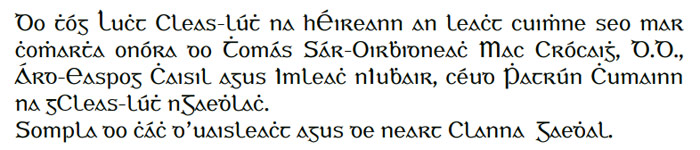
Translation: The Athletic Association of Ireland erected this commemorative plaque as a tribute of honour to the Most Reverend Thomas Croke, D.D., Archbishop of Cashel and Emly, the first Patron of the Gaelic Athletic Association.
An example to everyone of the nobility and strength of the Irish People.
 It is with great sadness that we learned of the death today, Sunday 22nd July 2018, of Mr Denis (Dinny) Cleary (Senior), Gragaugh, Ballingarry (SR), Thurles, Co. Tipperary.
The passing of Mr Cleary is most deeply regretted by his loving wife Imelda; sons Denis, Thomas, Oliver, Noel, and Paul; daughters Noelle, Theresa, Assumpta, Geraldine, Imelda, Caroline, Kathleen, Marie and Bernadette; 24 grandchildren; sons-in-law; daughters-in-law; extended relatives and friends.
Funeral Arrangements
The earthly remains of Mr Cleary will lie in repose at his residence in Gragaugh, Ballingarry, Thurles, [ Eircode E41 HF67 ], on Tuesday evening from 4.00pm to 8.00pm.
Removal on Wednesday morning to the Church of The Assumption, Ballingarry (SR), for funeral Mass at 11.30am, followed by interment immediately afterwards in the adjoining cemetery.
Note Please: House private on Wednesday morning. Donations in lieu, if desired, to the Irish Cancer Society.
Ar dheis Dé go raibh a anam dílis.
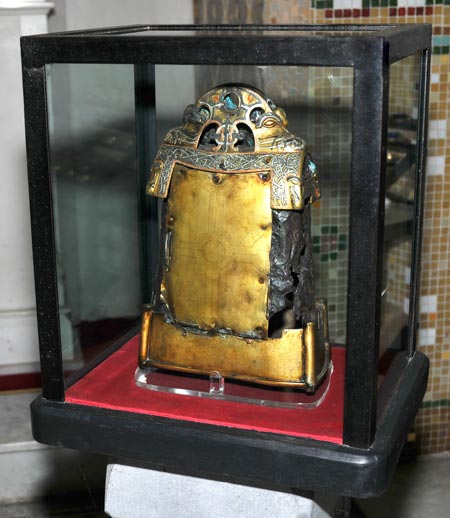 Replica of St. Cualan’s Bell, Sacred Heart Church, Borrisoleigh, Co. Tipperary. The ancient art of Handbell Ringing is largely unheard of here in Southern Ireland; first Handbells having being developed by brothers Robert and William Cor in Aldbourne, Wiltshire, England, between 1696 and 1724.
Now on Friday next two simultaneous Hand Bell Ringing Marathon Recital events will take place in the area of the village of Borrisoleigh, Thurles, Co. Tipperary on Friday next, July 27th, 2018. The bell ringing recitals will be conducted by the London-based guild of St. Cualan, under the direction of Mr Thomas Hinks.
This St. Cualan Guild take their name from the Bearnan Cualan, a 12th century Irish bell shrine, which originally belonged to the monastery of St Cualan at Glenkeen, Borrisoleigh, in Co. Tipperary.
St. Cualan’s Bell, (also known as the Glankeen Bell or An Béarnan Cuileáin) is a late 7th to early 8th century [Anno Domini], iron hand bell, latter encased in a richly ornamented early 12th century brass shrine; its height being about 30 centimetres, inclusive.
It had been located hidden in a tree trunk in the townsland of Kilcuilawn, Borrisoleigh, Co. Tipperary, in the late 18th century and the original now resides in the British Museum in London, (Reference Record No. 1854,0714.6.B.)
The bell shrine is decorated in what is possibly an Irish version of the Viking Ringerike style, (Ringerike style receives its name from the Ringerike district north of Oslo, in Norway who produced similar designs), with an inlaid Silver and Niello strip, (latter manufactured by fusing together copper, silver and lead before mixing the molten alloy with sulfur).
The work is similar to that found on the Clonmacnoise Crozier and the Lough Derg Sword and indeed it is quite likely that all three pieces may have originated from the same metal workshop. It is also possible that all three pieces were made either for use at or in commemoration of the Synod of Ráith Bressail, which met near Borrisoleigh in the year 1111. Latter was the most important of all the synods associated with the twelfth-century Church Reform movement in Ireland, organising for the first time an administrative structure and a territory based system of dioceses under the control of individual bishops.
Interesting: For many years St. Cualan’s Bell was used to detect false oaths; liars swearing by St. Cualan’s Bell, risked having their ‘heads reversed’. [Perhaps same should be moved for regular use in Dáil Éireann. No on second thoughts Dublin has already stolen, Viking style, most of Tipperary’s heritage and tourist attractions.]
The original bell is partially incomplete, missing its internal ‘clapper’ and a handle; however, an accurate replica of the shrine is kept on open display in the Roman Catholic parish Church of The Sacred Heart in the picturesque village of Borrisoleigh, just 14km or 16 mins drive from Thurles, Co. Tipperary, via route R498.
The bell somehow came into the possession of Birr attorney and historian Thomas Lawlor Cooke from Borrisoleigh, Co. Tipperary, who wrote important histories on the town of Birr and district [`Picture of Parsonstown’ (1826)]. Cooke went on to sell the bell shrine, along with other artefacts, to the British Museum, where it has remained as part of religious displays ever since.
When this visiting guild of bell ringers were first formed, they were not fully aware of the ancient story behind the famous Bearnan Cualan and its association with Borrisoleigh village.
Now, at about 1.00pm on Friday next, July 27th the welcome Bearnan Cualan Chapter will divide into two groups. One half will remain in the Church of The Sacred Heart, Borrisoleigh; while the other half will attend near the ivy-covered medieval ruins of Glenkeen church, before both commence a three hour long ‘Marathon Peal’.
Needless to say, everyone is invited to make an appearance to either or both venues and to remain for whatever length of time they can spare.
 It was with great sadness that we learned of the death on Tuesday last, 17th July 2018, of Brother Bernard (Edmond Noel) Bulfin, New South Wales (NSW), East Australia and late of Ballinure, Thurles, Co. Tipperary.
Predeceased by his sister Helen (Quinlan) and nephew Peter; Br. Bulfin passed away after a short illness.
His passing is most deeply regretted by his loving brothers, Rev. Austin, Tom, Br. Gerard (Jack) and Pat; sister Josephine; sisters-in-law and brother-in-law; nieces; nephews; grandnieces; grandnephews; Patrician Confrères, extended relatives and his many friends.
Funeral Arrangements
A funeral Mass will be held for Br. Bulfin, in Sydney, Australia on Wednesday next, July 25th, while a funeral Mass will also be celebrated in St. Mary’s Church, Killenaule, Thurles, Co. Tipperary, at a future date, to be announced later.
UPDATE: The funeral at Holy Cross College, Sydney, will be live-streamed. [ Google link Br Bernard Bulfin fsp. ]
Ar dheis Dé go raibh a anam dílis.
 It was with great sadness that we learned of the death yesterday, Thursday 19th July 2018, of Mrs Ann (Nan) Whelan (née Bolger) No. 64 Kennedy Park, Thurles, Co. Tipperary.
Predeceased by her husband Thomas and granddaughter Nicola; Mrs Whelan is most deeply regretted by her loving daughters Ann, Linda and Irene; son-in-law Paddy; grandchildren Patrick, Clodagh and Tomás; great grandchildren Teegan, Darragh, Lily and Maisie; brother Joe; sisters Breda and Mary; nephews; nieces; extended relatives; neighbours and a wide circle of friends.
Funeral Arrangements
The earthly remains of Mrs Whelan will lie in repose at her residence on Sunday evening, 22nd July, from 5.00pm to 7.00pm.
Removal will take place on Monday morning, 23rd July, to arrive at the Cathedral of The Assumption, Thurles at 10.15am for funeral Mass at 11.00am.
Interment will take place immediately afterwards in St. Patrick’s Cemetery, Moyne Road, Thurles, Co. Tipperary.
Note Please: House private on Monday morning. Family flowers only, however donations in lieu, if desired, to Thurles Meals on Wheels.
Ar dheis Dé go raibh a h-anam dílis.
|
Support Us Help keep Thurles.info online by donating below. Thank you.
Total Donated 2026: €300.00
Thank You!
Daily Thurles Mass Livestream
|



Recent Comments