Extract from a publication by L. M. McCraith, [Mrs Laura Mary McCraith-Blakeney (born 1870)], originally published in 1912.
“The first, the gentle Shure (Suir) that making way By sweet Clonmell (Clonmel), adornes (adorns) rich Waterford;…” (Excerpt from poem Edmund Spenser’s ‘Irish rivers’.)
Some eight miles from Templemore, spreading itself upon both banks of the Suir, is the ancient town of Thurles. The town has a distinctive, old-world, almost ecclesiastical, character of its own. Its name is a corruption of the Irish Durlas, a fortress. In the Annals of the Four Masters we read of a chief of Durlas, by name Maelduin, who was slain in 660 A.D. Thurles was the scene of one of the few signal defeats of the Danes by the Irish. This took place in the tenth century, and was long remembered and recorded locally.
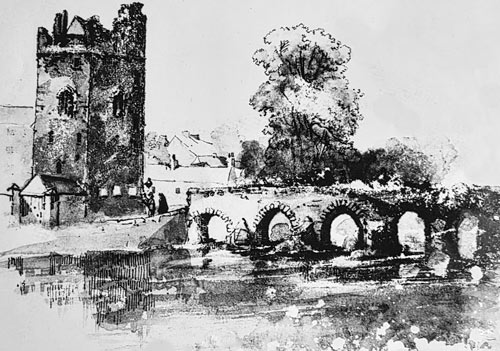
View of a bridge and the ruins of Thurles Castle, County Tipperary, dated 1909. [Artist James Stark Fleming (1834-1922)]
As has been said, Thurles was also the scene of the defeat of Strongbow by a coalition of Irish chiefs in 1174. When Strongbow heard that Conor and Donal Mór were advancing against him, he sent to Dublin for help. A contingent of Danish settlers and Norman soldiers, natural allies, came to his assistance. They endeavoured to join him at Thurles, but there, by the banks of the Suir, many of Strongbow’s men were slain. Donal Mór O’Brien was in command that day, and it would seem that the field was a fortunate spot to him; for when he returned to that same place seventeen years later, to fight another battle against the English, he was again victorious.
In 1197, however, six years afterwards the English took Thurles, and burnt many churches and temples.
View of the ruins of Thurles Castle, County Tipperary. [Artist James Stark Fleming (1834-1922)]
The Suir From Its Source to the Sea. Among the many notable Normans who established themselves in Ireland (and in time became “more Irish than the Irish”) were the Butlers. Theobald Fitzwalter came in the reign of Henry II, in 1172. He was kin to Thomas à Becket, (1119 or 1120 -1170) and it was part of the King’s accepted penance that he should ennoble all the murdered Archbishop’s relatives. Henry II, gave Fitzwalter large grants of Irish land, in return for which Fitzwalter was to act as the King’s Chief Butler and to hand him a cup of wine after his coronation. Hence the name of the family.
The Butlers ever remained loyal to the Sovereign whose vassals they were, and were frequently in opposition to that other powerful Norman house, the Fitzgeralds, or Geraldines, who were descended from Strongbow’s knight, son-in-law, and right-hand, Raymond le Gros, and were represented by the Earls of Kildare and Desmond.
The Butlers obtained large possessions in Wicklow, and in fertile Tipperary, and early in the thirteenth century became possessed of Thurles. The Butlers were ever notable as castle-builders, and founders of religious houses. They began to build on the banks of the Suir. Within the last half-century there were remains of no fewer than nine castles in this town. James Butler was created Earl of Ormonde in 1328. About that time (1324) he caused the castle to be built, the Norman keep of which still guards the bridge across the slow-flowing Suir. The Butlers also built, or endowed, Carmelite and Franciscan monasteries at Thurles; and there, as well as at Templemore, the Knights Templar established a preceptory. Viscount Thurles still remains the inferior title of the Marquis of Ormonde, the head of the Butler family.
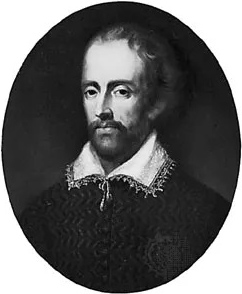
Edmund Spenser
Thurles to-day is an important and thriving town of about —— inhabitants. It has a notable horse fair, and it is the centre of a rich grazing and grain-growing district. It is the seat of the Archdiocese of Cashel and Diocese of Emly, and contains a magnificent Roman Catholic Cathedral and a handsome archiepiscopal residence. The bells and the organ of the Cathedral are notably fine. There is also a fine Roman Catholic College, two convents, and a monastery, the whole forming, as it were, a kind of religious quarter. Thurles was the scene of the famous Roman Catholic Synod in 1850.
From Thurles onward the Suir flows through the country of which the poet Spenser[Edmund Spenser (1552–1599)] said that it was “the richest champain that may else be rid”,(Taken from his unfinished epic poem, ‘The Faerie Queene’ ). Soon there comes in sight the mountain which he speaks of as “the best and fairest hill that was in all this Holy Island’s heights,” namely Galtee Mór, the highest peak of the Galtee range. [ NOTE:Latter description appears in Book VII, Canto VI, Stanza 37 of ‘The Faerie Queene’, specifically within the “Mutabilitie Cantos”. In the poem, Spenser uses Arlo-hill (Aherlow, South Co. Tipperary)as the sacred setting where the gods, led by Nature, gather to hear the plea of the Titaness Mutabilitie. Mutabilitie is a descendant of the ancient Titans, the race that ruled the universe before being overthrown by Jove (Jupiter).]
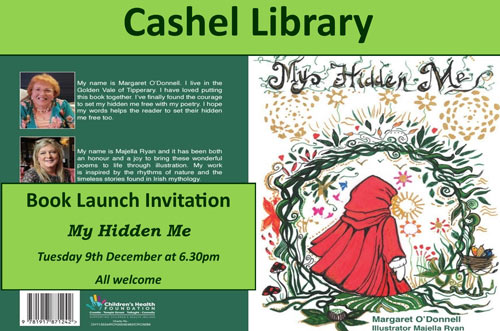
Next Tuesday, 9th December 2025, at 6.30pm Cashel Library are delighted to host a Book Launch of ‘My Hidden Me’, by local woman Ms Margaret O’Donnell and illustrated beautifully by Ms Majella Ryan.
Wine & Nibbles reception at 6.30pm sharp will be followed by the book launch and all welcome to attend.
Ms Margaret O’Donnell has stated. “I live in the Golden Vale of Tipperary. I have loved putting this book together. I’ve finally found the courage to set my hidden me free with my poetry. I hope my words helps the reader to set their hidden me free too.”
Visitors attending this event can locate the Cashel Library building; situated on Friar Street, Lady’s Well, Cashel, Co. Tipperary, HERE. (Eircode E25 K798).
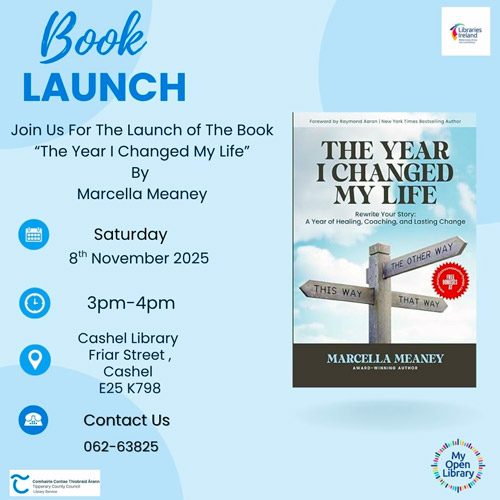
When betrayal shattered her life, author Marcella thought she might never recover. A mother of four, broken and raw, she found herself on the edge of despair, until she chose to begin again. “The Year I Changed My Life“, is part memoir, part guide: a year-long journey through heartbreak, healing, and the radical act of coming home to yourself.
Join us for a fun and interactive workshop launch – with Refreshments served.
This is just one of the many free eventsat Cashel Library each year. Do Remember booking is essential to Tel: 062-63825.
Visitors attending this event can locate the Cashel Library building; situated on Friar Street, Lady’s Well, Cashel, Co. Tipperary, HERE. (Eircode E25 K798).
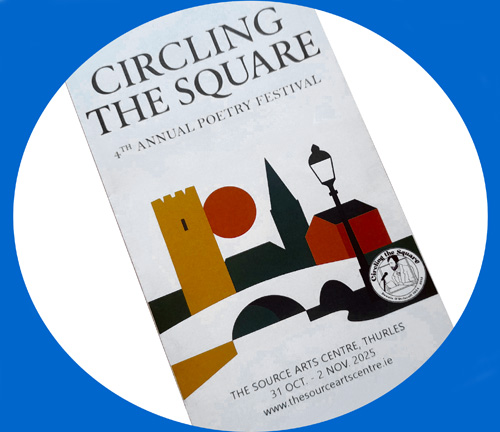
Popular “Circling the Square” Festival Returns To Thurles, Co. Tipperary, With Stellar Line-Up of Poets and Musicians.
Thurles is set to celebrate poetry, music and creativity in style as the fourth annual Circling the Square Festival returns to The Source Arts Centre over the weekend of October 31st to November 2nd, 2025.
“Outside new antique pubs, young consultants — well-toned women, gel-slick men — drain long-necked bottles of imported beer. Lip-glossed cigarettes are poised at coy angles, a black bra strap slides strategically from a Rocha top”.
Aboveextract from the poem“The Celtic Tiger”by the late, acclaimed Thurles poet, Dennis O’Driscoll.
This year’s performances promise a vibrant mix of poetry, live music and discussion, with four main headline events across Friday evening, Saturday afternoon, Saturday night concluding with a guided walk of Thurles, followed by Poetry readings and Open Mic Poetry on Sunday November 2nd.
The festival opens officially on Friday afternoon at 4:00pm with a reading by US former Poet Laureate and Novelist Joseph Bathanti in Bookworm No 1 Parnell Street in Thurles, followed by the first major performances at The Source Arts Centre, Cathedral Street, Thurles from 7:45pm. The evening, introduced by Jimmy Duggan, will feature music by Brendan Collins(Uilleann pipes), Gina Oberoi(Mezzo-Suprano) and Pat O’Callaghan(Saxophone), Hidden Highways, The Ed Dwan Trio and Leslie Dowdall & Hugh Buckley, alongside readings from poets Polina Cosgrave, Sean Lysaght, Moya Cannon, Joseph Bathanti, and Mary O’Donnell.
Saturday’s programme, November 1st, begins with a Poetry Workshop at 10:30am in the Community Rooms (above the Library) at The Source, presented by Professor Joseph Bathanti.
This event will be followed in the afternoon at 2:00pm by a panel discussion on the poetry of the late, great Irish poet Seamus Heaney. For this event Rosie Lavin & Bernard O’Donoghue, (latter editors of the newly published definitive edition of Seamus Heaney’s poetry) will join in conversation with Declan O’Driscoll.
Same will be followed by poetry readings from Amy Abdullah Barry, Michael Dooley, Charlotte Buckley, and Laoighseach Ni Choistealbha, accompanied by Classical Flautist Emma Roche from 2:30pm.
The Saturday evening showcase beginning sharp at 7:45pm, promises another standout event, featuring music from Classical Flautist Emma Roche, Hidden Pathways, Leslie Dowdall and Hugh Buckley, and the Ed Dwan Quartet, interwoven with poetry from Eleanor Hooker, Mark Roper, Bernard O’Donoghue, Grace Wilentz and Jane Clarke.
Again the night will round off at 10:30pm with the ever-popular Après Festival in The Monk’s licenced hostelry with a relaxed acoustic music session.
On the final day Sunday November 2nd at 11:30pm, commencing from the Anner Hotel, a guided heritage and history walk around Thurles will take place led by local historian Jimmy Duggan.
Finally, at 2:30pm, in The Monk’s, a Poetry Reading session, will take place, including an open Mic Session(For the latter those wishing to take part are invited to submit their names in advance). Those already taking part are D’or Seifer, Philip Lynch, John Noonan, Cathy Conlon, Trish Bennett, Linda Tavokali, Susan Miller Demars, Lauren Mc Namara, Cora Peters and Ron Carey.
The film ‘Cry of the Innocent‘ (1980) was an American made-for-television thriller, directed by Michael O’Herlihy.
Cast included: Australian actor Rod Taylor as Steve Donegin; Joanna Pettet as Cynthia Donegin / Candia Leighton; Nigel Davenport as Gray Harrison Hunt; Cyril Cusack as Detective Tom Moloney; Walter Gotell as Jack Brewster; Jim Norton as Jasper Tooms[He also played Bishop Len Brennan in ‘Fr. Ted’.] and Alexander Knox as Thornton Donegin. Stand-ins: [Latter persons who substitute for the main actors during the technical setup of a scene, such as lighting and camera blocking], were Miss Ireland 1973 Ms Yvonne Costelloe(Dublin), then a former model acting as stand-in for MsJoanna Pettet, and George Willoughby(Wexford, Wicklow & later Thurles), acting as stand-in for Rod Taylor, Nigel Davenport, and Cyril Cusack.
Mr Taylor came to Thurles, visiting Hayes Hotel to promote the above film in 1979. On arrival in Thurles, I was to discover that for several days Mr Taylor had been suffering from a severe and persistent toothache. Despite it being Sunday, a quick phone call to the home of then Thurles Dentist, the now late Mr Noel Treacy, and twenty minutes later Mr Taylor’s tooth problem was solved with Mr Treacy refusing to accept any payment for his work.
Film Plot: Steve Donegin (Rod Taylor), a U.S. insurance executive and former Green Beret, loses his wife and children in a mysterious plane crash. Determined to uncover the truth, Steve embarks on an investigation that reveals a deadly conspiracy involving corporate interests, espionage, and murder. The screenplay was based on a story by the acclaimed English novelist and journalist Frederick Forsyth (1938–2025), latter who sadly passed away in June of this year, 2025.
Production: Filming was completed in just three weeks in locations, Wicklow, including Ardmore Studios, and the slopes of Mount Branden in Co. Kerry.
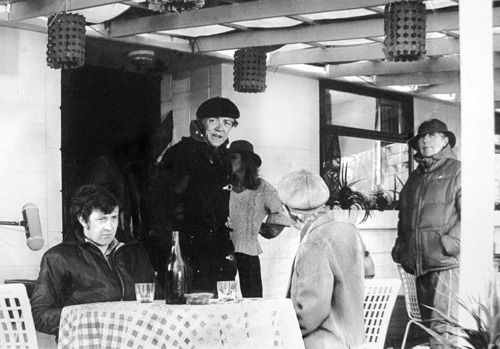
Pic. L-R: George Willoughby,Michael O’Herlihy, Joanna Pettet, Alexander Knox, and Josie MacAvin.
The above photo was taken by the then films stills photographer John Morris, husband of former Irish television presenter and artist MsThelma Mansfield. John Morris is the son of the late Michael Morris (1914–1999), [3rd Baron Killanin], and twin brother of Tipperary racehorse trainer and former professional jockey MrMichael “Mouse” Morris.
So lets take a closer look at those featured in the above picture, viewing left to right and starting with director Michael O’Herlihy.
Alongside his television work, Mr O’Herlihy also directed several films for Disney, such as ‘The Fighting Prince of Donegal’ (1966), ‘Mosby’s Marauders’ (1967), and ‘The One and Only, Genuine, Original Family Band’ (1968). His connection to ‘Star Trek’ endured long after his passing: in 2002, the Enterprise episode “First Flight” paid tribute to him by naming a fictional astronaut crew “O’Herlihy,” a nod to his direction of the original series episode “Tomorrow Is Yesterday,” which first mentioned the Earth–Saturn mission.
Mr O’Herlihy was the younger brother of Oscar-nominated actor Dan O’Herlihy. The former was married to Elizabeth Patricia O’Herlihy(née Ryan) a native of Thurles, Co. Tipperary, (a fact which we later discussed with me, during the making of Barbra Cartland’s ‘The Flame is Love’, when he discovered I had since moved to reside in Thurles, Co. Tipperary). I was given to understand that his wife Elizabeth O’Herlihy (nee Ryan), herself, a writer who contributed to the film “The Big Red One”, was from Thurles, connected to Ryan’s of the Brewery Store, whose home once resided at the junction of Mitchel Street and Kickham Street, facing unto Cathedral Street, Thurles.
Michael O’Herlihy sadly passed away in Dublin on June 16th 1997, at the age of 69, and was laid to rest in St Fintan’s Cemetery, Sutton, County Dublin.
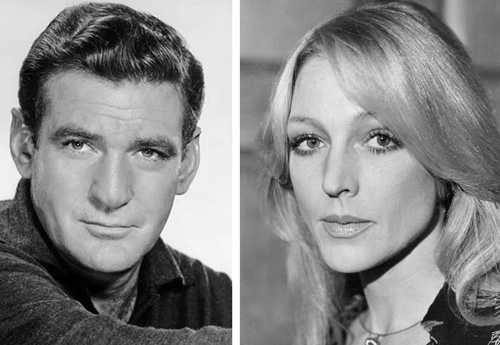
Left-right:Rod TaylorandJoanna Pettet.
Joanna Pettet: Actress Joanna Pettet, partially hidden in the picture, behind Director Michael O’Herlihy, was born in England in 1942, and enjoyed a versatile career in film and television during the 1960s and 1970s, appearing in projects such as ‘The Shuttered Room’ (1967) and ‘Petulia’ (1968). Known for her charm and poise on screen, Ms Pettet often took roles that highlighted her dramatic range and understated elegance, earning her recognition in both Hollywood and in British cinema.
Through the 1970s and 1980s, Ms Pettet made appearances on the television series ‘Harry O’; ‘Banacek’; ‘McCloud’; ‘Mannix’; ‘Police Woman’; ‘Knight Rider’; ‘Tales of the Unexpected’ (the UK series), ‘Cry of the Innocent’ and ‘Murder, She Wrote’. In 1984, she appeared as herself in a James Bond tribute episode of ‘The Fall Guy’ with ex-Bond girls Britt Ekland and Lana Wood.
It was in 1968, Ms Pettet married the American actor Alex Cord and gave birth to a son, Damien Zach. He was given the last name “Cord”, however, his biological father was British actor Terence Stamp. Ms Pettet and Cord were later divorced in 1989, after 21 years of marriage.
Ms Pettet was one of the last people to see actress Sharon Tate alive. She had visited Ms Tate, with her 10-month-old son, Damien Zachary at Tate’s Benedict Canyon home, for lunch, on the afternoon of August 8th, 1969. Later on that night, the pregnant Ms Tate and four others were brutally murdered by the Manson gang. This chilling brush with history is depicted in Quentin Tarantino’s 2019 film “Once Upon a Time… in Hollywood”, in which Ms Pettet is portrayed by Rumer Willis. The incident remains a striking moment in her life story, highlighting both her proximity to Hollywood history and the personal tragedies she endured.
Yet more tragedy was to follow. Her only child, the aforementioned Damien Zachary Cord, fell into a fatal coma, following an acute heroin overdose in 1995, at age 26 years.
She later became the caregiver and companion of her friend, actor Alan Bates, until his death from cancer in 2003.
In August 2021, Ms Pettet became trapped under a boulder for three hours, while collecting stones for her garden, near Anza, California. As a result, she required surgery to replace her shoulder and rotator cuff.
Alexander Knox: Alexander Knox(1907–1995)[pictured seated with back to the camera] was a Canadian actor, writer, and journalist. Active from the 1920s to the late 1980s, he appeared in more than 100 film, television, and stage productions. He received a Golden Globe and an Academy Award nomination for his portrayal of U.S. President Woodrow Wilson in “Wilson”(1944).
His career in the United States was limited during the McCarthy era (1950–1954), and he subsequently worked mainly in the United Kingdom. In addition to acting, Alexander Knox published several novels, often historical in theme, and contributed articles to newspapers and magazines. His later screen roles included the character of ‘Thornton Donegin’ in the film “Cry of the Innocent”.
His novels included ‘Night of the White Bear’(1971), a novel set in the Canadian Arctic; ‘Raider’s Moon’(1976), a historical novel also set in colonial Canada and ‘The Kidnapped Surgeon’ (1977), again, set in colonial times.
Josie MacAvin: Ms Josie MacAvin (1919 – 2005), was a physical education teacher, ballet dancer (Irish Ballet Club Gate Theatre 1943), set decorator, art director and costume designer. She won the Academy Award for Best Art Direction for ‘Out of Africa’ (1985). She was also nominated for her work on “Tom Jones”(1963) and “The Spy Who Came in from the Cold” (1965) and received a Primetime Emmy Award in Art Direction for “Scarlett”, latter a sequel to Margaret Mitchell’s 1936 novel ‘Gone with the Wind’, thus making her the only Irish designer to claim both honours.
Born in Dublin her credits include ‘Ryan’s Daughter’, ‘Educating Rita’, ‘Michael Collins’ and ‘The Butcher Boy’. Renowned for her meticulous design and collaborative approach, she frequently worked with directors such as Tony Richardson and John Huston.
This website uses cookies to improve your experience. We'll assume you're ok with this, but you can opt-out if you wish.AcceptRead More
Privacy & Cookies Policy
Privacy Overview
This website uses cookies to improve your experience while you navigate through the website. Out of these, the cookies that are categorized as necessary are stored on your browser as they are essential for the working of basic functionalities of the website. We also use third-party cookies that help us analyze and understand how you use this website. These cookies will be stored in your browser only with your consent. You also have the option to opt-out of these cookies. But opting out of some of these cookies may affect your browsing experience.
Necessary cookies are absolutely essential for the website to function properly. This category only includes cookies that ensures basic functionalities and security features of the website. These cookies do not store any personal information.
Any cookies that may not be particularly necessary for the website to function and is used specifically to collect user personal data via analytics, ads, other embedded contents are termed as non-necessary cookies. It is mandatory to procure user consent prior to running these cookies on your website.




Recent Comments