The film ‘Cry of the Innocent‘ (1980) was an American made-for-television thriller, directed by Michael O’Herlihy.
Cast included: Australian actor Rod Taylor as Steve Donegin; Joanna Pettet as Cynthia Donegin / Candia Leighton; Nigel Davenport as Gray Harrison Hunt; Cyril Cusack as Detective Tom Moloney; Walter Gotell as Jack Brewster; Jim Norton as Jasper Tooms[He also played Bishop Len Brennan in ‘Fr. Ted’.] and Alexander Knox as Thornton Donegin. Stand-ins: [Latter persons who substitute for the main actors during the technical setup of a scene, such as lighting and camera blocking], were Miss Ireland 1973 Ms Yvonne Costelloe(Dublin), then a former model acting as stand-in for MsJoanna Pettet, and George Willoughby(Wexford, Wicklow & later Thurles), acting as stand-in for Rod Taylor, Nigel Davenport, and Cyril Cusack.
Mr Taylor came to Thurles, visiting Hayes Hotel to promote the above film in 1979. On arrival in Thurles, I was to discover that for several days Mr Taylor had been suffering from a severe and persistent toothache. Despite it being Sunday, a quick phone call to the home of then Thurles Dentist, the now late Mr Noel Treacy, and twenty minutes later Mr Taylor’s tooth problem was solved with Mr Treacy refusing to accept any payment for his work.
Film Plot: Steve Donegin (Rod Taylor), a U.S. insurance executive and former Green Beret, loses his wife and children in a mysterious plane crash. Determined to uncover the truth, Steve embarks on an investigation that reveals a deadly conspiracy involving corporate interests, espionage, and murder. The screenplay was based on a story by the acclaimed English novelist and journalist Frederick Forsyth (1938–2025), latter who sadly passed away in June of this year, 2025.
Production: Filming was completed in just three weeks in locations, Wicklow, including Ardmore Studios, and the slopes of Mount Branden in Co. Kerry.
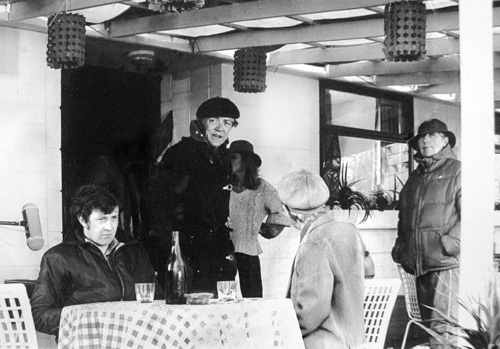
Pic. L-R: George Willoughby,Michael O’Herlihy, Joanna Pettet, Alexander Knox, and Josie MacAvin.
The above photo was taken by the then films stills photographer John Morris, husband of former Irish television presenter and artist MsThelma Mansfield. John Morris is the son of the late Michael Morris (1914–1999), [3rd Baron Killanin], and twin brother of Tipperary racehorse trainer and former professional jockey MrMichael “Mouse” Morris.
So lets take a closer look at those featured in the above picture, viewing left to right and starting with director Michael O’Herlihy.
Alongside his television work, Mr O’Herlihy also directed several films for Disney, such as ‘The Fighting Prince of Donegal’ (1966), ‘Mosby’s Marauders’ (1967), and ‘The One and Only, Genuine, Original Family Band’ (1968). His connection to ‘Star Trek’ endured long after his passing: in 2002, the Enterprise episode “First Flight” paid tribute to him by naming a fictional astronaut crew “O’Herlihy,” a nod to his direction of the original series episode “Tomorrow Is Yesterday,” which first mentioned the Earth–Saturn mission.
Mr O’Herlihy was the younger brother of Oscar-nominated actor Dan O’Herlihy. The former was married to Elizabeth Patricia O’Herlihy(née Ryan) a native of Thurles, Co. Tipperary, (a fact which we later discussed with me, during the making of Barbra Cartland’s ‘The Flame is Love’, when he discovered I had since moved to reside in Thurles, Co. Tipperary). I was given to understand that his wife Elizabeth O’Herlihy (nee Ryan), herself, a writer who contributed to the film “The Big Red One”, was from Thurles, connected to Ryan’s of the Brewery Store, whose home once resided at the junction of Mitchel Street and Kickham Street, facing unto Cathedral Street, Thurles.
Michael O’Herlihy sadly passed away in Dublin on June 16th 1997, at the age of 69, and was laid to rest in St Fintan’s Cemetery, Sutton, County Dublin.
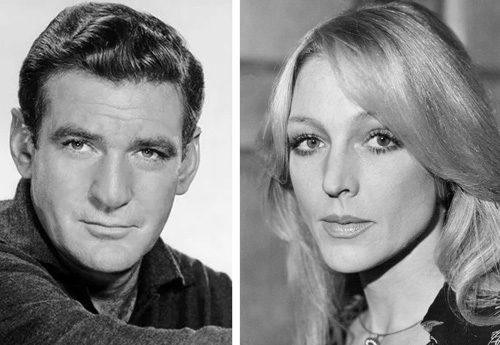
Left-right:Rod TaylorandJoanna Pettet.
Joanna Pettet: Actress Joanna Pettet, partially hidden in the picture, behind Director Michael O’Herlihy, was born in England in 1942, and enjoyed a versatile career in film and television during the 1960s and 1970s, appearing in projects such as ‘The Shuttered Room’ (1967) and ‘Petulia’ (1968). Known for her charm and poise on screen, Ms Pettet often took roles that highlighted her dramatic range and understated elegance, earning her recognition in both Hollywood and in British cinema.
Through the 1970s and 1980s, Ms Pettet made appearances on the television series ‘Harry O’; ‘Banacek’; ‘McCloud’; ‘Mannix’; ‘Police Woman’; ‘Knight Rider’; ‘Tales of the Unexpected’ (the UK series), ‘Cry of the Innocent’ and ‘Murder, She Wrote’. In 1984, she appeared as herself in a James Bond tribute episode of ‘The Fall Guy’ with ex-Bond girls Britt Ekland and Lana Wood.
It was in 1968, Ms Pettet married the American actor Alex Cord and gave birth to a son, Damien Zach. He was given the last name “Cord”, however, his biological father was British actor Terence Stamp. Ms Pettet and Cord were later divorced in 1989, after 21 years of marriage.
Ms Pettet was one of the last people to see actress Sharon Tate alive. She had visited Ms Tate, with her 10-month-old son, Damien Zachary at Tate’s Benedict Canyon home, for lunch, on the afternoon of August 8th, 1969. Later on that night, the pregnant Ms Tate and four others were brutally murdered by the Manson gang. This chilling brush with history is depicted in Quentin Tarantino’s 2019 film “Once Upon a Time… in Hollywood”, in which Ms Pettet is portrayed by Rumer Willis. The incident remains a striking moment in her life story, highlighting both her proximity to Hollywood history and the personal tragedies she endured.
Yet more tragedy was to follow. Her only child, the aforementioned Damien Zachary Cord, fell into a fatal coma, following an acute heroin overdose in 1995, at age 26 years.
She later became the caregiver and companion of her friend, actor Alan Bates, until his death from cancer in 2003.
In August 2021, Ms Pettet became trapped under a boulder for three hours, while collecting stones for her garden, near Anza, California. As a result, she required surgery to replace her shoulder and rotator cuff.
Alexander Knox: Alexander Knox(1907–1995)[pictured seated with back to the camera] was a Canadian actor, writer, and journalist. Active from the 1920s to the late 1980s, he appeared in more than 100 film, television, and stage productions. He received a Golden Globe and an Academy Award nomination for his portrayal of U.S. President Woodrow Wilson in “Wilson”(1944).
His career in the United States was limited during the McCarthy era (1950–1954), and he subsequently worked mainly in the United Kingdom. In addition to acting, Alexander Knox published several novels, often historical in theme, and contributed articles to newspapers and magazines. His later screen roles included the character of ‘Thornton Donegin’ in the film “Cry of the Innocent”.
His novels included ‘Night of the White Bear’(1971), a novel set in the Canadian Arctic; ‘Raider’s Moon’(1976), a historical novel also set in colonial Canada and ‘The Kidnapped Surgeon’ (1977), again, set in colonial times.
Josie MacAvin: Ms Josie MacAvin (1919 – 2005), was a physical education teacher, ballet dancer (Irish Ballet Club Gate Theatre 1943), set decorator, art director and costume designer. She won the Academy Award for Best Art Direction for ‘Out of Africa’ (1985). She was also nominated for her work on “Tom Jones”(1963) and “The Spy Who Came in from the Cold” (1965) and received a Primetime Emmy Award in Art Direction for “Scarlett”, latter a sequel to Margaret Mitchell’s 1936 novel ‘Gone with the Wind’, thus making her the only Irish designer to claim both honours.
Born in Dublin her credits include ‘Ryan’s Daughter’, ‘Educating Rita’, ‘Michael Collins’ and ‘The Butcher Boy’. Renowned for her meticulous design and collaborative approach, she frequently worked with directors such as Tony Richardson and John Huston.
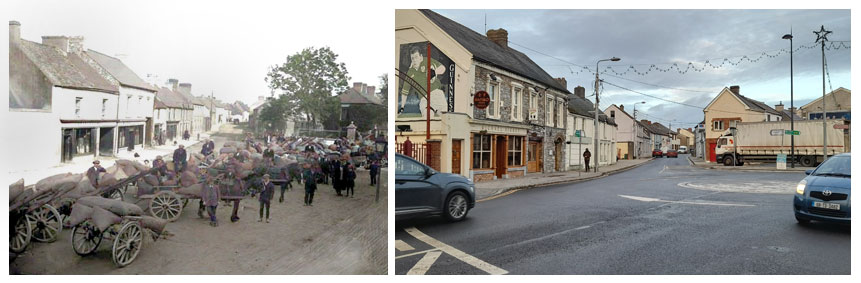
Cathedral Street, Thurles, (formerly East Main Street, Thurles), at the junction of (left – right) Mitchel Street(formerly Quarry Street); St. Mary’s Avenue(formerly Church Lane); and Kickham Street(formerly Pike Street or “The Pike”).
Picture left above shows farmers lining up to sell their wool to purchasers Ryan’s (Brewery Stores) on east Main Street Thurles. Picture right above shows East Main Street, today (December 30th 2020) renamed Cathedral Street, Thurles.
Sheep numbers grew significantly here in Ireland from some 2 million in 1848, towards the end of the Great Famine period; to 3.6m at the end of 2014. Land normally ploughed decreased almost by half within the same period, up until 1916, while land in pasture increased to double for grazing animals.
In hilly, mountainous areas, the selected breeds were prominently Blackface Mountain ewes and Cheviots, well able to survive on various and difficult terrains.
However, farmers, occupying the rich farmlands of Tipperary (Golden Vale), kept sheep for two main products, meat (mutton) and wool, thus reducing their dependence on the potato crop as their staple diet, towards the end of the 1800’s. Both mutton, wool and live sheep, in large numbers, were successfully exported to Britain.
Photograph on the left above was probably taken in the early years of 1900. The bright sunshine to the rear suggests the exposure was made mid-morning, towards the end of June when all sheep shearing was concluded. I base this observance on the fact that from June 1st in Tipperary, sheep were in the past, generally seen as ready to shear, with summer temperatures increasing.
The location of the top photo, as indeed all identical three pictures, can be found immediately east of Barry’s Bridge in Thurles, Co. Tipperary and was taken possibly sometime in the very late 1800’s
This street is known today as Cathedral Street, but back then, was identified as east Main Street; same being a continuation of Liberty Square, which was then west Main Street.
Barry’s Castle & Barry’s Bridge
But, firstly let us deal with the nearby Barry’s Bridge and Barry’s Castle, here in Thurles and how both acquired their names.
The names Barry’s Bridge & Barry’s Castle came about because of a major error made by an Ordinance Survey officer, latter involved in changing the names of certain Thurles streets and lanes; operating on behalf of the then Thurles Urban District Council. A local resident, named Thomas Barry, latter who was occupied as a ‘Nailor’, then resided at No. 92, just two doors up from the east side of the bridge; residing in a small building attached to and fronting unto today’s St Angela’s Academy of Music.
This Castle, referred to today as Barry’s Castle, has dominated the Thurles skyline since 1453, and was built possibly by the Norman invader McRickard Butler, of whom history records that he erected two castles at Thurles, around the aforementioned year. The bridge referred to as Barry’s Bridge was built three hundred and seventy years later, circa 1650, and was partially reconstructed again, circa 1820.
Perhaps it is time again to rededicate both these ancient structures, naming them Butler’s Bridge and Butler’s Castle, after our Liberty Square eventually gets upgraded. Same should be undertaken in an effort to encourage neglected tourism, and the rapidly fading town centre footfall.
Despite constant promises made by individuals, who put themselves forward for both local and national elections, proper tourism marketing plans have been strongly resisted, and only lip service, not backed by deeds are being offered; in the case of a town, whose past history should be the envy of Europe.
Cathedral Street, Thurles
While many will look at the top picture and state that little has changed over the years, this of course is not the true case.
Reading the picture from left to right note the changes: –
The Ursuline Convent brick wall was moved back and replaced by today’s visable stone. The front side gate, once positioned immediately to the left, has also been removed and the wall moved back.
The two, one-story houses immediately east of the Cathedral’s main gateway are also gone. The first house, at No. 87 Main Street, was once occupied by Mathew Cahill, a Baker by trade, while next door, No. 86, was a Public House, once occupied by Daniel Maher. Both houses today are gone, replaced by the front lawn of the current Archbishop’s residence.
Unseen in the picture, but eastward again, beside these latter two named houses, once existed Chapel Lane, leading up to the rear of the Archbishop’s Palace. Here in this lane was erected at the top was the Archbichop’s stables; with a school for girls at No. 2. Andrew Cahill, the Archbishops servant, resided at No. 4; Thomas Dowling resided at No.5 and Widow Ryan resided in a thatched residence at No. 6. These tiny dwellings have today been erased and form the present driveway to the back door of the Archbishops Palace.
The next major change to this street is the removal of the high wall and arched entrance in front of the Presentation Convent, the pavement outside displaying just one Gas Light. During the “Night of the Big Wind” (Oiche na Gaoithe Moire, feast of the Epiphany, 1839) the once thatched roofed row of six terraced houses, numbered 80 to 85, caught fire, when thatch was blown down one of the chimneys. These six ruined dwellings, which included No. 85 – Ryan’s Bakery; No. 84 – Ms Lucy Dohan’s home; No. 83 – Tierney’s Hucksters Shop; No. 82 – Clear’s Grocery and Bakery; No. 81 – Ryan’s Grocery, Spirits & Candle business and No. 80 – Headon’s Shoemaker’s premises, were later acquired by the Presentation Convent, who in 1862 would replace them, to build their Secondary School Boarding House, and the faintly pictured, yet visible high wall; latter no longer evident today and replaced by a lower wall and railings.
Obviously, missing today, centre of the picture and positioned at the junction of Quarry Street [today Mitchel Street], between Church Lane and Pike Street [today Kickham Street], was O’Keeffe’s Brewery; later to become Ryan’s Brewery Stores. Same residence, large buildings together with enclosed yard have now been replaced by shops and the Circle K petrol station.
Occupation ‘Nailor‘: A nailor, as the name suggests, was occupied making iron nails by hand and / or also occupied maintained the teeth on carding machines, latter used to separate and straighten wool & cotton before weaving. Names such as ‘rose’; ‘diamond’; ‘clasp’; ‘pearl’ and ‘sunken’; identified to any consumer the shape of the nail head, while their points were identified as ‘flat’; ‘sharp’; ‘needle’ or ‘spear’. The names; ‘bastard’; ‘strong’ and ‘fine’, readily described the thickness of any nail required.
Occupation ‘Huckster‘: A ‘Huckster’ was a person who sold small articles, either travelling door-to-door or from a market stall or small store; todays ‘Hawker’ or ‘Peddler’. The word today, when expressed, is usually spoken in derogatory terms, thus expressing negative connotation.
A complete planning application will now be lodged with Tipperary Co. Council, for the redevelopment of the Cashel Palace Hotel, latter a historic landmark since its erection in the early 1700’s.
Historic Cashel Palace Hotel.
Guinness porter of course was first accidentally conceived in the early to mid 1700’s at the now Cashel Palace Hotel, then the palace of Archbishop Arthur Price (1678 – 1752) Church of Ireland Archbishop of Cashel from 1744 until his death. Estate manager and father to Arthur Guinness Richard Guinness, was in charge of supervising the brewing of beer for the estates employees on the Price estate.
Supplying beer to employees at that time was considered part of their weekly wage entitlement. A servant was dispatched from the estate to purchase and convey the necessary beer making materials from Ryan’s brewery stores here in Main Street, Thurles, (today Kickham Street Thurles). During the later brewing process back in Cashel, some of these ingredients, barley possibly, was accidentally over heated in error, in fact roasted until virtually black, thus giving a unique burnt flavour to the beer and known to us today as Porters Ale or Guinness Porter and described then by the Archbishop himself as being “a brew of a very palatable nature.”
The historic Cashel Palace Hotel situated at Main Street, Cashel on some 28 acres of ground, closed its doors without warning with the loss of some 30 permanent jobs in December 2014 last. A resale of the building was concluded in late 2015 and announced in February 2016 by purchasers Trevester Ltd; a joint venture between the Magnier family of Coolmore Stud and other International investors.
A recognised workforce has been put in place to undertake the redevelopment under the leadership of project manager Trish Conroy, including award-winning and internationally respected architects Reardon Smith and heritage experts from Consarc Design Group Ltd, one of the largest architectural practices in Ireland.
It is widely speculated that some 40 new bedrooms, two new restaurants, a new spa together with a function room to hold some 175 people, will now be included in this completed planning application. The initial construction phase is expected to involve some 100 people working on the project, taking up to between 18 to 24 months to fully complete the required work. On its completion the hotel is expected to employ a minimum of 40 full-time professional staff, together with some 100 part time casual employees on a regular basis, by late 2019.
This same group of investors also acquired the famous Cashel pub known as ‘Mikey Ryan’s,’ latter which is adjacent to the existing hotel gardens, and with refurbishment work here already under way, same should be all set to reopen this summer, employing a further 20 to 25 professional staff.
This completed planning proposal should also see the delivery of a 3-acre town park, as already set out in the Cashel Development Plan which would further enable the reinstatement of the famed Bishop’s walk, allowing connectivity between the Rock of Cashel and the historic town centre.
Locally this news will be warmly received by Cashel residents who look forward to this project making an enormous contribution to local tourism and the overall economic life of historic Cashel; a town where, in a fifth-century a Romeo-British Christian missionary and bishop named Saint Patrick once preached at the royal hill, converting king Aengus, latter a member of the Tuatha Dé Danann and probably a god of love, youth and poetic inspiration.
The Royal College of Physicians Ireland (RCPI) have launched a scathing attack on Arthur’s Day, organised by Diageo, latter to supposedly celebrate the anniversary of the Guinness brewing company.
To this end RCPI have organised a public discussion aimed at highlighting the dangerous side of alcohol and to further underscore their concerns that alcohol related illnesses in Ireland have now reached epidemic proportions.
Dr Stephen Stewart a Liver Disease Specialist, together with Child and Adolescent Psychiatrist Dr Bobby Smyth will speak at this event tomorrow evening, with the Chairperson of the RCPI’s policy group on alcohol, Professor Frank Murray opening the meeting.
The RCPI claim that deaths relating to cirrhosis of the liver have doubled between 1994 and 2008, and that hospital admissions for alcoholic liver disease has almost doubled between 1995 and 2007. The RCPI also claim that increasing numbers of young people are dying from alcohol related illnesses due to alcohol substances being more affordable than ever, being more acceptable than ever and being more available than ever. (A pint of Guinness in Dublin is €0.70 cheaper than in Thurles.)
The RCPI debate will take place at 6:00pm tomorrow Monday, at the college’s headquarters on Kildare Street, Dublin, and will wave the banner “Join the National Conversation on Alcohol: Who’s calling the shots.”
Diageo is not aware yet, but Guinness porter of course was first accidentally conceived in the early to mid 1700’s at the Palace of Archbishop Price, here in Cashel, Co Tipperary, now known as the Cashel Palace Hotel. Estate manager and Arthur’s father, Richard Guinness, was in charge of supervising the brewing of beer for the estates employees on the Archbishop Price estate. Supplying beer to employees at that time was considered part of their weekly entitlement. A servant was dispatched from the estate to purchase and convey the necessary beer making materials from Ryan’s brewery stores here in Main Street, Thurles, latter now known as Cathedral Street. (Time for Urban Councillors to erect another Memorial Plaque in St Mary’s Graveyard perhaps.)
In the brewing process, later back in Cashel, some of these ingredients, barley possibly, was accidentally over heated in error, in fact roasted until virtually black, thus giving that unique burnt flavour known to us today as porters ale or Guinness porter and described by the then Archbishop as being “a brew of a very palatable nature.”
It is not too long ago in Ireland that pregnant women were told to drink a glass of Guinness every day to fortify themselves and their baby. Indeed US scientists in the state of Wisconsinin in 2011 gave Guinness to dogs who had narrowed arteries. They found that Guinness worked as well as aspirin in preventing clots forming. They believe that antioxidant compounds in Guinness are responsible for these health benefits because they decrease harmful cholesterol gathering on artery walls. But then what do I know?
Still this National Conversation on Alcohol could now lead to the start of Fine Gael and Labour’s promised two year Dáil Reforms, with Mr Enda Kenny closing the Dáil Bar instead of the Senate. (Possible new Logo for those opposed to Irish Senate closure. “Close The Bar Not Our Senate.”)
(Just a thought, sure you never know, Mr Enda Kenny and Minister for Health Dr James Reilly could decide to lead by example, instead of their “Do as we say, not as we do,” current philosophy.)
Support Us
Help keep Thurles.info online by donating below. Thank you.
This website uses cookies to improve your experience. We'll assume you're ok with this, but you can opt-out if you wish.AcceptRead More
Privacy & Cookies Policy
Privacy Overview
This website uses cookies to improve your experience while you navigate through the website. Out of these, the cookies that are categorized as necessary are stored on your browser as they are essential for the working of basic functionalities of the website. We also use third-party cookies that help us analyze and understand how you use this website. These cookies will be stored in your browser only with your consent. You also have the option to opt-out of these cookies. But opting out of some of these cookies may affect your browsing experience.
Necessary cookies are absolutely essential for the website to function properly. This category only includes cookies that ensures basic functionalities and security features of the website. These cookies do not store any personal information.
Any cookies that may not be particularly necessary for the website to function and is used specifically to collect user personal data via analytics, ads, other embedded contents are termed as non-necessary cookies. It is mandatory to procure user consent prior to running these cookies on your website.





Recent Comments