There is an important ocean current called the AMOC, the Atlantic Meridional Overturning Circulation.
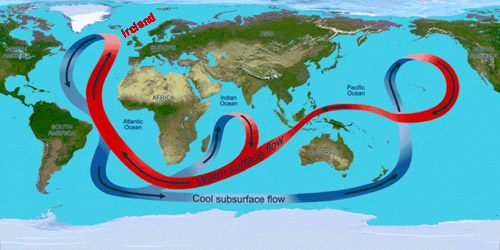
The AMOC includes Atlantic currents at the surface and at great depths that are driven by changes in weather, temperature and salinity (latter the measure of the concentration of dissolved salts, such as sodium chloride, magnesium, sulfate, and calcium, in a body of water). Those currents comprise half of the global thermohaline circulation or “Global Conveyor Belt,”, [See Image hereunder], that includes the flow of major ocean currents, the other half being the Southern Ocean overturning circulation.
Think of it as a huge system of moving water in the Atlantic Ocean. It carries warm water north and colder water south. This movement helps shape the climate of Europe and influences rainfall and weather far beyond the Atlantic.
Scientists are watching an unusual area of cooler water south of Greenland. It is sometimes called the “Cold Blob” or North Atlantic Warming Hole.
While much of the world is getting warmer, this part of the North Atlantic has not warmed as quickly and has sometimes cooled. Scientists believe changes in the AMOC are one important reason.
Why is this happening?
Greenland is losing enormous amounts of ice as the climate warms. Between 2002 and 2023, Greenland lost about 270 billion tonnes of ice each year on average.
When this freshwater enters the North Atlantic, it can make the ocean water less salty and less dense. Along with warmer ocean temperatures, this can make it harder for the normal overturning circulation to work as strongly.
Is the AMOC already collapsing?
No. Scientists do not currently know that an AMOC collapse is happening or about to happen. But scientists are confident that the AMOC is expected to weaken during this century as the planet continues to warm. A complete collapse before 2100 is considered less likely, but it cannot be completely ruled out.
Why should we care?
A major weakening of the AMOC could change weather patterns across large parts of the world.
It could affect:
- Temperatures and weather in Europe.
- Rainfall in Africa, Asia and the Americas.
- Farming and food production.
- Sea levels around parts of the Atlantic.
- Marine life and ocean ecosystems.
A complete collapse would cause much bigger changes, including major shifts in rainfall and regional climate.
The important message is the “Cold Blob” does not mean disaster is certain. But it is one of several important changes scientists are carefully watching in the North Atlantic.
Our oceans are connected. What happens around Greenland and in the Atlantic can affect climate and rainfall thousands of kilometres away. The main long-term pressure on this system is human-caused global warming.
Reducing greenhouse gas emissions lowers the amount of future warming, and reduces the risk of large, dangerous changes to our oceans and climate.
Awareness matters. Facts matter. And what we do now still matters.





Leave a Reply