An Coimisiún Pleanála’s decision to push back its ruling on Uisce Éireann’s massive Shannon water abstraction project is not just a planning delay. From a Tipperary perspective, it is a crucial breathing space.
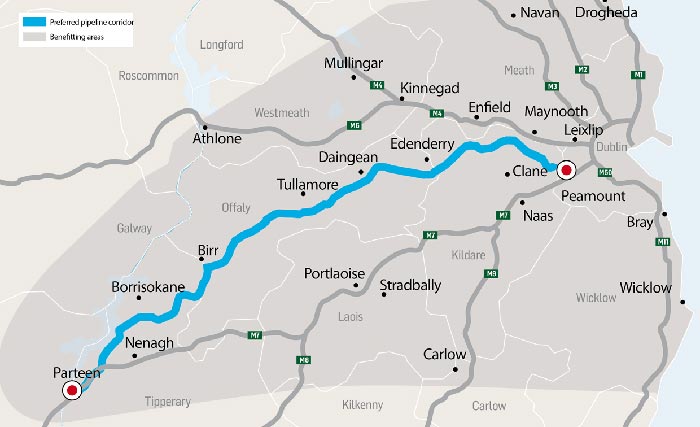
The proposed Water Supply Project for the Eastern and Midlands Region would see more than 300 million litres of water a day abstracted from the River Shannon at Parteen Basin, below Lough Derg, before being treated and piped across the country to serve the Midlands, the east and the Greater Dublin Area. It has been described as the largest water infrastructure project in the history of the State, with estimated costs in the region of €4.6 billion to €5.9 billion.
For communities in north Tipperary, this is not an abstract national infrastructure debate. The intake point is at Parteen Basin, and the project includes a major treatment plant close to the extraction point in Co Tipperary. That means local people are being asked to host the front end of a project whose main benefits will be felt far away, particularly in Dublin and the wider eastern region.
Uisce Éireann argues that the project is critical to providing a safe, secure and resilient water supply for up to 50% of the State’s population. It says planning permission has been lodged with An Coimisiún Pleanála and that the project is central to future housing, population growth and economic development. Those are serious national objectives, and nobody in Tipperary should dismiss the need for proper water planning.
But a project of this scale cannot be waved through simply because Dublin needs water. The Shannon is not just a line on an engineering map. It is an ecological, recreational, economic and cultural resource for Tipperary, Clare, Limerick, Galway, Offaly and many other communities along its course. Any long-term abstraction must be judged not only by what it delivers to the east, but by what it risks taking from the west and midlands.
The fact that 114 submissions have been made to An Coimisiún Pleanála shows the level of public concern. Environmental groups have warned about climate, ecological and sustainability risks, while business groups have urged approval on the basis of security of supply. That divide is exactly why the Commission is right to take more time.
The new decision deadline, now expected before July 2nd 2027, should be used properly. It should not become a procedural pause while the same assumptions remain in place. It must allow for deeper scrutiny of the project’s environmental impact, climate resilience, cost, alternatives, local consequences and long-term governance.
Tipperary needs clear answers. How will Lough Derg and the lower Shannon be protected during drought conditions? What guarantees will there be that abstraction levels will not damage habitats, fisheries, tourism or water quality? What permanent benefits will host communities receive? How will local voices be represented after construction begins? And what happens if the project costs rise beyond current estimates?
There must also be a fairer national conversation about water conservation. Before rural and regional communities are asked to carry the burden of supplying the east, the State must show that leakage reduction, demand management, rainwater harvesting, wastewater reuse and sustainable urban planning have been pursued with real urgency.
This delay is therefore welcome, not because Ireland does not need infrastructure, but because infrastructure must be done right. Tipperary should not be treated as the convenient source for a Dublin solution. The county has a legitimate stake in the future of the Shannon and deserves more than reassurances.
An Coimisiún Pleanála now has time to examine the evidence fully. Uisce Éireann has time to answer local concerns openly. Government has time to prove that this is part of a balanced national water strategy, not simply another example of regional resources being redirected towards the capital.
The Shannon belongs to the communities who live with it every day as much as it belongs to the State. If this project is to proceed, Tipperary must be heard, protected and respected from the very start.





If Ibhrahim Traore can bring/pipe water thousands of miles from the Sea, often through hostile communities, to the people of Burkina Faso, then Dublin should be able to do the same, with the SEA beside them, to give Dublin all the water they need, the cost of treating the Water(water from Shannon has to be treated also) is far less than piping the water from the Shannon, and no damage/in convenience to all the People from the Limerick (through Communities and Farmland) right into Dublin. One should question Uisce Eireann is the real reason they will not take Water from the Sea beside them IS THEY HAVE SO MUCH SEWAGE BEEN PUMPED INTO THE SEA AT DUBLIN. The costing of 4.5 to 5 billion Euros is a “Mickey Mouse” figures, just to pretend/convince the people. In fact 20 billion Euros and more before a drop of water hits the LEAKING PIPES THROUGHOUT DUBLIN. Time for commonsense to kick in. The wasted millions of Euros so far on this mad idea is already a sin.