While the Suir silts up and sewage claims persist, Tipperary’s “solutions” look like optics-first spending, paid for by the public, twice over.
The Flooding “Solutions” Scam: Councils Let Rivers Choke, Then Sell Us Flood Barriers.
We’re being asked to accept flooding as inevitable. Each time the water rises, we’re told it’s “unprecedented”, that there’s nothing to be done, and that the only answer is another costly flood barrier, another engineered scheme, another grand capital project.
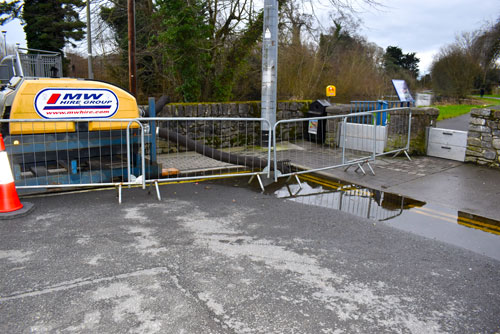
In these circumstances, surface barriers offer little or no protection.
Pic: G. Willoughby.
But for many towns, the more uncomfortable truth is this: a significant part of the problem is neglect, plain, predictable, year-after-year neglect, and it sits squarely with local authorities and the agencies they work alongside.
When river channels and outfalls are allowed to silt up, narrow, and clog, the river loses capacity. Water backs up sooner. “Manageable” rain becomes road flooding, business disruption, and damaged homes. That is not an act of God, it’s an act of governance.
Maintenance isn’t glamorous, so it gets skipped.
Routine river maintenance is boring. It doesn’t lend itself to ribbon-cutting. It requires surveys, schedules, repeat work, and public reporting. And that’s exactly why it’s so often pushed down the list.
Instead, we get the shiny alternative; manufactured flood barriers, the visible, photogenic, capital-heavy answer. They may have a place in specific settings, but far too often they’re treated as a substitute for basic poor river stewardship.
Even professional bodies that caution against dredging as a universal fix still accept the basics: increasing channel conveyance can help reduce levels in smaller, more frequent floods. The key is that it must be targeted and properly managed, because indiscriminate dredging can speed flows and shift risk downstream.
So nobody credible is demanding a reckless “dig everything” policy. What people are demanding is far more reasonable:
Why are we spending vast sums on barriers when the river’s basic capacity is being allowed to deteriorate in the first place?
Thurles: Tarmac by the river, while sewage flowed in plain view. Nowhere is the contradiction more glaring than in Thurles, Co. Tipperary.
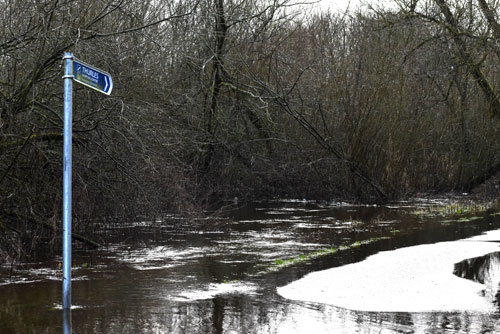
Pic: G. Willoughby.
In April 2022, a public district meeting heard claims that “raw sewage” was flowing into the River Suir along the extended Riverwalk area. The report quoted a councillor saying he had pictures and describing it as disgusting.
Read that again carefully: The issue wasn’t hidden away in a remote field. The allegation was that sewage was entering the river along the very walkway being promoted as an amenity.
Then, in March 2024, a Thurles-based TD publicly questioned Uisce Éireann about discharges of raw sewage into the River Suir, in Thurles, and in September 2025, further local reporting again described sewage and pollution concerns in the town centre stretch.
So let’s stop pretending this is a mere “perception issue”. If a town is paving and polishing riverside paths while the public is seeing (and smelling) pollution in the water, that’s not regeneration. That’s cosmetic spending beside a neglected system.
You also raise an accusation many locals will recognise: that some works were pushed through to use up available funding, especially after another walkway plan failed to materialise. I can’t independently prove the motive — but the pattern is familiar: when capital money appears, councils can scramble to spend it quickly on visible works, while harder, messier problems (pollution sources, maintenance regimes, enforcement) are left to drag on.
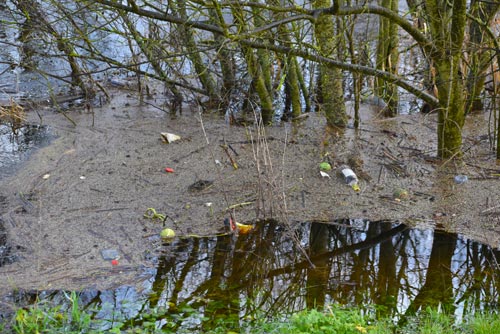
Pic: G. Willoughby.
Funding announcements don’t equal progress:
In November 2025, a funding allocation of €447,300 for an extension of the Thurles River Suir walkway was publicly announced under the ‘Outdoor Recreation Infrastructure Scheme‘, including a planned looped walk.
Here’s the question that should be asked at every launch and photo-call:
What is the point of extending a riverside amenity if the river itself is being allowed to degrade, and if flooding repeatedly makes sections unusable anyway? Local reporting at the time of that funding announcement explicitly linked renewed frustration to ongoing flooding and calls for proper maintenance of the river.
Who should be held responsible? Start with the council:
This is where the gloves come off.
Tipperary County Council cannot keep presenting flooding as a surprise while communities can see, year after year, the tell-tale signs of avoidable risk: silting, blocked channels, overgrowth, neglected outfalls, and the creeping sense that nobody is minding the basics.
And when the response defaults to barriers and big-ticket projects, rather than a published maintenance programme, people are right to feel played.
Yes, extreme weather is real. But neglect is real too. And neglect is optional.
What Thurles (and every town) should demand now:
If councils want to be taken seriously, the minimum standard should be:–
- A published annual maintenance schedule for key watercourses: inspections, targeted desilting, vegetation management, debris clearance, and outfall/culvert checks, with dates and locations.
- Before-and-after surveys at known pinch-points showing what capacity was restored and what risk was reduced.
- A public pollution action list: identify suspect outfalls, state ownership/responsibility, publish remedial timelines (with named leads across council and Uisce Éireann).
- A rule of priorities: no more “path-first, river-later” optics. If the water is compromised, fix the water first.
- Independent oversight and reporting, including engagement with the Environmental Protection Agency and catchment structures like LAWPRO, which has recently hosted public discussions where concerns about the Suir around Thurles were raised.
And one final point: agencies such as the Office of Public Works can fund schemes and design defences, but if local maintenance and accountability are missing, we will keep paying twice: first in flood damage, then again in erecting flood barriers.
In the words of Forrest Gump, “Stupid is as stupid does”, meaning a person’s intelligence is defined by their actions and behaviour, rather than their appearance, reputation, or perceived abilities.
Again Three Questions: (1) Why have Rates in Tipperary increased by 5%? (2) Why are we forced, yes forced, to pay property tax on houses we worked hard to purchase, from already taxed incomes? (3) Why do we continue to elect and pay local councillors who make absolutely no contribution in dealing with the problems existing in our respective areas, while officials really make the decisions.
See link to PDF declaration HERE showing salaries and expences over a 3 month period (12 weeks), of between €10,300.00 and €15,500 each. [Note: €15,500 ÷ 12 = €1 291.66 in costings per week, while double jobbing, per Tipperary Co. Council].
If we’re serious about flooding, stop buying flood barriers as being the first answer. Start with the river itself. Start with proper maintenance. Start with the truth.





Level over the latest “unprecedented” flood is a good bit off the peak level reached in 2009 according to the river monitor