Something is deeply wrong, when Ireland tolerates terrorist symbols but ignores the murder of Private Seán Rooney.
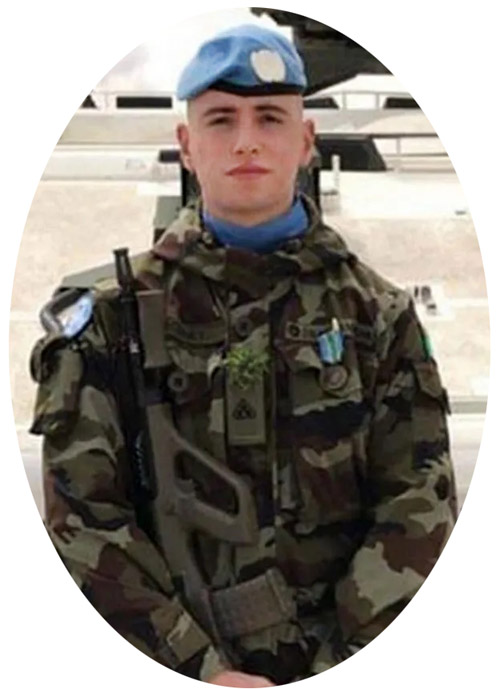
Private Seán Rooney was not a politician, activist or a celebrity; he belonged to a far higher order of human achievement and character. He was a 24-year-old Irish soldier from Donegal serving his country on a United Nations peacekeeping mission in Lebanon. By all accounts he was courageous, decent and deeply committed to protecting his fellow soldiers.
Private Seán Rooney, Irish Soldier Murdered by Hezbollah in Lebanon.
On December 14th 2022, just 11 days before Christmas, while travelling in a clearly marked UN vehicle near the Hezbollah stronghold of Al-Aqbiya, Private Seán Rooney and his colleagues came under sustained gunfire from Hezbollah-linked attackers. Seán, sadly, was killed trying to protect his comrades, while another Irish soldier was seriously injured.
The aftermath of this event has been a grotesque insult to his family and indeed to the Island of Ireland itself. The main suspect, Hezbollah member Mohammad Ayyad, was eventually convicted and sentenced in his absence after repeatedly avoiding court appearances. He still remains at large today, after previously being released on “medical grounds.” Meanwhile, others involved received sentences so absurdly lenient that even the Irish Government publicly condemned them as unacceptable. Private Seán Rooney’s mother correctly described the process as a “sham trial” and said justice had neither been done nor even seen to be done.
While Seán Rooney’s family continue to fight for accountability, Ireland has witnessed crowds marching openly through Dublin and Cork waving Hezbollah and Hamas flags, latter organisations synonymous with sectarian violence, terrorism, hostage-taking and the murder of civilians.
Perhaps nothing captures the moral confusion of our modern-day Ireland more than the sight of Irish Tricolours being waved beside Hezbollah and Hamas flags on the streets of Dublin and Cork, as though the values represented by our national flag are somehow compatible with organisations linked to terrorism, sectarian hatred and the murder of an Irish peacekeeper, Private Seán Rooney.
For Seán Rooney’s family, and for many decent Irish people, that image is not “solidarity” or “activism.” It is a profound national disgrace and an insult to the memory of a young Irish soldier who died serving under the UN flag at the hands of Hezbollah-linked gunmen.
What is truly repellent is not only that these flags appear, but that so many so-called and self-appointed champions of “human rights” refuse to condemn them. Many politicians, activists and celebrity figures appear far more interested in performative anti-Israel activism than in showing even basic solidarity with the family of an Irish peacekeeper, murdered by extremists, linked to Hezbollah. That silence is not moral courage; it is moral bankruptcy.
Jerome Lawrence rightly warned in his 1955 play, “Inherit the Wind”, that: “Fanaticism and ignorance is forever busy, and needs feeding.”
That is exactly what we are witnessing today. Fanaticism survives when hatred becomes fashionable, when ideological tribalism replaces moral consistency, and when people excuse or romanticise violent extremism because it aligns with their political worldview. Bigotry is not confined to race or religion; it also includes the irrational hatred and dehumanisation of anyone considered politically inconvenient, including Israelis, Jews, or even Irish soldiers whose deaths disrupt a preferred narrative.
Supporting innocent Palestinians does not require anyone to glorify Hamas or Hezbollah. But too many people in Ireland have crossed that line. They excuse terrorist symbolism, ignore antisemitism when it comes disguised as activism, and remain conspicuously silent about the murder of Private Seán Rooney because acknowledging it would force them to confront uncomfortable truths about the movements they openly, through ignorance, tolerate.
The Rooney family deserved national outrage, unity and relentless demands for justice. Instead, they got evasions, hypocrisy and silence from people who claim to stand against violence and extremism; latter a disgrace on modern Ireland.
Pre-deceased by her husband Billy, her parents Billy and Annie, brothers Danny and Paddy; Mrs Morris, passed away peacefully at her place of ordinary residence, while in the loving care of her family.
Her passing is most deeply regretted, sadly missed and lovingly remembered by her sorrowing family; daughters Ann, Marian (Fogarty), Leisha (Quinn), Bernie, Sue (Quinn) and son Richard, sons-in-law Michael and Ger, Ann’s partner Paddy, daughter-in-law Marie, grandchildren, great grandchildren, sisters Mary, Ann and Peggy, brothers Joe and Marty, sisters-in-law, brothers-in-law, nieces, nephews, extended relatives, neighbours and many friends.
Requiescat in Pace.
Funeral Arrangements.
The earthly remains of Mrs Morris will repose at her place of residence(Eircode E41 DW92) on Tuesday afternoon next, May 19th, from 5:00pm until 7:00pm same evening. Her funeral cortège will be received into the Church of Our Lady and St. Kevin, Littleton, Thurles, (Eircode E41 HD90), on Wednesday morning May 20th, at 10:40am, to further repose for Funeral Mass at 11:00am, followed by interment, immediately afterwards, in the adjoining graveyard.
For those persons who would wish to attend Requiem Mass for Mrs Morris, but for reasons cannot, same can be viewed streamed live online, HERE.
The extended Morris and Graham families wish to express their appreciation for your understanding at this difficult time, and have made arrangements for those persons wishing to send messages of condolence, to use the link shown HERE.
§The family of Mrs Morris would like to express their sincere thanks to the Palliative Care Team for their exceptional care and to Dr. Liam Meagher (Killenaule) and Carmel and Staff at Sammon’s Pharmacy for their care and kindness.§
RTÉ is once again at the centre of controversy after new figures revealed that more than 200 people at the broadcaster were earning over €100,000 a year by the end of 2025, including 18 individuals paid more than €200,000 annually.
This latest revelation lands after years of scandals involving hidden payments, secret commercial deals, undisclosed barter accounts, and repeated failures in transparency from Ireland’s national broadcaster.
The public was already furious after the 2023 payments scandal exposed how RTÉ had understated presenter earnings, while continuing to demand television licence payments from ordinary households struggling through a cost-of-living crisis. Trust in the organisation collapsed, senior executives resigned, and multiple government and committee investigations followed.
Yet despite the outrage, RTÉ has continued to rely heavily on taxpayer support.
In recent years, the broadcaster has effectively received two major state financial rescue packages funded by the public: ► A €725 million annual public funding model through licence fees and state support. ► An additional government-backed financial bailout package worth hundreds of millions aimed at stabilising RTÉ after the payments scandal and declining revenues.
At the same time, licence fee inspectors continued pursuing households across Ireland for non-payment, even as questions mounted over excessive salaries, waste, governance failures, and opaque contractor arrangements inside the organisation.
In Ireland, thousands of people have been prosecuted over non-payment of TV licences, but only a relatively small number have actually been jailed.
Historically; in 2012, there were about 11,500 prosecutions for TV licence non-payment. Of those convicted, 242 people were jailed, though most were imprisoned only for a few hours and six overnight. In 2008, 49 people were jailed over licence-related fines. Between 1973 and 1993, at least 15 people were imprisoned during a civil disobedience campaign linked to Irish-language broadcasting activism. More recently, prosecutions and convictions have declined sharply after the RTÉ payments scandal damaged public trust: Irish courts dealt with 7,263 prosecutions in 2022, falling to 6,555 in 2023. Nearly 15,000 court summonses were issued in 2022 alone for non-payment. Convictions for non-payment reportedly fell by around 30% over recent years amid the fallout from RTÉ controversies.
People are generally not jailed directly for “not having a licence” itself, but for failing to pay court-imposed fines after conviction. Fines can reach up to €1,000 for a first offence.
The newest figures also show nearly 1,300 people received between €50,000 and €100,000 from RTÉ in 2025, while thousands more contributors were classified as contractors.
Meanwhile, viewers and taxpayers are still asking the same unanswered question: How can RTÉ continue demanding mandatory licence fee payments from the public while repeatedly failing basic standards of transparency and accountability with public money?
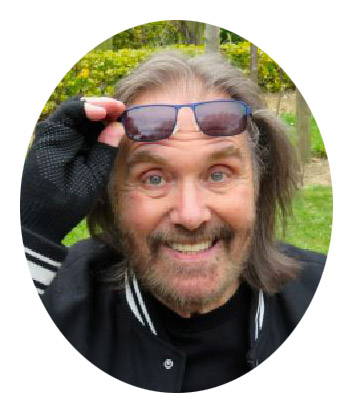
The music world has lost yet another legendary voice. Dennis Locorriere, the longtime frontman and founding member of Dr. Hook, has passed away at the age of 76, following a battle with kidney disease.
Late Dennis Locorriere R.I.P.
Before the huge chart success and unforgettable singalong hits, Dennis Locorriere gave Dr. Hook one of their most heartfelt performances with ‘Only Sixteen‘; a tender remake of the classic Sam Cooke song that became a worldwide hit for the band in the mid-70s. With Dennis’s unmistakable voice full of warmth, emotion, and honesty, the song captured the innocence and heartbreak of young love in a way only he could. Decades later, it remains one of the defining songs of Dr. Hook’s legacy and a reminder of the timeless talent Dennis brought to every performance.
Best known for other timeless hits including ‘When You’re in Love with a Beautiful Woman‘, ‘Sharing the Night Together‘, and ‘Sylvia’s Mother‘, Dennis helped define the sound of 1970s soft rock and country-pop, alongside bandmate the late Ray Sawyer.
According to his management, Mr Locorriere died peacefully yesterday May 16th 2026, surrounded by family and loved ones, after facing his illness with “strength, dignity, and resilience.”
Born in Union City, Mr Locorriere enjoyed a career that spanned almost six decades, recording more than 18 albums and continuing to perform long after Dr. Hook’s chart success. He had also made the UK his home for more than two decades. Though his voice may now be silent, the songs he gave the world will continue to live on for many generations.
New figures released by the Department of Justice and An Garda Síochána show that the number of Garda members assigned to Roads Policing Units has fallen by almost 40% since 2009. The total number of specialist personnel dropped from 1,046 to 645 by March this year; a reduction of 401 officers dedicated to policing Irish roads.
Dublin experienced some of the steepest declines, with roads policing numbers nearly halving over the period. One Dublin division recorded a 59% drop, leaving just 11 specialist Gardaí and two road policing vehicles covering the area.
Other regions also saw significant reductions, including Sligo/Leitrim, where staffing levels fell from 34 officers to 14. Limerick was the only area to record a slight increase in personnel since 2009.
Road safety advocacy groups described the falling numbers as deeply concerning, warning that reduced enforcement capacity impacts road safety efforts nationwide. Campaigners said roads policing units are struggling due to limited resources and staffing pressures, and believe enforcement on Irish roads has been weakened at a time when offences are increasing. Recent figures show that more than 211,000 vehicles on Irish roads were uninsured or unregistered last year, roughly one in every 15 vehicles nationwide. Despite Gardaí carrying out over one million vehicle checks during the first three months of 2026, more than 5,000 vehicles were still seized for having no insurance during that short period alone. Thousands of additional summonses were also issued.
In response, An Garda Síochána stated that all Garda members contribute to road traffic enforcement, including those outside dedicated Roads Policing Units. According to the organisation, non-specialist personnel accounted for a majority of DUI detections, vehicle detentions, and checkpoints carried out last year.
The force also said there is no policy aimed at reducing roads policing numbers and noted that more than 80 new members have been assigned to roads policing duties over the past 18 months. However, Garda management acknowledged that staffing increases have not yet delivered the “significant uplift” desired in roads policing capacity
This website uses cookies to improve your experience. We'll assume you're ok with this, but you can opt-out if you wish.AcceptRead More
Privacy & Cookies Policy
Privacy Overview
This website uses cookies to improve your experience while you navigate through the website. Out of these, the cookies that are categorized as necessary are stored on your browser as they are essential for the working of basic functionalities of the website. We also use third-party cookies that help us analyze and understand how you use this website. These cookies will be stored in your browser only with your consent. You also have the option to opt-out of these cookies. But opting out of some of these cookies may affect your browsing experience.
Necessary cookies are absolutely essential for the website to function properly. This category only includes cookies that ensures basic functionalities and security features of the website. These cookies do not store any personal information.
Any cookies that may not be particularly necessary for the website to function and is used specifically to collect user personal data via analytics, ads, other embedded contents are termed as non-necessary cookies. It is mandatory to procure user consent prior to running these cookies on your website.








Recent Comments