The controversy around Ireland’s scheduled football fixtures against Israel in 2026 is real, serious and understandable. People are entitled to strong political and moral views. They are entitled to protest, to criticise governments, to question sporting bodies, and to demand consistency from international organisations. But there is still an important principle worth defending: where possible, politics and sport should be kept separate.
That does not mean sport exists in a fantasy world, untouched by history or suffering. It plainly does not. Ireland knows that better than most.
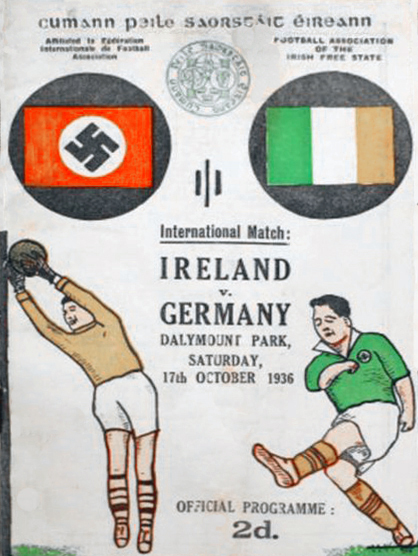
In October 1936, Ireland played Germany at Dalymount Park, at a time when Hitler’s regime was already in power. The German team gave the Nazi salute before the match. Looking back now, the images are deeply uncomfortable. Yet the match itself has also survived in Irish football memory as a sporting occasion, with Ireland winning 5–2, and the players on the pitch did what players are supposed to do; – they played football.
That example does not excuse the politics of the time. It does not make the symbolism harmless. But it does show the danger of making every football match a referendum on world affairs. Once we insist that teams may only play countries whose governments we approve of, sport becomes impossible to organise fairly. The rule will always be applied unevenly. Some states will be punished, others ignored. Some causes will become fashionable, others forgotten.
The recent Ireland match against Qatar also shows why consistency matters. Qatar has faced years of serious criticism over the treatment of migrant workers, especially around the 2022 World Cup. Amnesty International and Human Rights Watch have reported abuses including exploitation, unpaid wages, unsafe conditions and cases amounting to forced labour, even while acknowledging that some labour reforms have been introduced. Yet Ireland still played Qatar in Dublin in May 2026. That does not mean those concerns were unimportant. It means that, in practice, international football has continued to operate even when the opposing state has a deeply controversial human-rights record. If sport is to become a tool of political exclusion, the rule must be clear, consistent and applied equally; not selectively according to which controversy is most prominent at a given moment.
The players themselves are then placed in an impossible position. They are selected to represent their country in football, not to solve foreign policy. Asking them to carry the burden of international diplomacy is unfair. A footballer may have personal views, moral doubts, or sympathy with victims of conflict. But when a national team is drawn in an official competition, the decision to play should not be dumped on the shoulders of the players alone.
The same applies to supporters. Fans can protest. Fans can refuse to attend. Fans can display conscience. But the existence of protest does not automatically mean the fixture itself should be cancelled. A democratic society should be capable of allowing both: the match and the protest; the sporting contest and the political opinion.
There is also a practical issue. International sport depends on agreed rules. If Ireland refuses to fulfil a fixture, the consequences may not fall on the government whose actions are being criticised. They may fall on Irish players, Irish supporters, the FAI, and Ireland’s future standing in competition. That may satisfy a political demand in the short term, but it may do little to change the conflict itself.
None of this means sport should be morally blind. There are extreme cases where exclusion may be justified, particularly where international sporting bodies agree a clear, consistent and rules-based position. But that decision should be made transparently by the governing bodies responsible for the competition, not improvised country by country, match by match, under public pressure.
The lesson from Dalymount in 1936 is not that politics does not matter. It is that sport often becomes a stage onto which politics intrudes. The challenge is to prevent that stage from being completely consumed by it. Ireland can condemn injustice. Ireland can speak strongly in international forums. Irish citizens can protest, campaign and argue, but the national team should not automatically become a substitute foreign ministry.
Football cannot fix war. It cannot settle borders. It cannot undo suffering. What it can do, at its best, is preserve a small space where people compete under rules rather than slogans.
That space is worth protecting, not because politics is unimportant, but because sport matters too.
The Minister for Justice, Home Affairs and Migration, Jim O’Callaghan, will this week undertake a series of bilateral engagements with EU Member States ahead of Ireland assuming the Presidency of the Council of the European Union on 1st July.
Minister O’Callaghan will travel to Prague for meetings with his Czech counterparts, Lubomír Metnar, Minister of the Interior, and Jeroným Tejc, Minister for Justice. He will then travel to Warsaw, where he will meet Waldemar Żurek, Polish Minister of Justice and Prosecutor General, and Marcin Kierwiński, Minister of the Interior and Administration.
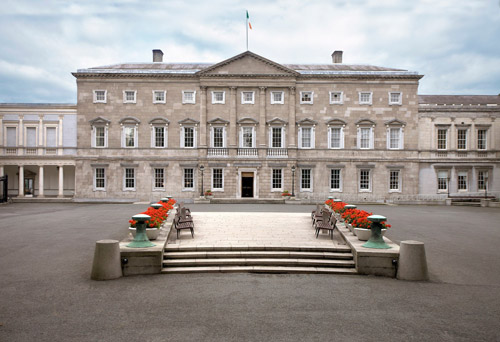
Leinster House, Seat of Ireland’s Parliament.
While in Poland, the Minister will visit the EU’s eastern border with Belarus, where he will receive a briefing on the current border security situation. Discussions during the visit will focus on preparations and priorities for Ireland’s Presidency, as well as areas of mutual interest including migration, organised crime and the rule of law.
Speaking ahead of the meetings, Minister O’Callaghan said: “I look forward to meeting with my Czech and Polish counterparts and building on the already strong relationships Ireland has with both nations. During Ireland’s Presidency of the Council of the European Union, our relationships with other Member States will be crucial to advancing our priorities of competitiveness, values and security. This visit will also provide an opportunity to hear first-hand how Belarus has instrumentalised migration, unacceptably exploiting human beings for political purposes.”
Minister O’Callaghan will conclude the week in Luxembourg at the Justice and Home Affairs Council on Thursday and Friday, where he will continue bilateral engagements with a range of other Member States.
Pre-deceased by his parents John and Peg, brother Joe and his wife Veronica; Mr Bourke passed away peacefully, while in the care of staff at the Community Hospital of the Assumption Thurles, surrounded by his loving family.
His passing is most deeply regretted, sadly missed and lovingly remembered by his sorrowing family; loving wife Mary, sons Cathal and Jack, daughter Cliodhna, daughter-in-law Ciara and granddaughter Avril, brothers Johnny, Tommy, Paddy, Seamus and Martin, sisters-in-law, brothers-in-law, nieces, nephews, cousins, extended relatives, neighbours and many friends.
For those persons who would wish to attend Requiem Mass for Mr Bourke, but for reasons cannot, same can be viewed streamed live online, HERE.
The extended Burke family wish to express their appreciation for your understanding at this difficult time, and have made arrangements for those persons wishing to send messages of condolence, to use the link shown HERE.
Note Please: Family flowers only. Donations in lieu,if desired, to the Parkinson’s Ireland (Tipperary Branch) and the Hospital of the Assumption Thurles.
Pre-deceased by his Dad John and his brother Thomas; Mr Meaney, passed away peacefully while in the care of staff at Pattersons Nursing Home, Roscrea, Co. Tipperary.
His passing is most deeply regretted, sadly missed and lovingly remembered by his sorrowing family; loving mother Teresa, sister Breda and brother Sean, brother-in-law P.J., sister-in-law Margaret, nephews T.J., John, Daniel and Jack, aunts, uncles, cousins, extended relatives, neighbours and friends.
For those persons who would wish to attend Requiem Mass for Mr Meaney, but for reasons cannot, same can be viewed streamed live online, HERE.
The extended Meaney families wish to express their appreciation for your understanding at this difficult time, and have made arrangements for those persons wishing to send messages of condolence, to use the link shown HERE.
Note Please: Family flowers only. Donations in lieu, if desired, to Milford Care Centre in Memory of Patrick Meaney, No. 4 Banba Terrace, Kickham Street, Thurles, Co. Tipperary..
The True Story of Villa Emma – The Village That Chose to Save Children.
At a time when Israel’s very presence on the football field is again the subject of protest, including the disruption of Ireland’s friendly against Qatar in Dublin over upcoming fixtures with Israel, the story of Villa Emma carries a particular force. The protests are framed by many as opposition to Israel’s conduct in Gaza, but for Jews and Israelis they also echo a longer and painful history: a people repeatedly attacked, excluded, and told that even their children, athletes, and symbols of ordinary national life are not entitled to safety or normality. From the Jewish children hidden in Nonantola in 1943, to the children killed at Majdal Shams, to Jewish children reportedly targeted in Skokie, the question is not only political but moral: when Jewish or Israeli children and communities are made vulnerable, do bystanders turn away, join the hostility, or choose protection?
In the summer of 1942, a group of Jewish refugee children arrived in the small Italian village of Nonantola, near Modena. They had already been on the run for years, fleeing Nazi persecution across Central and Eastern Europe. Most came from Germany, Austria, and the Balkans. Many had lost their families. An Italian Jewish aid organisation, DELASEM, arranged for them to stay in an abandoned countryside mansion known as Villa Emma. By the spring of 1943, their number had grown to around 70–73 children and teenagers, cared for by a small group of adult educators.
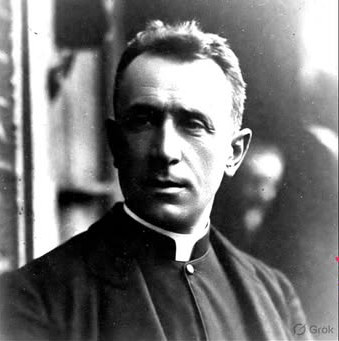
Catholic Priest & Teacher, Don Arrigo Beccari.
A fragile refuge. For about a year, life in Nonantola was unexpectedly peaceful. The children attended lessons, worked, and gradually adapted to village life. Local residents helped furnish the villa, brought food, and supported daily life. Two local figures became especially important, namely Don Arrigo Beccari, a Catholic priest and teacher, and Dr. Giuseppe Moreali, the village doctor. Both formed close ties with the children and helped organise their care. At this stage, despite anti-Jewish laws, Italy had not yet begun systematic deportations in the same way as Nazi-occupied territories but that would soon change.
By September 1943: everything shifts. On September 8th, 1943, Italy surrendered to the Allies. German forces quickly occupied northern Italy. The danger was immediate and clear. Within hours, the people responsible for the children realised that staying at Villa Emma would likely lead to arrest and deportation. What happened next was decisive. A village acts. In less than two days, often described as under 36 hours, the children were dispersed and hidden. Younger children were sheltered in the local seminary Others were taken in by families across the village and countryside Around 30–35 families, along with clergy and others, participated in hiding them. This was not a centralised operation directed by a government or military. It was a coordinated local response involving priests, doctors, educators, and ordinary villagers.
Forged identities and a dangerous plan Hiding the children was only a temporary solution. German patrols were active, and a search could happen at any time. Beccari, Moreali, and others began preparing an escape. They obtained blank identity documents and created false papers to disguise the children’s identities. The plan was to move them north, across the Alps, into neutral Switzerland.
The escape. Between early and mid-October 1943, the children left Nonantola in small groups. They travelled by train and on foot, guided through checkpoints using forged papers, and eventually crossed the Swiss border, often at night.Most of the group made it safely. One known exception was Salomon Papo, a boy who had been too ill to travel. He was later arrested and deported to Auschwitz, where he died.
Aftermath and consequences The rescue did not go unnoticed. Don Arrigo Beccari was later arrested and imprisoned by Fascist authorities. He was interrogated and beaten but did not reveal information about the network that had helped the children. He survived the war and returned to his life as a priest in the same community.
What this story really represents The rescue of the Villa Emma children was not the work of a single hero. It involved Jewish organizers who arranged the children’s refuge – Local clergy and medical professionals and dozens of ordinary families willing to take risks. Together, they protected and ultimately saved the lives of dozens of young people. After the war, many of those children emigrated to Palestine and later Israel, where they built new lives.
Why, then, are so many Christian communities silent? Perhaps because Israel has become politically contentious, and many fear that defending Jews or Israelis from hatred will be treated as taking a side in every aspect of the Middle East conflict. But this is a false moral trap. One can grieve Palestinian suffering and still condemn antisemitism. One can criticise Israeli policy and still defend Jewish children from intimidation, exclusion, and violence. The legacy of Villa Emma should make Christians especially uneasy about silence. When Jewish children were in danger, Don Arrigo Beccari and others did not hide behind complexity. They protected life. That remains the standard.
A legacy of quiet courage. In 1964, Don Arrigo Beccari and Giuseppe Moreali were recognized by Yad Vashem as Righteous Among the Nations for their role in the rescue. Today, the story of Villa Emma is remembered not just as an act of individual bravery, but as an example of collective moral choice. In a time of fear and occupation, a small rural community chose to help. and because of that, dozens of children survived.
This website uses cookies to improve your experience. We'll assume you're ok with this, but you can opt-out if you wish.AcceptRead More
Privacy & Cookies Policy
Privacy Overview
This website uses cookies to improve your experience while you navigate through the website. Out of these, the cookies that are categorized as necessary are stored on your browser as they are essential for the working of basic functionalities of the website. We also use third-party cookies that help us analyze and understand how you use this website. These cookies will be stored in your browser only with your consent. You also have the option to opt-out of these cookies. But opting out of some of these cookies may affect your browsing experience.
Necessary cookies are absolutely essential for the website to function properly. This category only includes cookies that ensures basic functionalities and security features of the website. These cookies do not store any personal information.
Any cookies that may not be particularly necessary for the website to function and is used specifically to collect user personal data via analytics, ads, other embedded contents are termed as non-necessary cookies. It is mandatory to procure user consent prior to running these cookies on your website.






Recent Comments