We stand to be corrected on the date; but an exhibition possibly organised in 2009, in the early days of ‘The Source‘ building in Thurles, asked what would Thurles would look like in future years.
The above picture indicates one of the futuristic exhibits.
Alas, Tipperary County Council employed consultants, better known in the business as “Daydream Believers” to continue their previous successes in destroying the town centre, and choose to shy away from the wishes of public residents.
What will be interesting to watch, however, is the car-park area behind the soon to abscond Ulster Bank, when primary school pupils will return to the class room at an adjoining primary school.
Because of stupid restricted parking on Liberty Square; same now given over to those “Loading” and to “Taxi Ranks”, and with enlarged upgraded footpaths now surrendered for use as public houses and tea rooms operating between the showers, all car-parks remain full to capacity.
The major difficulties will now arise when parents return in September to attempt to pick up their small school kids.
To date, per Johns Hopkins University (JHU), centre for Systems Science and Engineering (CSSE), there have been worldwide, 579,028.597 cases of Covid-19 contracted, with 6,404,533 deaths; 58,962 of which deaths occurring within the past 28 day period, up to 8:00pm this evening.
Here in the Irish Republic, on Wednesday, July 27th, (last published figures) some 523 PCR and 429 Antigen confirmed cases were identified with total deaths in the Republic, to date, since the beginning of the pandemic identified at 7675. As of 11:30am this morning there 27 patients in ICU’s and 435 patients in our hospitals across the State.
Covid-19 – Where did it come from?
Two scientific studies, which were published in the earlier part of last week demonstrated that the earliest known Covid-19 cases were clustered around Wuhan’s Huanan seafood and wildlife market.
Using genetic information, one of the studies tracks the timing of the outbreak and suggests that there were two variants introduced into humans in November / December of 2019, with this evidence suggesting that Sars/Cov-2 was present in live mammals that were sold at Huanan market in late 2019.
Scientists are now of the opinion that the virus was transmitted to people who were either employed or were consumers, shopping at the market, in two separate events, where a human randomly contracted the virus from an animal present.
Same crowded live animal markets, scientists agree, can provide an ideal transmission centre for such new diseases to spread from animals to humans, as a separate study showed that nearly 50,000 animals of 38 different varieties / species were sold at markets in Wuhan.
Scientists believe that the pandemic was most likely to have been the consequences of unhealthy, cruel and unhygienic practice, and these and other developing studies will correct the political wrangling, suggesting that such viruses was created deliberately in a laboratory.
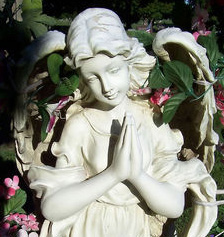
Pre-deceased by his parents Tom and Mary and brother baby Martin, Mr Hogan sadly passed away suddenly, following a short illness, surrounded by his loving family.
His passing is most deeply regretted by his loving sister Josephine, brother-in-law Gearoid, nephews Thomas and Mikey, cousins, extended relatives, neighbours and a wide circle of friends.
[NB: Due to C-19 virus fears; those attending will continue to observe strict adherence to social distancing, face covering, with no hand shaking.]
The extended Hogan family wish to express their appreciation for your understanding at this difficult time and have made arrangements for those wishing to send messages of condolence, to use the link shown HERE.
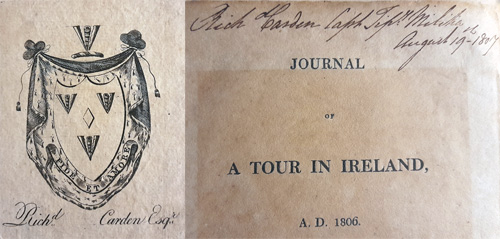
The book entitled “Journal of A tour in Ireland” was written by Sir Richard Colt Hoare, Bart. F.R.S. F.A.S.*, and Published 215 years ago, in 1807.
*Baronet – Fellow Royal Society, – Fellow Antiquarian Society.
The book once graced the library owned by Captain Richard Carden, Esq, Fishmoyne, Drom, Kilfithmone, Thurles, Co. Tipperary; latter Captain of the Tipperary Militia and today remains part of a private Tipperary collection.
Captain Richard Carden:
Captain Richard Carden was the son of Minchin Carden and Lucy Lockwood, and as already stated was born at Fishmoye, Drom, Co. Tipperary, Ireland, c 1760. He gained the rank of Officer in the 12th Regiment of Dragoons and on May 6th, 1787, he married Jane Blundell (daughter of Very Rev. Dixie Blundell and Elizabeth Ogle) in Co. Limerick. The couple had one son also named Richard Minchin Carden (latter born July 1st 1799, and died May 11th 1873.)
Richard Carden, the former, passed away on February 7th, 1812, aged 53 years, and is interned in Saint Michan’s Church, Church Street, Dublin 7. A plaque there bears the inscription: “Sacred to the memory of Richard Carden Esq of Fishmoyne in the County of Tipperary, who died at his house in Gardiner Street in this city . Jane Carden relict of the above Richard Carden and daughter of the Very Revd Dr. Blundell Dean of Kildare. Departed this life 22nd of January 1837 in the 73rd year of her age. She was a true Christian a fondly attached wife, the best, the most beloved of parents and a sincere friend. This tablet is placed here by their only son as a small tribute of his affection and respect. August 1837
Sir Richard Colt Hoare’s Tour.
The tour of parts of Ireland, by the above author, including some areas of Co. Tipperary; had taken place the year before, (1806) and the opening Preface of the book, bears the Latin headline; “Erranti, passimque oculos per cuenta tuenti”, (Translated: “Wandering, keeping his eyes here and there”.), gives us a certain insight into what life was like and how Ireland was viewed by the gentry, some 216 years ago.
Quotefrom the Preface; “To the traveller, who fond of novelty and information, seeks out those regions, which may either afford reflection for his mind, or employment for his pencil and especially to him, who may be induced to visit the neglected shores of Hibernia*, the following pages are dedicated“.
*In his book ‘Agricola’ or ‘Farmer’, (c.98 CE), Publius Cornelius Tacitus (c.AD 56 – c.120); a Roman historian and politician, latter widely regarded as one of the greatest of Roman historians, referred to Ireland using the name “Hibernia”. The name “Hibernia” or “Land of Winter”,was used on Irish coins in the 1700s, and more recently on a €2:00 coin, minted in2016.
AuthorSir Richard Colt Hoarecontinues: “The island of Hibernia (Ireland) still remains unvisited and unknown. And why? Because from the want of books and living information we have been led to suppose the country rude, its inhabitants savage, its paths dangerous. Where we to take a view of the wretched conditions in which the history of Ireland stands, it would not be a matter of astonishment that we should be considered as a people, in a manner unknown to the world, accept what little knowledge of us is communicated by merchants, sea-faring men and a few travellers. While all other nations of Europe have their histories, to inform their own people, as well as foreigners, what they were and what they are. The love of literature, however, seems to be gaining ground daily in Ireland, as well as in the remote districts of the sister Kingdom; and particularly that class of it which will tend and ultimately to make its provinces more frequent, and better known; which will not only excite the attention of the stranger, but point out natural beauties and curiosities unexplored even by the native.”
We will discuss more details on Sir Richard Colt Hoare’s tour of Tipperary in the coming days.
Three years ago, Thurles housewife Mrs Brooklin Casey a part-time well known, investigative, free-lance journalist; packed her overnight bag and headed to Afghanistan, to study the culture and treatment of Afghan women, under the then Taliban regime.
On arrival Mrs Casey was shocked to discover that all married women in Afghanistan were expected to walk a minimum of ten paces behind their chosen male spouses.
Brooklin asked her guide, Mr Abdul-Badi, why and he said, “Because women are considered to be of a lesser status in Afghan society.”
An outraged Mrs Brooklin Casey, 5 days later, left Afghanistan; arriving home to Thurles, to flood Irish newspapers and magazines, each hard pressed for news; dispatches condemning the Taliban regime’s treatment of married women in their capitol city of Kabul.
Last year, following further armed conflict in Afghanistan, she decided to return to report on the further violence in the region and was surprised to see all women walking some ten paces in front of their spouse.
She turned to her guide who again luckily was Mr Abdul-Badi and this time she asked, “Why has this custom regarding women suddenly changed?”
This website uses cookies to improve your experience. We'll assume you're ok with this, but you can opt-out if you wish.AcceptRead More
Privacy & Cookies Policy
Privacy Overview
This website uses cookies to improve your experience while you navigate through the website. Out of these, the cookies that are categorized as necessary are stored on your browser as they are essential for the working of basic functionalities of the website. We also use third-party cookies that help us analyze and understand how you use this website. These cookies will be stored in your browser only with your consent. You also have the option to opt-out of these cookies. But opting out of some of these cookies may affect your browsing experience.
Necessary cookies are absolutely essential for the website to function properly. This category only includes cookies that ensures basic functionalities and security features of the website. These cookies do not store any personal information.
Any cookies that may not be particularly necessary for the website to function and is used specifically to collect user personal data via analytics, ads, other embedded contents are termed as non-necessary cookies. It is mandatory to procure user consent prior to running these cookies on your website.








Recent Comments