The little bespectacled man, With the heavy newspaper bundle, Under his arm, Carried Indo, Press and Herald, The news of the time, To terrace, road and street, Door to open door, In all the frost and snow and rain, All the long year round, To our small town. He magically brought Disasters, Curly Wee and Gussie Goose, Rip Kirby, Crosswords, Sports, Cartoons- And a myriad things besides, To talk about and do. To pass the easy-going times, as were in it then. To give us a break from radio. I hear of laptops from journalism colleagues now, The technology of distribution- All in the times, I own, But Paddy Hickey, flesh and blood, Newspaperman, Walked them hard streets for years, To meet his deadline.
END
Tom Ryan, “Iona”, Rahealty, Thurles, Co. Tipperary.
The Laureate for Irish Fiction, Colm Tóibín, hosts ‘The Art of Reading’ Podcast in Cashel Library.
Maura Barrett, Cashel Library, Reports: –
The ‘Art of Reading’ is a monthly book club hosted by Irish novelist, short story writer, essayist, journalist, critic, playwright and poet Colm Tóibín, the Laureate for Irish Fiction. It is available to library book clubs across the country and offered as an online event for readers and booklovers everywhere on the last Thursday of every month.
Since February, the Laureate has met a different library book club each month to discuss a novel by an Irish writer, highlighting outstanding Irish writing and celebrating the reader and book clubs.
In November 2022, Colm Tóibín comes to the bookclubs in Cashel Library, where he will record live his podcast that will be aired live on the last Thursday in the month, through the Arts Council website and social media
The selected titles include new work by contemporary Irish writers as well as novels from the past, that the Laureate wishes to bring to a new generation of readers.
Readers, book lovers and book clubs everywhere are invited to join in the Art of Reading with the Laureate, to read these outstanding books and to engage in reading in a deep and focused way.
The Poet Laureate will discuss Elizabeth Bowen’s ‘The Last September’ with noted Cork Novelist and Poet Thomas McCarthy, before opening the discussion out to the Book Clubs.
Note: There are a limited number of spaces available to interested readers for this event and early booking is advised. Please contact Maura Barrett in Cashel Library on Tel: 062 63825, to secure a place at this event.
Colm Toibin was born in Enniscorthy, Co. Wexford in 1955. He studied at University College Dublin and lived in Barcelona between 1975 and 1978. His work has been translated into more than thirty languages. He is a regular contributor to the New York Review of books and a contributing editor at the London Review of Books. Between 2006 and 2013 he was a member of the Irish Arts Council. He has twice been Visiting Stein Writer at Stanford University and has also been a visiting writing at the University of Texas at Austin. He taught at Princeton from 2009 to 2011 and was Professor of Creative Writing at the University of Manchester in 2011. He is currently Mellon Professor in the Department of English and Comparative Literature at Columbia and Chancellor of Liverpool University. He is President of Listowel Writers Week and a member of the Board of Druid Theatre. His second collection of stories ‘The Empty Family’, published in 2010, was shortlisted for the Frank O’Connor Prize. His book of essays on Henry James ‘All a Novelist Needs’, appeared also in 2010. Also, in 2012, his novel ‘The Testament of Mary’ was published and short-listed for the Man Booker Prize. In April 2013, ‘The Testament of Mary’ opened on Broadway, with Fiona Shaw, and was nominated for a Tony Award for Best Play. In 2013 it was released as an audiobook with Meryl Streep. Colm Toibin’s novel ‘Nora Webster’, published in 2014, won the Hawthornden Prize. His ‘On Elizabeth Bishop’, published in 2015, was a finalist for the National Book Critics Circle Award for Criticism. His ninth novel ‘House of Names’ appeared in 2017. In May 2017, he co-curated ‘Henry James and American Painting’ at the Morgan Library.
Pheasant’s Tail grass in late September (Anemanthele lessoniana). Pic. G. Willoughby.
Fast-growing, frost hardy, Pheasant’s Tail grass (Anemanthele lessoniana), which enjoys full sun or partial shade, will provide all year-round colour in your garden, while also offering a certain movement and structure.
Pheasant’s Tail grass enjoys moderately fertile, medium to light, well-drained soil and will form a fountain-like clump of slender colourful foliage; its blades emerging first as healthy, green shoots, before quickly changing to irregular yellow, orange, brown and red streaks.
Like so many other plants, during the colder months of the year, these grass blade colours become much more intense; worthy of beholding especially if planted and viewed in an area, to the fore of where the sun either rises or sets.
An added bonus are the sprays of airy grass flower heads, which will emerge in August/September. It does self-seed, but unwanted plants can easily be removed or simply potted up and given to other lovers of gardening. Seed-heads do provide a winter food source for finches and other seed-eating birds.
In spring, as your garden comes back to life, you can easily tease out any deceased foliage by gently and safely running your fingers through its gentle blades.
By Scottish Novelist, Essayist, Poet and Travel Writer Robert Louis Stevenson. (1850 – 1894).
I have a little shadow that goes in and out with me, And what can be the use of him is more than I can see. He is very, very like me from the heels up to the head; And I see him jump before me, when I jump into bed.
The funniest thing about him is the way he likes to grow, Not at all like proper children, which is always very slow, For he sometimes shoots up taller like an india-rubber ball, And he sometimes gets so little that there’s none of him at all.
He hasn’t got a notion of how children ought to play, And can only make a fool of me in every sort of way. He stays so close beside me, he’s a coward you can see, I’d think shame to stick to nursie, as that shadow sticks to me.
One morning, very early, before the sun was up, I rose and found the shining dew on every buttercup, But my lazy little shadow, like an arrant sleepy-head, Had stayed at home behind me and was fast asleep in bed.
The water quality of our rivers, lakes, estuaries and coastal areas continues to decline, says Environmental Protection Agency (EPA).
Water quality in Ireland has further declined. While improvements are being made in some areas, these are being offset by declines in water quality elsewhere.
At the current level of progress, Ireland will fail to meet the EU and national goal of restoring all waters to good or better status by 2027.
Only just over half of surface waters (rivers, lakes, estuaries and coastal waters) are in satisfactory condition (that is they are achieving good or high ecological status and are able to sustain healthy ecosystems for fish, insects and plants).
The deterioration in estuaries and coastal waters is mostly along the southeast and southern seaboards and is due to agricultural run-off. Urgent and targeted action is required to reduce nitrogen emissions from agriculture in these areas.
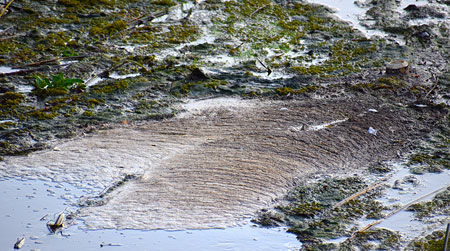
River Suir,Barry’s Bridge, Thurles, Co. Tipperary.
Suir estuary has lost its good water quality. Thurles.Info first raised this issue with Tipperary politicians, Tipperary County Councillors and the EPA, nine years ago, starting on November 7th, 2013. Our claims were denied. See also Here(April 2019). See Here(July 2018) etc. etc. Instead Tipperary County Councillors, lead by Fianna Fáil Councillor Mr Seamus Hanafin, ignored the river Suir, choosing instead to spread a 3 metre wide strip of tarmacadam on the river bank destroying existing biodiversity and local history.
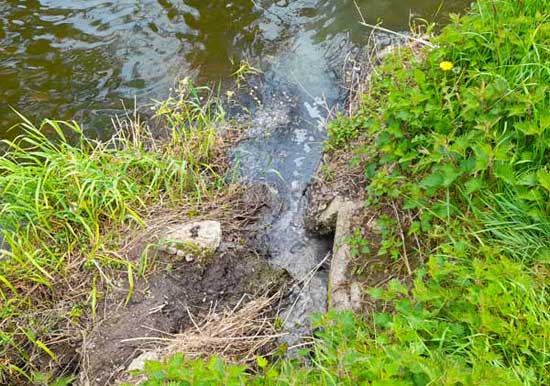
Domestic Sewage water allowed to flow continuously into River Suir, at Thurles , Co. Tipperary.
The Environmental Protection Agency (EPA) has today published the Water Quality in Ireland Report 2016-2021 which provides the latest assessment of the quality of Ireland’s rivers, lakes, estuaries, coastal and groundwaters. The report shows that water quality in Ireland is not as good as it should be. Only just over half of rivers, lakes, estuaries and coastal waters are in satisfactory condition. The overall ecological health of these surface waters has declined across all water body types since the last assessment (2013-2018). This means these water bodies are less able to support healthy ecosystems for fish, insects and plants.
While the decline in water quality of our rivers and lakes is relatively small (1% and 3% of waterbodies respectively), the number of estuaries and coastal water bodies in satisfactory condition has decreased by almost 16% and 10% respectively.
These declines are mostly along the southeast and southern coasts where nitrogen emissions from agricultural activities are having a significant negative impact on water quality. Excess nitrogen causes algal blooms in our estuaries which can damage the ecosystem, and excess nitrogen in drinking water can pose a risk to human health.
Commenting on the report, Dr Eimear Cotter, Director of the EPA’s Office of Evidence and Assessment, said: “The scale of the declines in our estuaries and coastal waters is alarming. In recent years the EPA highlighted that nutrient levels in our rivers and groundwaters are too high and that trends were going in the wrong direction. We are now seeing the impact of these emissions on our estuaries and coastal waters. Areas such as Cork Harbour, Wexford Harbour and the Slaney, Suir and Nore estuaries have lost their good water quality status. This directly impacts the marine biodiversity and ecological value in these areas”.
The report highlights that since the last assessment published in 2019, the number of monitored water bodies in satisfactory condition has declined by:
1% in rivers,
3% in lakes,
16% in estuaries,
10% in coastal waters.
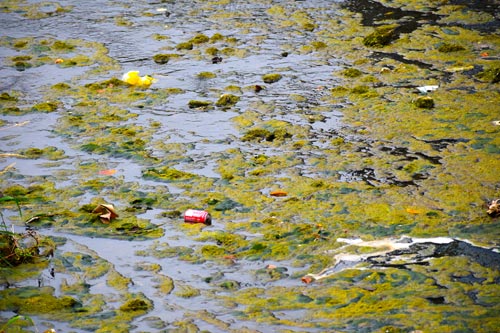
River Suir,Thurles Foot Bridge areanear ‘Swinging Gates’, Thurles, Co. Tipperary.
The main pressures on water quality are agriculture, physical changes such as land drainage and dredging, forestry activities and discharges from urban wastewater. These activities can lead to run-off of nutrients, sediment and pesticides and damage to the physical habitat of waterbodies. The number of waterbodies impacted by urban wastewater remains high, but it is reducing, and the trend is going in the right direction. The number of waterbodies impacted by agriculture has, however, increased in recent years.
Ms Mary Gurrie, Programme Manager, added: “Improvements in water quality are being made, particularly in the priority areas for action where there has been focussed action to restore water quality in the past three years. This shows that improvements to water quality can be made when actions are targeted. However, the gains made are being wiped out by declines in water quality elsewhere”.
The EPA is calling for urgent and targeted action to protect and restore water quality in the next River Basin Management Plan (2022-2027), and full implementation of, and compliance with, the Good Agricultural Practice Regulations.
The full report and a summary report are available on the EPA website. Further information on water quality data and catchment assessments is available HERE.
This website uses cookies to improve your experience. We'll assume you're ok with this, but you can opt-out if you wish.AcceptRead More
Privacy & Cookies Policy
Privacy Overview
This website uses cookies to improve your experience while you navigate through the website. Out of these, the cookies that are categorized as necessary are stored on your browser as they are essential for the working of basic functionalities of the website. We also use third-party cookies that help us analyze and understand how you use this website. These cookies will be stored in your browser only with your consent. You also have the option to opt-out of these cookies. But opting out of some of these cookies may affect your browsing experience.
Necessary cookies are absolutely essential for the website to function properly. This category only includes cookies that ensures basic functionalities and security features of the website. These cookies do not store any personal information.
Any cookies that may not be particularly necessary for the website to function and is used specifically to collect user personal data via analytics, ads, other embedded contents are termed as non-necessary cookies. It is mandatory to procure user consent prior to running these cookies on your website.







Recent Comments