|
|
The third National Action Plan to combat human trafficking was launched today.
The Plan aims to work towards ending human trafficking in the Irish State, as a key element of building stronger, safer communities.
A number of Government Departments, including An Garda Síochána, TUSLA and the HSE will all have significant roles to play in the implementation of the Action Plan to combat this criminal activity and support victims.
Its actions will include:
- Establishment of a new National Referral Mechanism, which will make it easier for victims to come forward, be identified and access support. It will ensure that victims can come forward to a range of agencies and not just An Garda Siochana as is currently the case. This is in recognition of the fact that victims may, due to experiences in their own countries, not trust police services.
- New and widespread training for all who may come into contact with victims of human trafficking across Departments and State agencies. This will include the Border Management Unit, as well as health and social care professionals, and Civil Registration Services staff working in the HSE.
- Ongoing development of training, through NGOs, targeting front line staff in industries such as hospitality, airline and shipping who may come into contact with trafficked persons.
- Ensure effective anti-trafficking screening measures are in place at point of entry to the State
- Establish dedicated accommodation for victims of trafficking.
- Expand the funding, use and awareness of cultural mediators and accompaniment services
- Provide victims of trafficking with protection from deportation.
- Provide exit pathways for individuals impacted by prostitution who may be vulnerable to trafficking for sexual exploitation.
- Continue to raise awareness through materials available in languages of recognised victims of human trafficking, and making information available in healthcare and other settings.
- The HSE Anti Human Trafficking Team will develop an online presence for reaching vulnerable and ‘hard to reach’ victims with a view to increasing access to medical and social care services.
- Ensure that all professionals in contact with children, and working on child related matters, are qualified in dealing with and recognising victims of trafficking and act in the child’s best interest.
The ultimate goals of this Anti-Human Trafficking Strategy is to create a more victim-centred approach to identifying and supporting victims, to raise awareness and provide training for those who need it and to prevent, detect and prosecute the culprits of this abhorrent crime.
The key objectives that the Plan will aim to achieve include:
Work towards the abolishment of human trafficking and its demand.
Identify and provide supports to victims of trafficking.
Enforce the rights of the victim and bring perpetrators to justice.
Ensure whole-of-Government co-ordination in supporting victims and decreasing incidents of trafficking.
In 2022, a total of 42 victims were formally identified by An Garda Síochána. Most victims are trafficked in to the State for sexual exploitation. Trafficking for labour exploitation also makes up a significant number of victims.
A report by the Human Trafficking and Exploitation Project on the Island of Ireland published by Mary Immaculate College in Limerick in 2021 suggests that the true incidence of human trafficking in the State may be 38% higher than the official figure.
The Report was supported by the Departments of Justice in this State and Northern Ireland, as well as An Garda Síochána and the PSNI.
An Garda Síochána report that 1,000 to 1,600 women are engaged in prostitution in any one year in Ireland and that prostitution and human trafficking are inextricably linked.
In September 2021 the first convictions in Ireland for human trafficking were handed down by the Courts, and there are a number of other human trafficking investigations ongoing by An Garda Síochána.
The actions in this plan fall under four Preventative Pillars:
- Prevention of human trafficking by working towards stronger protections for vulnerable people and the elimination of the demand for the services of trafficked persons.
- Identifying and providing supports to victims of trafficking.
- Enforcing the rights of the victim and bringing perpetrators to justice.
- Support evidence-based research on human trafficking.
Already, work is underway and specific elements of this issue are being examined as part of the Government’s Zero Tolerance Strategy to combat DSGBV. A number of significant measures to create a more victim-centred approach to identifying and supporting victims and to raise awareness and provide training, have been introduced.
In addition to the new National Action Plan, other ongoing initiatives which will help combat human trafficking include the improvements being made to the Criminal Justice System to support victims through the implementation of Supporting a Victim’s Journey.
It was with a great personal sadness that I learned of the death, today Sunday 5th November 2023, of Mr Michael Loughnane, No.35 Moyne Road, Thurles, Co. Tipperary.
Pre-deceased by his parents Dinny and Delia, his brother Fintan and Sister Mary; the passing of Mr Loughnane is most deeply regretted by his loving family; devoted wife Peggy, sons Donnacha, Micheal, Sean, Seamus, Gearóid and Tomás, daughters Fiona, Siobhan, Mairéad and Sinead, adored grandchildren, sons-in-law, daughters-in-law, brothers Jimmy, Paudie, Denis, Eddie, Kevin and Joe, sisters June, Ann, Phyllis and Delia, brothers-in-law, sisters-in-law, nephews, nieces, extended relatives, neighbours and a wide circle of friends.
Requiescat in Pace.
Funeral Arrangements.
The earthly remains of Mr Loughnane will repose at his residence [E41 X2R3] on Tuesday afternoon, November 7th, from 4:00pm until 7:00pm same evening.
His funeral cortège will be received into the Cathedral of the Assumption, Cathedral Street, Thurles on Wednesday morning next, November 8th, at 10:30am, to further repose for Requiem Mass at 11:00am, followed by interment immediately afterwards in St. Patrick’s Cemetery, Moyne, Road, Thurles, Co. Tipperary.
For those persons who are unable to attend the funeral service for Mr Loughnane, same can be viewed streamed live online, HERE.
The extended Loughnane family wish to express their appreciation for your understanding at this difficult time and have made arrangements for those persons wishing to send messages of condolence, to use the link shown HERE.
Note Please: House strictly private on Wednesday morning.
Family flowers only. Donations in lieu, if desired, to St. John of Gods, High Gate Lane, Dunleer, Co. Louth.
In ár gcroíthe go deo.
“In seven weeks time it will be almost over for another year”, said Mikey Ryan, “and only God knows if we will ever see another one in this life”
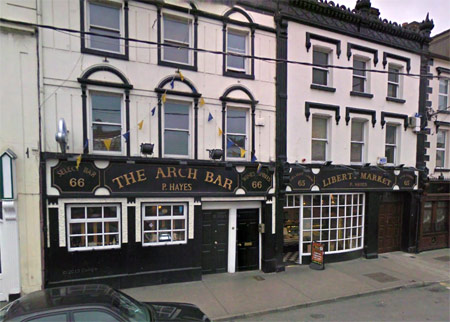
We were above in the Arch Bar on Liberty Square, which recently took Gold in Radio TippFm’s Best of Tipp Awards; each enjoying our usual Saturday night tipple.
“Another what”, says I.
“Christmas”, said Mikey, before continuing; “You know I had a dream last night. I dreamed that 3 Tipperary men died last Christmas eve. One was from the village of Littleton, one from nearby Two-Mile-Borris and the third was from here in Thurles town”.
“I think you need to stay off that Cashel Blue cheese and fresh crusty bread last thing at night”, said I.
“No let me finish”, said Mikey. “The other apostles had taken the night off and St. Peter was alone, supervising in person at the Pearly Gate. He informed the 3 Tipperary men, queued in single file, that to get into heaven on Christmas Eve, they must have something on their person that represented the Christmas season, otherwise they would end up in that ‘fiery lake of burning sulphur’, better known as Hell.”
The 3 men looked at each other, before the Littleton man flicks his cigarette lighter and says: “Peter this is a Christmas candle”. St. Peter lets him pass without further questions.
The Two-Mile-Borris man jingles his bunch of keys stating, “Peter these are jingle bells”.
St. Peter nods and again lets him pass without further questions.
The Thurles man steps up to the gate and pulls a woman’s black brassière out of his inside jacket pocket.
St. Peter asks, “What in the name of all things good and holy has that bra got to do with Christmas?”
“These are Carols”, replies the Thurles man.
“Go away out of that”, said I, “I thought you were being serious. Give us the same again there Pat.”
Fianna Fáil Minister for Education Ms Norma Foley TD, has announced that she is bringing a policy to Cabinet that will support parents not to buy ‘Smartphones’ for primary school children. Many in society will welcome this move, given mounting evidence that so called “Smartphones” are NOT a smart choice for our children.
The term ‘Smartphone’ refers to the now ubiquitous touchscreen phone that is so ‘smart’ it can perform any number of diverse functions; including stream movies, access the internet, email, access social media, take high quality video and photos, pay your bills and show you how to get from ‘A‘ to ‘B’ with built-in satellite navigation tools. Indeed, the potential of smartphones is unlimited given their ability to download applications (apps) for just about anything.
Despite their benefits and utility, increasingly, scientists, educationalists and parents are highlighting that they have the capacity to cause real harm, when put into the hands of children and teenagers (and some adults too). Smartphones enable unlimited access to social media platforms with multiple studies highlighting links between social media and increased levels of anxiety, depression and bullying.
Dove recently launched its “Cost of Beauty” campaign, and a short film, that is a stark warning to all parents about the devastating impact various platforms can have on young minds when these platforms enable them (and some would argue encourage them) to scroll through thousands of images of impossible beauty standards.
We are repeatedly warned of the dangers of excessive screen time and with apps purposely designed to keep users online and engaged, it’s impossible for adults, let alone young minds, to get offline. As well as spending too much time online, smartphones enable anyone to access anything online. You may think “that’s fine my kids only watch YouTube and Tiktoks”, but even these familiar apps can lead children to dark and strange content.
Please do take the time to watch, to the very end; this ‘Ted Talk’ video, shown immediately hereunder:
As well as the dangers of social media, screen time and exposure to inappropriate content, smartphones and apps are potentially invading our privacy. Our actions are constantly monitored and our data used and misused. It’s worth watching the documentary “The Social Dilemma” to get an insight into this area of danger.
Less dangerous, but troubling all the same, are the warnings about smartphones and the damage they are doing to our intelligence and creativity. We never get bored, never need to remember anything and never experience quiet solitude when in the presence of our smartphones.
Boredom and offline time is essential to learning, imagination and creativity. Indeed, back in 2018 “The Times” published an article entitled “Why the Silicon Valley titans who got our kids addicted to screens are sending their own children to tech-free schools”. Why? The Silicon Valley titans know the value of tech free time, hands-on learning, boredom, imagination and creativity and they want this, not their high tech, for their kids. It is even said that Steve Jobs, creator of the iPhone and iPad, did not allow his own children to use the very devices he created.
Many parents get their child a smartphone for understandable reasons. They want to be able, for example, to contact their child about ever changing after school activities, sports matches or visits with friends. This is important but you don’t need a smartphone to achieve this.
All you need for children is what’s known as a “dumb phone”, [View here for “dumb phone” ]. Dumb phones are so-called because their functions are limited. All you can do is make a call, receive a call and send and receive texts (some readers may remember these prehistoric devices). With all the negatives associated with smartphones these days, maybe “dumb phones” aren’t that dumb after all.
And whilst politicians don’t always get things right (“Do they ever”, I hear some of you say), Minister Norma Foley may be making a ‘smart’ move/decision here, and if her advice is followed, one that will really benefit our children into the future.
In an intelligence-led operation, Gardaí have arrested four men, following the seizure of drugs and handguns in a raid across four counties.
On Friday afternoon last, the Garda National Drugs and Organised Crime Bureau (GNDOCB) intercepted two vehicles in the area of Finglas, Co. Dublin, shortly before 4:00pm.
Planned searches of as yet unnamed addresses were conducted in Co. Kilkenny, neighbouring on Co. Tipperary; and also in Co. Waterford; Tallaght, Co. Dublin, and in Ashbourne, Co. Meath.
Three Glock handguns, together with a replica handgun; 28.5 kilogrammes of cocaine (with a street value of approximately 2 million euro) and 1 kilo of cannabis herb (latter with a street value worth approximately €20,000) were seized.
We understand Gardaí also recovered a hydraulic drugs press, a quantity of mixing agent, drug-mixing paraphernalia, €18,000 in cash and several communications devices.
Four, as yet unnamed men aged 55, 32, 27 and 22 years respectively, were arrested in relation to drug trafficking and have been detained, pursuant to the provisions of Section 2 of Criminal Justice (Drug Trafficking) Act 1996, and were detained at Garda stations in both Co. Dublin and Co. Meath.
All of the drugs seized have been sent to be examined by Forensic Science Ireland (FSI).
|
Support Us Help keep Thurles.info online by donating below. Thank you.
Total Donated 2026: €290.00
Thank You!
Daily Thurles Mass Livestream
|







Recent Comments