There is an important ocean current called the AMOC, the Atlantic Meridional Overturning Circulation.
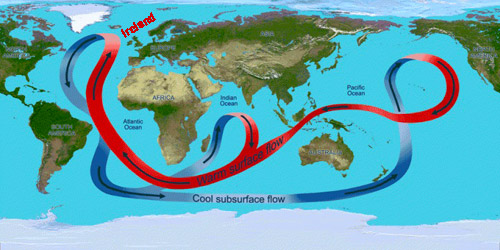
The AMOC includes Atlantic currents at the surface and at great depths that are driven by changes in weather, temperature and salinity (latter the measure of the concentration of dissolved salts, such as sodium chloride, magnesium, sulfate, and calcium, in a body of water). Those currents comprise half of the global thermohaline circulation or “Global Conveyor Belt,”, [See Image hereunder], that includes the flow of major ocean currents, the other half being the Southern Ocean overturning circulation. Think of it as a huge system of moving water in the Atlantic Ocean. It carries warm water north and colder water south. This movement helps shape the climate of Europe and influences rainfall and weather far beyond the Atlantic.
Thermohaline Circulation.
Scientists are watching an unusual area of cooler water south of Greenland. It is sometimes called the “Cold Blob” or North Atlantic Warming Hole. While much of the world is getting warmer, this part of the North Atlantic has not warmed as quickly and has sometimes cooled. Scientists believe changes in the AMOC are one important reason.
Why is this happening? Greenland is losing enormous amounts of ice as the climate warms. Between 2002 and 2023, Greenland lost about 270 billion tonnes of ice each year on average. When this freshwater enters the North Atlantic, it can make the ocean water less salty and less dense. Along with warmer ocean temperatures, this can make it harder for the normal overturning circulation to work as strongly.
Is the AMOC already collapsing? No. Scientists do not currently know that an AMOC collapse is happening or about to happen. But scientists are confident that the AMOC is expected to weaken during this century as the planet continues to warm. A complete collapse before 2100 is considered less likely, but it cannot be completely ruled out.
Why should we care? A major weakening of the AMOC could change weather patterns across large parts of the world. It could affect:
Temperatures and weather in Europe.
Rainfall in Africa, Asia and the Americas.
Farming and food production.
Sea levels around parts of the Atlantic.
Marine life and ocean ecosystems.
A complete collapse would cause much bigger changes, including major shifts in rainfall and regional climate.
The important message is the “Cold Blob” does not mean disaster is certain. But it is one of several important changes scientists are carefully watching in the North Atlantic. Our oceans are connected. What happens around Greenland and in the Atlantic can affect climate and rainfall thousands of kilometres away. The main long-term pressure on this system is human-caused global warming. Reducing greenhouse gas emissions lowers the amount of future warming, and reduces the risk of large, dangerous changes to our oceans and climate.
Awareness matters. Facts matter. And what we do now still matters.
Youth services in Thurles and Templemore are set to benefit from a €24,288 capital funding allocation, as part of a new nationwide investment in UBU Your Place Your Space youth services.
The Irish government has announced more than €1.6 million in capital funding to support improvements in youth services across the country. The funding will assist with minor works, the purchase of equipment and upgrades to youth facilities, with more than 500 individual projects nationally expected to benefit.
The funding comes from the Exchequer through the Department of Education and Youth’s UBU Your Place Your Space programme. UBU funding is administered locally through the Education and Training Boards, including Tipperary ETB and ultimately comes from Government revenues, which are in turn funded largely by taxes such as income tax, VAT and corporation tax.
In County Tipperary, four organisations have secured a combined allocation of €63,262.
The largest allocation in the county will go to YWI Tipperary, which has been awarded €24,288 for its youth facilities in Thurles and Templemore. The investment will support improvements to facilities serving young people in both communities.
The UBU Your Place Your Space scheme provides locally based youth services and supports for young people, including the Thurles Templemore Youth Project operated by Youth Work Ireland Tipperary.
Elsewhere in Tipperary, North Tipperary Development Company’s Roscrea Youth Service has been allocated €15,376, Foróige Nenagh Youth Project will receive €14,062, while Waterford and South Tipperary Community Youth Service in Clonmel has secured €9,534.
The funding represents a welcome investment in youth facilities across the county, with the €24,288 allocation for Thurles and Templemore providing a particular boost to services and facilities available to young people in the local area.
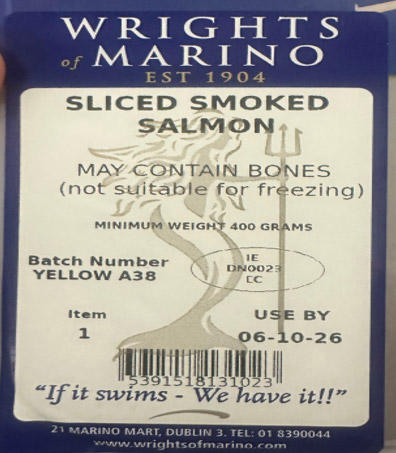
Message: The above batch of Wrights of Marino Sliced Smoked Salmon is being recalled due to the presence of Listeria monocytogenes. Recall notices will be displayed at point-of-sale.
Nature Of Danger: In healthy people, symptoms of Listeria monocytogenes infection can include mild flu-like symptoms, or gastrointestinal symptoms such as nausea, vomiting, and diarrhoea. However, in people who are more vulnerable, the infection can be severe and can lead to serious complications. People who are more vulnerable to Listeria monocytogenes infections include pregnant women, infants, older adults, and people with weakened immune systems. The incubation period (time between initial infection and first symptoms appearing) is, on average, 3 weeks but can range between 3 and 70 days.
Action Required: Manufacturers, Wholesalers, Distributors, Caterers and Retailers:
Retailers: Same are requested to remove the implicated batch from sale and display recall notices at point-of-sale. Consumers: Consumers are advised not to eat the implicated batch.
Parents across Thurles and County Tipperary are being advised to prepare for possible school closures on Wednesday, October 14, as teachers and other public-sector workers plan a nationwide 24-hour strike.
Primary teachers represented by the INTO and secondary teachers represented by the ASTI are due to begin work-to-rule action from Monday, October 5th, before joining the wider public-service strike on October 14th if the dispute remains unresolved.
The action is linked to the continuing dispute over a new public-sector pay agreement. The previous agreement expired at the end of June, with unions seeking assurances that cost-of-living pressures will be addressed as part of negotiations.
Some schools have already contacted parents warning that disruption is likely. The work-to-rule may also affect duties carried out by teachers outside normal contracted hours, including some early-morning supervision arrangements. Schools affected by changes to supervision are expected to communicate directly with parents.
Formal parent-teacher meetings and other activities normally carried out using additional “Croke Park hours” may also be affected by the industrial action.
Union leaders told Public Expenditure Minister Mr Jack Chambers this week that there is currently “no basis” for entering negotiations under the existing framework. The Government says it remains willing to enter talks, including without preconditions, and says any new agreement must be affordable and sustainable.
If the planned October 14th strike proceeds, schools in Thurles, across Tipperary and throughout the country could face widespread closures, although parents should await confirmation directly from their child’s school.
Further updates are expected as talks between unions and the Government continue.
Pre-deceased by her infant son Patrick, parents Michael and Margaret, sisters Mary, Peg and Nellie, brother Michael (Moke); Mrs Ryan, sadly, passed away while in the care of staff at the Slievenamon Unit, South Tipperary University Hospital, Clonmel, South Tipperary.
Her passing is most deeply regretted, sadly missed and lovingly remembered by her sorrowing family; loving daughter Margaret, sons Michael, Patrick and Martin, their dad Patsy, daughters-in-law Trish, Teresa and Mairead, grandchildren Liam, Michael, Sadhbh, Declan and Eimear, nieces, nephews, extended relatives, neighbours and friends.
The extended Ryan and Cleary families wish to express their appreciation for your understanding at this difficult time, and have made arrangements for those persons wishing to send messages of condolence, to use the link shown HERE.
This website uses cookies to improve your experience. We'll assume you're ok with this, but you can opt-out if you wish.AcceptRead More
Privacy & Cookies Policy
Privacy Overview
This website uses cookies to improve your experience while you navigate through the website. Out of these, the cookies that are categorized as necessary are stored on your browser as they are essential for the working of basic functionalities of the website. We also use third-party cookies that help us analyze and understand how you use this website. These cookies will be stored in your browser only with your consent. You also have the option to opt-out of these cookies. But opting out of some of these cookies may affect your browsing experience.
Necessary cookies are absolutely essential for the website to function properly. This category only includes cookies that ensures basic functionalities and security features of the website. These cookies do not store any personal information.
Any cookies that may not be particularly necessary for the website to function and is used specifically to collect user personal data via analytics, ads, other embedded contents are termed as non-necessary cookies. It is mandatory to procure user consent prior to running these cookies on your website.





Recent Comments