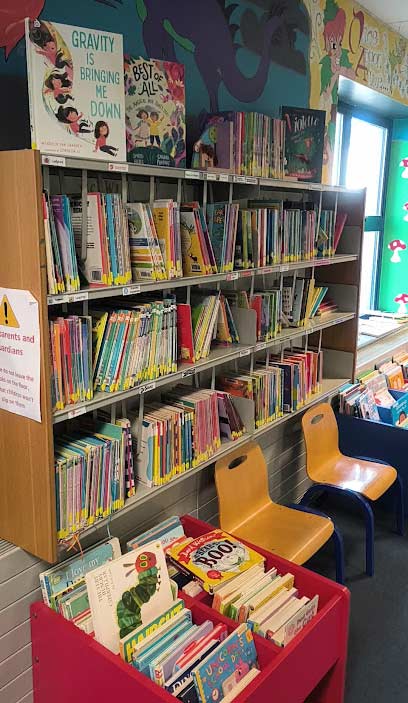
Below are details of next week’s Adults and Children’s events in Cashel Library.
Ms Maura Barrett, Reports From Cashel Library, Co. Tipperary:
Monday 21st September – at 11:00am – Comhrá sa Leabharlann – Do you want to practice your cúpla focal? Bain triail as do chúpla focal sa leabharlann Chaiseal Mumhan. Tá fáilte roimh gach duine, (Translated – Try out a few words of Irish at the Cashel Library. Everyone is welcome).
Monday 21st September – at 2:0.30pm – Learn English – Free Conversation English Classes.
Tuesday 22nd September – at 1:30pm – Free Lecture – Dr Damian Gleeson on Fr John Joseph Therry founder of Australian Catholicism and his acquired wealth and unethical dealings (New Research).
Wednesday 23rd September – at 10:00am – Cashel Craft Circle Cashel. Bring along your own project to work, share ideas, patterns and enjoy a chat and a cuppa with others. All welcome.
Friday 25th September – at 10:00am – Toddler Story time.
Friday 25th September – at 3.30pm – LEGO Free Play – Strictly ages 7 years plus.
Please Note: Booking is essential to attend at FREE events, so please Tel: 062-63825, to be sure of a seat.
You canlocate the Cashel Library building, situated on Friar Street, Lady’s Well, Cashel, Co. Tipperary, HERE. [Eircode E25 K798]
Approximately 5,600 people will become Irish citizens at the Convention Centre Dublin over two days, marking a significant milestone for individuals and families from across the island.
Six ceremonies on Thursday and Friday will welcome applicants from more than 138 countries, who now live in nearly every county on the island of Ireland.
Judge Mr Paddy McMahon will preside over the ceremonies, administering the Declaration of Fidelity to the Irish Nation and Loyalty to the State. Participants will pledge to uphold the State’s laws and respect its democratic values.
Minister for Justice Jim O’Callaghan will attend on Friday. Minister of State with responsibility for Migration Colm Brophy and Minister of State Frank Feighan will also attend ceremonies across the two days.
Ahead of the celebrations, Minister O’Callaghan described citizenship as a significant milestone that reflects both a connection to Ireland and a commitment to the country’s future. He recognised the contributions the new citizens have already made and welcomed their role as full and equal participants in Irish democracy.
Minister Brophy highlighted the sense of belonging and community at the heart of the ceremonies. He praised the experiences, talents and perspectives of those who have chosen to build their lives in Ireland, describing citizenship as the start of a new chapter.
Minister Feighan also welcomed the new citizens, acknowledging their contribution to critical projects and public services across the country.
For those taking part, the ceremonies mark both a personal achievement and a lasting connection to the country they now call home.
Content warning: Allegations of child physical and sexual abuse.
Canon Mr William George “Billy” Neely held a respected position within the Protestant Church. Within the Church of Ireland, he served as secretary and convenor of the Church of Ireland Historical Society (COIHS), co-edited church-history publications and was commemorated through a postgraduate prize bearing his name.
Yet accounts from men who say Mr Neely abused them as children raise serious questions about his then continued ministry, the response of Church authorities and how his reputation was subsequently preserved.
On September 29th 2022, Thurles.info reported findings from a BBC Spotlight investigation by Mr Conor Spackman and Ms Pippa Cooke. It identified Kilcooley, Gortnahoe, Thurles, Co. Tipperary, as the parish to which Mr Neely moved in 1976, after allegations of child sexual abuse arose during his ministry at Mount Merrion in east Belfast, Northern Ireland. The report described approximately ten years of ministry at Mount Merrion. It placed Kilcooley within the dioceses of Cashel, Ferns and Ossory and associated its parish grouping with Littleton, Crohane and Johnstown.
According to the investigation, the Scout Association told the BBC that it became aware of inappropriate behaviour by Mr Neely in 1977, confirmed by the then Bishop of Down and Dromore, Mr George Quin. In October 1977, it removed Neely as a volunteer leader and took steps to prevent him from rejoining.
Despite that exclusion, the BBC found that Mr Neely continued to have access to children in his Tipperary parish through Sunday school and visits to a local school. The allegations concerned beatings of boys for sexual gratification.
The 2022 report also recorded the Church’s position at that time; it declined further comment because of ongoing legal proceedings. The PSNI said it had no records of allegations made to the RUC during the 1970s. That statement concerns the records available to police; it does not establish that nobody raised concerns.
Mr Neely returned to Northern Ireland in the 1980s, serving in Keady, County Armagh, and subsequently again held the title of Canon. He died in 2009 and was interred in the grounds of St Patrick’s Church of Ireland Cathedral, Armagh.
Further testimony appeared in a BBC report dated as recent as June13th of this year, 2026. Mr Francis Bostrom, a former Mount Merrion, Belfast, chorister, said Mr Neely began abusing him in 1971, when he was 14 years old, and in receipt of tuition for his O-levels.
Mr Bostrom described repeated beatings, being required to undress and instructions to keep the punishment secret from his family. He said he believed the abuse was sexual. The BBC reported that he had initiated legal proceedings against the Church of Ireland.
Retired Canon Dr Jonathan Barry told the BBC that two women brought serious allegations concerning Mr Neely to him around 1976. He said he advised them to contact both Church authorities and police. Canon Barry criticised Mr Neely’s subsequent placement in the Tipperary parish, where he could continue encountering children.
In its response to the later reporting, the Church expressed regret, said abuse would not be tolerated and pledged cooperation with investigations. The statement quoted by the BBC did not explain Mr Neely’s move to Tipperary.
Researcher Mr Niall Meehan has documented allegations that COIHS removed references to Mr Neely’s founding role and retrospectively changed references to the “W.G. Neely Prize”. His compilation reproduces website comparisons dated September 24th and November 26th 2022. The original archived pages require independent comparison before the precise extent and timing of those changes can be stated conclusively.
Mr Bostrom told the BBC that he had forgiven Mr Neely but wanted the Church to acknowledge publicly the harm done. His account puts the central questions plainly; what did Church authorities know, what action did they take, and why did Mr Neely continue in ministry with access to children?
An accurate historical record must include the testimony of those who say they suffered, alongside the honours and positions Mr Neely received.
Gardaí are continuing enquiries after Independent Kerry TD Mr Michael Healy-Rae was assaulted, while sitting in his car in traffic on Cork Street, Dublin, today Wednesday, September 16th.
Officers from Kevin Street Garda Station responded shortly after 4:00pm. According to the Garda account, a lone man approached and assaulted the motorist while he was stopped in traffic. Mr Healy-Rae was brought to Kevin Street station for medical attention, before being transferred to St Vincent’s University Hospital. His injuries were described as not life-threatening.
Witnesses and camera footage sought Gardaí are asking anyone who witnessed the incident to come forward, particularly people who have camera footage from the area at the time. In the latest reports checked, no arrests had been made and enquiries remained ongoing.
Anyone with information is asked to contact Kevin Street Garda Station Tel: 01 666 9400, or the Garda Confidential Line Tel: 1800 666 111or indeed any Garda station.
Application Ref: 2660699. Applicant: McDonald’s Restaurants of Ireland Ltd. Development Address: Lands At Slievenamon Road And Thurles Relief Road , Thurles , Co. Tipperary. Development Description: the addition of a 6.5 metre totem sign with yellow acrylic internally illuminated “Golden Arch”, located on the western side of the site, and all associated works necessary to facilitate the development. The McDonald’s drive-thru restaurant is permitted on site under planning permission reg. ref. 2460829/ACP ref. 322465-25 and is now under construction. Status: Conditional. Application Received: 17/07/2026. Decision Date: 08/09/2026. Further Details:http://www.eplanning.ie/TipperaryCC/AppFileRefDetails/2660699/0.
Application Ref: 2660495. Applicant: Philip Ryan & Claire Hayes. Development Address: 77 Kennedy Park , Thurles , Co. Tipperary. Development Description: (a) the demolition of existing garage, (b) construction of a single-storey pitched roof extension to the rear and side of the existing dwelling, (c) alterations to existing external elevations to include changes to windows and openings to accommodate proposed new extension and internal layouts, (d) all associated site works. Status: Conditional. Application Received: 22/05/2026. Decision Date: 11/09/2026. Further Details: http://www.eplanning.ie/TipperaryCC/AppFileRefDetails/2660495/0.
This website uses cookies to improve your experience. We'll assume you're ok with this, but you can opt-out if you wish.AcceptRead More
Privacy & Cookies Policy
Privacy Overview
This website uses cookies to improve your experience while you navigate through the website. Out of these, the cookies that are categorized as necessary are stored on your browser as they are essential for the working of basic functionalities of the website. We also use third-party cookies that help us analyze and understand how you use this website. These cookies will be stored in your browser only with your consent. You also have the option to opt-out of these cookies. But opting out of some of these cookies may affect your browsing experience.
Necessary cookies are absolutely essential for the website to function properly. This category only includes cookies that ensures basic functionalities and security features of the website. These cookies do not store any personal information.
Any cookies that may not be particularly necessary for the website to function and is used specifically to collect user personal data via analytics, ads, other embedded contents are termed as non-necessary cookies. It is mandatory to procure user consent prior to running these cookies on your website.





Recent Comments