Thurles, Co. Tipperary has apparently developed an innovative transport policy; to force enormous juggernauts through streets designed when the principal form of heavy traffic had four legs and ate hay.
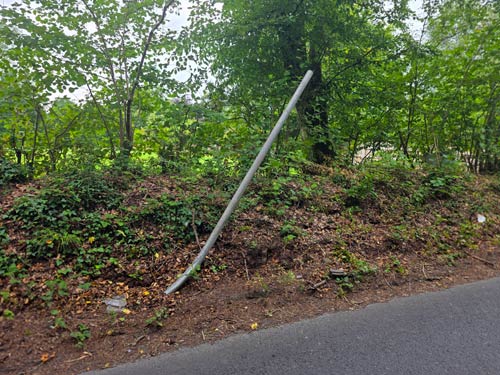
Available to view on Mill Road, Thurles, one of two signs within metres of each other, originally warning of a dangerous junction and dangerous bends. Pic: G. Willoughby.
The predictable result can be seen in the accompanying, undeniable video shown hereunder; for months damaged signs, battered street furniture, demolished walls, uprooted and dinged bollards and not surprisingly yet another enormous bill waiting for the over-stretched ratepayer.
If the claim that 90% of signs are seriously damaged is to be stated as fact, Tipperary County Council should immediately conduct and publish a proper survey. What is already beyond dispute is that the council; not passing motorists or magical road-sign fairies, is totally responsible for maintaining signs on local and regional roads.
Video courtesy of G. Willoughby. (Feel free to copy/share).
Local residents may know every turn in Thurles by instinct, by memory and generations of experience, but tourists, delivery drivers and other non locals do not. They depend on clear, visible signs to identify directions, restrictions and hazards.
Damaged or unreadable signage is therefore more than an embarrassment; it creates a genuine road-safety concern, particularly where unfamiliar drivers must make sudden decisions while navigating narrow, heavily trafficked streets. The Road Safety Authority expressly identifies regulatory, warning and information signs as essential guidance for tourists using Irish roads. Visitors should receive directions, not an unscheduled navigation exam, with a juggernaut approaching from the opposite direction.
For years, Thurles residents have heard about an Inner Relief Road and an Outer Bypass. The council’s 2024 – 2030 Local Area Plan still describes both as projects for which funding must be secured. The Inner Relief Road alone is intended to provide a 1.1-kilometre connection between the N62 and Mill Road, while the proposed bypass would link the N62, N75 and R498.
In 2025, only €100,000 was allocated to progress the Inner Relief Road’s detailed design. That is progress in the same sense that buying a doormat means your house is nearly built.
Mr Michael Lowry TD, Mr Alan Kelly TD and Mr Ryan O’Meara TD must now provide the public with something more useful than announcements, photographs and recycled assurances.
The evidence for action is already visible on the road. Official data published for the N62 at Turtulla records an average of 9,539 vehicle movements every day. More importantly, Tipperary County Council’s own Thurles Local Transport Plan concludes that the proposed road schemes would reduce total traffic in the town-centre core by approximately 20%, cut traffic crossing the River Suir bridge by more than 50%, and reduce town-centre heavy-goods traffic by approximately 50%.
The same plan states that roughly three-quarters of the predicted reduction would involve strategic traffic that neither begins nor ends its journey in Thurles. Vehicles presently passing through the town would use a suitable alternative route which presently does not exist. These are not speculative complaints, they are the council’s own measurements and modelling, providing compelling evidence that the relief road and bypass are necessary for safer streets, more reliable commercial access and a town centre that can perhaps function more effectively.
Thurles Needs Immediately:-
► A confirmed and fully funded delivery programme for the Inner Relief Road. ►A published timetable for the bypass. ► A professional audit of damaged signs and street furniture. ►A costed plan to prevent heavy vehicles repeatedly causing further damage. ►Clear public reporting of who sought funding, when it was sought and what response was received.
Thurles residents have waited long enough. They deserve proper engineering, funding and dates, not another series of ceremonial announcement that the announcement of a future announcement is progressing according to plan.
As of approximately 1:40pm, today, Sunday, August 2nd 2026, it has been confirmed that a fire has again reignited on the southern slopes of Slievenamon, outside Clonmel in County Tipperary.
Tipperary County Council reported that crews from Clonmel and Carrick-on-Suir fire stations were responding to the incident and working to contain the affected area. Aerial firefighting support was also requested to assist operations.
Importantly, officials said that, at the time of the update, there was no threat to life or property. The situation was being closely monitored, with emergency resources remaining in place as required.
This appears to be a renewed flare-up connected to the major wildfire that has affected Slievenamon since July 20th and not a confirmed new fire beginning. Authorities had previously warned that hotspots could remain beneath the surface for a prolonged period and reignite during warm, dry or otherwise favourable conditions. Substantial, sustained rainfall may be needed to dampen the affected ground and vegetation fully.
People should avoid the affected area, allow emergency crews unrestricted access and report visible fire or immediate danger through 999 or 112.
Further verified updates will be published as they become available.
Pre-deceased by his beloved wife Josephine, daughter Mary, and sisters Kitty and Bridget; Mr Ryan passed away peacefully, surrounded by family members, while in the care of staff at Lexington House, Clondalkin, Dublin
His passing is most deeply regretted, sadly missed and lovingly remembered by his sorrowing family; loving grandchildren Judy, Kara and Fionn, sister Mary, nephews, nieces, grandnephews, grandnieces, cousins, extended relatives, great neighbours, colleagues in Seán Treacy’s GAA Club and a wide circle of friends.
For those persons who would wish to attend Requiem Mass for Mr Ryan, but for reasons cannot, same can be viewed streamed live online, HERE.
The extended Ryan family wish to express their appreciation for your understanding at this difficult time, and have made arrangements for those persons wishing to send messages of condolence, to use the link shown HERE.
Note Please: Family flowers only. Donations in lieu, if desired, to Milford Care Centre, in memory of Josephine and Mary (Wife and Daughter).
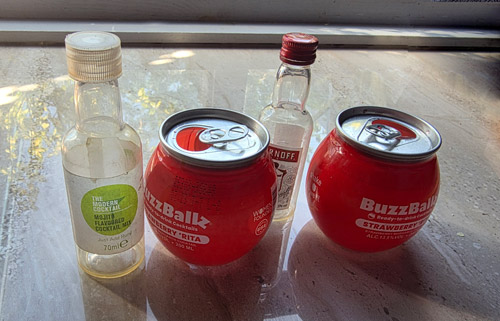
The photograph hereunder accompanying this post shows several small ready-to-drink alcohol and cocktail containers of a kind increasingly found discarded on streets, roadsides and public spaces around Thurles and other Irish towns. They include round aluminium BuzzBallz cocktail cans and plastic miniature bottles used for spirits or cocktail mixes.
BuzzBallz containers sold hereunder in Ireland are imported American products, rather than drinks manufactured in Ireland.
Ireland’s new litter menace – same rejected byReverse Vending Machines, since no Re-turn logo.
Ireland’s Deposit Return Scheme accepts aluminium and steel drinks cans, and PET plastic drinks bottles, holding between 150ml and three litres. However, a container must be registered in the Irish scheme and normally carry the Re-turn logo and an appropriate barcode. It must also be empty, undamaged and retain its original shape. Therefore, although a BuzzBallz container may be made from aluminium and fall within the correct volume range, an imported or unregistered version without the required Irish markings will be rejected by a Reverse Vending Machine. Miniature glass bottles and bottles made from plastics other than PET are also outside the scheme.
This creates an obvious weakness. Consumers have become accustomed to receiving a deposit refund for cans and bottles. When an unusually shaped container or miniature bottle is rejected, some people may simply abandon it beside the machine or throw it on the street. That behaviour is completely unacceptable, but manufacturers, importers, retailers and the operators of the recycling system must also recognise the emerging problem.
Retailers selling these products should provide clearly marked recycling bins and explain how each container should be disposed of. Producers and importers should also be required, wherever technically possible, to register eligible aluminium containers with Re-turn. Attractive, brightly coloured, single-serving packaging should not become tomorrow’s litter merely because it falls through a gap in the system.
There is also a public-health issue. The BuzzBallz Strawberry ’Rita, shown, is a small 200ml drink, but it contains 13.5% alcohol by volume. Despite its compact, colourful appearance, that represents approximately two Irish standard drinks in one container. The manufacturer lists more than 230 calories and almost 20 grams of carbohydrate in a single Strawberry ’Rita.
These products can taste sweet and fruity, potentially disguising their alcoholic strength. Drinking several in a short period could cause rapid intoxication, impaired judgement, accidents, blackouts or alcohol poisoning. The HSE advises adults not to consume more than six standard drinks on any one occasion. Its weekly low-risk guidance is no more than 11 standard drinks for women or 17 for men, spread across the week, with at least two or three alcohol-free days. These are low-risk limits, not completely safe limits.
It should also be made clear that alcohol may only be sold to people aged 18 or over in Ireland – not 16. Alcohol is a carcinogen, and the HSE states that it increases the risk of at least seven cancers, including cancers of the breast, bowel, liver, mouth and throat. The less alcohol consumed, the lower the risk.
Towns across Ireland should not have to choose between cleaner streets and convenient novelty drinks. Every container placed on the market should have a practical, clearly explained route back into recycling and every consumer must take responsibility for using it.
Mr Crowley passed away peacefully, while in the care of staff at Oak Ward, University Hospital Waterford, following a long illness bravely borne with great courage and dignity.
Her passing is most deeply regretted, sadly missed and lovingly remembered by her sorrowing family; loving husband Liam, children Caia, Allie, Dale and Barry, parents Noel and Phyllis (Power), brothers Declan and Marcus, brother-in-law Michael, sisters-in-law Sabrina and Annie, aunts, uncles, nephews, nieces, extended relatives, neighbours and many friends.
For those persons who would wish to attend Requiem Mass for Mrs Crowley, but for reasons cannot, same can be viewed streamed live online, HERE.
The extended Crowley and Power families wish to express their appreciation for your understanding at this difficult time, and have made arrangements for those persons wishing to send messages of condolence, to use the link shown HERE.
“The Crowley and Power families wish to express their heartfelt gratitude to all those who cared for and showed kindness to Mrs Crowley throughout her illness. Their thoughtfulness, prayers and messages have been a great comfort and are deeply appreciated.”
This website uses cookies to improve your experience. We'll assume you're ok with this, but you can opt-out if you wish.AcceptRead More
Privacy & Cookies Policy
Privacy Overview
This website uses cookies to improve your experience while you navigate through the website. Out of these, the cookies that are categorized as necessary are stored on your browser as they are essential for the working of basic functionalities of the website. We also use third-party cookies that help us analyze and understand how you use this website. These cookies will be stored in your browser only with your consent. You also have the option to opt-out of these cookies. But opting out of some of these cookies may affect your browsing experience.
Necessary cookies are absolutely essential for the website to function properly. This category only includes cookies that ensures basic functionalities and security features of the website. These cookies do not store any personal information.
Any cookies that may not be particularly necessary for the website to function and is used specifically to collect user personal data via analytics, ads, other embedded contents are termed as non-necessary cookies. It is mandatory to procure user consent prior to running these cookies on your website.






Recent Comments