In his 90th year, and pre-deceased by his daughter Colette, sons Patrick and Declan; Mr Molloy passed away peacefully, surrounded by his loving family, while in the care of staff at South Tipperary University Hospital, Clonmel, South Co. Tipperary.
His passing is most deeply regretted, sadly missed and lovingly remembered by his sorrowing family; loving wife Margaret (of 64 years), sons James (Jockey), Michael, Kieran, John and Dermot, daughters Rosie, Joan and Rebecca, brothers-in-law John (Jack) and Ian (Hickey), sisters-in-law Mary, Frances, Barbara and Finola, adored grandchildren, sons-in-law, daughters-in-law, extended relatives, neighbours and a wide circle of friends.
The extended Molloy family wish to express their appreciation for your understanding at this difficult time, and have made arrangements for those persons wishing to send messages of condolence, to use the link shown HERE.
“The Molloy family would like to express their heartfelt gratitude to all those who cared for Mr Molloy throughout his illness, especially all the staff of Medical 2B Ward, University Hospital, Clonmel, South Tipperary. The family also wish to thank everyone who has shown such kindness, support and sympathy during this difficult time. Your thoughtfulness and prayers are deeply appreciated”.
Pre-deceased by her parents James and Margaret, sisters Gertie, Mary, Jenny, Rita, Kathleen and brother Jimmy; Ms Lyons, sadly, passed away peacefully following a long illness at ‘Tír na nÓg’ Pallative Care Unit, Our Lady’s Hospital, Cashel, Co. Tipperary.
Her passing is most deeply regretted by her sister Betty, brothers Din and John, sister-in-law Bridie, brother-in-law Billy, nieces Sharon, Denise, Lisa, Clare, Sarah, Tanya, nephews Jason, Gerard, James, Michael, grandnieces, grandnephews, extended relatives,neighbours and friends and her faithful and adored dog Prince.
For those persons who would wish to attend Requiem Mass for Ms Lyons, but for reasons cannot, same can be viewed streamed live online, HERE.
The extended Lyons family wish to express their appreciation for your understanding at this difficult time, and have made arrangements for those persons wishing to send messages of condolence, to use the link shown HERE.
Note Please: House Strictly Private.
“The Lyons family would like to express their deep gratitude for their kindness and care of the staff of Tipperary University Hospital Clonmel and the Cashel Palliative Care Hospice.”
The high church spire, which can be seen from all parts of the village, is a daily reminder of our local Christian heritage dating back to 1786. Great credit is due to the Church of Ireland community who despite structural damage, costly interior decoration followed by a fire have kept this building beautiful and safe for future generations.
The Venerable Robin Bantry-White, (Temporary Rector), welcomed members of the Moycarkey – Borris – Littleton parish with their recently appointed parish priest Fr Dominic Meehan. He also praised the work of former clergy that have over many years built good relations between the Catholic and Church of Ireland communities. He is looking forward to a joint celebration, on Good Friday next, in the Church of Our Lady and Saint Kevin’s. The visiting preacher on the night was the VeryReverend Mairt Hanly, (Dean of Leighlin).
With a few rods and a piece of canvas he assembled a small tent to help us understand a passage from the Old Testament, (Leviticus 23:42). “You shall live in booths (tents) for seven days so that your generation may know that I made the people of Israel live in booths when I brought you out of the land of Egypt. Sukkot, the Feast of Booths, is a seven day celebration observed at harvest time by Jewish communities worldwide. For a migrant nomadic people it was a seven day celebration of past blessings and a fruitful harvest.
Some people present on the night may have remembered that a previous rector the Reverend Ian Cruickshank, distributed chocolate smarties as a reminder of our duty of gratitude for the bits and pieces of our everyday lives. Words may be forgotten but the images of tent and smarties remain.
Others may have recalled that over twenty five years ago, Annie Cawley, one of Littleton’s saintly Traveller ladies, lived in a barrel topped wagon alongside the walls of Saint Mary’s Church. She had lived previously in a small canvas tent under the shade of a ditch in the nearby townland of Ballyerk. Her sincere “God bless you”, was felt by all who called. Like other members of her Traveller Community who had often travelled long, hard, lonely and hungry roads, she could understand at a much deeper level than most, the trials, hardships and blessings of her nomadic Jewish ancestors. In the 1960’s members of the Dublin Bewley family of Quaker and Coffee tradition, provided free canvas to the Traveller Community for their tents and wagons.
In later years, Fr James Meehan, (no relation to Fr Dominic), helped provide them with caravans. This was a major move from tent to better conditions in a caravan. Many have since made their home in our wider parish area.
Our thanks to Diocesean Reader Mr Tommy Cooke who prepared a prayer of thanksgiving for the work of many hands that give us “our daily bread” at the table. He prayed God’s blessings on all who plough and till the fields, who sow and reap the crops, who process, pack, market, distribute, sell, flavour and cook our food. In spite of changing weather patterns we can rejoice and give thanks for this years rich and bountiful harvest.
After the ceremonies it was time for tea and chat, chance to meet old friends and catch up on local news.
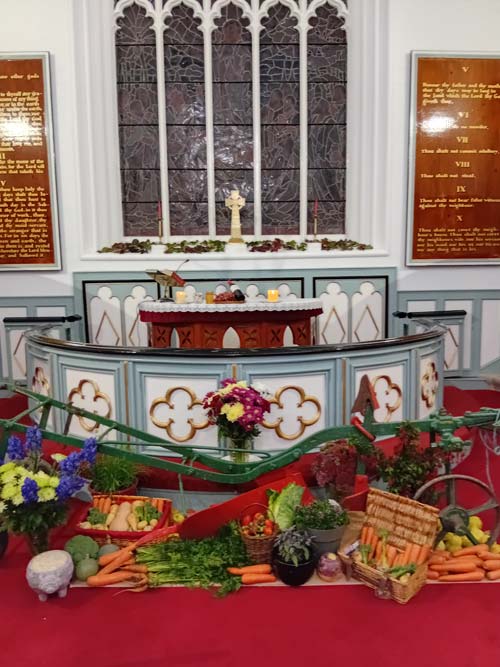
A final thanks to all who decorated the church and altar with fruits of the harvest and to those who continue maintaining this building in excellent condition for future generations.
Pressure is growing on the Government to address Ireland’s high fuel and energy costs ahead of Budget 2027.
More than 1,000 people attended a public meeting in Moate, Co Westmeath, where organisers warned that further protests could follow if the Budget does not deliver meaningful reductions in fuel costs. Among the demands raised was the complete abolition of the carbon tax on fuel, alongside further reductions in other fuel taxes and additional support for households, farmers, hauliers and businesses struggling with rising costs.
The debate comes as motorists continue to face significant prices at the pumps. September figures from AA Ireland showed petrol averaging around €1.87 per litre and diesel around €1.94 per litre. The Government has already introduced temporary excise reductions and postponed some planned tax increases. However, those measures are temporary, and decisions on what happens next are expected to form part of Budget 2027, on October 6th. Representatives of the haulage sector have also warned that further fuel protests cannot be ruled out, if businesses continue to face unsustainable diesel costs.
With the Budget approaching, the key questions now are whether existing fuel-tax reductions will be extended, whether further relief will be introduced, and what decision will be made on carbon-tax measures.
For households and businesses depending heavily on fuel, the outcome could have a significant impact on costs heading into the winter.
The Cost-of-Living Crisis And Its Impact On Mental Health.
We need to stop pretending that the cost-of-living crisis is only about money. It is about stress. It is about anxiety. It is about lying awake at night wondering how the next electricity bill will be paid. It is about standing in a supermarket adding up the cost of groceries before reaching the checkout. It is about parents cutting back on their own needs so their children do not go without. It is about people working hard, doing everything they were told they were supposed to do, and still feeling as though they are falling further behind.
Increasingly, all of the above is becoming a mental health crisis. Yes, the growing cost-of-living crisis is having consequences that reach far beyond household finances. It is increasingly affecting people’s mental health, emotional wellbeing, and sense of security.
Recent research from St Patrick’s Mental Health Services found that almost three-quarters of more than 1,000 adults surveyed, identified the cost of living as the leading factor negatively affecting their mental health. The same research found that 92% of respondents believe there is a worrying level of anxiety in society.
These findings should be taken seriously. Behind these statistics are individuals and families facing the daily pressure of rising food prices, rents, energy bills, housing costs, childcare expenses, and other essential living costs. For many people, financial stress is no longer an occasional concern. It has become a constant presence in their everyday life. This pressure can have a profound impact on mental wellbeing. Financial insecurity can affect sleep, concentration, relationships, confidence, and a person’s sense of hope for the future. People may continue going to work, caring for their families, and carrying out their daily responsibilities, while privately struggling with anxiety and fear.
It is important that we continue encouraging people to seek support when they are struggling with their mental health. Counselling, professional services, community supports, family networks, and open conversations all have an essential role to play. However, we must also recognise that mental health does not exist separately from the daily circumstances in which people live. It is difficult to reduce anxiety when someone is unsure how they will pay their rent or mortgage. It is difficult to manage stress when a household is choosing between heating, food, childcare, and other essentials. It is difficult to tell people simply to “look after themselves” without acknowledging the real and continuing financial pressures many are experiencing.
For some people, anxiety is a direct response to difficult and uncertain circumstances. That means our conversations about mental health must also include honest discussions about housing, wages, energy costs, food prices, childcare, poverty, and financial security. There are encouraging signs that more people are willing to seek help for mental health difficulties, and that progress should be welcomed. No person should ever feel ashamed for admitting that they are struggling or for asking for support. At the same time, too many people continue to suffer in silence. Some do not want to worry their families. Others feel embarrassed about financial difficulties or believe they should simply be able to cope. Many appear outwardly well while carrying significant stress privately.
We need a culture in which people feel able to say, without shame, “I am struggling,” or “The financial pressure is becoming too much.” We also need to recognise that meaningful responses to mental health difficulties cannot focus solely on helping people cope with pressure. We must also address the conditions contributing to that pressure. People need accessible mental health services, strong community supports, secure housing, financial stability, and the dignity of knowing that working hard should provide a reasonable standard of living. This is not about creating fear or hopelessness. It is about acknowledging the reality facing many people and responding with compassion, seriousness, and practical action.
The question we should be asking is not only, “Why are so many people experiencing anxiety?” We must also ask what pressures people are being expected to carry every day and what can be done to reduce them.
The cost-of-living crisis is not simply an economic issue. It is a social issue. It is a family issue and increasingly, it is a mental health issue. We must continue to support those who are struggling, encourage open conversations about mental health, and work towards a society in which people can live with greater security, dignity, and hope for the future.
Political Parties And Their Response To Concerns. The pressure created by the cost of living should also encourage the public to look carefully at how political parties respond to these concerns. Governments must ultimately be judged on the decisions they make, the measures they implement, and the results those measures produce. Opposition parties, meanwhile, have an important responsibility to challenge Government policy and present alternatives, but those alternatives should be examined with the same seriousness. Promises made in opposition can sound attractive, particularly when households are under severe financial pressure, but voters are entitled to ask whether those commitments have been properly costed, whether they can realistically be delivered, what trade-offs would be required, and how they would be funded over the longer term.
Ireland already has mechanisms through which political parties can have proposals independently costed by the Department of Finance and Department of Public Expenditure, while the Parliamentary Budget Office also provides independent analysis of fiscal and budgetary proposals.
For that reason, public debate on the cost-of-living crisis should not become simply a competition over which parties can make the largest or most appealing promise. The same standard of scrutiny should apply to everybody seeking political power; those in Government should be questioned about what they have actually delivered and whether existing policies are working, while those seeking to replace them should be challenged to demonstrate that their alternatives are financially sustainable and practically achievable.
Previous analysis of Irish election manifestos has shown that substantial spending commitments can be made across both Government and Opposition parties and that questions can arise about whether the total package of promises fits within prudent fiscal limits.
When families are already experiencing financial stress and anxiety, political debate should therefore be grounded not only in promises, but in true credible figures, realistic implementation plans and an honest explanation of the choices and the consequences involved.
This website uses cookies to improve your experience. We'll assume you're ok with this, but you can opt-out if you wish.AcceptRead More
Privacy & Cookies Policy
Privacy Overview
This website uses cookies to improve your experience while you navigate through the website. Out of these, the cookies that are categorized as necessary are stored on your browser as they are essential for the working of basic functionalities of the website. We also use third-party cookies that help us analyze and understand how you use this website. These cookies will be stored in your browser only with your consent. You also have the option to opt-out of these cookies. But opting out of some of these cookies may affect your browsing experience.
Necessary cookies are absolutely essential for the website to function properly. This category only includes cookies that ensures basic functionalities and security features of the website. These cookies do not store any personal information.
Any cookies that may not be particularly necessary for the website to function and is used specifically to collect user personal data via analytics, ads, other embedded contents are termed as non-necessary cookies. It is mandatory to procure user consent prior to running these cookies on your website.







Recent Comments